From Zombos Closet

Meet the Horror Bloggers: Lightning Bug’s Lair

Tbugg

Many fans of horror, amateur and professional alike, have devoted
themselves to blogging about the thrills, chills, and no-frills side of the genre as seen in cinema and print. In this ongoing series that highlights the writers behind the blogs, we meet the unique personalities and talents that make the online horror scene so engaging. Up close and personal.

In this installment, T.L. Bugg of the Lightning Bug’s Lair reveals his initial distaste for the fear, his passion for a guy named Bela, and a rich background in horror.


As Bill Cosby once said back when he did standup and was funny, “I started out as a child.” like Mr. Cosby, I also started out as a youngster and a rather fearful one at that. While I was obsessed with images from the Universal horror films of the 1930’s and 40’s, I could not be coerced by anyone to see a modern horror film. I recall one afternoon when a next door neighbor recounted to me the story of C.H.U.D. It
was enough to trouble my sleep for at least a week.

My parents fondly recall when they tried to show me the Disney approved horror film, Something Wicked This Way  Comes. I got about five minutes into the film, the kids saw their own heads getting cut off, and I was done. I have not ever attempted to see that movie since. The last early memory of my yellow steak was when Hellraiser came out on videotape. My folks called me in to see the part where Frank’s body rises from the floor and reconstitutes. It took me some time to recover from that as well.

At the same time that I avoided horror in Technicolor, Bela Lugosi and Boris Karloff were both great favorites of mine, and each year for Halloween I would request to be a
vampire. More than being a bloodsucker, I wanted to be like Bela, or Dracula, the two almost inseparable in my young mind. He was intimidating with only a stare, suave yet dangerous, evil but sophisticated about it. It was around this same age that I discovered old time radio due to my love of Abbot and Costello films. (It surely did not hurt that they crossed over with the Universal monsters a few times.) While my tastes ran mostly toward the comedic programs of Fibber McGee and Molly, and Burns & Allen, there were quite a few nights where I clutched my Walkman to my chest in the darkness of my bedroom and listened intently to the horrors of the Inner Sanctum or (Shock Theater).

The Cat and the Canary (1927)

Annex - Marshall, Tully (Cat and the Canary, The)_01
Zombos Says: Classic

“No, that’s not it,” said Sosumi Jimmy Jango, Zombos’ lawyer. He continued to search his memory while pulling yet another paper from his briefcase.

We were sitting in the library, waiting for Jimmy to shuffle through a few more papers before he read Uncle Hiram’s will. After twenty years gathering dust in Zombos’ Irish tin box, it was time to finally reveal old Hiram’s wishes. He passed away while moose hunting. The annoyed moose helped him on his journey. Seated around the table were Zombos, myself, and Zombos’ furthest relative from Nova Scotia, Clorinda. Billy Bounce Boukowski and Jeremy Singleton, more distant relatives on this side of the pond, were also in attendance. Glenor Glenda served drinks all around.
“Glad to see everyone could make it,” said Jimmy, reaching deeper into his briefcase. “I got it!”
“The will?” asked Zombos with much hope in his voice. He was getting tired of sitting so close to his distant relatives. I never could get him to explain their names or lineage.
“No, the movie this all reminds me of,” said Jimmy. “The Cat and the Canary, the 1927 version. It starts off with an old geezer’s will being read after twenty years, too.”

“I know that one,” I said. “The geezer was Cyrus West, and his relatives are summoned to his old dark mansion, overlooking the Hudson River, by the family lawyer Roger Crosby, twenty years after his death for the reading of his will. He and Uncle Hiram must have been twins.”

“On a dark and stormy night,” added Jimmy, chuckling. “Just like tonight.” We looked at the rain drops splashing against the library’s windows when he said it.

“So, what happens?” asked Billy Bounce. His gruff voice punctuated the Bounce part of his name really well. He tipped his third Jack Daniel’s, daintily held in the baseball glove he had for a hand, over and down in one gulp.

“It is a silent movie directed by Paul Leni, a German Expressionistic director, whose talents included blending humor with his stylish melodramatic horror,” said Zombos.

Billy smiled. “Sounds like an oxymoronic, don’t it? Funny horror?”

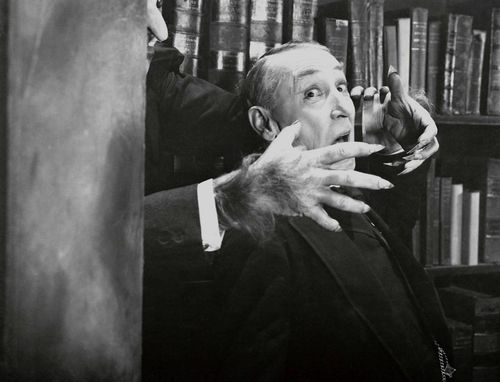
“It does,” I replied. “But Leni’s movie provided the creative template–hairy arms reaching through secret panels and around doorways, sliding bookcases leading to secret passages, upright bodies stuffed in closets flopping down when you open the door, sinister housekeepers, spooky mansions–stuff like that was recycled in the old dark house movies that followed, and it provided much comedy fodder for Abbott and Costello, too.”

Hold That Ghost!” piped up Jeremy. “I love that movie. Keeping the money in the moose’s head. Hilarious.”

“Oh, and Laura La Plante is so marvelous in it.” Glenor spilled a drink as she spoke. “I wish I’d inherit a vast fortune like hers.”

“When you do, let me know so I can send you the dry cleaning bill,” said Zombos dryly, grabbing a napkin to daub off the wet stain on his jacket.

“Whose Laura La Plante?” asked Clorinda.

“She plays Cyrus West’s most distant relative, Annabelle,” answered Jimmy. “Anabelle’s the looker who winds up getting all of West’s inheritance if she can prove she’s sane enough to keep it. Of course, the trick is to make her go loopy during the night so the next in line will get the money. An escaped homicidal lunatic from a nearby asylum–he’s called the Cat– is on the prowl, too, spicing things up.”

“So who’s the guy who saves the dame?” asked Billy. “There’s always some guy around to save rich dames in movies, am I right?”

“Right you are,” I said. “That would be Paul, played by Creighton Hale in glasses and with much chagrin. He’s not much of a hero type. Skittish from his own shadow, really. Being a woman in a 1920’s movie, Annabelle can only be rescued by her potential suitor, of course. I mean, woman weren’t expected to be unmarried with vast fortunes pending and all that. Paul provides the comedy relief, but eventually succeeds in subduing the killer and winning the rich dame’s hand.”

“I’m not sure I’d want to immediately get married if I inherited a fortune,” said Clorinda. “I mean, why spoil the fun of all that solitary spenditure.”

“I don’t know, but so far it doesn’t sound too scary,” said Billy.

“Well, of course in its day I’m sure it had enough fright per frame to make it the box office success it was, but Leni directed it more for black humor.” I took my White Russian from Glenor’s serving tray and took a sip before continuing. “Still, his sharp direction keeps the horror elements moving briskly through the cobwebs and gloom. His eye glides past long hallways filled with billowing curtains in front of opened windows, it plays with each relative’s sinister potential for thwarting Annabelle’s inheritance with its expressive close-ups, and it goes beyond verisimilitude as emotionally charged superimpositions coalesce into dramatic scenes. I would have loved to see his camerawork unleashed in Browning’s Dracula.”

Jeremy, Billy Bounce, Jimmy, and Clorinda looked at me.

“Superimpositions,” interjected Zombos, “are images put on top of other images.”

“Oh, I get it,” said Jimmy. “You mean like the towering medicine bottles that slowly turn into the mansion’s ominous silhouette, or the image of the grandfather clock’s gears striking midnight over the scene of the reading of the will, as everyone is gathered around the table in the library.”

“Right,” I said. The Hermle Grandfather clock in the west hallway starting chiming the twelfth hour.

“Ooh, that gives me goosebumps,” said Glenor shivering.

“Speaking of goosebumps, that creepy housekeeper, Mammy Pleasant–love that name–played intensely by Martha Mattox, provided the role model for sinister butlers and maids in subsequent movies,” I said. “She reminds me of that other creepy housekeeper in Robert Wise’s The Haunting, trying to scare everybody with talk of ghosts and such. Of course, being the only person in the mansion for twenty years, it’s no wonder she’s a bit nipped around the buds.”

“Now this is odd,” said Jimmy, holding up two envelopes. “I only remember one envelope from your Uncle Hiram, not two. That’s funny. This is exactly what happened in the movie. The killer slipped in the second envelope into the wall safe just before the reading of the will. It named the next relative in line for the inheritance should Annabelle not last the night.”

“Killer?” asked Billy Bounce. Glenore had given up on refilling his glass and just left the bottle of Jack Daniels with him. “What killer?”

“Well, in the movie, the lawyer Roger Crosby is murdered. It’s his body that eventually winds up doing a pratfall from Annabelle’s closet. So the movie turns into a whodunit when that happens.” Jimmy cleared his throat. “Umm…well. I’ll figure this out soon enough. Zombos, where’s the checklist I left you? I want to see if I recorded this second envelope twenty years ago.”

“Over in the Irish tin biscuit box, by the bookcase there,” pointed Zombos. Jimmy stood up, stretched, and walked over to the bookcase.

“The intertitles are lots of fun to read, too.” I added. “Nice transitions are used for the text to create a spooky effect here and there. The opening title credits appear as a hand wipes away the cobwebs covering them. For a silent movie it all moves pretty briskly as Leni’s gliding, ever inquisitive camera keeps the mood gloomy and spooky, and us in the middle of the mystery. It’s a testament to the movie’s novelty that it’s been remade five times.”

“Speaking of time, I say, Jimmy, did you find the checklist? Jimmy?” Zombos looked over to the bookcase. We followed his gaze. “Now where the deuce has he gotten to? Did anyone see him leave the room?

“I’ll go check the closets,” I said jokingly. No one laughed.

Picture courtesy of Dr. Macro’s High Quality Movie Scans

Interview With Gino Crognale’s Makeup Effects
For Sorority Row

Audrina_corpse_ginoby Scott Essman

When you conjure images of the sets of classic horrors such as Lon Chaney’s Phantom of the Opera, Jack Pierce’s The Wolf Man with Lon Chaney, Jr. or Frankenstein’s Monster with Boris Karloff, and Wally Westmore’s Mr. Hyde with Fredric March, you picture the lone makeup artist creating magical character concepts inside a cramped makeup studio, then arriving with his makeup kit to the set of his movie alone to realize the character for film. Such was the case with Gino Crognale on the new horror picture Sorority Row.

Like many in makeup effects, Crognale originally paid his dues in the trenches of makeup effects studios Los Angeles. “I’m originally from Philadelphia and I lived
in LA from 1983 to 2001,” he said. “I left for a good place to raise my kids. I had enough years under my belt so that I could leave and do my thing.”

Heading for Pittsburgh, Crognale had a job teaching makeup at Tom Savini’s school for 8-9 months. “It was a good gig to come back to, but I had to get back to what I
really love,” Crognale said of creating makeup effects for movies. “We were in Austin shooting Sin City and Greg Nicotero [of KNB EFX Group, who Crognale has known since 1985] said that they were shooting George Romero’s mega-zombie Land
of the Dead
movie in Pittsburgh. But George couldn’t get Pittsburgh, so George packed up and went to Toronto and shot it there.”

Audrina_patridge_kill_scene

Later, Crognale returned to Pittsburgh to work in the business when he was offered Sorority Row via the producer on another film, Bill Bannerman. “He thought he had a show that I could knock out myself,” said Crognale. “I got the script and did a breakdown and got the gig. Bill knew the town, and I was the guy. I was working for Bob Kurtzman from KNB on this movie that shot in India. I literally wrapped on his show on September 10 and Bill called me on September 11 for Sorority Row.

After doing a rudimentary makeup effects breakdown by circling everything in the script that would be part of his department, Crognale put together a budget and “build list” for all of his makeups and effects gags based on a schedule of when production was shooting his work. “We had to hit the ground running with this,”
he said. “I built the whole show out of my garage. It was old school, like [makeup legend] Dick Smith building in his basement. All of the artwork, sculptures, and molding were done here in my garage and some finishing things at Bob Kurtzman’s. It
was a wonderful experience for me after years of doing things. We were treating it like we were 19!”

In all, Crognale executed 11 gags – he was hired September 12, 2008 and started shooting October 5. With a short schedule and working all alone, Crognale drew on his years of experience to create makeups and gags that were both impressive on film and
delivered in a timely manner. “When you are pressed for time, you don’t have the luxury of time or R&D,” he said. “I had nobody assisting me in the lab or on set. I had a runner that production gave me to do my supply runs. Pittsburgh has a good
plaster place and fiberglass place plus chain stores that have the paints we use.”

Chugs_bottle_effect

Diving into the show, first up for Crognale on the Sorority Row schedule was the creation of the fake head and upper torso to resemble Margo Harshman for her death scene playing the character of Chugs. “It was a complete sculpture all the way,” Crognale said for his initial foray into the effects work. “I had three weeks to
crank that out in addition to getting everything else ready. I hadn’t seen Margo Harshman to that point. I had a buddy in LA lifecast Margo’s face and it was shipped to me, but it was totally destroyed. The cast wasn’t great, so I had to do a silicone mold on that and reproduce it from the ground up getting photos from production and online. I finally got it done and took it to set.”

Given his limited time on the build, the Chugs head is a remarkable achievement as even in closeup photos, it is identical to Harshman in every way. “It was made out of
silicone and heavily plasticized,” said Crognale of a prop which would have a
glass bottle stuck into its mouth. “I had sculpted it a little smaller than the bottle. The fiberglass underskull would give it that stretch of the mouth going open, filling that vacancy in the throat.”

On location, Crognale delivered the Chugs head for filming, becoming one of the best gags in the film. “We had that lock on the location on the north side of Pittsburgh and we only had it for two nights in mid-October,” he explained of the shoot. “Everybody was happy with it and we shot it a lot and got everything we needed. Later in the show, we were shooting in this old film lab place where we did a couple
more inserts with the Chugs head with the bottle going down her throat.The director Stewart Hendler wanted a couple of different angles. It was fun being put to that test.”

While preparing the Chugs head, Crognale simultaneously had to get the makeup ready for Jamie Chung whose character gets a flare shot into her mouth for another grisly kill. Crognale explained the evolution of the makeup effects on the performers, such as with Chung’s death. “Once I had all of the gags written out, I sat down with Stewart,” he said. “Those are the best meetings. I have a list of stuff to build and he tells me what they need to see. With Jamie, he still wanted to see her eyes –
just make her mouth and neck bubbly.”

Unbelievably, because Crognale had no access to Chung until the actress arrived in Pittsburgh, he unconventionally had to build her whole makeup generically. “I pulled an old lifecast of a female, and sculpted it on her; I didn’t know how it was going to
lay down on Jamie until the night we shot it,” he said, revealing some makeup tricks. “I tested it the night we shot it, flying by the seat of your paints. Because I have enough years in, I was able to do it. She got a kick out of it. She had the foam latex makeup on her in an hour and fifteen minutes.”

One key to Chung’s makeup was hiding a wire that the practical special effects team needed to rig a gag with the makeup. “We had to conceal this wire along the side of her face and underneath the prosthetic and glue that bubbling skin over the wire,” Crognale described. “It was a big challenge getting that wire to lay down and blend the makeup off over the wire. The makeup was not bloody – just sore and blistery. We shot it that way, then added some black and did a few more takes.”

Another major task on Sorority Row was creating a full body appliance for the death scene of Audrina Patridge. “I had to build a whole fake chest of Audrina that would bleed,” Crognale stated. “The blood was squirting out but they didn’t use [much of] it the movie. How they edit it and cut it wasn’t as good as what we shot. It was a basic rubber body with a nice paint job on the finish which sold it.”

Audrina_corpse

For scenes taking place long after Patridge’s death in the story, Crognale also had to create a full Audrina corpse. “I kept e-mailing Stewart asking how long she had been dead in that well,” Crognale said of the development stages. “He said, ‘anywhere between a year and a year and a half, but you still have to have some skin.’ I thought it would look cool with hair – old school horror stuff. I did a light hair
job and hand punched some around the front and kept doing that with her whole
body, mixing and matching skin and bone. When I finally had it done, Stewart just lost it. You know when you hit a homer with these guys when they really enjoy it.”

After weeks of development, the finished Audrina corpse was made out of polyfoam and latex and took an 8-10 hour day painting it to make it look “cool and decayed.” Of the finished look of the corpse, Crognale noted that the paint job was essential, as is the case for many special makeup effects. “It all came together in the paint,” he said.

Another memorable gag was Leah Pipes’ death scene by a “pimped-out tire iron” which she gets right in the mouth. “I had to get a teeth cast of Leah and built these upper and lower dentures that only locked into the back of her mouth – an H-shaped solid piece,” Crognale explained. “The top molars were locked in and bottom molars locked in – I made a dental apparatus that opened her mouth wide and the tire iron centered
into. She would feel a little bit of pressure of the weight of it. Then, I
poured blood in her mouth with this whole thing anchored in her mouth. I also built a piece behind her hair for an exit piece – but you can’t even see it in the movie.”

For the Pipes gag, Crognale noted its simplicity and how he had to figure out the angle of attack. “Stewart would ask me to change it another 1/8 inch,” he said. “While
she was acting on another stage, I would ask for her and get it into the right angle. It went really well the night we did it – it was her last shot on the movie – getting stabbed in the mouth, and I pulled it out, and they wrapped her!

Other gags included an apparatus for another tire iron in the head, a pair of legs set to break with appliance of a bone coming out through a pair of pants, and slashed wrists on a character which are so bloody that you can’t even make them out. For
Carrie Fisher, Crognale built a bleeding rig harness for the actress that went over her left breast. It had an exit piece of the tire iron and a piece comes through the front of her that she leaned into.

If doing his scheduled work was not enough, Crognale noted that production later “threw a couple of different ones at me. They wanted an actor to get hit in the back
of the head with an ax.” With no prep time and a full plate already in place, Crognale improvised. “I dug through my molds and found an old lifecast. I rigged a whole gag where the guy gets an ax in the back of the head and there is this blood explosion, then he is lying there with the ax handle in his head. I rigged it with paint job and wardrobe. We shot it on an insert stage with four-five takes where I would repack the blood bags. I built a fiberglass plate that he wore in the back of his head. It was a nice camera angle that sells it.”

Looking back nearly a year from production schedule to the September 2009 release of the film, Crognale took stock of his achievements on Sorority Row. “Bill [Bannerman] gave me this challenge, and I didn’t want to let him down, but I knew that I couldn’t have made any mistakes,” Crognale summarized. “It’s a great feeling when you see the light at the end of the tunnel and knew that you could pull it off. It was a challenge personally and professionally, and I just wanted to do right by these guys – they put their faith in me. There were nights where I kept working [long into the night], but it was fine. When it’s all on you, you’ve got to come through. I hope we do another one!”

Meet the Horror Bloggers: Groovy Age of Horror

Curt Purcell

Many fans of horror, amateur and professional alike, have devoted themselves to blogging about the thrills, chills, and no-frills side of the genre as seen in cinema and print. In this ongoing series that highlights the writers behind the blogs, we meet
the unique personalities and talents that make the online horror scene so engaging. Up close and personal.

In this installment, Curt Purcell of Groovy Age of Horror reveals the influences, from Lovecraft to Eurotrash, that keep him in the groove of horror.

I guess having kids makes some people start going back to church. When my dad went back, pre-millennialist dispensational eschatology sank such deep hooks into him that his idea of a bedtime Bible story was reading me the freakiest prophecies and visions from Daniel, Ezekiel, and the Book of Revelation. Whatever religious lessons he meant to impart were lost on young me, but the frightful, bizarre imagery sure made an impression.  My enduring fascination for the weird and fantastic probably traces back in large part to that.

Two of the first books I chose for myself from the library and struggled through mostly on my own were companion collections of Greek and Norse mythology. They probably should have been way above my reading comprehension level, but they were treasure-troves of grotesque creatures and uncanny figures, and I was determined to mine them for all they had to offer.

Jennifer’s Body (2009)

Jennifer's bodyI need you frightened. I need you hopeless. (Jennifer in Jennifer’s Body.)

Zombos Says: Excellent

With Diablo Cody’s pop, slang-twang dialog peppering the lines in Jennifer’s Body, imparting a youthful, social media slickness to this story of girlfriends, boyfriends, and evil that is not just high school evil, physical looks can be deceiving. It’s a blend of dark humor involving the gray relationship between the desirable Jennifer and her groupie-like friend since childhood, the desirous Needy Lesnicky, and witty, supernatural gore that revisits and updates 1980’s teen horror movie angst with tongue in cheek playfulness and a knowing nod.

Not that this movie is all pom-pom kicks and giggles: Cody’s dialog goes down like spooned sugar with Castor oil, her adults are few and out of touch, and her characters are lost, nearly found, then lost again. The ugly demon inhabiting Jennifer’s beautiful body is the only one not lost, or uncertain, or confused, or lusting after fame, fortune, love, or identity. Demons are always so damned self-assured in cinema.

Needy (Amanda Seyfried with her beauty toned down to bookworm dull) tells us how it all started, from her room in the asylum, and how she finished it (make sure you stay to watch the ending credits). Like Faith the Slayer in the Buffy the Vampire Slayer television series, Needy is a confused, antagonistic survivor living by the fingernails she’s dug deeply into the edge of the personal cliff she’s dangling from. How she gets to that point is a story that starts with her and Jennifer (Megan Fox) as best buddies “since the sandbox,” and now close friends in high school.

Director Karyn Kusama (Aeon Flux) and Cody take us around the high school, Needy’s thoughts and remembrances, and the blood-spouting boy-munching with an aplomb that easily shifts between somewhat serious and acerbically light. I don’t recall a recent horror movie where the hues from clothes, lighting, and surroundings are subtly blended in each scene to fortify the tone and actions as well as they do here. Die-hard horror fans will rebuff me, I am sure, for my saying this is a horror movie. But it is a horror movie; just one that tops off its deathly pallor with a light polish of
black devilish fun.

Which begins when the rock band Low Shoulder comes to the town of Devil’s Kettle (named after a weird waterfall-like sinkhole) to play at the local dive bar, Melody Lane. Jennifer is eager to meet the band, the band is strangely eager to meet her, and Needy asks why a band like theirs is playing a backwash, situated-in-nowhere town like the Devil’s Kettle. She does not like the band’s leader Nikolai Wolf (Adam Brody); he reminds her of
the black twisted tree she was frightened of as a child. The band’s purpose becomes clear after a fire decimates the bar and Jennifer irrationally insists
on going with them in their van. They think she is a virgin because Needy told them so. Needy was mistaken. Only virgins fare well in horror movies; at least better than non-virgins on average, anyway.

When Jennifer returns later that night, she is ravenous, listless, and vomits up black, oily puke all over Needy and the kitchen floor. Needy stays up cleaning the vile mess while a beauty sleep apparently does wonders for Jennifer. She is all pink and perky the next morning and oblivious to what happened.

In a short amount of time, Low Shoulder becomes rich and famous, and Jennifer chases after the boys for a change instead of them chasing after her. Needy realizes her best friend is not herself and researches in the school’s library how best to deal with her. In one of those how odd moments, Needy, the bookwormish geek, actually does research using real books instead of the Internet. I suppose book illustrations of demons are more artistically
effective to dissolve through onscreen than flipping through them on a computer monitor. On average, how many times have you seen books used to research demons and such, instead of computers, in horror movies?

Needy’s “hard-ass, Ford-tough, mama” is no help, and Chip (Johnny Simmons) thinks Needy is losing her grip on reality and him. The Spring Formal high school dance is coming up and Needy has to stop Jennifer from turning the boys into “Satan’s chow.” A brief glimpse of the loneliness you can find in one of those social dances (believe me, I know) gives way to a showdown between Needy, Jennifer, and Chip, who is close to becoming another helping of “lassagnia with teeth” for Jennifer’s hunger.

The smackdown fight takes place in a decrepit, abandoned, pool house overgrown with huge vines.

There is so much style to savor in Jennifer’s Body. I disagree with Roger Ebert who said there is no art here (although he did rate this movie 3 of
4 stars). Jennifer’s Body has artistic touches that come from how it uses dialog, its characters, and its story to create a familiar but stylish rhythm, scored with traditional horror tropes. That it does so with a slight poke in the eye, which more serious-minded horror fans will possibly not like, should not be held against it.

Meet the Horror Bloggers: Reflections on Film and TV

john kenneth muir

Many fans of horror, amateur and professional alike, have devoted themselves to blogging about the thrills, chills, and no-frills side of the genre as seen in cinema and print. In this ongoing series that highlights the writers behind the blogs, we meet
the unique personalities and talents that make the online horror scene so engaging. Up close and personal.

In this installment, John Kenneth Muir of Reflections on Film/TV shares his adrenaline rush with horror, writing, and blogging.

It was a Saturday in 1975, and close to Halloween. As dusk approached, my parents
sat me down in front of the TV and, in particular, an episode of a new series called Space: 1999. The episode airing that night was titled “Dragon’s Domain” and it concerned a malevolent, tentacled Cyclops entrapping and devouring hapless astronauts in a Sargasso Sea of derelict spaceships. In an image I’ve never forgotten, this howling, spitting monster regurgitated the astronauts’ steaming, desiccated bones onto the spaceship deck. The episode was one part 20,000 Leagues Under The Sea, and one part precursor to Alien (1979). But the direction of this five year old boy’s life was set in stone during those 50 minutes.

By the time I was in sixth grade, a viewing of Tobe Hooper’s intense The Funhouse (1981) at a girlfriend’s Friday night movie rental party – a big thing in those days — deepened my obsession with the horror genre. The film terrified me on a level I had never before experienced (or even imagined, frankly…), but I survived it. And afterwards, I couldn’t stop thinking about the nerve-tingling experience of being really frightened by a film, or about the specific details of Hooper’s grisly narrative. I wanted to know more, to understand more, and most importantly, to talk endlessly about the experience and what it had meant to me. Many of my friends thought I was nuts. It's just a scary movie, right?

From Zombos’ Closet of Horror

Ilozzoc

Many fans of horror, amateur and professional alike, have devoted themselves to blogging about the thrills, chills, and no-frills side of the genre as seen in cinema and print. In this ongoing series that highlights the writers behind the blogs, we meet the unique personalities and talents that make the online horror scene so engaging. Up close and personal. In this installment, Iloz Zoc (that’s my alter ego) lazily borrows heavily from previous interviews to conveniently provide excuses for my cheeky horror excesses.

I remember it all quite well.

I was old enough to hate the babysitter and young enough to play the guilt trip on my parents. So I admit I ruined their night out at the movies by sitting between them during Roger Corman’s The Terror. They were married so nothing naughty would have happened anyway; except for the effect on my impressionable young mind. This was my first time at the movies, and my first experience with horror. My most vivid memory, to this day, is watching the girl melt away into bubbling goo as Jack Nicholson looks on in terror and my parents taking it all in stride, like scenes with melting girls happened every time they went to the movies. The horror bug nipped me that night.

And so it began. I loved watching Shock Theater movies on television, Alfred Hitchcock Presents, The Twilight Zone, and my mother–a big horror and sci fi fan–took me to the best and worst movies, like Night of the Living Dead, Dr. Phibes, and Frankenstein Meets the Space Monster. Speaking of that last movie, we actually went to see James Bond in From Russia With Love , but the theater, I don’t remember why, was showing that hokey movie instead. We stayed anyway.

LOTT D Horror Round Up

Beast from 20000 Fathoms Beware! Once again, the archives have been unburied, and the hideous horrors unleashed! For your entertainment and edification pleasure, of course. Members of the League of Tana Tea Drinkers dig six feet deep to find their past misdeeds…and reveal them to you, one favorite and notable post at a time!


Slasher Speak shrinks in terror from The Invasion:

In this third retread of the 1956 sci-fi classic Invasion of the Body Snatchers (based on Jack Finney’s 1955 novel The Body Snatchers, critics and audiences will likely be caught up in the backstage brouhaha that had director Oliver Hirschbiegel’s original cut deemed “too cerebral” for studio execs, the much-ballyhooed Wachowski brothers of Matrix fame being brought in for eleventh-hour rewrites, and up-and-coming action director James McTeigue V for Vendetta adding extra action sequences to the mix.

Vault of Horror shares their top movies of the 1960’s with us:

In the grand tradition of my previous decade-favorite lists, I’m moving right along to the era when your parents used the Vietnam War as an excuse to smoke dope and get on the pill! That’s right friends, it’s the 1960s–quite possible the most tumultuous age of horror. This is quite an interesting list if i do say so myself, a telling mix of traditional terrors and more modern-style flicks. This was, after all, the decade in which the Hays Code and studio system died, and all the rules went out the window.

Dinner With Max Jenke takes on Manhattan along with Jason in Friday the 13th Part VIII:

For horror fans, the decade of the ’80s did not end on a proud note. By 1989, the titans of terror – Jason, Freddy, Michael Myers – who had once ruled over the box office had all frittered away their popular appeal along with their street cred. Arguably the most grievous fall of the bunch was with Jason and Friday the 13th as the series disappeared up its own ass with Jason Takes Manhattan.

TheoFantastique sees The Lost Boys as the Brady Bunch, and lives to tell about it:

One of my favorite vampire films is a “cult” classic, Joel Schumacher’s 1987 film The Lost Boys. I was therefore pleased to find a paper presented by Jeremy Tirrell at the national convention of the Popular Culture Association that deals with the film titled “The Bloodsucking Brady Bunch: Reforming the Family Unit in the The Lost Boys. The paper is found on Tirrell’s “print archive” section of his website, and he considers it a “work in progress.

The Drunken Severed Head explores why monsters make good friends:

A friend of mine (I’ll call him “Bill”) lost his mother very recently, and I sent him my wishes for “many lasting solaces, great and small.” Knowing my friend, it’s likely one of the solaces he’ll turn will be his love of classic horror films.

Classic Horror teases us with Lisa and the Devil:

The story of Mario Bava’s Lisa and the Devil is the stuff from which cinema legends are made: brilliant auteur is given carte blanche to make his masterpiece, but the end result can’t find a distributor. To recoup costs, the film’s producer pressures the director to add scenes of demonic possession to cash-in on a popular American film (in this case, The Exorcist).

Sorority Row (2009) Press Kit

Sorority Row “When five sorority sisters of Theta Pi cause the death of one of their own during a foolish prank gone wrong, they conspire to discard the evidence and never speak of the nightmare again. But when a mysterious killer targets the group a year later with a series of bizarre attacks, the women find themselves fighting for their own lives amidst the revelry of an out of control graduation party.

“Based on the original screenplay, Seven Sisters, this modern tale of revenge served icily cold echoes the original’s mix of horror and humor while creating a fresh take on terror uniquely its own.”

Download Sorority Row_Pressbook


Meet the Horror Bloggers: The Moon is a Dead World

Ryne Many fans of horror, amateur and professional alike, have devoted themselves to blogging about the thrills, chills, and no-frills side of the genre as seen in cinema and print. In this
ongoing series that highlights the writers behind the blogs, we meet the unique personalities and talents that make the online horror scene so engaging. Up close and personal.

In this installment, Ryne Barber of The Moon is a Dead World talks about his dad’s involvement with his love for horror, and why the shadows on your ceiling are so important to dwell on.

You know when you’re lying in bed, looking at the shadows that a particular object is throwing off on your ceiling, and thinking up different ideas of what the shapes look like? Trying to decide what looks most similar? Attempting to define the experience that really hooked me to the horror genre is kind of like that.

Sorority Row (2009)
Party Hardy Till You Die

Sorority Row 2009 Zombos Says: Very Good

What a difference a decade or two makes. In this remake and retinkering of The House on Sorority Row (1983), the overheated and nubile Theta Pi girls are non-stop partying like it’s 2009; and the usually horribly-deformed-and-mentally-somewhere-beyond-Saturn stalking killer is easily a People or US magazine cover candidate. Stewart Hendler’sSorority Row is overly-sexed, overly slick and glossy, and murderously fun.

All the elements for successful slashing are here: a prank gone horribly wrong; a deep dark secret to be kept; a mysterious killer who, months later, knows the deep dark secret that apparently has not been kept very secretive. And then people start dying in creative, bloody ways with a signature weapon–in this case a pimped out lug wrench. What is different is Hendler’s playfulness with an audience’s expectations for the murderous mayhem, and the sincere acting from a cast that is not just eye-candy, which balances this cat and mouse game between tongue in cheek and serious terror. Carrie Fisher as the shotgun toting house mother, Mrs. Crenshaw, puts up a classy mean fight, bringing legitimacy and sophistication to the action.

Sorority row 2009 jessica Bacchanalian partying, hot tub simmering, and excessive drinking round out the sorority girls’ studies. Bossed by Jessica (Leah Pipes, when the prank they play on Megan’s (Audrina Patridge) cheating boyfriend, Garrett (Matt O’Leary) results in death, they hide the body down an old mine shaft. Arguments for going to the police and for not going to the police are heatedly exchanged, leaving the sisters in disagreement and the body still hidden; until eight months later, at graduation time, when their ringing cell phones tease them with a picture of the lug wrench. Does someone else know or is it Garrett succumbing to remorse?

Ellie (Rumer Willis), the bookish one–she wears glasses–starts to crack under the strain, while Claire (Jamie Chung) gets hot and not so bothered with her boyfriend in the hot tub. Meanwhile, the keep-it-warm-between-my-legs Chugs, (Margo Harshman) goes in search of prescription-strength fun only her shrink can provide, but finds a nasty mouthful instead. Chugs is my favorite. I was sorry to see her go so soon. The death by bottle is not pretty or humorous and so smoothly executed it kicks off the slashing with promise. Hendler draws more suspense out of the subsequent killings, dwelling over each dispatch with a fine eye to gruesome–but not gory–detail. I do not want to spoil the hot tub and bubbles everywhere walk and stalk for you, but I will leave you to imagine how a misused flare gun can brightly light up the bubbles and a sister at the same time. Another moment to savor is when Claire’s hot to trot boyfriend Mickey (Maxx Hennard) has a fatal bottoms-up interlude with a dumbwaiter.

Who the killer turns out to be is not much of a brain-twister: Hendler telegraphs the identity throughout by emphasizing a certain handy feature available on most cell phones these days. But the fun is getting to that point, even with the preposterous time it takes for the fire engines to finally show up and the somewhat jittery camera eye.

Halloween Sighted 2009:
Target Laboratory Shocker Door Knocker

Halloween Laboratory Shocker Door Knocker Target has begun to stock Halloween gruesomeness onto their store shelves. I fell in love with this Laboratory Shocker Door Knocker immediately. It's shockingly detailed–nice touch with the dangling electrical wires–and fun to use. Just press down on the handle and it lights up.

Oh, and blood-curdling screams will be heard in-between jolts of zizzing electricity, adding to the merriment. A must for haunted attraction fans.

You can find it online at the Target.com website as well as the store. Click the image to see it close up. Just don't drool.