If you are a horror movie fan, you know the last few years have seen a number of documentaries on the subject of television horror hosts. Vampira: The Movie came out in 1998, but it wasn’t until it hit DVD shelves in 2007 that most people got a chance to see it. While it got mixed reviews, the film was important for several reasons. Foremost, it cast light on a major cult figure of the 1950s who officially set in motion the craft of television horror hosting. In turn, the documentary launched the craft of documenting those boils and ghouls who kept several generations up late.
Since then, American Scary, Watch Horror Movies, Keep America Strong, Every Other Day is Halloween and other documentaries have followed, including a film my company released in late 2009, Virginia Creepers: The Horror Host Tradition of the Old Dominion. In that particular opus magnum, we explored the chronological history of Virginia and DC hosts, a subject much richer than even we knew when we began the project.
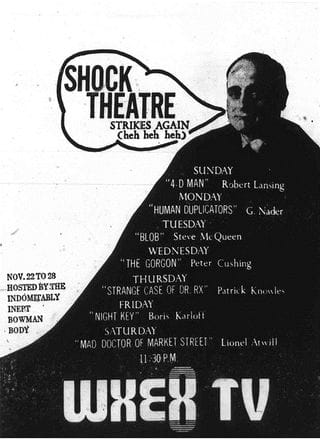
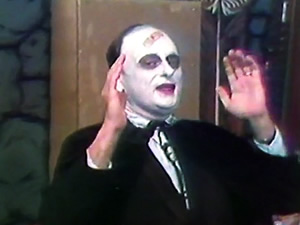
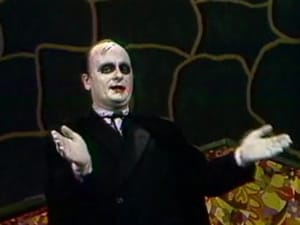
And…that in turn has sprung a new documentary, Hi There, Horror Movie Fans, which is something of a sequel to the previous film. We kept getting requests for more on Bill Bowman and his character, The Bowman Body, and there was a ton of material we had to cut to trim the Bowman section to a manageable length, so…sure! There’s room for that too.
 Why This, Why Now?
Part of the trend toward these films is admittedly, simple nostalgia. Most of the people making these films are somewhere around 40-50 years old. Like it or not, when you get to be that age, you start to think more about your personal history. As horror host Mr. Lobo put it, when we were filming Virginia Creepers, there is an irresistible force in us to justify and elevate our guilty pleasures. Documentaries tend to do just that.
A second factor is equally obvious: technology. Every day, good quality cameras, computers and software come down in price and up in accessibility, making independent films proliferate like mad. Add in YouTube and its cousins you now have an instant stage (though you are surrounded by millions of others).
One more social-historical factor has come into play as well: reality TV. There! I said it! Reality TV has actually been a positive factor in the growth of documentaries in general.
In short, people have become a lot more accustomed to watching real people talk about their lives in front of a camera. Without getting into the politics of it, consider also the high profile documentaries of Michael Moore. He has inserted himself into the format, accidentally carving a place for more personal interest and less news-style objectivity (not that we have that even in news any more).
 Hosts With the Most
But, these are all general factors. What of horror hosts in particular?
What follows are not remarkably original observations, but they are critical ones when it comes to understanding horror hosts in history, and the rebirth of the genre.
Horror hosts fill the very old role of shaman/spirit guide. For those of us who first watched horror hosts on TV, late at night with the lights down, the host played that role with information about the film. Before IMDb and instant access to every bit of information on the planet, young viewers especially relied on the wisdom of these older weirdos to set the mysterious elements of the universe in place. That has a powerful emotional impact when you are young and it helps explain their appeal.
Also, in the heyday of horror hosting on TV, between 1957 and 1977 (i.e. from the SHOCK! package to Star Wars and VCRs), this was the only way to see classic horror films. It was also a time when kid culture, particularly monster kid culture, was evolving into what we know today. The two combined in a powerful way to create a subculture-cool that hosts made possible./p>
Consider this: one of the things we found in the process of doing Virginia Creepers was a shared behavior pattern among the lingering devotees. Each week, when the TV listings came out in the paper, kids would circle every monster movie they could find and plan their week around it. Many kids were taping the audio on cassette recorders and cutting out ads as part of their ritual as well. Like comic books and Aurora models, this was another form of collecting and offered similar social rewards. After all, being the only kid in your neighborhood to see ALL the Frankenstein movies made you very, very cool.
Additionally, one of the interesting 'accidents' of the TV horror host phenomenon is that it gave kids an introduction to another time and culture. Movies from the 30s, 40s and 50s featured different clothes, cars, speech, and relationships than what kids grew up with in many cases.
When I was first catching Dr. Madblood and Bowman Body in the early 1970s, no one I knew wore a hat, jacket, and tie everywhere, but that’s how you fought giant ants and hunted mummies back in the day. However, no one worried that they were not getting a full experience simply because it was in (horror of horrors) black and white, either! That, in a strange way, opened doors.
An additional factor is locality. Because hosts played in a local market, they had local sponsors most of the time. They referenced local events and landmarks and they appeared at supermarkets and tire stores you could actually go to. They were typically very accessible in a way we simply cannot imagine today.
For example, in the course of doing our latest film about the Bowman Body, it has become clear that part of his personal legend is his record of public appearances. He never spoke down to adoring kids and never distanced himself from exuberant teenagers and college students. Think about that for a minute…college students! Can you imagine any local TV personality today attracting the attention of college students, let alone being invited to host a fraternity party? But that is just what Bill Bowman did.
 Once More Into the Breach, Dear Friends
Okay, so does all this justify yet another horror host documentary? Damn straight!
Maybe it's just me, but there are two good reasons for adding one more documentary to the growing pile.
First of all, Bill Bowman’s character was genuinely unique. He put on the ghoul make up but never attempted to play the part. He had a remarkable comic timing and could play cornball next to double entendre seamlessly. It was a wild little ride where anything could happen that week. His enduring popularity as a pitchman, even two decades after his show left the air, says a lot about him.
Secondly, wherever there is an interest in telling a story about these folks it contributes to the whole. Maybe we are just trying to justify our guilty pleasures, but if we don’t do it, who will? To put it another way, during the early 1970s, when Bill Bowman first started his show, there was Watergate, Vietnam, bussing, the Manson family, several species of equality movements, and the end of the Beatles. All that—the world of adults at the time–will get documented over and over again.
But, if those who lived through a world of Universal classics on TV, horror comics on the 7-11 racks and Aurora models on the shelf don’t document that side of the time, then don’t hold your breath for the History channel or PBS to do it for us.
