From Zombos Closet

Storage 24 (2012)
Alien Storage Hunters

storage 24 on imdb
Zombos Says: GOOD (but last third of movie keeps if from scoring only FAIR)

I don’t understand why the insectoid creature (gooey droppings, menacing mandibles)  in Storage 24 sticks around. After a military plane crashes near a 24/7 storage building in London and it escapes from its cargo container, it stays in the building. Power fluctuations cause lights to go on and off and the electronically controlled gate to drop down, trapping people inside, but the creature bends metal and pummels mortar into powder fairly easily, so I’m at a loss to explain why it sticks around to attack these people, one by one, in tried-and-true horror movie sequencing (or should I say black-and-blue sequencing to be more accurate?). Of course I realize you wouldn’t have much of a movie about a monster in a storage facility if it did leave, but I’d expect to see a little more motivation built into the storyline. Critics like me can be annoying like that.

Of those who want to leave the building, there are: Charlie (Noel Clarke) and his recently ex-girlfriend Shelley (Antonia Campbell-Hughes); Charlie’s best friend Mark (Colin O’Donoghue); and Shelley’s best friend Nikki (Laura Haddock). Also trapped and providing the real potential for red-shirt landing party status, shown in gory closeups, are the storage facility’s front office crew and a creepy unshaven fellow hiding out from his wife by living in a storage unit on the fourth floor. Sure, Charlie and friends can get killed, too, but they need to stick around for most of the running time to keep us invested in the drama, right? Besides, we all like Noel Clarke because he’s been on Dr. Who, so there’s a good reason not to piss us fans off by killing him willy-nilly. He didn’t get the girl in Dr. Who, either, so why beat on the poor guy?

While the creature stays in the building, the men driving in the black SUVs pulling up outside, shortly after the plane crashes, don’t bother to.  Director Johannes Roberts and writers Clarke, Fairbanks, and Small keep the budget well under budget by moving monster, people, and calamity between the storage building’s narrow hallways and tight units. There are no expensive military ops to gung-ho through the storage units with automatic weaponry blazing and macho quips of scrappy do’s and don’ts while they fight and flight. Instead, Charlie  alternates between feeling sorry for himself, being mad at Shelley for ditching him, and working up his anger because she’s tossed him out of her life. It takes him and the others a fairly long time to realize there are more important things in life, like staying alive, especially when screams ensue and people go missing.

As we stay inside with them and the creature, half-way in I wished the writers had seen some American storage unit reality shows like Storage Hunters or Auction Hunters (note the dramatic use of “hunters” in each title).  The UK writers would have realized the wild and dangerous things to be found squirreled away in storage that could provide more fire-power, or survival assurance, for Charlie and company. After Charlie and Mark knee and elbow their way through HUGE air vents (yes, another independent movie takes the shortcut and budget-wise approach for moving characters around cheaply), they only find a crowbar, a few fireworks, and a battery-operated toy dog. Their finds are put to very good use later on, but I was hoping they’d find a grenade launcher or mini-canon. Given the crazy things these shows find in storage units here in America, it’s a let-down to find the Brits are so damn sensible. They should have shot this movie in Texas.

Two-thirds in, the movie finally moves from Charlie’s relationship troubles amid intermittent terror to their creature relationship troubles and continuos terror. Shelley is wrong about Charlie: he may not make her laugh anymore or be very exciting, but he knows how to pluck up when death is a storage unit or two away.  A few well-timed, deadpan delivered, quips from Charlie perk up the otherwise by the numbers action, and the camera’s movement is handled well, especially when the practical makeup and CGI effects mingle. Everyone does the usual dumb-ass actions when confronted by the usual horror-movie-unknown to keep us properly stupefied or mortified.

Not sure if the ending is a good idea, as it cuts into “first” ending (the resolution of the soured relationship and creature menace), but it could make for a fun sequel if the right budget is allocated. Some will lambast Storage 24 for its heavy-handed male-centric view on the relationship breakup, though there is a nice twist with who actually turns out to be the unexciting/you-don’t-make-me-laugh-anymore type. It certainly isn’t Charlie.

Texas Chainsaw 3D (2013)
When a Chainsaw is Not Enough

001 130110
ZC Rating: Fair

Listen to Movie Review

Here are some of the takeaways for me after seeing Texas Chainsaw 3D: make sure to read important letters left to you by dead relatives before you move into their mansions; don’t jump in open caskets in graves in cemeteries you’re not familiar with; women went bare tummy, wore tight jeans held up by wide belts, and traveled in VW mystery machines in the 1990s; stay away from meat packing facilities that have been shut for over 20 years and still have electricity and machinery in perfect running order; don’t look through your cell phone camera when walking in strange hallways filled with dead things; and finally, don’t pay for 3D when 2D sucks just as much.

Now that I’ve gotten those takeaways off my chest, I do have a few nagging questions after seeing the movie, too. For one, why doesn’t the sheriff shoot? For another, why does Heather stay?

There are a lot of things in Texas Chainsaw 3D that irked me; the gore factor is high and palpable (or pulpable, to be more descriptive) without that freakish energy powering up from the drive-in trashy grit and hillbilly inbred insanity the original sparks with.

Another disappointment is how the promises made during the opening scenes highlighting the original’s backstory go unfulfilled. A baby girl is taken after the Sawyer family is killed by local vigilantes fed up with all the Sawyer craziness bringing attention to the small town of Newt, Texas. That girl grows up to be emo Heather (Alexandra Daddario), who creates morbid art from bones, likes slicing meat at the supermarket she works at, and dresses for a different time period than this movie’s situated in.

Or maybe I’m confused. Is she twenty-something or near-forty-something? What time period does this movie take place in anyway?

The creatively commercial, but ill-advised, use of a cell phone would place everything in the present, but Heather’s sexy bare tummy throughout the movie, and the beat-up Scooby Doo-style VW van (it’s like 1974 all over again), and the hitchhiker pickup scene (people still pick up total strangers?) are retro-fits to another decade. Doing the math while basing the total on the original Texas Chainsaw Massacre of 1974 starting point, Heather is either nearing 40 but looks smashingly nubile for her age, or she’s really in her early twenties and a Dr. Who type time-warp bubble allows a modern and over-priced cell phone to co-exist with her in the 1990s.

It’s a wonder they didn’t manage to shoehorn in a plot-use for Michelob, with Heather rolling a cold, wet one across her bare stomach while she’s meeting up with the family lawyer (Richard Riehle) in the bar; or at any other time since she never wears a shirt completely buttoned or large enough to cover her mid-section.

Oh, right, about Leatherface…time-warping, sexist clothing, and product positioning aside.

Jed (Dan Yeager), who still wears his polyester clothes from the 1970s, hasn’t aged at all. Sequels will do that to you. Like the equally ageless Jason in 2009’s Friday the 13th reboot, Jed now has a whole bunch of rooms and hallways to tenderize and skewer his victims in. We see the curious and grisly furnishings while an unwise sheriff holds his gun and cell phone prominently in front of him as he walks through the “catacombs” to his doom.

Spoiler? Are you kidding? How long you been watching horror movies?

Jed’s den of iniquity lies beneath the southern mansion Heather has inherited, deep in the heart of Newt, Texas; and behind the metal door (amazing how Heather’s grandmother made sure she installed another metal door), waiting with meat mallet at the ready, is Leatherface—and a closet full of chainsaws. The best scene showing context and portent has Jed playing like a cowboy holstering up for his showdown with the bad folk that killed his kin. Now we know what happens when you take Leatherface’s chainsaw away: he gets another one.

And he wields it with grisly skill, slicing through torsos, ankles, wrists, chests, and various other body parts not moving out of the way fast enough. An extended face-removal with carefully positioned foot-twitching gave me nightmares. Having Leatherface stitch on a new face (which, curiously, looks like any of his older faces) through his cheeks with a large needle—under what I suspect are very unsterile conditions—in closeup, is not very cheerful, either.

Other critics of Texas Chainsaw 3D appear torn between the semi-humanization of Leatherface as he squares off against the bad guys, and the lack of zest he displays in not lopping off limbs during the carnival festivities as he chases Heather up a Ferris Wheel. One critic even derides the tossing of the chainsaw at the sheriff (and into the 3D audience) as laughable, but Jed’s got a whole closet full of them, so why not?

As for humanization and restraint, both are in keeping with the character’s motivations. As for me, I’m torn over how Heather, after seeing her friends horribly butchered, still considers Jed family, and the sheriff’s decision to let the crazy homicidal son of a bitch keep living, and why Dr. Who never show’s up to solve the temporal paradox of director John Luessenhop’s screwed up timeline.

If Texas Chainsaw 3D is any indication of what we can expect from Hollywood in their treatment (mistreatment?) of classic horror movie reboots, I want to travel back in time myself before it’s too late.

In the meantime, watch John Dies at the End instead.

Conjure Wives by Professor Kinema

Weirdwoman

O, creator of Hecate, Damkina, Marduk's Messenger … tem-khepera, khnemu … Beelzebub in the netherworld … Satan in Gehenna … Controller of seven thousand and seven curses and talismans … and who is known to obedient desciples as Gangida … hold all your powers and those of your do-bidders … and their familiars … and cast a protecting shield above those gathered present…Pull back from airy bodies those vested with evil … grant, O, magnificent one, no harm from the spells about to be witnessed. Direct them not! This faithful servent begs for Thy favor! Eftir irne-zet! Now with a free mind and protected soul, we ask you to enjoy Burn Witch, Burn!

Fritz Leiber's first novelette, Conjure Wife, originally appeared in the April, 1943 issue of Unknown Worlds , a pulp magazine. An expanded and revised version was published by Twayne Publishers in its Witches Three anthology in 1952, then issued as a stand-alone novel in 1953. Both hardcover and paperback editions, by a variety of publishers, continue in print to this day. Leiber's story is widely acknowledged to be a classic of modern horror fiction, included in David Pringle's Modern Fantasy: The 100 Best Novels, and in Fantasy: The 100 Best Books by James Cawthorn and Michael Moorcock. In The Encyclopedia of Fantasy, David Langford described it as "an effective exercise in the paranoid." Science Fiction author Damon Knight wrote:

"Conjure Wife, by Fritz Leiber, is easily the most frightening and (necessarily) the most thoroughly convincing of all modern horror stories… Leiber develops [the witchcraft] theme with the utmost dexterity, piling up alternate layers of the mundane and outré, until at the story's real climax, the shocker at the end of Chapter 14, I am not ashamed to say that I jumped an inch out of my seat…Leiber has never written anything better."
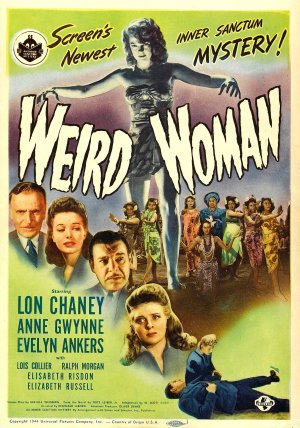
Weird Woman posterIt was the original pulp novelette on which the screenplay of its first film version, Weird Woman (1944), was roughly based. Universal had initiated a B unit-produced series inspired by, and copying the name of, the popular radio series The Inner Sanctum. At the time, the series was in it's heyday and a series of Inner Sanctum books was equally popular. The Universal series, however, was promoted as a separate and original entity.

The first film of the series was Calling Dr Death (1943), which featured Lon Chaney, Jr, who went on to star in the entire series over the next couple of years. The director was Reginald Le Borg, under contract to Universal. Le Borg and Chaney had previously made The Mummy's Ghost (1943) and, after Calling Dr Death, moved on to the second of the Inner Sanctum series, Weird Woman. The series continued with Dead Man's Eyes (1944, again directed by Le Borg), Pillow of Death (1944), The Frozen Ghost (1945) and Strange Confession (1945). Of the entire Inner Sanctum series, Weird Woman is generally considered to be the best.

Weird Woman's screenplay was prepared by Brenda Weisberg and W.  Scott Darling. The credits read "Screenplay by Brenda Weisberg, from the novel by Fritz Leiber, Jr" and "Adaption by W Scott Darling." The title of Leiber's novelette is not mentioned. Le Borg was handed the script a week before production was to begin and prepared for filming without reading the novelette. Via promotion, theater-goers were reminded that Lon Chaney, Sr was known as "The Man of a Thousand Faces," so now his son, Chaney, Jr was touted as "The Man with the Voodoo Voice." According to Weird Woman's pressbook, Chaney developed this talent in order to "project the voice of the supernatural," supposedly using a trick of ventriloquism taught to him by his father. Evelyn Ankers, the heavy of the story, carried the label "The Queen of the Horror Films."
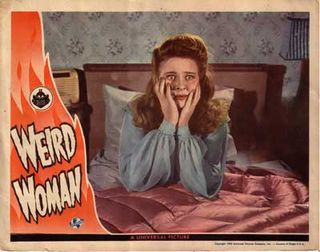
WeirdwomansmxxChaney was cast as Professor Norman Reed, a teacher of sociology at Monroe College in New England and the author of 'Superstition vs Reason and Fact.' In the novelette, his name is Norman Saylor, a teacher at Hempnell College who is preparing a paper, 'The Social Background of the Modern Voodoo Cult.' Ann Gwynn plays his wife, Paula (Tansy Saylor in the novelette), and Evelyn Ankers is Ilona Carr (Mrs. Carr in the novelette, referred to at one point as "…that libidinous old bitch"). It is not clear which of the female leads can truly be referred to as the weird woman. Since several women in the cast are involved in some sort of witchcraft, the film could more appropriately be titled Weird Women.
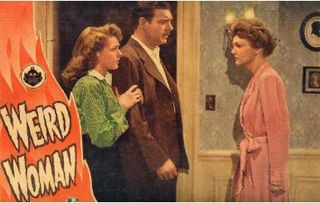
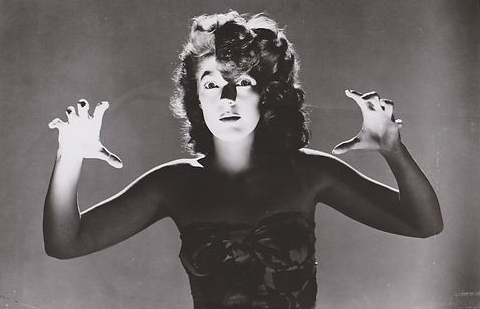
Wierdwoman01Ann Gwynne proves to be the victim-weird-woman while Evelyn Ankers proves to be the evildoer-weird-woman. Promotion featured a provocatively sinister-looking Anne Gwynne posed in a sarong, hands outstretched and exuding a diabolic nature that is not developed as such in the film. Yet the term 'Weird Woman' could ultimately refer to woman-kind in general, as it is with the women in the plot who are bewitched and bewitching. Reportedly, the confrontation sequence between Gwynne and Ankers proved to be a difficult undertaking because they were such good friends.

Weird Woman reached a new audience when it was included as part of the original SHOCK! package of 52 Universal titles released to television in 1957.

After the 1953 publication of the reworked Conjure Wife in hardcover, it was to be the inspiration of the definitive screen version nine years later. In the meantime, a Twilight Zone episode titled The Jungle appeared on the airwaves on Dec 1, 1961. It was based on a short story of the same name by Charles Beaumont, first published in 1954 in If magazine. It later appeared in Beaumont's collection, Yonder (1958).

Plot-wise there were similarities to Leiber's novel, with a few touches of Val Lewton's Cat People tossed in. The story involves actors John Dehner and Emily McLachlin in a tale of a hydroelectric company executive whose firm is moving into an African nation to build a dam. The native residents don't take to the idea. An early sequence focuses on the (conjure?) wife whose husband discovers and subsequently destroys her magic charms and talismans. All, save one, are tossed in a fireplace. They go up in little puffs of smoke and make the wife terribly upset. Other elements common to this TV episode and the later Burn Witch, Burn crop up, such as Dehner's pursuit by an invisible force. His ultimate demise happens at the teeth and claws of a ferocious beast (here a lion) who inexplicably manifests itself after first appearing in stone form. No credit is given to Leiber.

In London the following year, two weeks before the cameras were to roll, writer George Baxt was handed a script written by Richard Matheson and Charles Beaumont. Director Sidney Hayers was dissatisfied with what he felt was an unworkable treatment of Leiber's novel and turned to Baxt for help. Hayers and Baxt had previously worked successfully together on Circus of Horrors (1960).

Like Le Borg almost two decades earlier, Baxt had not read Conjure Wife. His task was to take the Beaumont/Matheson script and 'doctor' it, removing what was felt to be inane dialogue. For example, the professor's wife is confronted by her husband, who demands that she give up her witchcraft and voodoo and destroy her magic symbols, talismans, charms and so forth. An exact quote from the novel's text, also in the script, was "But couldn't I just quit by degrees?" This was changed to, "Couldn't I just taper off?"
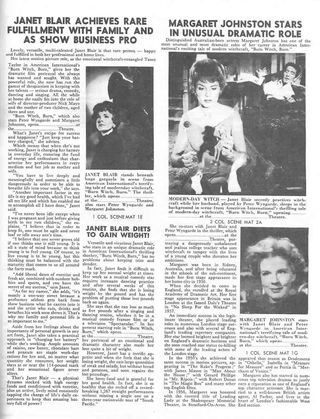
BWB02In an interview I had with him in his NYC apartment, Edgar Award winning author George Baxt related his involvement with what was to eventually released as Burn Witch, Burn:

"It started with a call from an agent. I was living in London at the time. British director Sid Hayers had a script based on Fritz Leiber's Conjure Wife that was prepared by Charles Beaumont and Richard Matheson. The working title was Night of the Eagle. I previously prepared the screenplay for Circus of Horrors, also directed by Sid. The association was a good one. Both Beaumont and Matheson were established, well-known screenwriters, yet they came up with an unfilmable treatment. I was given two weeks to deliver a product and, needless to say, I had to work quickly. I had never read Leiber's novel. Work on the script continued during principal photography with additional pages and revisions delivered to the set on a daily basis.

(Note: I didn't ask him if Hayers or Baxt had seen and were familiar with Weird Woman of 1944)

"The original actress who was to play Tansy was June Allyson. Because of personal problems she was dropped and replaced by Janet Blair. Peter Wyngarde (Norman Taylor) was also cast as a replacement when the original actor became ill. Additions to the script that I was responsible for were the sequence in the graveyard and Tarot-card-burning scene. I thought the graveyard scene was handled well on the screen. Sid wanted me on the set throughout the shooting of the faculty bridge game. Margaret Johnston (Flora Carr) was the heavy of the story and it was important to the plot that she be positioned within the frame, appearing menacingly. Throughout she was constantly casting leery glances at Peter Wyngarde. The whole sequence was put on film in about an hour. I suggested at one point to place the camera behind the fireplace shooting out at the players (The Old Dark House-type of shot). As far as the eagle pursuit sequence goes, I originally didn't like the way it was handled, looking phony. Now, I think it was impressive."

Mention should also be made of the eagle that assays the role of the giant 'demon bird' who pursues Peter Wyngarde. It was a golden eagle named Lochinvar, trained especially for film and TV roles. The shot of the eagle bursting through the door was achieved by punching a glove puppet through a miniature of the door. There are only a few frames of this sequence before a very quick cut to a shot of an actual eagle in a miniature of the hallway, but the shape of a hand and wrist can just be made out in silhouette. Also, when the eagle is briefly shown in flight, a thin cable is visible attached to one of it's feet, guiding it's path. All in all, the complete sequence was effective for a film of it's day.

Pressbooks for Weird Woman and Burn Witch, Burn both emphasize supernatural elements of voodoo, witchcraft, and superstitions. Theatrical prints for the American release usually contained a pre-credit opening incantation (quoted at the start of this article), read by Paul Frees. It is heard over a totally blank screen, designed to expel 'evil spirits' from the theater, and psychologically prepare the audience for the story.

At one point in the story Norman jokingly refers to Mrs. Carr as "That old warlock." An interesting point since traditionally a warlock is what a male witch was referred to. Later in the story Norman catches Tansy with her charms and talismans. Angrily she states, "…yes, I'm a witch!" The 'not for publication' synopsis mentions a final shot of Tansy clutching the lucky charm behind her, the only one she managed to save. However, the actual final image is of the audio tape of one of Norman's classroom lectures unraveled on the ground right after the death of Mrs. Carr. The not-so-subtle question Do You Believe? is superimposed over the shot (instead of the simple 'The End' title that is in the British version).

Crawlspace (2012)

crawlspace movie IMDB
ZC Rating: Good

I disagree with a few of the online critics that have reviewed this movie. While they cite likely plot inspirations from sources like Scanners, and Aliens, and Event Horizon, I would instead point to movies like The Power. In that 1968 movie (starring George Hamilton), members of a research group are killed off, one by one, through telekinesis, by someone within the group. Justin Dix, the director of Crawlspace (this is his first full-length movie), sort of uses the same scenario, just not as straightforward or as suspenseful.

Being a special effects supervisor, his direction perks up when the effects come into play, but you do notice a difference between those moments and moments without special effects. The dramatic interactions drag on a little too long, the recriminations and rebukes come a little too easily and are a little too volatile, and having an elite military unit, highly trained for special ops, so easily revert to behaviors usually exhibited by mercenaries is lazy scripting. So is having big guys squeezing through narrow air vents, that perennial movie and television trope that trims budgets and expediently moves people from point-here to point-there.

But this movie is called Crawlspace so the air vents make more sense here; and Dix, for his first go at a complete story does a competent job of telling and showing it. And there’s a killer gorilla; in my playbook you can never go wrong when you toss in a killer gorilla. What’s missing from Crawlspace is more surprises like that, and naming the mysterious woman “Eve” (Amber Clayton), who has amnesia and a nasty surgical scar on her head, is a giveaway to what’s coming.

Deep underground, in a maze of pathways reminiscent of those plastic mice habitats, military units are dispatched to handle a major crisis unfolding in a secret research facility. One unit comes across Eve, who doesn’t remember much, but unit leader Romeo (Ditch Davey), recognizes her as his dead wife (now not so dead, of course). Between bullets and running from danger the soldiers unravel into a frenzied mess of nerves and fears–the drill for horror movie dramatics. Eve begins to remember and Romeo fears that the most. We find out why Romeo is so guilt-ridden, but that’s after a fanatical scientist (what goes for mad these days) provides some explanation. Another fanatical and more dangerous scientist completes the story. Both scientists are treated to special effects scenes that are mind-blowing (for them) and gruesome for us. When Eve fully remembers, matters become much worse. The ending isn’t, so there’s plenty of room for a sequel.

While I agree with a few of the online critics that the movie rehashes the same hash, I disagree that this makes it a bad movie. It’s cooked with enough satisfying action and pulp science fiction thematics to make it worth watching. I just wish there were more killer gorillas. Now that would have been great.

A courtesy screening copy of this movie, on disc, was provided for this review.

Mexican Lobby Card: Day the World Ended

Roger Corman's fourth movie, The Day the World Ended. Note the card shows "Jorge Corman" as director, and there's a misspelling in "trmendo;" should be "tremendo." I also don't recall a woman running around in a skimpy outfit, especially with all the radioactivity outside. Pay particular attention to the positioning of the two men: one is fighting the monster, the other is holding a gun but facing away from the monster. In the middle is the woman. In this primitive and colorful illustration the artist has told us there's a villain, there's a monster, and there's a hero. Oh, and a beautiful woman caught in the middle. Sadly, this card holds more drama than the movie itself, and it also shows the plot quite well.

El Fin Del Mundo Mexican Lobby Card

Movie Pressbook: Tarzan’s Fight for Life

Tony Rivers, from the Classic Horror Film Board, guides us through the jungle one more time with Tarzan’s Fight for Life pressbook……Tony says: “Here’s the last of my Tarzan pressbooks (for now; still looking to get TARZAN’S HIDDEN JUNGLE again to replace the one I had), a 12 page MGM pressbook celebrating the 40th anniversary of Tarzan back in 1958. [The movie] has Jane (Eve Brent) and “Tartu” (shortened version of Tarzan2 or a new version of Boy) and native tribes causing unrest in the jungle. Tarzan to the rescue. Jil Jarmyn, who plays Ann Sturdy, lost out for the role of Jane to Eve Brent as they were the two finalists for the role. They made the right choice!”

Note: Due to a scanning faux pas, a line of text is repeated in the middle column on page 4. Oops.

tarzan's fight for life pressbook

Mexican Lobby Card: The Undead

The Undead is one of my favorite AIP movies. According to Wikipedia "The movie was filmed in a converted supermarket, and was completed in only six days. Its original title was The Trance of Diana Love. The bats that the imp and witch continually change into were left over from another Corman movie, It Conquered the World." This Mexican artist's version of the poster art adds more bats and less nightgown.

Los Muertos Vivos Mexican Lobby Card