From Zombos Closet

February 2011

Mexican Lobby Card: Monster on the Campus

Monstruo En La Noche >Mexican Lobby CardThis Monstruo En La Noche lobby card for Universal's Monster On the Campus (also called Monster in the Night) is from the Professor Kinema archives.

A simple combination of red and black inks combine to create a striking image that's more exciting than the actual movie. Note the interesting contrast between the King Kong grip on the heroine by an over-sized monster in the illustration compared to the insert picture. The small picture of the scientist acting scientifically and the hypodermic needle outline cue the science-horror aspect of the movie.

Vanishing on 7th Street (2010)

Vanishing on 7th street ZC Rating 3 of 7: Good (but wastes precious time)

Rosemary: We can wait till morning.
Luke: You sure there’s one still coming? 

The problem with Vanishing on 7th Street comes into view at a critical moment, when time is of the essence. In a movie that plays its shadows menacingly long across city walls while Detroit’s streets go empty after almost everyone has inexplicably disappeared into an unnatural darkness–leaving only their clothes behind–and where light is the only defense but its slowly dying out, the handful of confused survivors talk too much. Nothing they say is important enough for them to take the time to say it,  not when menacing things prowl all around them, inches away, waiting for the light to go completely out.

Here’s what I mean. I’ll give you the setup first. Luke (Hayden Christensen) and Rosemary (Thandie Newton) have left Paul (John Leguizamo) and James (Jacob Latimore) in Sonny’s Bar. The gas generator powering the bar’s lights is failing. Luke insists on going for the one truck in all of Detroit that still has enough juice in its battery to shine its headlights, but not enough to start the engine. He figures if they push it to the bar, he can charge the truck’s battery off the generator just enough to turn over the engine and drive them out of the city. Luke and Rosemary head out, armed with flashlights, a bunch of those crack-and-glow sticks people wear on Halloween and at the circus, and a sense of urgency: they need to make it back to the bar as fast as possible because the gas generator is on its last gasp and James, a twelve year-old kid minus his mom, and Paul, the theater projectionist who’s suffering from shock, will be sucked into pitch blackness if they fail. And with the generator dead, there’s no way to charge the truck battery so they can make their escape on wheels.

Sounds intense, doesn’t it? If you’ve seen Darkness Falls, you know how nerve-racking fighting the darkness can be for movie-people when it fights them back.

Luke and Rosemary hustle to the truck. Their feeble light is flickering. The light in the bar is flickering. The shadow people popping up all around them, straining at the edges of Luke’s flashlight’s fading glow, are almost able to wrap their long, shadowy arms around him and Rosemary. Shadowy images of gigantic hands reach out for them. Ominous, vaguely human silhouettes chase after them. Barely making it to the truck in time, they snap on the headlights to dispel the shadows. Time continues to run out. They now need to quickly push the truck back to the bar before its battery dies and the headlights go out; before the bar’s lights go out. They push hard.

Half-way there, Luke and Rosemary take a break to rest and mope. A Walmart 15-minute kind of break. Granted Luke has a swollen ankle, but frankly, it won’t hurt if he fails.

They sit down by the car and ponder. Apparently the moping session they argued through before, when they first met in the bar, when Rosemary stumbles in looking for her kids, almost shoots him, and then blames it all on God’s wrath on all of mankind for sinning, didn’t waste enough of their precious time. Situational credibility gone. Setup tension broken.

Brad Anderson and Anthony Jaswinski trip over their own two frames. It’s the proverbial ‘kill the moment’ moment. In dire situations, people don’t think and chew on their words or thoughts slowly. If you or I were surrounded by piles of clothes formerly filled by people, and surrounded by an evil darkness reaching out to grab us from all the unlighted nooks and crannies, we’d–I have no doubt–be busting a move like our lives depended on it. I’d think even Sarah Palin would have to agree with this one: you betcha!

Vanishing on 7th Street is still a good movie. It just, oddly, ignores common sense to give character depth at an inopportune time, and when we don’t need it. Up until then, the enveloping creepiness, the unknown evil intention of it all, and the Lovecraftian doom that came to Detroit is palpable. It is a movie that glues our nerves to jangle because what’s happening is so alien and everyone is so screwed because of it. You can’t help but hope for the best, even knowing the worst has to happen. Anderson and Jaswinski hold our attention and bring it deeper and deeper into the mystery.

Until they fumble and kill the moment.

Faces of Boris Karloff
Le Monstre Sacre…Behind the Mask…

Boris Karloff: Le Monstre Sacre, Behind the Mask…Collection Horror Pictures from Gerard Noel faneditions, copyrighted 1989.  I found this digest-sized book in Professor Kinema's Boris Karloff file. Picture comments are in French, by Jean-Claude Michel. (click to enlarge)

IMG001

IMG_0001

IMG_0002
IMG_0003
IMG_0004
IMG_0005
IMG_0006
IMG_0007
IMG_0008
IMG_0009

Captain Company Monster Wallets and Wall Plaques

Wallet Ad01It doesn't get much cooler than these Captain Company items. The colors, the poses, the Universal monsters; grownup monsterkids still salivate at the sight of them.

While I've seen the vinyl wallets now and then (especially after the re-issues), I don't recall seeing any of the wall plaques.

Note to Phil Kim and the new Famous Monsters of Filmland: maybe it's time to resurrect the wall plaques. I'd even update them if I were you. Add Freddy, Jason, and Chucky (but for godsakes, not the remake versions!) And add a backlight so they glow in the dark. Just a thought.


Thanks to Professor Kinema for supplying this back cover ad from Famous Monsters of Filmland #29.

They’re Closing My Borders Bookstore

Borders_store_closing Do you remember the Night Gallery episode, They're Tearing Down Tim Riley's Bar? It's the matching bookend to Rod Serling's Twilight Zone episode, Walking Distance.

They aren't horrific in the usual sense of the word, but they're both terrifying nonetheless. Both are about time marching on and how change happens around you, through you, in spite of you, and how you don't change–because you can't or won't or just plain get your butt stuck in the middle.

A transcendental fly, mired on some decade by decade sticky paper, you keep wiggling your little life's butt–and go nowhere. The kicker is you're still moving, even though you're ass isn't. You have no choice. Time's beating it's chronological fly swatter, hard, around you, swiping out the places, the people, and eventually all the sweet things you buzz around. And it sucks having to watch them go.

I'm going to miss the Borders they're closing in Westbury. It is better than Tim Riley's bar. It is close. It is convenient. It is comforting. It's where I spent time watching my son grow up from reading picture books to young adult vampire novels. It's where, after Tower Records crashed, my next favorite magazine place–before Borders downsized the racks–kept me coming back for new issues, fresh coffee, and stale pastries. It's where my family goes a few times each month to browse, to lounge, to explore. To be a family.

You remember browsing, don't you? It's a quaint ritual–not the same as web surfing–a little bitty thing, where you make time stand still on purpose, and directionless, so you can peek and prod around the usually hidden edges of may-be-interesting.

Catch my drift? Catch my key action word here? I don't think Borders did. In time it became too often that too few books and magazines were there to browse. Too often I was told the bookstore could order it for me, and I'll see it in a few days. Why bother? I can order online and get it faster.

I'm kind of sad, kind of annoyed. Bookstores are like libraries. There's something reassuring in being able to walk up and down their aisles, directionless, timeless, without a search query based on what somebody else thinks I'm looking for pointing the way. And when you've done it for a time in the same place, you start feeling like that guy in They're Tearing Down Tim Riley's Bar, even if you only drink coffee, and even though they're just books after all, when it goes away.

1984 Dark Shadows Festival Program

20110214163142_001 Professor Kinema (Jim Knusch) attended the Dark Shadows Festival of 1984, with Jonathan Frid in attendance. The professor was a guest speaker, delivering a presentation on 'The Cinema of the Vampire." He was an 11th hour replacement for author Leonard Wolf. The convention and Jim are mentioned  in the Dark Shadows chapter (#20) of True Tales of the Unknown, the Uninvited.

Here's the Festival Program (pdf), and Jim's mementos from the event.


Jonathan_frid
20110214163723_001
20110214163946_001

Captain Company Creepy Cousins

Creepy and Eerie magazines are the epitome of monsterkidism, back in the day. Without Warren Publishing pushing the horror craze in print, we'd be the lesser for it. It's ironic when you think of it, but with all this horror came a more stalwart social awareness through the telling of it, which kids were privy to and adults abhorred.

The first known interracial kiss in mainstream comics (as opposed to underground comix occurred in Warren's Creepy #43 (Jan. 1972), in "The Men Who Called Him Monster" by writer Don McGregor and artist Luis Garcia. McGregor said in 2001 that the kiss was actually due to the artist misunderstanding the line "This is the clincher" in the script. McGregor would later script color comic books' first known interracial kiss, in the "Killraven: Warrior of the Worlds" feature in Amazing Adventures #31 (July 1975).
(from Wikipedia)

Creepy

Welcome to the Spook Show
By Sean Kotz

If you are a horror movie fan, you know the last few years have seen a number of documentaries on the subject of television horror hosts. Vampira: The Movie came out in 1998, but it wasn’t until it hit DVD shelves in 2007 that most people got a chance to see it. While it got mixed reviews, the film was important for several reasons. Foremost, it cast light on a major cult figure of the 1950s who officially set in motion the craft of television horror hosting. In turn, the documentary launched the craft of documenting those boils and ghouls who kept several generations up late.

Since then, American Scary, Watch Horror Movies, Keep America Strong, Every Other Day is Halloween and other documentaries have followed, including a film my company released in late 2009, Virginia Creepers: The Horror Host Tradition of the Old Dominion. In that particular opus magnum, we explored the chronological history of Virginia and DC hosts, a subject much richer than even we knew when we began the project.

And…that in turn has sprung a new documentary, Hi There, Horror Movie Fans, which is something of a sequel to the previous film. We kept getting requests for more on Bill Bowman and his character, The Bowman Body, and there was a ton of material we had to cut to trim the Bowman section to a manageable length, so…sure! There’s room for that too.
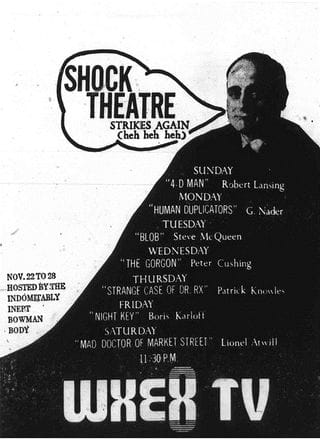


BB-ad-11-22-70
Why This, Why Now?

Part of the trend toward these films is admittedly, simple nostalgia. Most of the people making these films are somewhere around 40-50 years old. Like it or not, when you get to be that age, you start to think more about your personal history. As horror host Mr. Lobo put it, when we were filming Virginia Creepers, there is an irresistible force in us to justify and elevate our guilty pleasures. Documentaries tend to do just that.

A second factor is equally obvious: technology. Every day, good quality cameras, computers and software come down in price and up in accessibility, making independent films proliferate like mad. Add in YouTube and its cousins you now have an instant stage (though you are surrounded by millions of others).

One more social-historical factor has come into play as well: reality TV. There! I said it! Reality TV has actually been a positive factor in the growth of documentaries in general.

In short, people have become a lot more accustomed to watching real people talk about their lives in front of a camera. Without getting into the politics of it, consider also the high profile documentaries of Michael Moore. He has inserted himself into the format, accidentally carving a place for more personal interest and less news-style objectivity (not that we have that even in news any more).
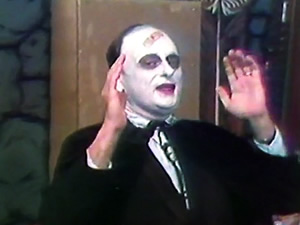
BowmanWVIR1 Hosts With the Most

But, these are all general factors. What of horror hosts in particular?

What follows are not remarkably original observations, but they are critical ones when it comes to understanding horror hosts in history, and the rebirth of the genre.

Horror hosts fill the very old role of shaman/spirit guide. For those of us who first watched horror hosts on TV, late at night with the lights down, the host played that role with information about the film. Before IMDb and instant access to every bit of information on the planet, young viewers especially relied on the wisdom of these older weirdos to set the mysterious elements of the universe in place. That has a powerful emotional impact when you are young and it helps explain their appeal.

Also, in the heyday of horror hosting on TV, between 1957 and 1977 (i.e. from the SHOCK! package to Star Wars and VCRs), this was the only way to see classic horror films. It was also a time when kid culture, particularly monster kid culture, was evolving into what we know today. The two combined in a powerful way to create a subculture-cool that hosts made possible./p>

Consider this: one of the things we found in the process of doing Virginia Creepers was a shared behavior pattern among the lingering devotees. Each week, when the TV listings came out in the paper, kids would circle every monster movie they could find and plan their week around it. Many kids were taping the audio on cassette recorders and cutting out ads as part of their ritual as well. Like comic books and Aurora models, this was another form of collecting and offered similar social rewards. After all, being the only kid in your neighborhood to see ALL the Frankenstein movies made you very, very cool.

Additionally, one of the interesting 'accidents' of the TV horror host phenomenon is that it gave kids an introduction to another time and culture. Movies from the 30s, 40s and 50s featured different clothes, cars, speech, and relationships than what kids grew up with in many cases.

When I was first catching Dr. Madblood and Bowman Body in the early 1970s, no one I knew wore a hat, jacket, and tie everywhere, but that’s how you fought giant ants and hunted mummies back in the day. However, no one worried that they were not getting a full experience simply because it was in (horror of horrors) black and white, either! That, in a strange way, opened doors.

An additional factor is locality. Because hosts played in a local market, they had local sponsors most of the time. They referenced local events and landmarks and they appeared at supermarkets and tire stores you could actually go to. They were typically very accessible in a way we simply cannot imagine today.

For example, in the course of doing our latest film about the Bowman Body, it has become clear that part of his personal legend is his record of public appearances. He never spoke down to adoring kids and never distanced himself from exuberant teenagers and college students. Think about that for a minute…college students! Can you imagine any local TV personality today attracting the attention of college students, let alone being invited to host a fraternity party? But that is just what Bill Bowman did.
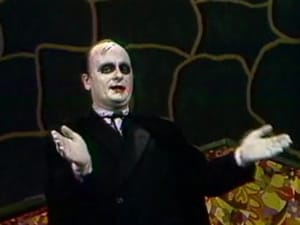
BowmanWXEX1 Once More Into the Breach, Dear Friends

Okay, so does all this justify yet another horror host documentary? Damn straight!

Maybe it's just me, but there are two good reasons for adding one more documentary to the growing pile.

First of all, Bill Bowman’s character was genuinely unique. He put on the ghoul make up but never attempted to play the part. He had a remarkable comic timing and could play cornball next to double entendre seamlessly. It was a wild little ride where anything could happen that week. His enduring popularity as a pitchman, even two decades after his show left the air, says a lot about him.

Secondly, wherever there is an interest in telling a story about these folks it contributes to the whole. Maybe we are just trying to justify our guilty pleasures, but if we don’t do it, who will? To put it another way, during the early 1970s, when Bill Bowman first started his show, there was Watergate, Vietnam, bussing, the Manson family, several species of equality movements, and the end of the Beatles. All that—the world of adults at the time–will get documented over and over again.

But, if those who lived through a world of Universal classics on TV, horror comics on the 7-11 racks and Aurora models on the shelf don’t document that side of the time, then don’t hold your breath for the History channel or PBS to do it for us.

Captain Company Horrorscope!

Monster viewer I didn’t order the 5 foot balloon, though as I think of it, it would have been fun playing The Prisoner and having it chase me down the block, with me screaming “I am not a number, I am a free man!” as I ran. Just look at that kid in the picture; you can imagine he’s practically screaming those words before the big weather balloon engulfs him.

But I did get the spankin’ monsterkid-cool Horrorscope. The packaging it came in was even more exciting than the viewer. The monster illustrations on it were colorful and brash, daring you to watch. The design was fairly nifty, too, though I recall it being a bit hard to crank.

Of course, I lost it along the journey from dream-filled childhood to reality-numbing adulthood, but when you can say you had a great monsterkid toy–scarce and expensive to find now– as opposed to not ever having it, well, that’s a plus, right?

“What is most unique about the success of the Captain Company was the fact that it survived for so long. While it is understandable how reruns of the films would remain popular it is nothing sort of shocking how such massive volumes of tie in merchandise were still selling well into the late 1970’s. Much of the reason for this was the Captain Company’s unique ads that promoted monster “stuff” as the coolest thing in the world and this kept kids sending off their money orders for these great items. Unfortunately, nothing lasts forever and the horror fad faded and interest in tie in merchandise waned to nothingness. But, for a time it was incredibly popular and even more incredibly cool!” (Captain Company and the Lost Era of Magazine Marketing)