From Zombos Closet

zombies

Comic Book Review: I, Zombie 3, The Dead of Night


I Zombie comic vertigo Zombos Says: Good

I don't know, Diogenes. How can you be sure she's a bloodsucker?

Horatio–Do you think she'd be talking to a guy like that if she wasn't?

Okay, I'll admit this is one of my guilty pleasures of comic book reading. Although Roberson and Allred keep Gwen and her odd friends squeaky clean for a brain-munching zombie, a ghost with Barbie's fashion sense, and a moonlight-afflicted hairsute friend that looks like Zombos' miniature schnauzer in a hooded sweat top, this horror-lite series is fresh and lively with color and character.

In this issue Gwen finally meets Mr. Amon, the mysterious guy in the big, spooky house, and Spot's body-hairdo gets mussed when he's outed by his nerdy friend. His other nerdy friend is in neck-deep trouble with a paintball vamp hookup, but Horatio and Diogenes, the white coat dressed pair of investigators, are close at hand to stop her blood-pecking.

Or were close at hand until Gwen falls head over heels for Horatio. Actually, Gwen was practically tossed his way by the vamp when she collided into Gwen in front of Dixie's Diner. But it looks like Gwen and Horatio's chance meeting may blossom into something more.

The vamp, by the way, is the one on the right of the cover. Vamps always dress sassy, like vamps, so they're easy to spot. I'm not sure why Gwen insists on wearing green, though; it doesn't go well with her purple skin pallor at all. Browns and earth tones are more apropos for a cute zombie like her.

Comic Book Review: Victorian Undead 1
Sherlock Holmes vs. Zombies

Victorian_undead Zombos Says: Good

The game's afoot once again for Sherlock Holmes and Dr. Watson, although this time around it is much gamier; downright putrid, in fact. Not so elementary zombies are prowling the fog-bound streets of London in this steampunk and Inverness coat-dressed pastiche from author Ian Edginton and illustrator Davide Fabbri.

In Part One, The Star of Ill-Omen (Issue 1 of 6), Holmes and Watson are brought into the investigation of peculiar and inexplicable events occurring around Baker Street by Inspector Lestrade. In the opening pages, Holmes tangles with an adversary well-versed in the scientific arts of automata–a certain Professor perhaps?–while a green comet sets the stage for the undying detective to meet the undead, who are becoming more common on the streets than hansom cabs.

The story moves quickly, leaving enough mystery to hold promise. The artwork is adequate, but lacks the edginess the world's first consulting detective and his vibrant London warrant. The scenes of 221b Baker Street are perfunctory, and Holmes' visage and dress borders on the dashing; unusual for someone of his spontaneous and somewhat untidy habits. The color palette used for London is also far too chipper.

But this is Holmes and Watson against zombies, a capital idea; so I anticipate an exhilarating adventure grander than his encounter with the Giant Rat of Sumatra.

Review copy courtesy of Wildstorm/DC Comics.

Zombieland (2009)

Zombieland

Zombos Says: Excellent

Chef Machiavelli tossed the 4-iron to me. I restrained from yelling “four!” as I whacked the nasty, multi-legged, brown fur-ball scuttling toward me up and over the pool table. Times like this made me wish I had kept up my golf lessons. Not too shabby, though: I hooked the little bugger to the right. It hit the Yule marble fireplace mantel with a splat, leaving a gooey green stain. Glenor will certainly not like that. I turned my attention to the dozen or so other nasties climbing up Chef Machiavelli’s legs, but he signaled he didn’t need my help. What a trooper.

Lawn Gisland, family friend and rodeo star attraction for the Smith and Walloo Brothers Circus, was showing off by improvising a coil of clothes line into a lariat and lassoing the bigger bugs. At least I think they were bugs. What he missed with the lariat he stomped hard with his Nocona boot heels. If he said “little-doggy” one more time as he threw the lasso, or “tarnation” every time he stomped, I was going to whoop him good myself. There are just so many “little-doggies” and “tarnations” a city-slicker like me can take in a day, if you know what I mean.

I took another swing while Chef Machiavelli bowled a 7-10 split on a handful of fur-balls. Surprisingly, they rolled very well. His usually immaculate white chef’s uniform was stained green, and bits of fuzzy hair and goo stuck on his shoulders, looking like weird epaulets. That and his crushed-in Chef’s hat made him look quite the worse for wear. I turned to Lawn to see if he needed my help. He was swinging a pool cue like a stick-ball bat sending toothy fur-balls flying in all directions. One clamped tight onto the end of it. Always the showman, he did a neat combination kick shot, squishing the bugger and pocketing the nine-ball at the same time, and then returned to batting away the rest of the competition. Within five minutes we had the situation under control and a hell of a mess to clean up. But that could wait.

The three of us collapsed onto the wrap-around leather sofa to catch our breadths.

It started when we began bowling in the mansion’s recreation room. Lawn needs a bowling ball that fits his massive left hand—and its missing middle finger—so the ones we normally have on display don’t fit. We did have one custom made for him, but since he so seldom wants to bowl we keep it with the other more customized—hence little used—bowling balls in the second play-accessories storage closet. So we walked into the closet looking for his bowling ball. It wasn’t my fault I dropped it—it’s heavy, really heavy—on his foot. Luckily his boots were hard leather, but he still jumped high, bumping a low shelf. On it were more golf balls than we would ever, ever, need, some very old gut-string tennis rackets we stopped using, fishing tackle we never use, three-hundred and forty-eight bright orange ping pong balls (I know because I counted them later when I picked every single one of them up), and all the Halloween candy Zimba’s been snatching and hiding from me and Zombos over the years. She insists on giving out toothbrushes and floss
packs instead of sugary-treats for the kids, which always leads to major problems for Zombos and me.

In back of the shelf was a hole the size of Lawn’s fist, and behind the hole were these hairy, candy-gorged fiends grown fat on years and years’ worth of Hershey bars, M&M’s, maple candy corn (my favorite), Reese’s Pieces, Milky Way Bars, and every other deep dark sinfully-rich, cavity-prone delight imaginable worth cramming into a trick or treat bag. The bugs followed the spilled candy onto the floor, then followed us out the door as fast as we could run. In one of those annoying turn of events that happen every now and then, Chef Machiavelli was bent over, serving his sugary sweet maple-toffee, dark apple cider, with melted caramel and toasted almonds, when we crashed into him, spilling it all over us and the floor. That overpowering sweet smell of sugary nirvana sent the buggers into a feeding frenzy.

“Say, hot-doggie!” said Lawn, scooping up a Twinkie from the candy assortment strewn across the floor. Zimba had banned those from the pantry, too. “All this sweetness has me hankerin’ for something sweet.” He unwrapped it.

“Are you crazy?” I said. Chef Machiavelli said something to the same effect in Italian, I think. The two of us looked at Lawn. “That’s probably been in
that closet for ages! It’s not fresh.” Chef Machiavelli nodded in agreement. Lawn ignored us and ate the Twinkie.

“Tarnation, it’s a darn-tootin’ Twinkie,” he said, downing the golden spongy cake in one bite. “Don’t get your boots caught in the stirrups, they last
forever.” He licked his fingers. “Everybody knows that.”

He did have a point.

We looked at the mess all around us.

“Well,” I summed up, “at least they weren’t zombies.” Lawn and Chef Machiavelli nodded in agreement.

“I’d miss Twinkies in a zombie apocalypse,” added Lawn.

“Me, too,” I said. Being eaten alive is bad enough, but no Twinkies? That’s really hell on earth for sure.


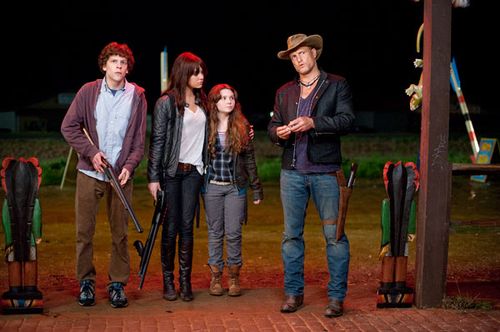
Tallahassee (Woody Harrelson) won me over immediately. Traveling a landscape overrun with zombies—that have really let themselves go as he puts it—his main goal, the one that keeps him alive and psyched for survival, is finding the last fresh Twinkie. Hostess Sno Balls just don’t do it for him. He wants the golden, creme-filled, real deal. His quest provides one of the lighter themes in Zombieland, an apocalypse romp that brings together four survivors, each psyched for survival by formulating his and her own rules for success in a really down economy of the undead.

Columbus (Jesse Eisenberg) has a laundry list of rules: there’s one designed to keep his stamina up (Rule 1: cardio to outrun zombies); another to be wary of bathrooms (Rule 3: they know you are vulnerable when on the potty); and one to make dead sure the undead are really dead (Rule 2: do a double-tap with bullets to the head every time). His rules have kept him alive after a contaminated burger kicks-off the rise of the undead. He tells us how the girl next door, the one he had a crush on, introduces him to the dire situation. Up until then he was holed-up in his apartment eating pizza, drinking Code Red Mountain Dew, and playing World of Warcraft non-stop. So rules for staying alive come naturally for him: he just needed to switch his mindset from trolls to zombies.

Tallahassee and Columbus are an unlikely pairing. When they meet, Columbus is trying to get back home, and Tallahassee is trying to find Twinkies. They have little in common; Tallahassee is more of a redneck survivalist, cool to the touch and more loose in dealing with the walking dead, while Columbus is more of a rational, follow the rules or be dead kind of person. Tallahassee also really hates zombies. Columbus is non-committal; he just wants to get home to his parents. Driving down the highway, they stop to watch a zombie crack the bones and scoop up the intestines of one unlucky motorist. Tallahassee makes a point of opening his car door as he drives past to knock over the zombie. Columbus would have gone around and avoided it.

The quest for the last Twinkie brings them to a supermarket where they meet Wichita (Emma Stone) and Little Rock (Abigail Breslin), two sisters, the older one looking out for the younger one. They’re heading to Pacific Playland where there are no zombies but lots of fun rides. No one uses their real name. The only important thing is to not get attached, keep on moving, do not make friends. Familiarity and togetherness are for zombies, not survivors. The boys and girls go their separate ways.

They meet again on the highway and this time they stay together.

Stopping at the Kemo Sabe trading post, they first clear the place of zombies and then browse the merchandise. And then trash the place realizing it all doesn’t matter. Back on the road, Tallahassee can’t believe Little Rock doesn’t know who Willie Nelson is, and Columbus and Wichita are beginning to like each other, which goes against their own hard and fast rules.

Using a homes-of-the-movie-stars map they decide to hold up in a Beverly Hills mansion. The one they pick, with its well-known owner still in residence, provides the silliest fun you will ever have in a zombie movie. When Columbus and Wichita get too close for comfort, Wichita takes Little Rock and heads to zombie-free Pacific Playland. Or Zombie free until they turn on the rides and lights and sounds anyway. One of the rides provides momentary safety, but not for long.

Zombieland is a movie filled with clown and Charlie Chaplin zombies and big gun-toting survivors. It takes an NRA, redneck approach to a problem of apocalyptic proportions, and has fun doing it. After watching so many seriously undead in so many serious zombie movies, it’s refreshing to see an old-fashioned shoot ‘em up, where the bullets outnumber the zombies and the survivors are so likable I did not want any one of them to get bitten or
eaten because that would spoil the fun. Harrelson is a natural zombie-hunter and very believable when handling high-impact automatic weaponry. I certainly would want him by my side when the zombies come: I’d be desperately searching for Twinkies, too.

A light-hearted gory romp with its brief serious moments makes Zombieland a refreshing bullets and zombies showdown break from the usually more depressing fare. This and Sean of the Dead would make a solid double bill viewing session on Halloween night.

Meet the Horror Bloggers: Gospel of the Living Dead

Kim Paffenroth Zombie Many fans of horror, amateur and professional alike, have devoted themselves to blogging about the thrills, chills, and no-frills side of the genre as seen in cinema and print. In this ongoing series that highlights the writers behind the blogs, we meet the unique
personalities and talents that make the online horror scene so engaging. Up close and personal.

In this installment, author and horror blogger Kim Paffenroth of Gospel of the Living Dead talks about zombies and religion, and how the two meet to provide enlightening revelation.

I think, like many people, my first interest in horror goes back to adolescence, when I was fascinated with some horror movies (especially Romero's zombies), and with some written expressions of horror (especially
Lovecraft). I thought gross, bleeding, oozing things were cool. I think it's pretty typical at that age. Then my mother died a slow, lingering death from cancer, and that made my interest a little less "cool" and a lot more brooding and sullen. I put some of my feelings into bad fiction writing and bad poetry at that age, I suppose as a kind of catharsis or self-therapy. It worked, for what it was, I guess.

But when I went off to college, that phase just stopped. It didn't trail off, it just stopped the day I got off the bus in front of Campbell Hall. Something about the place (St John's College, Annapolis, MD) just awed me with the ideas of dead guys who knew so much more than I did; I should stop and read every word I could and not interrupt with
my sophomoric attempts to put angst or pain or rebellion into words. (I know, I wouldn't have articulated the feeling that way at the time, but in hindsight, that's what I was feeling at all the ivy-covered walls and dusty books and rather arcane, 19th century-looking lab apparatuses.)

Interview With Stephen Lindsay Hates Zombies

Jesus Hates Zombies Vol 2

In Those Slack-Jaw Blues, writer Stephen Lindsay and various artists explored the outrageous, seemingly impious, mixing of one baseball bat swinging Son of God with legions of the undead. Two volumes later, Jesus is searching for believers among the survivors, trying to find an elusive congregation supposed to help him, and hooking up with the only zombie that recognizes him, Laz, and a beefy, thong-wearing male stripper named King. Together they continue the good fight, not only against the ravenous undead, but also against an unholy army raised by a zombiefied angel, and time-traveling werewolves. Lucky for them, honest Abe Lincoln joins the battle, wielding a mean axe.

I admit, at first, I had my doubts. What could have easily become a blasphemous cavalcade of bad art and profanity-filled dialog has risen to a stylish–classy but cheeky–story of strong-armed salvation, unlikely faith found in the worst places, and one tall log of a president skipping through the ages to aid in mankind’s salvation. The simple but effective power of Lindsay’s straightforward narrative, exhuberantly visualized in frenetic panels by artists Steve Cobb in volume one, and Daniel Thollin in volume two, compels you to keep reading. While I wait for volumes three and four, I asked Stephen Lindsay to confess to a few questions.

How did you come up with the idea for Jesus fighting zombies?

I knew I wanted to do a zombie comic, but there were so many great zombie survival horror/drama comics out there that I knew I had to do something different. So I decided to take more of a B-Movie approach. And as with everything I do, I instantly went back to my Catholic School upbringing for inspiration (my therapist says it’s good to let it out…). The title instantly popped into my head and made me chuckle. From that moment on, it was off to the races to try to get the ideas out of my head and onto paper!

Edges of Darkness (2008)
Zombies, Vampires, and Saviours

Edges of Darkness Zombos Says: Fair

Jason Horton and Blaine Cade’s Edges of Darkness is the kind of low-budget arthouse film that, given its uneven acting and shoe-string budget production values, is still important to watch for those flashes of good writing and good direction that shine through. In three separate stories following people dealing with a zombie apocalypse in their own ways, God and Devil, vampires, and organic computing provide the unusual themes wrapped around this flesh-eating grue.

While the stories do not intertwine, they are intercut, which at times jostles the pacing and dramatic continuity. Tying them together is the gated community locale, an unrelenting threat from zombies lumbering just outside, and the need for satisfying hungers that go beyond flesh-munching closeups and dripping gristle.

Edges_of_darkness Even in the least engrossing story there is a wonderful and unexpected flash of macabre poetry shown when Dana (Alisha Gaddis) dreams she is dancing with a roomful of zombies. It is compelling, like the dance of the dead in Carnival of Souls and the dancing dead in Robert Aickman’s short story, Ringing the Changes, because it plays with our sense of propriety. It is unsettling enough that the only person who listens to her is Morris (Wayne Baldwin) the zombie–out of reach, of course–outside her bedroom window, while her husband writes endlessly on his computer. Has he gone mad from the stress? Who does he think will read his story? We never find out, and instead watch as he eagerly plugs in the weird computer chip from DHell. When the lights go out, it starts searching for an alternate power source, sending out wires (tentacles) that first power-up from a house plant, then a mouse, and eventually you know what.

While Dana yearns for romance, her husband Dean yearns for backup power. Uneven acting almost cripples the pent-up tension and despair here.The climax is predictable, but the relationship between Dana and Dean (Jay Costelo) provides a refreshing psychological perspective seldom seen in more mainstream fare. We need to explore more atypical relationships like this one in the cinema of the undead, and devote time to the frustrated, freaked-out, living, coping with the voracious dead, instead of the over-used gut-churning closeups of zombies feasting.

Interview: Edges of Darkness’ Jason Horton


Three interconnected tales of terror set against the backdrop of a zombie apocalypse…

  • A young vampire couple struggle to survive as the zombies eat up all their food.
  • An obsessed writer powers his computer with a chip that runs off the life force of others.
  • A survival nut takes in a woman and her child who are on the run from a group of renegade priests hell bent on destroying the child.

…Welcome to The Edges of Darkness.

Currently in post-production, the indie horror thriller is written and directed by Jason Horton and Blaine Cade, with makeup effects by Tom Devlin. Actor Lee Perkins plays a renegade priest battling the anti-christ in one of the tales of terror.

Jason was kind enough to chat with us about his work.

With Rise of the Undead and Edges of Darkness, you seem to have a flair for “end of the world and zombies, too” movies.  Why is that?

I’ve always been fascinated with end of the world stories. Extreme circumstances seem to bring out the “real” in people and I don’t think there is anything more extreme than an apocalypse.

As far as the zombie thing goes, one of my earliest cinema memories is of my older brother taking me to see a midnight showing of Romero’s Dawn of the Dead. It moved me like no other film had. Ever since I had a thing for zombies. So when it came time to do my first movie (ROTU) it seemed like the only choice. Having them be a part of Edges was sorta my way of making up for some things that weren’t so right about Rise.

How did you become interested in independent filmmaking?

I always wanted to make movies. Exploring that in the realm of Independent moviemaking made the most sense to me. I’ve worked on a few bigger features and just didn’t fancy working another 15 or 20 years in the trenches before I got a shot to direct, and then have to do it under someone else’s thumb. When you’re doing it all yourself, you have only yourself to answer too and only yourself to blame if things go wrong (or your co-director.)

What is it about horror filmmaking that draws you to it?

I love movies. All kinds. But there’s something especially fun about working in horror. You get to explore more of the human experience. Create new and unique worlds that could never exist, and see how real people would react in them. Plus there’s just something about the visceral fun in watching a woman shove a bowling ball through a zombie’s head.


What challenges did you face making Edges of Darkness and how did you meet them?

I suppose money is the cliché answer, but it’s so true. When you’re doing something for little money, no one gets paid what they’re worth. And even though most of the people who worked on it are friends, it’s still a pretty big favor to ask someone to invest so much time into something that may only compensate them months or years later. I overcame that with preparation. Being prepared keeps things moving, that way no one thinks I’m just wasting their time figuring out what I want.

Which directors influence you the most and why?

Romero: To me he’s created the definitive view of an apocalyptic world, and did so with rich character work and social relevance. Peter Jackson (especially his earlier work): His love for movies shows in every frame. Tarantino: He opened my eyes in ’92 to a whole slew of things. Hong Kong Cinema, Walter Hill, Peckinpaw, French New Wave, Blaxploitation. Joss Whedon: For really nailing home the notion that you can make a joke in your work without making your work a joke.

Did you have to compromise between your role as co-writer and co-director on Edges of Darkness?

Not really. The only compromises that were made were due to time or physical limitations of the sets and locations. Even though the three segments intertwine, they also very much stand on their own. I wrote and directed Undone (the anti-Christ segment, and Overbite (the vampire segment) Blaine wrote and directed Entanglement.

What’s next on your list of projects?

Next for me is most likely a prequel of sorts to Edges. Following the earlier exploits of the Vampire Couple. It’s larger scale and should be a lot of fun.

Can you share with us any funny or interesting stories regarding the filming of Edges of Darkness?

Don’t work with animals. There was originally a dog in Blaine’s story. He brought the dog to the set. It was a huge, horse of a thing. It sh*t all over the warehouse and wouldn’t do anything we needed it to do. The cast and crew were complaining so Blaine decided to axe the dog. He replaced it with a rat. It works better than it sounds.

How did Edges of Darkness come about?

I was working in LA. Shooting and cutting ultra low budget features for several different companies and getting pretty burned out. I was watching these cats turn out pretty shoddy work for next to nothing, turning it over and making quite a bit. It was disheartening. I was tired of working for people who were really only in it to make a buck.

I met Stephen Kayo while camera oping on a project of his. Convinced him that quality work could be done for little money, and started work on Edges.

What advice can you give to independent directors just starting out?

First, watch more movies. You can never see enough. Love movies. If you don’t love movies, don’t direct. Go work at a bank. I’m sick and tired of running into directors and producers in Hollywood that don’t even like movies. They don’t watch them. WTF?

Second. Make movies. Work on someone else’s. I went to film school. I wouldn’t give that time back for anything. But my real education happened on sets. I did Rise of the Undead right after film school. I did Edges after working a few years on sets and in post production. You only have to glance at the trailers to see the difference.

What’s the one question you would love to be asked and what’s your answer?

What’s you’re favorite color? Blue.

Can you give us a “day in the life of an independent horror director?” What’s it really like?

Get up. Work on something else. Making your own flicks doesn’t always pay the bills. Then put every other waking minute into finishing your current project or prepping the next or watching a movie.