From Zombos Closet

movie review

Hollow’s Grove (2014)

Hollows Grove movie posterZombos Says: Good when the horror kicks in.

Once you get past the irritatingly sophomoric and time-wasting improv at the beginning, we follow S.P.I.T (Spirit Paranormal Investigation Team) as they prepare for an episode of their show that will film at Hollows Grove, a derelict orphanage and hospital. This collected-footage narrative of their would-be fake investigation turns into a screamer with some good chills.

Lance Henriksen provides a cameo at the beginning as the special effects guy who sets up the fake scares for every episode. Only this time around the scares are on him and the rest of the crew as they are suddenly faced with malevolent occupants who like to play; and by this time, are probably very bored at not having anyone living to slay with for a long time.

Probably the worst evil monsters you can write about in horror are kids gone bad and this orphanage has a lot of them. The backstory has the children dying from disease and cremated in the basement. I know a lot of the usual horror outlets downgraded this movie when it first hit digital in 2014, but they’re wrong: there is a lot to like here, with most of it coming from a really downbeat  mood — that always important constant dread — permeating every scene the minute these bozos realize it’s all real. Films like the recent Until Dawn may have more graphic kills, but the tradeoff is no mood, leading to a rote checklist of you die this way, you die that way. The fun in watching Hollows Grove is seeing everyone on the team suddenly step knee deep into it and realizing that they are knee deep into it, while still falling for the old divide and bicker and die alone formula. Given their earlier goofiness I enjoyed this even more. With Until Dawn, I kept looking at my watch and wondering when a gritty and emotionally pummeling story was going to kick in. Hint: it never did. Towards the last quarter of Hollows Grove, the manic panic is well executed, along with the team.

The wrap around contrivance isn’t the most stellar. An FBI agent sets up the disturbing collected footage to watch, but the actor is really bad at being an FBI agent, so it lands with a thud; especially when given the weird (not in a good way weird) epilogue where agents supposedly captured some evidence. The frantically paced ending before that deserved better.

Of course, every good horror story usually has an idiot leading the way to doom. In this one it’s Tim (Matt Doherty). Ignoring the grounds keeper Hector’s warnings (Eddie Perez), they blow past him and enter the building after he removes the thick chains on the front door. Setting up the cameras and beginning their walk-through of the premises, the first and best reason to not continue pops up in the kitchen. It’s a sudden blunt statement of get out now or else, clearly punctuated with a splash of blood. For the horror movie to continue though, they ignore it and keep going. Go team.

Interesting use of two cameras to provide the footage is a novelty: Chad (Val Morrison) handles the closeups with his camera, though rather clumsily and we never really see his footage, while Harrold (Matthew Carey) tags along with his camera, capturing the team and Chad filming them. The rest of the team includes Julie, who handles the logistics, and Roger, who handles the EMF gadget.

Camera batteries dying, weird noises, bad smells, a cold spot, and things moving by themselves are par for the investigation. At one point both Chad and Julie (Bresha Webb) are left alone in the staging room on the first floor. He turns on his damaged camera to see if it is still working and captures the best scene in the movie. It’s all downhill for the rest of them from there. The next best scene is when Harrold screams for Tim to close the damn door, for good reason.

Pretty soon the lights are going off and the No Exit signs are lit. Watch this one late at night. And feel a little pity for Harrold. The poor schlub just needed the job to perk up his career. He should have stuck to comedy.

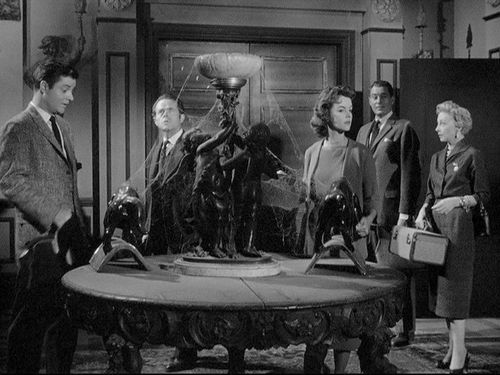
House on Haunted Hill (1959)
Movie Review

House_on_haunted_Hill
Zombos Says: Classic

In his book, Step Right Up! I’m Gonna Scare the Pants Off America, William Castle describes his chance meeting with a depressed Vincent Price in a coffee shop on a rainy evening. Price, melancholy over losing out on an important picture earlier that day, listens to Castle’s pitch on the role of the scheming millionaire Frederick Loren, who’s out to murder his wife.

“Sounds interesting,” he [Price] said. “Go on.”
“During the night, many strange ghostly things happen…blood dripping from the
ceiling…walls shaking…apparitions appearing. The millionaire—the part I
want you to play—has plotted to kill his wife. She plots to kill you…It’s a
battle of wits.”
Price smiled. “Who wins?”
“You do, of course. She tries to throw you in a vat of boiling acid.”
Price’s eyes gleamed. “How charming! I think I’ll have another piece of pie.”

Castle sums up by saying “the deal was made on the second piece of pie that same rainy night.”

While the 1940s had Universal’s iconic Monsters and RKO’s Val Lewton and Jacque Tourneur, the 1950s had William Castle’s spook show entertainment. Your ticket price guaranteed receipt of thrills and chills not only on the theater screen, but in the aisles as well. Realizing his B-movies—mostly written for a younger audience—needed a little something extra to generate buzz, Castle ramped up the marketing hype by using lurid
trailers, tawdry poster art, and clever—silly—gimmicks to hawk his movies. Like that wonderful prize you can’t wait to get to in a Cracker Jack Box, Castle’s gimmicks were always simple and sweet in effect, and perfect for the Saturday matinée crowd.

Whether it was the insurance policy handed out during Macabre, or Percepto tingling your theater-seated butt in The Tingler, or squinting through Illusion-O glasses to see all Thirteen Ghosts, you always got your money’s worth. While he didn’t quite scare the pants off America with his theatrics, he did put a nice crease in them for many horror fans.

For House on Haunted Hill he used Emergo, which was an inflatable, glow in the dark skeleton moving across a wire hung overhead. It emerged during a key scene to allow the audience much frightful merriment derived from throwing a concession stand’s worth of candy and popcorn at it. My guess is it also increased sales for those items, so the theater owner was quite merry, too.

Vincent Price had already proven his mettle at playing a smarmy, sinister sophisticate (The Mad Magician, House of Wax, and Richelieu in The Three Musketeers), so the role of Loren was right up his dark alley as Castle shrewdly knew. Price’s star presence would give the movie a touch of class plus a delightfully petulant malevolence that would bolster ticket sales to the young audience members making up the majority of theater-goers in the 50s. With adults staying home to watch the new novelty of the small screen, kids and teenagers ventured forth in record numbers to have a good old corny time in front of the big one. And with the major studios cutting back on A-movie, and especially B-movie productions, and their studio system of star-grooming and film distribution in tatters, the era of carnivalesque promotion and independent stars had begun.

Gimmickmeister Castle ate it all up like a kid eagerly scarfing down popcorn, Milk Duds and Chuckles in one mouthful, but he did take movie distribution seriously: his melodramatic send-ups of spook show horror clichés, done in remarkably simple dark and light, accompanied by shrill screams and throaty groans, were family-friendly terrors Joey and Janey could enjoy while their older siblings smooched in the back rows with their boyfriends and girlfriends. The film’s haunted-house-ride styled opening, with the screen kept black as a piercing scream rips through the theater, followed by moans and chains clanking, was astutely tailored for hugging and smooching.

To play against Price’s more sober Loren, Castle cast the master of the wide-eyed stare, and perennial fall guy, character actor Elisha Cook Jr. (Captain Kirk’s anachronistic lawyer, Samuel T. Cogley, in the Classic Trek episode, Court Martial) as the woebegone house owner, Watson Pritchard, to scare up the gruesome with his tales of disembodied heads never found, blood stains dripping from ceilings, and that vat of boiling acid awkwardly placed in the middle of the gloomy cellar’s floor.

It’s all ludicrous fun in a slick, schlocky package that, surprisingly, exhibits some memorably eerie terror moments, hinting at J-horror stylization long before Japanese horror came to the forefront: a floating apparition with long hair, albeit blond, appears in lightning storm flashes through a barred window high above the ground, and the cloudy-eyed housekeeper with her annoying habit of gliding—more like rolling—quietly across the floor in the darkest places antes-up the fright-sights. Also unusual for a low budget film, composer Von Dexter’s music rises above its B-movie assignment
to become an evocative and melodramatically creepy as hell—in that 1950s creepy as hell sort of way—accompaniment priming shivers of its own.

The flimsy plot has Frederick Loren inviting five guests to spend the night with him and his wife in the notorious house. If they survive, each guest will receive ten thousand dollars for their unwitting part in his cat and mouse game to do away with his adulterous wife. The cheerless Loren, along with the cheerless Pritchard, greets everyone amid the cobwebs. Loren carefully chose each guest, they all need the money badly, and chauffeured them to the house in cheerless hearses. His droll sense of humor continues when he hands out the party favors: handguns, neatly packaged in mini-coffins.

Before you can say “cheese dip anyone?” Pritchard leads them on a murder-highlights tour of the house, ending with the vat of acid in the cellar for his show-stopper. “You mean that’s still filled with…?” asks one astonished guest. He picks up a dead rat, tosses it in, and in a few roiling seconds up comes the bony white skeleton picked clean.

No one wanted cheese dip after that.

In venerable horror movie victim tradition, everyone decides to go it alone after one guest’s nerves start to unravel and the mysterious housekeepers high-tail it before midnight, locking everyone in. Nora Manning (Carolyn Craig), the screamer of the bunch, keeps finding reasons to scream her fool head off, and the frisky Lance (Richard Long)—all frisky guys in horror and pornography movies are named Lance by the way—insists on walking into pitch dark rooms to get knocked unconscious or trapped. The spookiness kicks in gear when they stay behind to explore the gloomy cellar; actually Lance stays behind hoping to explore Nora. By the way, did I mention there’s this big vat of corrosive acid carelessly placed in the middle of the cellar floor where anybody could kind of trip into it…or get pushed into it?

There are two really chilling scenes in House on Haunted Hill.

The first happens when Lance disappears into a dark room, leaving Nora alone in the gloomy cellar. The doors to the many rooms Lance opened, to poke his head into for a quick look, one by one slowly close on rusty hinges as the lights wink out in turn. What’s that you’re thinking? Why yes, of course; a spook sends Nora screaming up the stairs to get the party started. The other terror moment happens when spook-magnet Nora gets all tied up by a floating apparition during a lightning storm. With Von Dexter’s music dramatically pounding in-between the lightning flashes, it’s a hair-raising moment. Toss in the organ playing by itself and the hairy monster hand reaching for her throat from behind a door (a set up first seen in The Cat and the Canary and later exploited for laughs by Abbott and Costello), and off we go to the visually impressive, but implausible, climax where the cat and mouse game turns nasty.

The ticket sales for House on Haunted Hill impressed Alfred Hitchcock so much he was inspired to do his own B-movie: Psycho. The IMDb notes in their trivia section that while only orchestral theme music was used in the film, lyrics for the music were written by Richard Kayne. Here they are:

There’s
a house on Haunted Hill
Where ev’rything’s lonely and still
Lonely and still
And the ghost of a sigh
When we whispered good-bye
Lingers on
And each night gives a heart broken cry
There’s a house on Haunted Hill
Where love walked there’s a strange silent chill
Strange silent chill
There are mem’ries that yearn
For our hearts to return
And a promise we failed to fulfill
But we’ll never go back
No, we’ll never go back
To the house on Haunted Hill!

I hope you will pay a visit to House on Haunted Hill. It wouldn’t be too hard to hook up an Emergo gimmick yourself. Just make sure to have lots of popcorn, Milk Duds and Chuckles on hand for your guests. You can leave out the cheese dip and handguns.

Picture courtesy of Dr. Macro’s High Quality Movie Scans website.

Tap Dancing to Hell and a Pot o’Gold Part 1
The Living and the Dead
Castle of Blood (1964)

Castle_of_blood.jpg

Do to an issue with Google still showing my older posts after I removed my typepad blog, I will be reposting some posts through wordpress to kick the search engine in the ass a bit. 


Zombos Says: Very Good

“More hot chocolate please,” I said to Chef Machiavelli.

He put down the large and very sharp looking knife he was using to fillet the eel for his incredible eel livornese and refilled my cup. His hot chocolate is exquisite; filled with little lumps of white vanilla, a little anisette, and lots of dark, sweet
chocolate. It’s the perfect warmer-upper. I was sitting in the kitchen waiting for the plumber to find the problem with our recalcitrant boiler. He was sure taking his time.

“I will take a cup, too,” said Zombos joining us to bask in the warmth coming from the brick oven. “I wonder what’s taking the plumber so long.”

“You did give him the map?” I asked.

“Yes, of course. I do not want to lose another plumber down there. They are skittish as it is. Lucky for us this fellow is new.” He sipped his hot chocolate.

It was so hard trying to get plumbers to come out to the mansion; even harder keeping them once they saw our basement. The labyrinthine passages and rooms below us would give even Erik, the poor suffering Phantom of the Paris Opera, a run for his money.

While we waited, I looked at the long, gleaming knife Chef Machiavelli was using. I found it fascinating that a sharp implement can slice through atoms and molecules, severing their tenuous connections so easily—and the whole concept of self-sharpening was beyond me.

“How is the time doing?” asked Zombos.

We looked at our watches.

“Merda!” cursed Chef Machiavelli. He reached into his pocket and pulled out his eel-skin wallet. He handed Zombos five dollars.

“I’m still good,” I said as Zombos tucked the fiver into his shirt pocket with a grin.

“We will see about that,” he said.

We had placed bets on when the plumber would be done and Chef Machiavelli’s chosen time had passed. I was still on target, though. I crossed my fingers. I really hate losing a bet to Zombos: he was rich enough.

“This wagering reminds me of that horror movie, Castle of Blood, where the journalist bets he can stay in a haunted castle for the night,” I said.

“I remember that movie.” Zombos sipped his hot chocolate. “Barbara Steele is in it.”

“Yes, and gamboling fog as the journalist enters the Poor Devil Inn—how apropos,” I continued. “When he comes upon the table where Edgar Allan Poe (Silvano Tranquilli) and the owner of the haunted castle are discussing the reality of the supernatural, he can’t help but listen and take the wager of staying overnight in that place where no one has survived the stay. Soon they’re off to the castle and the journalist’s misadventure with the undead begins.”

Havenhurst (2016)
Movie Review

Havenhurst 2016Zombos Says: Good (But an extreme gore effect is jarringly unexpected)

Movies about dwelling places holding dark secrets, hidden passageways, and maniacal intentions are the no-brainers of the horror genre. Just think of Crawlspace (1986), or The People Under the Stairs (1991), or Thir13en Ghosts (2001). Such places take on an horrific character all their own, and a good movie or book presents that character foremost in as many scenes or chapters as possible.

Of course, visually speaking, for a movie it's relatively easy. Just spend as much time as you can in the endless hallways, the old apartments, and that stifling basement you don't want to find yourself in. That will do the trick. Havenhurst has all of that, and old fixtures, the quiet rooms, the spooky closets, and the permanent and transitory residents one would need for the terrors to begin. And a very, very, slow elevator when your dying for speediness. And a dungeon-like basement waiting for you if you misbehave.

Jackie (Julie Benz) takes up residence at the stuffy and musty Havenhurst apartment building after her rehabilitation from her addiction to alcohol. She has been a neglectful and self-destructive mother (we learn that from her fitful nightmares), but she is aiming for a fresh start with the help of her detective friend, Tim (Josh Stamberg), and her counselor who referred her to Havenhurst (wink, wink; hard to say if he is on the up and up here, but I sense a sequel may address that).

Havenhurst BasementShe takes up residence in her missing friend's spacious, but oddly suffocatingly close, apartment. Her friend, Danielle (Danielle Harris in a brief appearance before she disappears), has left all her photographs and antique cameras behind. Jackie suspects foul play. Jackie soon realizes Havenhurst is full of foul play. Cue the terror. Director and writer Andrew C. Erin, along with Daniel Farrands co-writing, are not too sure in how they play that foul terror, though. Not so much a mystery, not so much a slasher, not so much a gorehound delight, but a little bit of each moves the story along. Some of the movie posters show Jed (Douglas Tait), a mushroomy-skinned denizen of the hidden passageways, trapdoors, and sudden long drops to the basement, so not much mystery there. Hint! He is dressed a bit like a Hostel hosing-it-down man doing superintendent work in his spare time. So we know Jed's role in all of this right off the bat.

His brother, Ezra (Matt Lasky) is the building's handyman. He is good at cleaning up Jed's bloody messes. Both of them are dutiful sons to Eleanor (Fionnula Flannagan). She runs the building and decides who stays or gets evicted. After Jackie takes a drink too many, there is an understated scene where Eleanor goes to a large antique cabinet, opens it to reveal dozens of pegged apartment keys, and reverses the one to Jackie's apartment. That's when you notice a few other keys had already been flipped over, just like Jackie's. Needless to say, you don't want to be like Jackie, and those others, and have your key reversed in that big old cabinet.

Havenhurst Lobby

A hidden door in the laundry room (yes, me too! I hate creepy laundry rooms with hidden doors.) is revealed, as are the surprisingly versatile hallways and walls, in the photographs Danielle had left behind. Jackie investigates, get's her detective friend involved, and befriend's Sarah (Belle Shouse), a foster child who has her own secret room to hide from her foster parents. Sarah's parents eventually get evicted too, and that's where the gore kicks in. It seems out of place in this Gothic chiller and the camera stays too long admiring it. But soon the running away from Jed begins and the family that slays together is revealed, giving explanation to the building's unique luxury-to-die-for features.

Havenhurst Secret Room
The ending is a bummer as it clearly is done to set up the franchise for Jed and the building's future apartment dwellers. But there is more to tell about Havenhurst, so hopefully we will see the sequel soon. That deadly family tradition needs further exploration and I'm very curious to know what Jed does in his spare time. When he's not butchering tenants.

A courtesy screening link was provided for this review.

The House with Laughing Windows (1976)
An Overlooked Giallo

The House With Laughing Windows - 3

Zombos Says: Very Good

This review was written for the upcoming Unsung Horrors, an anthology of horror movies you should watch, written by the fiends at We Belong Dead magazine. The book should be available at the end of this month.


The House with Laughing Windows (La casa dale finestre che ridono) is a neglected giallo.

Directed by Pupi Avati with music composed by Amedeo Tommasi, and a screenplay by Avati, Gianni Cavina, Antonio Avati, and Maurizio Costanzo, you would be hard pressed to find much written about this slowly building suspense movie, shot in Lido degli Scacchi, in the Ferrara province of the Emilia-Romagna region in Northern Italy. Yet, with its mounting dread, a longstanding mystery in a way-too-quiet town where tourists are never seen, and an undercurrent of old evils that may still be walking around, there should be more attention paid to this little gem of terror that builds to a deliberately arguable climax.

The opening credits hint at the madness and horror that have transpired in the town where Stefano (Lino Capolicchio) arrives by ferry. He is greeted by the short Mayor Solmi (Bob Tonelli) and the taller Coppola (Gianni Cavina), providing an odd contrast as the two wait near a red car for his ferry to dock. He has come to restore a fresco in the local church, a painting depicting the martyring of St. Sebastian, at the request of a very nervous friend who is conducting water tests for the mayor.

With a budget that needed to stay lean, Avati uses his camera wisely. There are no flourishy or overtly stylized frames, but three instances, each involving Stefano, are worth noting. Two involve seeing Stefano through an open door, with him standing in the light of the room, but darkness outside that room. This impresses by implying he is surrounded by the unknown and the unseen, a strong foreshadowing element created by his position within the room, the open doorway, and the darkness leading to the camera watching him from a distance.

The third instance is either an aberration of the camera lens or a brilliant toss-away, which, either way, comes at the right moment in the movie to show the uneasiness slowly mounting in Stefano, and the shaky hold he has on the unknown and unseen that is closing in around him. As he slowly walks up a narrow stairway, the camera appears to remain immobile as the walls jiggle around Stefano’s ascent. Perhaps a camera anomaly due to the need for a handheld camera in such a tight space, or maybe it is an artifact from duping the film to DVD. A discussion on IMDb is not conclusive. You will need to decide for yourself. However it happened, it still leaves a strong impression.

The stairway leads Stefano to a large, mostly empty room, where Legnani, the painter who committed suicide, who tortured and murdered local villagers in the pursuit of his madness, mixed his palette with paints and blood. The painter was aided by his two sisters, who shared in and inflamed his insanity. All this ties to the fresco in the church that Stefano is restoring, and as he slowly uncovers more and more of the painting, he begins to delve deeper into the life and death of Legnani and the secret of the house with laughing windows. The priest in the church is non-committal: he can take or leave the restoration. But why? The assistant to the priest is an oddball who does nasty things and is allowed to. But why? Stefano’s nervous friend, who involved him in the restoration, is desperate to tell him something important about the painting, but will he be able to since no one else wants Stefano to know?

Sound and silence help build the mystery and the sense of foreboding throughout the movie. An old wire recorder comes to life as power fuses are blown. The recording is Legnani’s voice describing his ecstasy experienced through the agony of others and his visions from tortured madness. The effect is as chilling and telling as the recordings heard in The Exorcist and The Evil Dead. Threatening phone calls are made to Stefano, warning him to give up and get out; deep-voiced, throaty calls that mean business. And Tommasi’s score provides the convincing atmosphere of danger and oppressiveness, while the silence of townspeople and the quiet countryside establishes a sense of collusion and indifference.

Coppola, bothered by his conscience, decides to help Stefano. How long both of them will live to find the answers is questionable. While the body count is low and people are not murdered in the usual graphic giallo style, House with the Laughing Windows compensates and goes one better, by relying on the slow burn, the unsettling painter of agony’s legacy, and a twisted ending that leaves you with hope or despair, depending on how you want to paint this picture.

The Boy (2016) Movie Review

The boy movie

Zombos Says: Good

Beautifully filmed and with a brooding country mansion harboring dark secrets, The Boy doesn't pack an emotional wallop from intense scares or mind-numbing body counts, but what you will find in this gentle-gothic, that borrows much from other horror movies, is a simple treat of creepiness and mystery.

Lauren Cohan plays an American, Greta Evans, traveling to the Heelshire's family estate in the United Kingdom. It's an old, large, stuffy, and filled with hunting tweediness and wood trimmings kind of mansion, forgotten deep in the surrounding woods. Mom and Dad Heelshire need a nanny to take care of their son as they go on a much needed vacation away from–their son. They introduce 8 year old Brahms to her, but he's a life-sized porcelain doll, neatly dressed and somewhat melancholy in expression.

She laughs. They look appalled. She realizes they are serious. She settles in. Greta needed to get away so she has little choice. The grocery man, Malcolm (Rupert Evans), warms up to her and explains the background of Brahms and his parents. He gives Greta the pub gossip version and the regular gentrified version, and both tend toward providing just enough information for us to know there's something odd going on with the Heelshire's and their very odd son: the porcelain one and the real one.

The Heelshire's (Jim Norton and Diana Hardcastle) look tired, on edge, and desperate to leave the mansion. Mrs. Heelshire apologizes to Greta for leaving her alone with Brahms. A hint that maybe the other nannies they hired had their hands full and then some. The list of to do items, left behind, directs Greta to play music, make sure the boy is fed, dress him for bed with a goodnight kiss, read aloud to him, and do all the things you would normally do if he were a living boy.

But he's a porcelain doll so of course Greta gives up the listed duties a short time after the Heelshires have left. That's when strange things begin to happen. As Stacy Menear (writer) and William Brent Bell (director) mix in the hoary horror elements amid the splendidly brooding images of the mansion's animal carvings, hallway windings, and cloistered presence in the forest, away from neighbors and town life. Greta begins to suspect that the porcelain Brahms is alive. 

As her suspicion grows, her seclusion and avoidance of Malcolm's interest in her grows, too. She becomes more protective, more mothering, and starts adhering to that list of duties with unwavering determination. But then her reason for leaving the States catches up with her, forcing Brahms and his mysterious story into a new direction. 

While Menear's story resorts to too many overly seen tricks of the horror trade, without twisting them in non-traditional or quirky new ways, she does provide a kick in your seat moment as Brahms and Greta's pasts knock into each other. You will either like it or hate it, but it provides a direction that's not expected. For fans of, and those not familiar with, Lauren Cohan, she's very good at making the story work beyond the simple premise of "our son, the life-sized porcelain doll" and keeps to the fine line between histrionics, vulnerability, and assuredness.

Not so welcomed is the sequelantic ending tacked on beyond the perfectly good one. It's the kind that screams "not dead yet!" while ruining the natural denouement. I will say that there's a lot of backstory here that's left to imagination or future sequels, but I would have preferred a less blatantly commercial ending here. The story's mysteries are sufficient enough to spark a revisit, should the movie's box office mojo allow.

The Forest (2016) Movie Review

TheforestZombos Says: Good (but  not scary)

Director Jason Zada's camera framing is chokingly tight in The Forest, opening up once for a drone mounted camera overhead view that tellingly follows Sara (Natalie Dormer), Aiden (Taylor Kinney), and Michi (Yukiyoshi Ozawa) as they walk a path through Aokigahara Forest, at the foot of Mt. Fuji. The forest is a notorious place for hikers looking to commit suicide, and legend has it, is filled with Yurei (spiteful ghosts), who play deadly tricks on those who stay after dark. So you must not leave the main path and you don't stay in the forest after dark, or so goes the warning. But this is a horror movie and warnings are always ignored in horror movies. Sara meets Aiden, a reporter, who in turn knows a forest guide, Michi. Michi takes regular hikes through Aokigahara looking for suicides, and Aiden goes along for the walks, looking for a potential story.

The story Aiden finds in Sara is that her sister Jess is missing, last seen in this potentially scary forest. Being twin sisters, Sara knows Jess is still alive because she feels it. They share a preternatural ability of knowing when something is wrong with the other. It's not much help beyond that since it doesn't work like GPS, and after the few times Sara keeps insisting she knows her sister is alive because of it, you wish it had been left out of the story. It's not used well or needed. (This is when I noticed there are three credited writers, so maybe an undeveloped thread?)

Sara convinces Aiden to convince Michi to take both of them along on his jaunt through the forest. He's not happy with the idea, but agrees to help. He explains that those who are sad are most vulnerable to the dangerous spirits that lurk there. The question that unfolds and eventually is answered for us is who is actually the sad one: Jess, who's had a rocky life, or Sara, who has a happy marriage but seems to worry a lot about her sister? This becomes the underpinning for the story and provides a layer of involvement missing from the visuals. It's also an essential element within J-Horror: the character who doesn't know herself or himself and who is taken advantage of because of it.

We travel with Sara to Japan fairly quickly, slow down once we get there while she languishes lost in thought, then take the train ride and long walk to the forest with her, where we slow down again for a somewhat confusing (is she dreaming, is this real?) stock scare in the basement of the tourist cabin, and another half-hearted scare at the inn she's staying at. Then Zada jumps out of his routine by capturing the essence of Japan in a scene at twilight, involving schoolgirls crossing her path while she's, once again, lost in thought, snapping her out of her reverie to notice the inn she's standing in front of. An evocative scene that stands out among many less memorable ones. 

Finally walking through the cheery forest (those chirping birds do sound cheery), Sara ignores all of Michi's warnings and insists on staying the night after she finds her sister's yellow tent. And this is after they find a somewhat gamy suicide hanging from a tree. Aiden agrees to stay with her. As night falls, the Yurei come out. The scares do not. Either I'm too jaded or Zada hasn't seen enough Japanese horror to realize breaking a tradition or two here would have made a smarter movie. We didn't need to travel to Aokigahara to see his spirits, we've seen them often enough elsewhere. After getting us and Sara into the forest, he doesn't make us lose our way in the creepy darkness with the visual or stylish flair promised by his birds-eye view or twilight scenes earlier. What he does do well is build the paranoia Sara feels as she questions what's real and what isn't, while opening her backstory to us.

It's infectious. Why did Aiden stay with her? Does he know what happened to Jess? What exactly happened to her parents? Is Sara being tricked and lied to by malevolent spirits dressed as Japanese schoolgirls? Zada reaches a good level of uncertainty but fails to really sell it without more visually unique horrors. What he shows are standard images, within standard events, and providing standard clues. The story unfolds as it should, and there's a nice twist ending–just who exactly is the lost one here?–but it all boils down to an often seen horror scenario presented without enough visual flair or tricky timing to make it more than simply good and not nearly good enough. 

Movie Review: Kids vs Monsters (2015)

KidsVsMonstersZombos Says: Poor

At 100 minutes, Kids vs Monsters doesn't live up to its title, becoming instead tedious, poorly written, unamusing, and not fetching at all. And you know a movie's bad when I use a word like "fetching" in a review. 

I keep wondering where the 7 plus millions of dollars spent on this (according to IMDb) went. Not even the feckless, irksome cartoon backstories interrupting the less than lively live action (see my comment on "fetching" as it also applies to "feckless") show the expenditure. The two principal sets used–one a monster realm throne room where the rich parents watch their kids being attacked by each monster in turn, and the second, Ms. Gallagher's Reform School, where the kids hang around insulting each other while waiting for each monster to attack them, in turn–show little effort toward original art direction or intentions for originality. 

It's ho-hum from start to finish in spite of having talents like Lance Henriksen, Malcolm McDowell, Richard Moll, and Armand Assante. With the dialog they're given, I'm surprised they didn't roll their eyes more often when delivering each line. The lackluster script ignores the essential character evolution necessary to make this work, and the monsters are laughable in all the wrong ways. Endless talking by McDowell, monotonously delivered, is energy-draining to see and listen to. 

Director Sultan Saeed Al Darmaki and scripter Sarah Daly should have realized they had some monstrous-sized shoes to fill after Monster Squad, Little Monsters, and any number of animated monster movies with kids that have set a baseline for expectations. None of which are met.

The kids include the obnoxious fatty, Bobby (Jesse Camacho), the spoiled beauty queen, Candy (Francesca Eastwood), the depressed goth girl, Molly (Sidney Endicott), the do-good kid, David (Bridger Zadina), the social media girl, Daisy (Anna Akana), and the pugilist, Oliver (Daniel David Stewart). Each of them has disappointed their parents so much, their parents go to Boss Monster (McDowell) to complain and sign a contract with a strong death clause. Boss Monster, who doesn't look like a monster at all, is in charge of all the other monsters that look like monsters in the Monster Realm. We know it's the Monster Realm because McDowell eats up a lot of screen time telling the parents they're in the monster realm. And, of course, we have to listen too.

Henriksen is one of the minions of Boss Monster and assists with more pointless and spiritless dialog in-between McDowell's laborious descriptions of each monster as he introduces them to square off against the kids. One by one. This movie's title is wrong: it isn't kids versus monsters, it's a monster versus a kid. Way too late into the movie do we get any sense of team coordination with the kids actually banding together to fight and protect each other. But that doesn't last long at all and the singular kid versus monster modus operandi resumes. If you're expecting a Monster Squad team up, forget it. This movie doesn't have the nards to make it happen here.

Each prelude to an encounter includes watching a lengthy cartoon backstory for each monster as McDowell explains its life story before we finally cut back to the reform school for live action, or any action at this point. Before that return, however, the parents are also given way too much time to complain and chitchat. And this happens for every encounter. EVERY FREAKING ENCOUNTER.

The monsters are as creatively inspired as the kids. I'm being sarcastic. Among them are Mr. Beet (yes, he's a big beet-headed monster played by Michael Bailey Smith), who punches Oliver to the moon, a Cthulhuish witch who puts the hex on them, for a spell, and a lumberjack Big Foot with a French accent who likes sweets to death. One actually humorous scene has Big Foot in the bathroom as he's interrupted dropping a log. Enjoy it while it lasts. 

In-between the flat back and forth from reform school to monster realm throne room, the fussy Butler (Richard Moll), acts all Lurch-like to provide comedy relief in a comedy.

It doesn't help. After 45 minutes, you'll agree with the person who says "I want more action!"

 A courtesy stream-screener was provided for this review.

Tower of Evil (1972)

Tower of evil posterZombos Says: Good

Normally, Tower of Evil, also known as Beyond the Fog and Horror on Snape Island, a Shepperton Studios’ budget-minder with process shots (you know them as phony background scenes), get-it-done scene lighting, and enough bare buttocks and breasts to raise an eyebrow’s–if nothing else–worth of attention, wouldn’t be worth a critical mention. The story, however, does warrant one.

Attractive young people running around au naturel looking for action, then getting more action they hoped for, would become a staple of popcorn-munching horror fans later in the 1970s, when cutting up nubile teenagers in ever more creative ways became the box-office drawing power to emulate. Here we see an inkling of that direction to come, salted with supernatural and Gothic elements, making Tower a notable transitional horror movie if nothing else.

Gurney and his father, John (George Coulouris), are heading to Snape Island in the opening scene. It’s late at night, or too early in the morning, with darkness and dense fog obscuring the many rocks aiming to cripple their small boat as they approach the island. They have important business to finish that couldn’t wait. On the island, more gory business greets them with one severed hand, one severed head, two dead males, and an understandably upset survivor wielding a mean knife in her frenzied breakdown. The mystery begins, and it’s added to when the large, solid gold, and ancient sword used to pin one of the victims to a door, like a bug to a board, perks the interest of the police and archaeologists who believe it’s part of a sizable Phoenician burial treasure. The impaled, door-hanging, male reminded me of a similar door-hanging murder seen in Carpenter’s Halloween.

The survivor, Penny (Candace Glendenning), is comatose and placed under psychiatric evaluation. The police have to wait for answers as a very progressive psychiatrist rolls out a syringe and flashing colored lights to hypnotize Penny into recalling what happened. Given the long sideburns, bell-bottom pants, and Barrymore-collared shirts worn in this movie, the flashing lights fit right in. Her brief but vivid recollections provide flashbacks that exploit the gore and nudity. Each flashback digs deeper into Penny’s mind allowing O’Connolly to cut back and forth between what happened to her and what is happening on the island, now that the archaeologists and Gurney have returned to it to find the hidden treasure. The gruesome deaths, the mystery of the sword, the isolation of the lighthouse, and hints of the former lighthouse keeper’s family tragedy provide plot depth that goes beyond simply waiting and watching for people to be killed. Equal attention is also given to male and female nudity, a savvy move that broadens the movie’s audience appeal. We get to see John Hamill’s tight bum as much as Glendenning’s perky breasts. Murderous intent also is equally distributed among the sexes and not driven by the undercurrent of misogynistic contempt seen in later slasher slaughterfests.

It’s easy to forgive the obvious pandering to the audience; many horror movies do it to pad weak storylines while titillating audiences anyway, but the sexual display and tension here works with the movie, not against it, especially when you’ve written a horny Phoenician god into the subplot. Of course, slasher enthusiasts will reason that lusting and groping is necessary to initiate the morality-righting vengeance of the killer, which brings back propriety and social stability by butchering its flaunters. Bouncing bare breasts and firm derrières do little to bring in box office, of course, so the enthusiasts may have a point. Hard to excuse is the cheap trick of re-releasing Tower in 1981, re-titled Beyond the Fog, in hopes of cashing in on The Fog‘s success by faking Tower as a sequel to John Carpenter’s more studious movie. That’s pretty low, even by today’s standards of marketing.

I can be fairly lenient with Jim O’Connolly’s (Valley of Gwangi) direction. It’s tight and sufficient for generating enough atmosphere to move his (and George Baxt’s) story along at a no-dawdling pace. He makes good use of his studio-bound frame depth and the few sets where the events take place, creating a claustrophobic atmosphere suitable for terror with his close camera and its angles, especially in the caves running under the lighthouse. Bolstering the ensemble of frisky and bickering characters is Jack Watson’s Hamp Gurney. He’s steady as a rock while everyone else is being chipped away around him. His heavily-lined face, strong masculine presence, and ability to move effortlessly to the foreground or background of a scene is always impressive to watch. His classy presence benefits every movie he’s in. The usual bickering and libidinous undercurrents break out among the boys and the girls, but he’s just along for the ride. Or is he? His secret agenda adds a little more suspense and mystery as everyone does what they shouldn’t by opening doors best left closed, walking up to rocking chairs that shouldn’t be rocking in the dark by themselves, investigating odd sounds alone, and meandering through damp caves after splitting up.

I must be less lenient with Desmond Dickinson’s (City of the Dead, Horrors of the Black Museum) set lighting. Moonlit scenes are shown in bright, full color, and the lighthouse model isn’t lit in such a way as to help camouflage that it is a model–and it’s not helped by the dry ice haze, either. The lighthouse interiors are overly lit–you can’t get that much steady light from paraffin lamps–but the narrow stairway, small rooms, and the abandoned condition they’re in, along with the creaky furnishings, provide an adequate level of unease for us as much as it does for the archaeologists and investigator (Bryant Haliday) hoping to either find the gold or the truth. To be fair to Dickinson, using the Technicolor process could have reduced the amount of light hitting the film stock, requiring increased lighting on the set. Given his black-and-white background, Dickinson may have overcompensated with too much lighting for his color scenes given the film stock used. Or he simply had no choice and did the best he could with what he had to work with. But I have no reservations in recommending Tower of Evil to the slasher fan who thinks he or she’s seen it all, or any horror fan not satisfied, so far, by 2014’s paucity of decent horror fare to scream at.

Naprata (2013)

NaprataZombos Says: Good

So much for swearing off found footage horror movies. When Mladen Milosavljevic messaged me on Facebook offering his movie, Naprata, for review, I could have declined but I didn’t. I’m more open to watching foreign horror movies because their tempo, their tone, and their cultural nuances tend to make them more interesting and less standardized than the American made fare; at least when they are at the beginning of a potential franchise cycle anyway.

Ad-libbed dialog, the use of a non-professional Canon camcorder, and a simple storyline setup, all combine to make this hour-long movie about local legends and a clear lesson in what you shouldn’t do when told, repeatedly, not to do it an effective little chill.

There’s a silent demon we see briefly; enough to know he’s badass as hell. There’s also an odd, matter of fact attitude conveyed by the local villagers about the demon and his good and bad sides: a yes-he’s-real-but we’ve-learned-to-live-with-him-around-here attitude that is either intentionally directed or accidentally produced from the ad-libbing, but either way it works to create the necessary should we or shouldn’t we situation for the newsteam from Belgrade.

The movie is in need of trimming–the interview with Kaleja (which is the actor’s name)–goes on a little too long. Also needed was a less shaky-cam approach: the premise has a seasoned newsteam going around interviewing people about violence against women. I would expect an experienced news cameraman to set up his framing better than how the camcorder is utilized here, especially when filming people around a table where the framing would be less mid-shot and close-ups–causing a lot of unnecessary panning back and forth to each person speaking–and more wide-shot with a 3 to 4-shot framing, smoothly combined with zoom-ins for dramatic effect where appropriate.

What’s not needed is better acting. It’s natural and near cinéma vérité flow here is provided by Baco (Marko Backovic), Ivana (Ivana Bogdanovic),  the strange and yet inviting Guardian of the Cemetery (Dusan Colakovic), and everyone else in this micro-budget, three-day, exercise in minimalist horror.

The Professor (Branko Radakovic) is even stranger and less inviting, and we never fully understand his intentions. He refuses to talk about violence against women, sees cats that aren’t there, and knows way too much about local lore. The newsteam goes to him to continue their interviewing in the Serbian Village where Kaleja hit his mother with a tray. It is Kaleja’s bad behavior, now very popular on FaceBook, that brings investigative reporter Ivana to the village. Ivana is serious, but her crew, including Backo who pees in odd places (he must be the producer) aren’t that enthusiastic until the Professor detours their investigative reporting with tales of local vampire lore. Ivana loses control as Baco and her shaky cameraman insist on meeting another odd pair of villagers who tell more tales, of a demon called Naprata. And, oh yes, you can easily summon him with little food offerings or an evil task. But you must be absolutely quiet or he will not be a happy camper, okay?

Any horror fan will know how well that goes over.

Jug Face (2013)
Toby Jugs Are Scarier

Jug Face horror movie posterZombos Says: Fair

Chad Crawford Kinkle’s monotonous pace for his Southern pottery folk art inspired Jug Face makes for an excruciatingly boring movie with—and I’m definitely not in agreement with other critics on this point—no tension whatsoever because of it. Whatever intended or implied subtexts of mysticism and the effects of stagnating religious fealty that may be tucked into this simple, stretched thin, script are lost while we wait for something to happen. Close-ups of the bubbling pit where backwoods families sacrifice each other to maintain their community’s health, close-ups of Ada’s (Lauren Ashley Carter) big, brooding eyes, and close-ups of those glossy face-bearing jugs made by Dawai the potter (Sean Bridgers), which herald the next sacrificial victim chosen by the omnipresent pit monster, are comatose as the camera moves around them with much more vitality.

Sustin (Larry Fessenden) is the patriarch who easily and righteously slits the throats of his decreed sacrifices to placate the pit monster, thereby maintaining his closed community’s social order and keeping its “well” being intact. Ada upsets the balance when she realizes she’s the next sacrifice and buries the jug with her face on it.

Her incestuous relationship with her brother (Daniel Manche) leaves her pregnant; her unwelcomed arranged marriage to a neighbor’s son (Mathieu Whitman) leads her to deception; and her mother’s crude virginity examination (performed by Sean Young with her usual, limited, cigarette-emotive acting skills) leaves her subservient to the expectations of her community and its rules. Kinkle keeps everything so monotone he never elicits the necessary question we should be feeling to engage our sense of terror: what’s the truer evil here, the pit monster or the community that accepts its demands?

There is also the Tinkerbell ghost, smoking all dark and ominously, popping up to explain to Ada that she’s toast, no matter what she tries to do. Perhaps Kinkle was trying to evoke a folk tale’s worth of supernatural terror with his apparition’s presence, but if you’re looking for terror watch Deliverance instead; that movie’s atmosphere of other-worldliness and alienation is greatly needed here to make Krinkle’s folk art horror concoction upsetting and disagreeable for us.

Much throat-cutting and blood dripping ensues as the pit monster grows angry. Eyes turn cataract-white as the pit monster bubbles up and flexes its annoyance. Hillbilly cult slice-of-life scenes and moonshines distracts us from Ada’s predicament. Although they provide necessary contrast to her dire situation, they disengage us from that tension because of Kinkle’s even-handedness as he doles out each scene with equal tone. The acting is at the correct pitch, but Kinkle never lets his direction open up to generate fear, or despair, or a smidgen of absurdest eloquence through it. Unlike Dawai’s pottery, the story is only half-baked and not fired up to its true horrors of circumstance and entrapment within a stultifying society.

The musical interlude helps redeem the dullness, but it doesn’t last long enough. Jug Face is a 60-minute movie shot in 80 minutes of tedium. It suffers from film festival laissez faire: it wastes time on emotionless visuals and empty character dioramas, and presumes the vacuum it leaves is emotively and intellectually engaging and multi-nuanced. It isn’t.

Frankenstein’s Army (2013)
The Dieselpunk Dead Are Alive!

Frankensteins_Army_Theatrical_Poster_HiZombos Says: Good (in spite of the found footage POV inconsistencies and inaccuracies)

I was expecting a larger scale of military engagment from director Richard Raaphorst for Frankenstein’s Army, but he and his scripters (Chris W. Mitchell and Miguel Tejada-Flores) create strong dieselpunk and art house aesthetics with a haunt attraction’s worth of frenzied
creature-fest chills. Madcap amalgams of mech and flesh kill anything and everything within striking distance with their propeller heads, long drill-bit snouts, and skull crushing claws.

I wasn’t expecting the gimmicky found footage approach. Even if Raaphorst and cinematographer Bart Beekman know how to exploit it for all it’s worth with clever POV positionings and digitally mottling the “film” to show Frankenstein’s grandson Viktor’s (Karel Roden) sadistic megalomania and perverse family skills with dead body parts (or
living ones). With a Hammer-styled blood infusion of pacing and cinematography
(I’d also add a touch of Amicus) and a Hostel and Saw-liberated gory relish, and even maybe a Fulci’s sensibility for crazy deep-dish body-zombie-horror, the use of a wind up motorized handheld camera interferes as it goes well beyond what would have been possible with such technology available during World War II. Ignore the fancy but impossible use of the camera and you have an artsy-trashy Octoberfest delirium dressed with exposed
brains and sudden deaths that is compellingly and intentionally awful; don’t ignore the found footage inaccuracies and inconsistencies with the then level of technology and you are left with only an artsy-trashy misconception filled with nightmarish haunt-attraction worthy monsters doing serious body damage to anyone unlucky enough to cross paths with them.

The unlucky ones include the Russian soldiers, whose unsavory character traits are given as such to alleviate our concern over their eventual splattery dispatch, or Raaphorst is making a political statement but it’s lost in the helter skelter. In either case, cracking open the skull of one unfortunate individual–which is as upsetting to watch as it is for the poor bastard to experience–to remove a hemisphere’s worth of gray matter from his head, and then chop around the edges to make what remains fit with another person’s other brain half, is effectively over the top (or off the top, to be more precise). Watching this movie is like re-experiencing the tacky excesses of the Video Nasties from another decade, but done here with more verve for shock value to compensate for our jadedness.

And it does work to a good degree.

Horror can be most memorably terrifying and perversely exhilarating when it assaults our sense of propriety or dares to insult our intelligence with clever but contrived artifice. Frankenstein’s Army does both, which makes for great critical analysis on the one hand,
and great criticism on the other. At its center is a highly creative and well executed terror movie for those who like their horror served raw on the plate without garnish. Story elements are minimal, focusing on the Russian soldiers being filmed for propaganda and archival purposes as they travel through enemy territory to find supposed comrades held captive by the Nazis. It’s toward the end of the war and the Nazis are in retreat. Except for Viktor. He’s following Henry Ford’s assembly line process to create undead zombie robot (zombot)
soldiers: Mr. Potato Head assemblages of men, spare body parts, and whatever machinery or tools are at hand. Once assembled they roam around, killing anyone they come across. Whatever Viktor’s purpose was originally, clearly his insanity has reassembled it, too.

Slowly the Russians come across the remains of Viktor’s surgical skills. For a spring powered camera it runs for a noticeably long time without needing rewinding. Held by Dimitri (Alexander Mercury) it never falters to record everything, stretching our credulity as does every POV found footage movie since The Blair Witch Project. A failed zombot hooked up to a generator eviscerates one soldier, signaling the stalk and skewer phase of the story. Another zombot with a crushing propensity leads to a grossly funny helmet removal as more than the helmet is accidentally removed. Each zombot appearance is more outrageous than the other, and the terminal visit to Viktor’s fright-assembly factory reveals more secrets and more horrors.

Given a larger budget, grander scale of Allied military carnage, and a lighter, more mainstreamy tone shot with conventional
camerawork, Frankenstein’s Army could have won over a larger audience. But there is no nostalgia here or matinee popcorn to be served. The Andrews Sisters do not perform their musical interlude of Boogie Woogie Bugle Boy, and no U.S. Commandos come to the rescue.

But the zombots and Viktor’s crazy behavior make up for what’s missing, at least for those horror fans who don’t cover their eyes when it gets messy and who aren’t enamored of subtle terrors and highbrow storylines.