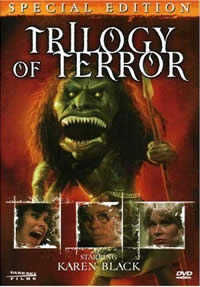
From Zombos Closet

Trilogy of Terror (1975)

Trilogy of Terror

Zombos Says: Very Good

The year 1975 was a banner year for horrorheads. Stephen King’s Salem’s Lot was chewing up the bookstalls, a hungry and demonic shark was chewing up anything that moved in Jaws, and the gender-bender Rocky Horror Picture Show, with Meat Loaf, was chewing on some tasty morsels of iconic horror like a bat out of rock and roll hell.

And on television, horror and terror were being introduced to a new generation of viewers by producer and director Dan Curtis. In 1967 he thought long and hard on his failing soap opera, Dark Shadows, and out of desperation tossed in a vampire to shake things up. Sure, when all else fails, call in the monsters.

It worked.

Dark Shadows, with the help of passionate and pathetic vampire, Barnabas Collins, grabbed the ratings like a banshee screaming in the wind. Like many boys in 1975, I became hooked with the goings-on at the decaying Collinwood Mansion, and I hurried home from school to watch each episode. I even took Barnabas as my Confirmation name. And while the priests thought I took the name of Saint Barnabas, one of the first prophets and teachers of the church at Antioch, I knew the truth.

Dan Curtis’ horror express sped into high gear after that, and the stops along the way produced some of the best terrorific television series and movies the genre has seen, heavily inspiring future fright-meisters and their cinematic and literary creations. He also had the good sense to work with one of the best writers in the field, Richard Matheson. Together they brought Trilogy of Terror to the small screens of millions of viewers in 1975, and created a diminutive image of horror that still brings chills and thrills today.

Originally conceived as a pilot for a television series, Trilogy of Terror takes three of Matheson’s stories, adds the talented Karen Black in numerous roles, and for an extra dollop of terror, peppers in a little Zuni Fetish Warrior doll with a hideous grimace of pointy teeth and a penchant for bloody mayhem. Throughout the three stories there is also the quintessential Robert Cobert music, so much associated with Dan Curtis’ gloomy cinematography.

While the first two stories, adapted by William F. Nolan, may seem cliche today, they were highly original back in1975. In the first, Julie, Karen Black plays a reserved, plain-looking English professor who unwillingly becomes embroiled in a sexual tango with one of her students. Or so it seems. In the second story, Millicent and Therese, Ms. Black plays two sisters at polar opposites in their personalities, and heading for a violent confrontation because of it.

Richard Matheson wrote the screenplay for Amelia, the third episode which is based on his short story Prey. And it is this story that stands out as an important and memorable entry in cinematic horror. Indeed, in the audio commentary provided by Nolan and Black, Nolan jokes how he was always congratulated for the Amelia episode—the one he didn’t write—when approached by fans. He eventually stopped telling fans he didn’t write it and just accepted their appreciation.

The story is that good.

Take a lone woman, psychologically battered by her mother, add a little present wrapped in a curiously odd-looking box for her anthropology boyfriend, and toss in a warning not to remove the little chain that holds the savage warrior’s spirit at bay, and you have a simple recipe for…disaster!

As the chain falls from the little, and hideously looking, doll, you know what’s coming. Curtis builds it slowly, with a little foreshadowing as Amelia cuts her finger on the very sharp spear the doll carries. After her bath, Amelia, dressed only in a bathrobe, notices the doll is no longer on the table. Curtis also changes the camera angle, and moves it lower to the floor, heightening our fears of what is to come. As Amelia reaches under the couch she again gets cut, and reaching further, pulls out the spear. Even with the lights on, her apartment is dark—Dan Curtis dark—and Cobert’s music hits its ominously strident tones.

Out of the corner of her eye, a shadow scampers across the floor. She begins to suspect something crazy is going on, and just before you can say ‘Zuni Fetish Warrior Is Alive!’ the lights go out, and the bolt on her front door is reshaped into a metal pretzel, trapping her in the apartment.

The first frenetic attack is sudden, loud, and brings her down to floor level as the little savage uses a knife swiped from the kitchen counter to stab her feet and ankles again and again. The rushing of the little doll, screaming as it relentlessly attacks her, is still amazingly effective and scary. Locking herself in the bathroom does no good, as the little monster is very resourceful. She tries to drown it in the bathtub, but that also fails. The scene, as it climbs out of the tub with the big knife firmly gripped in its mouth, borders on almost funny, but Curtis’ direction keeps this story deadly serious.

Karen Black, speaking in the Three Colors Black featurette on the DVD, describes the fear of vaginal entry that this episode plays on. She also mentions the humorous troubles the special effects people had in animating the little bugger. In the first attack, where she stumbles to the floor, she describes how they had trouble keeping the limbs on the doll as they rapidly pulled it along the floor. In the scene where it clamps down on her neck, she also describes how she had to hold onto it and act like it was alive and biting her. In the hands of lesser talent, this episode would have become a quirky absurdity; instead, it remains one of the most intense sessions in terror committed to the small screen. Interestingly enough, she explains that the dental work appearing at the end was actually her idea, which Dan Curtis did not agree with at the beginning. But it works well, and provides a lasting image of horror that speaks volumes even to this day.

Additional featurettes on the DVD include Terror Scribe, in which Richard Matheson talks about himself and the film, and the audio commentary by Karen Black and William F. Nolan. Dark Sky Films has done a wonderful job in releasing this horror classic again on DVD.

The Funhouse (1981)

Thefunhouse

Zombos Says: Very Good

Director Tobe Hooper, who did the unsettling Dance of the Dead episode for Masters of Horror on Showtime, as well as the family classic, Texas Chainsaw Massacre (1974)—insane family, that is—presents a not so pretty picture of carnival life, and a somewhat pathetic, definitely homicidal, disfigured monster with a penchant for temper tantrums.

The opening of the movie is a nod to Halloween and Psycho, and from there builds into a creepy story revolving around teen lust, sleazy carnival characters, and a ‘man-made monster that has needs like everyone else, but simply cannot satisfy them in more socially acceptable ways. A fascinating subtext running through the story is that it is a variation on the tragedy of Dr. Frankenstein and his monster. Here, the monster is one born of genetic mutation, as foreshadowed by the Freak Animals Alive tent exhibit, where the fetal brother of the monster floats in a jar as an abominable attraction for the hoi polloi.

In the movie’s opening sequence, the Frankenstein Monster is shown, first as a poster showing the Glenn Strange characterization (my favorite!), and then as a Mego doll—oh sorry, action figure—carried by the young Joey, whose sister soon curses him because of his bizarre prank that scares the wits out of her. Joey’s actions are also another subtext running through the movie: he dons a mask to become a monster that frightens his sister, and the actual monster wears a Frankenstein Monster mask to become less frightening to others.

It’s interesting to note that, unlike the current spate of horror movies that feature eye (popping)-candy and little else, in this movie the characters are presented with choices, yet consistently make the wrong ones. And as we all know, in a
horror movie when you make the wrong choices someone—or more likely everyone—winds up dead.

Amy, Buzz, Liz, Ritchie, and Joey consistently make the wrong choices, and suffer the dire consequences. In the tale of Dr. Frankenstein and his monstrous creation, wrong choices led to death and disaster; at least here we have the funhouse; iconic abode for numerous urban legends and rustic tales told over and over again around camp fires and sleep-over parties.

The funhouse is surrounded by the carnival, a seedy, grimy affair filled with seedy and grimy denizens. There is a bag lady that looks very much like Grandmama from the Addams Family spouting “god is watching you!;” a homeless man that wanders around like a zombie from Night of the Living Dead; a few bums; the past-her-prime fortuneteller and palm reader (Sylvia Miles); and the not so magnificent Marco the Magician and the carny barkers (three of them played by Kevin Conway as if he were a natural).

Properly toned by John Beal’s score and Andrew Lazlo’s moody cinematography, the loud and brightly lit carnival facade hides a darker, more primitive underbelly of murderous anarchy, repressed emotions, and dark secrets, with the funhouse as its nexus. Hooper’s use of two tracking crane shots, one at the beginning and one at the ending of the mayhem, emphasize this emanation of evil flowing first toward the funhouse, and then outwardly from it.

Our hapless group of victim fodder soon regrets their decision to stay the night in the funhouse, and Joey soon regrets sneaking out from his bedroom—down the trusty-trellis-by-the-window to visit the carnival. We also learn that the father of the monster has regrets about letting it live, in a scene that contains a wealth of hinted at backstory. Because of his decision he must share responsibility for its murderous actions, just like Dr. Frankenstein must share responsibility for his Monster’s subsequent actions.

Priming the coming mayhem, the fun-seeking and frisky teens decide to spend a night in the funhouse after closing time, and after the requisite fun-that-must-be punished-for scenes, they witness a murder, and promptly wind up stepping deeper and deeper into a big pile of no return. One of them makes another spur-of-the-moment bad decision, letting the wrong people learn about their presence in the locked funhouse. Scenes of carnage follow as one by one the teens meet their untimely and grisly death in 1980s horror fashion.

A particularly harrowing moment has our heroine calling to her parents through a large, wildly-spinning exhaust fan, but of course they can’t hear her because she is too far away—in the funhouse, where they specifically told her not to go. But they aren’t there for her; they are looking for their errant son Joey, who also disobeyed them. People who disobey or don’t listen or don’t read signs well in horror movies suffer dire consequences for their actions, and little Joey is no exception. His parents meet the shady and perhaps too-interested carnival handyman that found Joey sneaking around the tents. His actions are never quite clear, and Joey is strangely out of it so we never really know what
happened between him and the handyman, but whatever it is it’s hinting at unsavory.

The climactic confrontation in the mechanical belly of the funhouse is suitably horrific yet uses little gore, and unlike the requisite sequelization-antic of many fright movies today provides a definitive and satisfying closure. Unlike the simplistic snuff-horror by the numbers approach in today’s movies, The Funhouse explores dark themes and provides a story depth that is worth experiencing, along with the thrills and chills.

Scarecrows (1988)

Scarecrows

Zombos Says: Good

Listen to Movie Review

Scarecrows is one of those horror movies that with better acting and better direction, and a more coherent script, would be quite compelling as a good example of a horror movie. As it is, it’s still creepy with effective makeup and gore effects, and does manage to maintain its mood of unknown evil biding time in the corn fields. A plus here is there are no dumb—but pretty—teenagers getting offed one by one, just very dumb misbehaving adults, so there’s a refreshing change of pace you will enjoy at least.

Similar to the storyline in the movie Dead Birds, there’s a precipitating robbery, an abandoned spooky house in the middle of nowhere, and demonic evil happening without explanation, in and around that house. The future victims are shown witless enough to run around aimlessly before getting killed, one by one, in ways that you and I would have easily avoided.

Escaping in a hijacked plane with a reluctant pilot and the pilot’s daughter after a lucrative robbery, para-military crooks are double-crossed by one of their own: a very nervous guy named Bert (B.J. Turner). Bert’s first mistake is made when he jumps out of the plane with the big—and very heavy—box that holds all the stolen money, with no plan on how he’s going to carry it once he’s on the ground. Being the dumbest of the bunch, he’s murdered first, but not before he finds the Fowler residence, nestled snuggly amid lots of ominous-looking scarecrows perched all around the wooden fence that’s covered with barbed-wire and lots of warning signs saying “stay away.” The weird weathervane on the roof, with the pitchfork and pteradactyl, is a clear sign this old homestead is more deadstead than homey. Bert makes his second mistake when he ignores all the warning signs.

Until he’s murdered, we hear what he’s thinking through his very unnecessary voiceover as he, way too easily, comes across the key to the decrepit truck in the yard. He hoists the box onto the truck and makes his getaway. Sure, why not? Decrepit trucks lying dormant for years in yards always have lots of gas in them, especially with today’s prices, and car batteries last and last, right?

Although he wears night-vision goggles to walk through the foliage and find the house, he TAKES THEM OFF to drive the truck away and TURNS ON the headlights instead to see where he’s going. The rest of the crooks, still circling in the plane, spot the headlights.

Brilliant. He deserves to die he’s so stupid.

I’m not sure why he needed night vision goggles in the first place since every scene is brightly lit, from the interior of the plane to the night-time scenery, even the house. The cinematographer was either myopic or recently graduated movie school, or he had to deal with really cheap moviestock and a skimpy budget.

Bert meets his demise when the truck dies in the middle of nowhere and the scarecrows get him. One nice touch, and there are a few of them, is when he opens the truck’s lid after stalling out. I won’t ruin the hair-raising surprise, but any fan of American Pickers on the History Channel will pretty much know what to expect with rusting derelict trucks.

The story-sense, what less cinema-minded people call common sense, falters when dead and stuffed-like-a-flounder-with-straw-and-stolen-loot-Bert returns to the house. The rest of the crooks rough him up, then realize he’s gutted and stuffed like a flounder. Dead Bert manages to put up quite a fight, grabbing one fellow by the mouth and pushing him through a window, causing him to bite off more than he could chew in a gorylicious scene to savor. At this point, faced with an obvious supernatural threat, you’d think the crooks would be racing out of the house and back to the plane pronto. Instead, they stay to look for the rest of the money, even if one of them complains “Bert was walking around dead, for chrissakes!”

The stolen money suddenly appears on the ground outside the house, and the crooks—being greedy and all that—go for the bait without stopping to wonder how it got there. One of them is cornered by the scarecrows, and with a dull handsaw, they make him less handy. Now dead and gutted himself, Jack (Richard Vidan) returns to the house and attacks the remaining crooks.

If you listen closely to Jack’s demonic growl you will hear the same monster-growl heard often in the Lost in Space TV episodes.

The last two survivors finally get smart and run like hell back to the plane.

But that doesn’t help.

For a B-movie, Scarecrows is more C than D. Still, the surprising amount of sustained dread and the 1980s evocative eeriness many of the scenes hold to the finish are worth a look-see. Especially on Halloween.

Sin-Jin Smyth’s Ethan Dettenmaeir

Hangman_2With a mysterious title like Sin-Jin Smyth, and a talented cast that includes Roddy Piper and Jeff Conaway, this is one horror film high on my must-see list. Here’s the synopsis: Sin-Jin Smyth takes place over Halloween weekend. Two Federal Marshals receive orders to cross the state border to the small town of Shin Bone, Kansas in order to transfer a prisoner during a tornado warning. Nothing is known about the prisoner except his name: Sin-Jin Smyth. The film is based, in part, on an old legend that tells of the Devil appearing simultaneously in the high plains of India and a quiet cemetery in Kansas at midnight on Halloween.

I wanted to find out more about the creative force behind this upcoming horror film slated for October release–writer and director Ethan Dettenmaeir, and here is the interview we recently had. You can also check out Sin-Jin Smyth at Wikipedia.