From Zombos Closet

Graphic Book Review: Young Howard Lovecraft
and the Frozen Kingdom

Lovecraft and the Frozen Kingdom Zombos Says: Good (but is it Lovecraft?)

Blasphemy? Heresy? Bruce Brown and Renzo Podesta are treading very thin ice by making the anglophilic cosmic horror of Howard Phillips Lovecraft palatable for kids in the graphic novel Howard Lovecraft and the Frozen Kingdom. Or perhaps, by their adolescent-themed story based on Lovecraft's Mythos they may instill a fresh appreciation of those eldritch horrors that have become the first base and potent home run in much of horror fiction? Perhaps. But missing in the atmosphere created by their words and illustrations are the Gothic Noir and Rococo stylings–the stiffly starched shirt, rumpled cuffs verbiage Lovecraft is either praised or damned, but always noted for.

Drawing on Lovecraft's own tragic childhood, young Howard, in the company of his mom, pays a visit to Butler Sanitarium to see his raving mad dad. His father comes out of delirium long enough to implore Howard not to read that book, you know, the quintessential one that keeps getting every acolyte, neophyte, and unfortunate slub stepping into Lovecraft-land into terrible trouble. Here, it is his father's hand-written journal, containing the fruits of his occult explorations. Howard's mom, ironically, dumps that book into his little hands that same night for some bedtime reading enjoyment.

Interview: On Writing Horror With Lee Thomas

Lee Thomas Author

Author Lee Thomas writes horror, queer horror, slightly bent horror, and more than horror. If you've read his I'm Your Violence short story in Unspeakable Horror: From the Shadows of the Closet, I don't really need to tell you how he writes it. In that story he brought guilt, retribution, pasty gore, and gruesome death from under the pillow, leaving a nasty stain of reflection to think about. 

In an interview you said writing has always been a part of your life. Why is that?

I'm not sure of the "why" of it. It probably had something to do with childhood insecurity. I wasn't (and am still not) very comfortable around people, and I didn't express myself well verbally; but if I had the opportunity to write an idea down and tinker with it, I was able to convey my thoughts with some form of clarity. In the third grade I wrote short stories and puppet show scripts. I wrote my first novel when I was sixteen. It was a really bad werewolf novel and the character names kept changing, but a lot of it ended up informing my first published novel, Stained.

Though I've been writing most of my life, I didn't really try to sell my work until about eight years ago, and since then I've seen dozens of my short stories published, along with 10 novels (for adults and young adults) and a handful of non-fiction pieces.

You like to write horror fiction: tell us about your monsterkid influences as you grew up, and how they affected your writing.

I think my first exposure to horror was catching Frankenstein on television. There was that moment when the "monster" turned to the camera from a doorway and it scared the hell out of me. I liked it. So, I spent a lot of time looking to repeat that thrill. I watched anything with a creature in it, from Hammer films to Toho giant monster flicks. When I started reading "real" books, around 10 or 11 years old, I jumped in head first, reading Stoker's Dracula, Blatty's The Exorcist, and anything else I could get my hands on. Then I was exposed to James Herbert and early Stephen King, and a whole slew of really awful mass-market novels, some of which were brilliantly bad.

The older I grew, the more discriminating I became in what I read, and the sheer pulpy fun of the bulk of those mass-market titles took a backseat to more accomplished writing with greater depth of character and intricacy of plot (a la Peter Straub). Then Barker came along and brought a different sensibility to the genre that blew me away. Joe R. Lansdale was another great influence. In my own writing I keep trying to find the balance between intellectual and emotional engagement and the extremely fun gut-punch of the pulps I loved as a kid. One of these days, I'll get it right.

What is your daily routine for writing?

Oh that I had one. I've been writing full time for about 5 years now, but no pattern has emerged, except that I wake every day intending to write and I usually get something done everyday. Sometimes my entire day's production will take place before noon. Other times, I need some TV, reading or video game action to wake the brain up, so it might not be until afternoon or evening before I get to work. Some projects, like The Dust of Wonderland, come in a flood and I'm obsessed from the time I wake up until I crash, and I spend every available minute on them. Others move at a more leisurely pace. If I'm researching, which I've found I enjoy, a whole day can pass as I follow one thread of
information to another.

dust of wonderland Really important question: having grown up in Seattle, are you a tea or coffee drinker?

Coffee. Morning, noon, and night. There aren't enough hours in the day for all of the coffee I want to drink.

Which authors does Lee Thomas read and why should we read them too?

I covered the early influences above (and I'm still reading most of them). I discovered Thomas Tessier, Graham Joyce, and Jack Ketchum more recently (in the last 10 years or so), and I've gone back and devoured their work. Newer authors I enjoy include Joe Hill, Tim Lebbon, Sarah Langan, Brian Keene, Tom Piccirilli, Laird Barron, Gary Braunbeck, Jim Moore, David Wellington, and a handful of emerging folks like Nate Southard, Joe McKinney, Paul Tremblay, John Langan, Nick Kaufmann, Joel Lane, and others I'm sure I'm forgetting.

Outside of genre I'm reading James Lee Burke, Russell Banks, Michael Cunningham, Armistead Maupin, John Irving, Ken Bruen, and going back, as I always do, to Hemingway, Steinbeck, Capote, and Baldwin.

What about horror movies?

Wow, just about everything, from ultra-bad slashers to brilliant mind-screws. Universal classics, particularly The Wolf Man; Hammer Studios; Italian horror from Bava, Fulci, and Argento; The Evil Dead trilogy; The Exorcist; The first few Romero zombie films; Carpenter's The Thing, Halloween, and The Fog; Stuart Gordon's work (with a soft spot for his film Dolls); about one-third of Wes Craven's films; a good amount of Asian Horror with big love for Ringu, Ju-On, and Cure. Of the recent spate of remakes I've enjoyed My Bloody Valentine 3-D, Friday the 13th, and Dawn of the Dead.

parish damned What does it take to become a successfully published author in today's market?

I imagine it takes what it always has: hard work, which includes pushing yourself to improve your craft; persistence in sending your work out; and a bit of luck in getting the right story in front of the right eyes (which can be managed through persistence). Beyond that it can take a good amount of patience. This is the thing that's tough for a lot of new writers to get their minds around.

Authors sign bad–sometimes pure-crap–deals on their work just to have it out there fast (I know I did early on). This does them, their careers, and their readers a great disservice. Granted some authors have found short cuts with online publishing, podcasting, self-publishing, and other new media, and for some it has translated into success, like Monster Island author David Wellington who first published his books as blog posts. Eventually the publishing dynamic is going to shift dramatically as a result of new media, but right now, the traditional route to publication is still firmly in place, and that means an author may have to wait a very long time to see his/her work reputably published.

What can we expect from you in the future?

My short story collection, In the Closet, Under the Bed, which collects 15 of my queer-themed short stories, will be out December 15th from Dark Scribe Press. I'm thrilled about this one; it's a unique horror collection to be sure. Plus, I have some new short stories coming out, including "Nothing Forgiven," which will appear in Darkness on the Edge from PS Publishing, and "Inside Where It's Warm," a zombie story I wrote for a forthcoming anthology edited by Joe McKinney.

There are a couple of others I can't talk about right now. My novella The Black Sun Set will be released next year by Burning Effigy Press out of Canada, and a novella collaboration I did with Nate Southard called Focus will also be hitting in 2010. Other things are in the works but I can't comment until contracts are signed.

Meet the Horror Bloggers:
Zombies Are Magic

Zombiesaremagic Many fans of horror, amateur and professional alike, have devoted themselves to blogging about the thrills, chills, and no-frills side of the genre as seen in cinema and
print. In this ongoing series that highlights the writers behind the blogs, we meet the unique personalities and talents that make the online horror scene so engaging. Up close and personal.

In this installment, Jennifer from Zombies Are Magic tells us how how a zombie helped her escape hearing Tevye sing in Fiddler On the Roof, leading to a life-long passion for sleeping with the lights on.


My first “horror” memory is rather embarrassing, but pretty accurately sums up my love/hate relationship with the genre. I was 4, and my Mother had dragged me to the
movies to see the re-release of Fiddler on the Roof. While standing in the lobby waiting for her to get popcorn I became captivated by the poster for Dawn of the Dead. It was the classic poster, with the head emerging from the earth and the tagline “When there’s no more room in HELL the dead will walk the EARTH.” The image thrilled and terrified me. As my mother dragged me into the theater tears started streaming down my face; not because I had to watch Fiddler, but because I knew the bad monster from poster was going to come and get me. I remember staring at the floor of the theater, just waiting for that head to pop out. The fit I threw was so epic we were asked to leave before Tevye got to singing “If I were a rich man.” As my poor Mother apologized to the Manager I remember thinking: I want to go back. I want to go see that monster. This was the start of a life-long fascination with Zombies and a good ten years of sleeping with the lights on.

Zombies cat I am no horror expert. In fact, what I don’t know about horror could fill a stadium. But I am a fan of all aspects of horror culture, from film to television, literature to music. Since that day at the theater I have loved to be scared. Luckily, my Parents loved horror films, and they pretended not to notice when I sneaked into the living room while they were watching the latest Friday the 13th or Nightmare on Elm Street flick. They even comforted me when I woke up crying in the middle of the night convinced the strange guy from the Halloween movie was standing outside my window.

As I grew up, my attraction/revulsion complex about horror turned into a deep, abiding affection, beginning with the Universal Horror marathon I watched on Turner Classic Movies one Halloween. I was home with the flu and I only had Dracula, Frankenstein’s Monster, and the Mummy to keep me company. I remembered these films from my childhood, but I had forgotten what an impact they had on me. This led me to revisit many of the horror films I watched growing up. Most of them made me laugh. A few, like Halloween, still scared me. And then I re-watched Night of the
Living Dead
. Alone. On a stormy night. I had Zombie nightmares for a week. Instead of running to the shrink I decided to embrace the genre.

Films led me to literature, and I discovered that, like Romero, Lovecraft could also keep me up all night. I was in love. There was no turning back.

Zombies are Magic! didn’t start as a horror blog, but I seemed to get a better response to my “stream of consciousness” reviews of horror films than I did to the endless pictures of my cat. My horror bi-curious friends encouraged me to keep writing, and my understanding, “not a huge fan of horror” husband relinquished rights to the television so I could watch things like Cannibal Holocaust. Now, after fully turning to the dark side (sorry cat) I am so proud to be a part of this awesome horror blogging community. Like many of my fellow bloggers, I am waiting to be really scared again. I haven’t given up hope that the next film I see or book I read will make me feel like I did that day when I was 4 years old: scared out of my mind and all the better for it.

Books For Horror Movie Bloggers

Einstein show Right off the bat I can tell you the one thing you don’t want to get that horror movie blogger on your holiday shopping list: movies. Yes, that’s what I said. Movies.

Sure, they seem like they would go together like bread and butter, Starsky and Hutch, and vampires and romance, but let’s face it, if a horror blogger is worth his or her salt, movies are already piled high all around within easy viewing reach. The last thing any horror movie blogger needs is another movie to add to the pile!

So how about giving that special someoneotherwise known as always difficult to get gifts for–something really useful: something they will really appreciate and actually use to hone their skills; something that will even benefit their readers: books on movies.

And not just horror movies, mind you, but books on all-around movies. Books to broaden knowledge of the cinema, its history, its craft, and its always present commercial side, which impinges on the history and craft sides, sometimes to wondrous result, many times not.

Here’s an essential bookshelf’s worth of reading and reference any smart horror movie blogger would appreciate having in his or her critique la arsenal before letting the slinging arrows of outrageous commentary fly:

Comic Books for Horror Fans Gift Ideas

Scary Christmas Here is a list of gift ideas for that comic book fan in your life. You know, the nephew you thought would love Peanuts and Calvin and Hobbes because that helpful patron in Borders–the one who thought Myra Breckinridge was a cook book author–insisted he would. Now you know better.

No need to check over this list twice; every book is a surefire winner that will light up the holiday for any devout comic book reader, especially the horror-minded ones.

Z3599 1000 Comic Books You Must Read
by Tony Isabella

Starting briefly with Superman in the 1930's, then into the Fighting Forties, Tony Isabella provides cover shots and brief synopses of many notable issues categorized by decade up to the present. Archie and Millie the Model, super heroes and horror mix it up in a sumptuous memory lane experience for older fans (like me) and a wonderful, if-you're-so-smart-what-about-that-issue, reading list for younger ones (like me, too). Some older issues will, of course, be harder to find by themselves, but with so much of historical and reading interest being reprinted today in archived volumes, it's becoming easier to catch up on all this sequential art goodness.

Swampthing Saga of the Swamp Thing, Books 1 and 2
by Vertigo and DC Comics

Horror never had it so good until Alan Moore decided to explore its elements in Swamp Thing. I recently received Book 2 from DC Comics for review. With Moore's depth of storyline and penchant for bringing in familiar DC characters, and Stephen Bissette and John Totleben's expressive illustration gallivanting across panels–and printing it all on superbly non-slick, dull, pulpy paper to retain the original sense of coloration and tactile nuance, this hardcover edition, along with Book 1, is essential reading for any horror comic fan.

15819 Boris Karloff Tales of Mystery, Vol. 1
by Dark Horse Archives

This hardcover archive collects the first four issues of Boris Karloff Thriller retitled to Boris Karloff Tales of Mystery. Sara Karloff provides a brief introduction and bios of the creative people involved are included. Confined to static panels, five per page, the artwork is a tidy balance between adequate story-telling and heavy-inked momentum. The stories come with morals or little twists of fate. Boris the Uncanny introduces each one and sums up the lesson afterward. Not overly scary or expressively artistic, this volume will either bring back delightful memories for older fans or provide a good example of what bread and butter comic art and story are all about for others.

Readingcomics Reading Comics: How Graphic Novels Work and What They Mean
by Douglas Wolk

For the hardcore comics fan who's not squeamish about exploring what lies under the panels, Wolk's book will irritate, infuriate, and possibly elucidate. Agree or not, you will find plenty of reading-list material here, many thoughts to ponder or pummel, and inspiration to delve more deeply between the lines or write that great American graphic novel and put Alan Moore to shame.

Walkingdead The Walking Dead Compendium, Vol. 1
by Image Comics

Run, don't walk, to add this baby to your comic fan's Christmas stocking or gift basket. Just measure the stocking or basket first; this book is big, heavy, and filled with enough zombie mayhem, soap opera nuance, and humanity to keep anyone up all night. Without color and tights, it's amazing how much power and terror Robert Kirkman, Charlie Adlard, Cliff Rathburn, and Tony Moore can quietly generate in this us-against-them-and-us series. Volume One collects the first 48 issues in a hefty softcover format that's easy to read and retains the gory black and white illustration in all its glory. Larger formats and hardcovers are available, but having all these issues in one book is a reading pleasure and a great way to introduce someone, who is not familiar with the series, to The Walking Dead.

Dylan dog The Dylan Dog Case Files
by Dark Horse Comics

Seven stories in digest-sized format fill close to 700 pages in this compendium of Italy's supernatural detective Dylan Dog (though he lives in London). Written by Tiziano Sclavi and illustrated by various artists, anyone who has seen the movie Cemetery Man already has a sense of the surrealism and classic horror Sclavi brings to the comic. Being Italian, Dylan Dog is a romantic, although he can never seem to hold onto any of the women he meets from story to story. Maybe it's the annoying screaming doorbell to his flat on Craven Road that keeps them away. The black and white art rarely strays beyond the 5 or 6-panel pages, but it's crisp and vibrant; and filled with Dylan Dog's phobias, untidy habits (though he does play a mean licorice stick), and monsters.

Meet the Horror Bloggers:
Black Hole Reviews

Black hole reviews Many fans of horror, amateur and professional alike, have devoted themselves to
blogging about the thrills, chills, and no-frills side of the genre as seen in cinema and print. In this ongoing series that highlights the writers behind the blogs, we meet the unique personalities and talents that make the online horror scene so engaging. Up close and personal.

In this installment, Mark from Black Hole Reviews reveals his appetite for horror, yokai, anime, and more.


I feel a little guilty sneaking into the pantheon of horror bloggers. While horror is my favourite genre, my blog isn’t that specialised. Probably a bad thing, because it’s not easy to describe or categorise. The Black Hole is me devouring as many movies as possible. It’s also the well that Sadako fell into in Ring. But I once considered splintering the blog into different subjects. I don’t think that many people live exclusively inside the genre all the time. I want to suggest a wide range of relatively obscure movies as an alternative to the big three in the cineplex every week, those that will live on endlessly repeated on TV. Whether they’re good or bad. I want to offer up weird, unusual, shocking, dark, mad movies – that are interesting and entertaining.
Why don’t you watch some of these instead?

On Boris Karloff the Uncanny

Boris karloff It was a truly classic performance–the monster was no monster, but a pathetic, confused creature caught in a situation it couldn't comprehend. Karloff portrayed all this with marvelous pantomime, restricted as he was to a series of grunts and despite the handicaps of his heavy costume. "Whale and I both saw the character as an innocent one," he later said, "and I tried to play it that way. The most heart-rending aspect of the creature's life, for us, was his ultimate desertion by his creator. It was as though man, in his blundering, searching attempts to improve himself, was to find himself deserted by his God" (John Brosnan, The Horror People).

As I thought about what I would write for Frankensteinia's Boris Karloff Blogathon, I found myself reading through the titles in my library for inspiration in choosing a subject worthy of such a momentous project. Perhaps I would review one of Karloff's important films? I thought. I've only scratched the surface of his noteworthy acting career with my reviews of Frankenstein, Bride of Frankenstein, Son of Frankenstein, and The Mummy. Then I thought maybe I would examine  Karloff's extensive work for television, which would include, of course, Thriller, the anthology series of horror and suspense I still vividly recall scaring the bejesus out of me, and its spin-off into comic book format as Boris Karloff's Tales of Mystery (recently reissued by Dark Horse Comics). As I thought about it some more, I realized the books I paged through, the ones I often pull from the shelf when I am thinking about Karloff or classic horror, in preparation for writing a review, might be noteworthy to mention.

Meet the Horror Bloggers:
Dr. Gangrene’s Tales From the Lab

Dr_Gangrene Many fans of horror, amateur and professional alike, have devoted themselves to blogging about the thrills, chills, and no-frills side of the genre as seen in cinema and print. In this ongoing series that highlights the writers behind the blogs, we meet the unique personalities and talents that make the online horror scene so engaging. Up close and personal.

As a special treat for Thanksgiving, noted horror host Dr. Gangrene of Tales From the Lab mixes up a wonderful formula of weirdness with all the dressings.

It’s hard to say exactly when the horror bug bit me. For as long as I can remember I just always seemed drawn in that direction. I know for a while I worried my parents. I seemed obsessed with the dark side of life. If I went to the library I came home with books on ghosts, or Poe, or the supernatural. If there was a Horror or Science-Fiction
movie on TV I always wanted to watch it. My best friends were comic books and cartoons. I just wasn’t “normal.” But then who is, really?

Thinking back on it, the biggest influences on me were things that I encountered
in my youth. When I was a kid I was in Boy Scouts (this was in the early seventies). At one Scouting event we met local Nashville horror host Sir Cecil Creape. I have some vague memories of this (I was probably around 7 or 8 years old at the time (1st or 2nd grade). Everyone there received a patch that said “Sir Cecil’s Ghoul Patrol.” I still have that patch to this day, and in fact the first
thing I did when I started my own horror host program was to sew that patch onto my lab coat in homage to Sir Cecil Creape. But I’m getting ahead of myself…

Comic Book Review: Victorian Undead 1
Sherlock Holmes vs. Zombies

Victorian_undead Zombos Says: Good

The game's afoot once again for Sherlock Holmes and Dr. Watson, although this time around it is much gamier; downright putrid, in fact. Not so elementary zombies are prowling the fog-bound streets of London in this steampunk and Inverness coat-dressed pastiche from author Ian Edginton and illustrator Davide Fabbri.

In Part One, The Star of Ill-Omen (Issue 1 of 6), Holmes and Watson are brought into the investigation of peculiar and inexplicable events occurring around Baker Street by Inspector Lestrade. In the opening pages, Holmes tangles with an adversary well-versed in the scientific arts of automata–a certain Professor perhaps?–while a green comet sets the stage for the undying detective to meet the undead, who are becoming more common on the streets than hansom cabs.

The story moves quickly, leaving enough mystery to hold promise. The artwork is adequate, but lacks the edginess the world's first consulting detective and his vibrant London warrant. The scenes of 221b Baker Street are perfunctory, and Holmes' visage and dress borders on the dashing; unusual for someone of his spontaneous and somewhat untidy habits. The color palette used for London is also far too chipper.

But this is Holmes and Watson against zombies, a capital idea; so I anticipate an exhilarating adventure grander than his encounter with the Giant Rat of Sumatra.

Review copy courtesy of Wildstorm/DC Comics.

Meet the Horror Bloggers:
The House That Dripped Blog

house that dripped blog Many fans of horror, amateur and professional alike, have devoted themselves to
blogging about the thrills, chills, and no-frills side of the genre as seen in
cinema and print. In this ongoing series that highlights the writers behind the
blogs, we meet the unique personalities and talents that make the online horror
scene so engaging. Up close and personal.

In this installment, Jake from The House That Dripped Blog tells us why he never watched a horror movie to be scared.


Let me begin by asking if any readers out there have any knowledge of a film called Mole Men of Morocco. This film featured blue hands reaching out from cave walls and grabbing unsuspecting explorers. It was the scariest film my grandfather ever saw. Or it was a figment of his imagination. Stories like that created a world of horror entertainment that I could only dream about.

My grandfather, like everybody else I am related to, grew up in a small town in Virginia. Mike Starr’s great explanation of marketing in Ed Wood was accurate—the South loves crap like this. My grandfather would tell stories about seeing Tana leaves brewed up for Kharis, about the English policeman squishing a mewling half-Canadian/half-fly, and about Raymond Burr in the original-ish Godzilla. This last drive-in tale particularly captivated me because Godzilla had been an obsession since I can remember.

Meet the Horror Bloggers:
Monster Land

Monster_scholar Many fans of horror, amateur and professional alike, have devoted themselves to
blogging about the thrills, chills, and no-frills side of the genre as seen in
cinema and print. In this ongoing series that highlights the writers behind the
blogs, we meet the unique personalities and talents that make the online horror
scene so engaging. Up close and personal.

In this installment, monster scholar Jeanette Laredo of Monster Land reveals how she overcame her fear of horror movies and discovered the rich vein of horror literature.


My love affair with horror cinema is a fairly recent one and unlike some of my fellow horror bloggers, I wasn’t really exposed to horror films as a kid. I was never traumatized by Linda Blair’s spinning head or haunted by nightmares of Freddy Krueger and his nifty bladed gloves. Instead I was raised on Nick at Night’s weekly lineup of wholesome shows like Mork and Mindy, Dick Van Dyke and I Dream of Jeannie. The nearest I got to experiencing horror in my youth was watching Goosebumps, Are You Afraid of the Dark? and the odd episode of Unsolved Mysteries.

I got my first real brush with horror my senior year of high school. I was taking dual credit courses at a community college when I met my best friend Stacy. Stacy was a theater student and an avid fan of horror, something that struck me with awe and admiration. I remember once she was reading Poppy Z. Brite’s Lost Souls back stage when another actor asked to take a look. She handed it over cool as anything at a time when I was embarrassed to be seen reading Laurel K. Hamilton in public.

Stacy tried many times to lure me to horror’s dark side with films like Re-Animator, Evil Dead and Night of the Living Dead, but I refused to watch anything more hard core than Tim Burton’s Frankenweenie.

That was until we went to a screening of Rob Zombie’s House of A Thousand Corpses. I fought the urge to bolt as the lights went down in the crowded theater and the screen in front of me filled with bloodthirsty psychos, rotting corpses and killer clowns. I watched the movie from between clenched fingers and tried not to scream uncontrollably as Dr. Satan vivisected his teenage victims. I don’t remember getting home or crawling into bed, but I lay awake half the night petrified that the Firefly clan was going to get me.

Needless to say, my relationship with the genre was one of love/hate, and for the next few years I avoided horror with exception of a few films like Saw and Hostel. Nerdily enough, it was my academic career that turned horror around for me.

My current appreciation of horror stems from my academic experience with two fantastic professors. As an undergrad, my interest in monsters flowered thanks to Barbara Vielma and her classes on the Literary Vampire and Monsters in Literature. I had hit the monster jackpot and I devoured the works of Frankenstein, Varney the Vampyre, Dracula, Jekyll and Hyde and The Beetle. I made up my mind then that I wanted to study monsters and I immersed myself in exploring their stories and the fears they represented.

This love for monsters in literature was translated into film when I took a graduate class with Harry M. Benshoff, author of Monsters in the Closet: Homosexuality and the Horror Film. The class was Gender and Sexuality in the Horror Film and it made me realize that there was so much more to horror than just fear. I think the light bulb went off when we were watching Peter Jackson’s Dead Alive as an example of a postmodern horror film, complete with in-jokes and over the top gore. As I watched the scene where Lionel dispenses of the zombies with a lawn mower, it was like the magician’s trick had been revealed and I didn’t have to be afraid anymore.

In that way my analysis of horror texts can be considered my own special coping mechanism. When I found that I could examine horror instead of simply being scared by it, I felt I could face the monsters instead of losing sleep over them.

Monster Land was born out of this impulse, as well as a desire to think critically about horror films and literature. Through the wonders of the Internet, including e-mail and Twitter, I have become part of a large community of devoted horror fans who have made me feel at home in my study of the genre. The amount of support I’ve received from readers and other bloggers is staggering, and I’m constantly amazed that other people care about what I have to say. So stay tuned monster devotees, because there’s plenty more where that came from.

Ghost In the House of Frankenstein Part 3
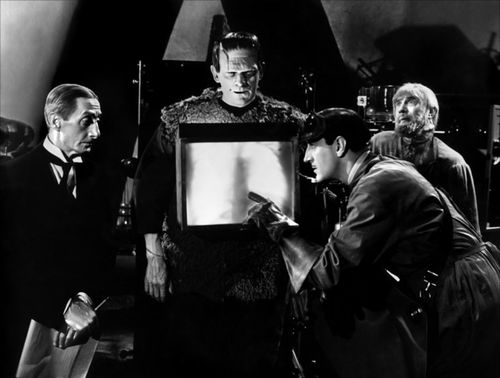
Son of Frankenstein (1939)

BORIS KARLOFF son of frankenstein
Part 2: Bride of Frankenstein (1935)

“Your pants are
talking,” said Wally the Bat.

“What…oh.” I
reached into my pocket for the two-way radio.

“Zoc? Zoc? Where
are you?” It was Zombos’ voice. He sounded frantic.

“Yes, what is it?
I'm still…” I looked at Wally. “…I’m still in the attic.”

“It is your—” 

A bolt of
lightning flashed close to the mansion, quickly followed by a thunderous boom.
It shook the dormer window open again.

“What’s that? I
didn’t hear you,” I said through the static.

The door to the
attic flew open. A tall, slim silhouette glided ominously through the door
frame and headed toward me.

“It is your
sister!" said Zombos. "I tried to warn you. She is—”

“Iloz! Where the
hell are you?” she loudly asked. "This place is a mess. What the hell is
taking you sooooo long. Ouch!" She tripped in the gloom. "Where the
hell are the lights? I can't see a thing."

Wally the Bat,
startled, squeaked as he rapidly unfurled his wings. “Time to go! It's been a
real pleasure.”

He flew out the
dormer window. I closed it behind him, wishing I could do the same. My sister
Trixie was coming closer.

 "You're all wet! Well,
don't stand there like a cow," said Trixie. "Everybody's waiting for
the birthday boy." She took me by the arm and alternately pushed and
pulled me downstairs.

"Here he
is!" announced Trixie as she pushed me into the drawing room. Everyone was
gathered around Chef Machiavelli and his serving cart. He held a large cake
knife poised at the ready. My birthday cake shimmered beneath the flames of
numerous red candles. Ace of Cakes would have been jealous. 1313
Mockingbird Lane was represented right down to the crooked bat weather vane.

"I don't
recall the Grim Reaper appearing in any Munsters
episode," I said, noticing the hooded scion of death standing, scythe
poised at the ready, on the little dilapidated porch. 

"The Grim
Reaper is my idea," said Trixie. "I thought you would adore it. Well,
go on. Hurry up and blow out the candles."

"Marilyn
Munster I adore, Grim Reaper not so much. Don't rush me. I'm savoring the
moment. You don't turn fifty-two more than once, you know." I sucked in a
long breadth, took aim at the little plastic Grim Reaper, and blew out the
candles. He held fast. Damn.

"How does it
feel being fifty-two?" asked Zimba, pulling a candle out to lick the
icing.

"A lot like
fifty-one, only older," I replied.

The number fifty-two: it's
the atomic number of tellurium. It's one of the tombstones in
 Goth: The Game of Horror Trivia. The Mayan Calendar moves through a
complete cycle every fifty-two years. At age fifty-two, Alfred Hitchcock
directed
 Strangers on a Train. At fifty-two, Boris
Karloff played the Frankenstein monster, in earnest, for the third and last
time in
Son of Frankenstein.

"What were
you doing stumbling around up there?" asked Trixie as she helped remove
the candles.

"Zombos
thought he left his–"

"Oh, let us
not start this again," said Zombos. "I clearly remember I did put it—"

"Hush,"
said Zimba. "You'd forget where your own head was if it wasn't bolted
on." She pulled out the last candle. "Let's cut the cake!"

"I can help
with that," volunteered Trixie. Before I could stop her she snapped her
fingers. Instinct took over and I ducked just in time. The cake split open down
the middle, sending the Grim Reaper high into the air along with most of the
cake's hazelnut icing. Zombos was standing closest to the calamity. Zimba
handed him a napkin to wipe the icing off his glasses as he removed the Grim
Reaper, now stuck in his hair.

"Oops. Sorry.
I thought I had that spell down pat." My sister's witchery skills always
did leave much to be desired.

"So. How  are those lessons coming along at
the Witch Finders School of Cauldronic Arts? asked Zombos.

"Never mind,
dear," said Zimba. "No harm done." She gave Zombos her always
persuasive stare-of-Medusa and he kept quiet. "Let's get comfortable by
the fire while Rudolpho puts more frosting on the cake."

Only Zimba called
Chef Machiavelli by his first name. Mostly because only she could keep a
straight face while doing so. Rudolpho wheeled the cake back to the kitchen as
we made ourselves comfortable by the fire.

Lightning still
flashed now and then across the large windowpanes, and streams of water ran
pell-mell across the glass. The roaring flame on the grate lulled me with
thoughts of torches held high by beleaguered villagers chasing down the
Frankenstein Monster, again and again…


…Lightning,
dreary, near endless, drizzle, and beleaguered people play their important parts
in all the Frankenstein movies. It took
four years after Frankenstein to make the lonely Monster a reluctant mate
in Bride of Frankenstein, and another four years for Wolf Von
Frankenstein to take on his father's less than stellar work habits in Son
of Frankenstein
to restore
the Monster's health.

Boris Karloff
returns as the Monster, but he is a ghost of his former self, playing a lesser
role as foil to Bela Lugosi's
indelible performance as another equally undying monster, Ygor. Finally, the
Monster has found a friend, although a homicidal miscreant one with a penchant
for black humor.

With Basil Rathbone as the effusive Wolf Von Frankenstein and Lionel Atwill as the studious Inspector Krogh playing to
the rafters, Lugosi's Ygor takes center stage this time around. Karloff
realized his beloved creation had become just another fixture in the mad
scientist's lab, like the glassware and electrical apparatus, providing the means
but no longer the method to an end: Frankenstein's Monster, truly given life by
Karloff the Uncanny's emotive portrayal, had been reduced to mere appliances
and neck bolts anyone willing to undergo the grueling makeup process could
wear.

The humanity and
soul-stirrings of Frankenstein's creation were not the only things left out in
subsequent movies. Any dichotomy of nature versus nurture, dialectic regarding
the balance between responsibility and determinism, and all displays of
sympathy gave way to a plot gimmick that begins in Son
of Frankenstein
and
continues through Abbot and Costello Meet Frankenstein:
since the monster's brain is bad, he is bad; replace his brain with a good one
and he becomes good. But first, like a drained rechargeable battery, he must be
powered up to full strength through his bolt-like electrodes before the operation
can take place.

The role of the
Monster was not the only thing that changed.

Son of Frankenstein stands as the bridge spanning the
ambivalent melancholia and mania of James Whale's and Todd Browning's Gothic
night sweats to the slick-slacks, neatly cleaned-and-pressed, B budget trimmed
finery of Universal's front-office controlled monster package for a new decade
of movie-goers versed in the realities and hardships of World War II. But it’s
an impressive bridge, nonetheless, thanks in large part to four consummate
actors playing horror for all it was worth and then some.

The placeless-ness of Universal Studios' Grimm's fairy
tale-like world of monsters and madmen is strongest here. The train that Baron
Wolf Von Frankenstein and his family travel on to the cursed village of his
father—which, oddly enough, is now named after the man who brought so much
misery to it—seems modern enough; until it passes through a particularly dark
and dreary landscape of withered, gnarled trees and the Baron and his family
arrive at their destination. Mel Brooks in Young Frankenstein plays off
this stark change from present day to not-quite-sure-when-or-where for laughs,
but it is this blurring of past and present, an abstract recognizability, which
makes Universal's horror canon so appealing, even though it was probably driven
more by script and budget and global market necessities than artful construct.

In these first few
minutes we've crossed into a distorted, unhealthy landscape and unpleasant
climate, where technological and agrarian artifice mingles with the arcane;
where people dress in both contemporary and quaintly antiquated, but
nondescript, clothing, and where mundane laws of continuity from movie to movie
no longer need apply. Here be villains, heroes, and those caught between the
two, walking through shadows, strutting and fretting their fears, triumphs, and
downfalls on a timeless stage that leers at the face of convention.

Only in this
peculiar environment can art director Jack Otterson's team compose an
architectural chiaroscuro of overgrown, expressionistic buildings more suited
to a Max Fleischer cartoon than a sane town, and fill them with dark cavernous
rooms containing overbearing archways, oddly intersecting angles, and
recklessly sprawling wooden staircases without handrails. Austere furnishings
accentuate the cheerless emptiness of Castle Frankenstein, in contrast to the
extravagant furniture and dressings in Frankenstein and Bride of Frankenstein.
Outrageously large commonplace artifacts, like the metal knocker that Inspector
Krogh pounds against the front door to announce his arrival, complement the
surreal dreamscape of this isolated fiefdom.

The villagers meet
the train, huddling under a sea of oversized black umbrellas, in the pouring
rain, waiting to see—not greet—the new face of their fear. They quickly
dissolve away as the Baron stumbles across ill-chosen words of praise for his
father. Receiving a brusque welcome by the town council, his father's chest of
papers is quickly dumped into his hands. Only Inspector Krogh is somewhat
cordial. He realizes the danger Wolf
Von Frankenstein is in: the intoxicating allure of power that comes from
dabbling in forbidden science; a devastating family trait. Driving up to the
estate, a skulking Ygor is briefly seen in a flash of headlights as the motor
car pulls up to the front door; a portent of bad things to come.


In the minds
of many horror aficionados, [Lionel] Atwill's greatest performance came in a
supporting part–as the unforgettable, wooden-armed Inspector Krogh in Son of Frankenstein. Constructed with
equal parts bottled rage and gallows humor, Krogh ranks as the most completely
assembled supporting character of Universal's entire Frankenstein series
(unless you count Bela Lugosi's Ygor, who became the de facto star of Son and Ghost of Frankenstein). Krogh also remains the only hero from
the entire canon of Universal horror classics who's as much fun to watch as the
studio's monsters and mad scientists. (Mark Clark, Smirk, Sneer and Scream: Great Acting in Horror Cinema)


Falling under the
black shadows of Frankenstein's legacy, the surrounding, bog-filled
countryside, accentuated by Hans J. Salter's sumptuous music, reflects more
death than life. Through the mist-covered tombstones tilting left and right—much
like Ygor's teeth—the hanged but still kicking shepard prowls, gleefully
playing a dirge on his horn to annoy the already agitated villagers. These
moonlight spookshow tableaus move to the forefront of Universal's later
efforts.

 In Philip J. Riley's SON OF FRANKENSTEIN: Universal Moviescripts Series Classic Horror
Movies Volume 3
, it’s mentioned director Rowland V. Lee made sure
to use third-billed Bela Lugosi as much as possible after the studio cut the
former Dracula star's contracted
weekly salary in half by insisting all his scenes be shot in one week. Not in
the original shooting script to begin with, the character of Ygor was hastily
crafted by Lee and writer Willis Cooper as production started, but it was
Lugosi's character-acting skills that fleshed out Ygor with wicked panache. Not
much of the finished movie comes from the initial scripting either. Scenes were
written throughout the shooting schedule, resulting in a somewhat uneven flow
in the action. Watching the glee with which Lugosi, Atwill, and Rathbone chew
on the scenery tends to hide this unevenness, however.


Bela Lugosi, originally signed to play a
police inspector in the movie, had the role of a lifetime improvised on the set—the
broken-necked, snaggletoothed, and demented Ygor. Gone completely was any hint
of Dracula; here, for virtually the only time in Hollywood was Lugosi as the
versatile character actor he really was. Unfortunately, Hollywood paid little
attention, and would never extend Lugosi such an opportunity again. (David J,
Skal, The Monster Show: A Cultural
History of Horror
)


Ygor, who has been
using the monster to do his revengeful dirty work, insists Wolf Von
Frankenstein revive his only friend, made comatose by a lightning bolt strike
(although it is a lightning bolt the monster seeks to innervate
him in Ghost of Frankenstein).
Frankenstein's son can’t resist the challenge. Soon the villagers are throwing
rocks at the large boxes of equipment heading for the watchtower laboratory.

Wait a minute; wasn’t it blown to
smithereens in the last movie?

Yes, it was
reduced to rubble in Bride of Frankenstein, with the
Monster buried deeply under it.

Well, if you are going to break that
continuity, why not go big time and throw in a boiling pit of sulfur, that’s
been around since the Romans, in the middle of it, and how about a split-level
design for the lab? And put it right next to Castle Frankenstein so the Monster
and Ygor can easily prowl around using secret passages running from the lab to
the castle.
 

Okay. Done.

The Monster is
revived through Kenneth Strickfaden's quintessential electrical
phantasmagorical high amperage light show of pyrogeysers, crackling and arcing
away. Before Wolf can say "why haven't the sulfur fumes knocked me
out?" the Monster is back on his eighteen-pound asphalter boots and
kicking up mayhem at Ygor's bidding.

After trying to
make friends and woo a lab-ordered bride, Karloff's Monster no longer seeks
understanding; he is fed up with people screaming at the sight of him, shooting
at him, and chasing him with flaming torches. Passing in front of a mirror he
pauses to despise his visage (or perhaps it is the woolly vest he despises, a
holdover from the color tests, which now replaces his iconic jacket?). He hates
what he is and not even Dr. Phil can help him now. Misunderstood and feared,
after being treated as a monster for so long, he now acts accordingly.

The hunt for a new
brain begins with little Shirley Temple cute Peter Frankenstein (Donnie
Dunagan), Wolf's son. The monster takes a liking to Peter–the boy reads fairy
tales to him—and eventually figures out that if he had Peter's brain, perhaps
he would be as sweet and innocent and fun to be with; still awfully big and
creepy, but fun to be with. Of course, Donnie Dunagan's grating Southern drawl
should have given the monster pause for concern.


Corny. And I had a Southern accent! With
this dignified European cast, they had this little kid in there with this loud
voice. They kept saying "Speak up!" because I didn't speak that loud
then…And as you speak up, your accent is always accentuated. So here's this
little curly-haired jerk runnin' around there with this very deep Memphis-Texas
accent (laughs)! They had the courage to do that! (Dunagan interview in Universal's Horrors: The Studios Classic
Movies 1931-1946)


Inspector Krogh
begins to suspect foul things are afoot when town council members start turning
up dead while Ygor brazenly plays his horn in public. Wolf becomes increasingly
high-strung—astounding, really, given Rathbone's already energetic delivery—becoming
more ill-tempered each time Krogh pays a visit. Both Rathbone and Atwill,
classically-trained British actors who could intentionally overact, play off each other,
with Atwill slowly simmering and Rathbone rapidly boiling. As the villagers
once again ready their torches, Krogh's impatience with Wolf's supercilious
attitude reaches fever pitch. In answer to Wolf's defiant question to name one
person who the Monster has killed or hurt, Krogh matter-of-factly recollects
his own horrific experience.

Here’s the scene as
written in the movie script:


Wolf: Do you
honestly know of one criminal act that this poor creature committed? Did you
ever even see him?

Krogh: The most
vivid recollection of my life.

[Solemn instrumental
music]

Krogh: I was but a
child at the time, about the age of your own son. The monster had escaped and
was ravaging the countryside…killing, maiming, terrorizing. One night, he
burst into our house. My father took a gun and fired at him…but the savage
brute sent him crashing to a corner. Then he grabbed me by the arm.

[Thud] Inspector
Krogh slams his fake arm against the wall, a vacant look on his face.

[Tense
instrumental music]

Krogh: One doesn't
easily forget, Herr Baron, an arm torn out by the roots.

[Pause] Wolf is
stunned, humbled.

Wolf: No, I…

Krogh: My lifelong
ambition was to have been a soldier. But for this…


Atwill's little
bits of business as he remembers—he pushes his monocle between the wooden
fingers of his prosthetic arm and casually polishes it with a handkerchief—make
this scene a show-stopper. The sudden thump as he slams his useless wooden arm
against the wall in disgust punctuates the intense revelation. Krogh, in spite
of his loss, still has a sense of gallows humor: during a heated game of darts
with the Baron, he uses his wooden arm as a convenient dart holder. If you’ve
seen Young Frankenstein or Dr.
Strangelove
 you understand
how influential Atwill's Inspector Krogh performance has been.

The dart game is
interrupted by the disappearance of Peter and a search ensues. Inspector Krogh
finds the secret passage that leads from Peter's room to the laboratory, while
Wolf heads to the laboratory by other means.

When Ygor is
gunned down, Karloff has one last moment of glory with the Monster legacy he
created: realizing his only friend is dead (until the next movie, that is), he
vents his sorrow. With Peter now under foot—the monster's left one—Inspector
Krogh has his wooden arm torn off before
Wolf grabs hold of a chain and swings into the Monster, sending him screaming
into the boiling pit of sulfur.

All's right with
the village now.

Wolf deeds over his
castle and estate to the cheering villagers before leaving the Village of
Frankenstein for good. Perhaps they’re happy because the Monster pays a visit
to the next town over, for a change, in Ghost of Frankenstein.