From Zombos Closet

Meet the Horror Bloggers:
The Horror Effect

B-Movie Becky Many fans of horror, amateur and professional alike, have devoted themselves to blogging about the thrills, chills, and no-frills side of the genre as seen in cinema and print. In this ongoing series that highlights the writers behind the blogs, we meet the unique personalities and talents that make the online horror scene so engaging. Up close and personal.

In this installment, B-Movie Becky of The Horror Effect explains how horror crept into her life.


Upon the lap of my guffawing father, I was raised on the horror film. Armed with a clunky VHS camcorder, I fell in love with filmmaking at the age of thirteen in my rural hometown of Maple Valley, Washington. Countless short films and bottles of fake blood later, I went on to earn a Bachelor of Fine Arts in Film Production, with minors in Honors and Legal Studies at Chapman University in Orange, California. After graduation, I married the man I met over a friendly game of Counter-Strike nine years ago. We have since graduated from Counter-Terrorist vs. Terrorists to Infected vs. Survivors. When it comes to filmmaking, we are partners in crime and are constantly working on new projects. I am currently editing a documentary on ecology for a non-profit organization and continuing to build my resume with film experience.

Some Blogging Rules To Review By

Scream-painting …after seeing it, I realized that I was faced with an interesting dilemma…the movie was not very good. The acting, for the most part, was uninspired, with the exception of the
female lead, who was awful. The editing and camerawork was sub-par, to the point of seriously detracting from the viewing experience. The script was amateur and forced. At just under an hour in length, it was still difficult to get through. Even the opening and closing theme
music seemed entirely inappropriate to the material. However, in researching the film, both before and after viewing, virtually all the reviews and feedback I found regarding it were resoundingly positive. And this has been a situation echoed many times since I began the
Vault. This time, I was tired of saying nothing about it. (The Vault of Horror: The Emperor Has No Clothes; or Payola In the Age Of Blogging)

B-Sol at The Vault of Horror, in writing his review for the movie Serial: Amoral Uprising, has touched upon the dirty little black book too many horror movie reviewers carry around with them. Scan the pages of that book and you’ll see notes on how to avoid offending would-be directors, actors, scriptwriters, and anyone connected with a bad movie; a movie showing little creative energy or talent in its production–a category in which many independent movies all too often fall into. Now I have not seen Serial: Amoral Uprising. I cannot say if it’s good or bad or middling or whether it’s worth watching or not. This is not the point, I think, B-Sol is trying to make (although he clearly did not like the movie). What surprised him–maybe not surprise, let’s say irked him–is how a movie, which measured badly on many critical points, could receive only glowing reviews; not one, but many. How could that be? The answers are in that dirty little black book.

When I first started blogging I eagerly sought after screeners. I wanted to be a movie critic and I believed screeners would be a great way to hone my critical skills. After the second year of receiving them–and I admit I actively solicited for them–I found myself in a predicament: I realized most of them were of movies done by amateurs who had not paid their dues, or worse, didn’t realize they needed to. Basic camerawork, basic scene setups, basic storytelling, basic acting, and all those basic craft things taught in school–or by hard knocks–to produce a watchable movie were ignored outright, or worse, trifled with. I began to feel insulted. I also felt embarrassed, even intimidated, because I had asked for many of them and I felt compelled to not write a bad review. I felt beholden to the director or marketing agent who sent it. This was not, and is not, a good place to be put in.

I’m not saying all the screeners I received were bad. I’ve had good and rewarding indie movies come my way, and through them I’ve developed relationships with directors, actors, and writers who’ve helped me grow as a blogger and critic. Some were skilled people who knew their way around a camera, and others who, with a little more budget, a little more practice, and a little more experience would improve their craft; their movie showed that.

But like B-Sol, many times when I’d research a movie’s reviews before accepting or soliciting for it I’d find raves where hisses should have been heard. No balanced reviews, just kudos for clearly what should have been recognized as poor filmmaking. Of course I stopped reading those reviewers, some of whom were connected to commercial horror websites. Either their critical acumen was questionable, or they simple didn’t want to hurt someone’s feelings, or they didn’t want to be shut out from receiving more screeners. That last one can be found in that dirty little black book’s table of contents under How to Keep Getting Screeners By Not Biting the Hand That Gives.

It’s a situation every movie blogger, and especially horror blogger, eventually faces, and one which test’s your professionalism. Once you’ve compromised by writing a misleading review so no feeling’s are hurt or because you’re afraid you won’t get those freebies anymore–and I’ve walked that tightrope–why should any reader value your opinion? Worse still, you are letting down those who most need the feedback from your honest appraisal: the directors, writers, actors, and production people who need these reality checks to help them improve their craft.

Roger Ebert provides some very good guidelines for dealing with situations like these and how to review movies while keeping your integrity intact.  I recommend reading his little rule book for any movie blogger who takes his or her writing and reputation seriously.

Graphic Book Review: The Chill

Vertigo51_by_MiCk1977 Zombos Says: Very Good

I worry a lot when reviewing a graphic novel. So many things to consider; you've got the artwork, you've got the writing, you've got everything between the art and the writing–and it all works up to either a good or a bad story. It's an encompassing beam bar balancing act and one little slip can send everything screwy. Then there's the personal bias; every critic has one, whether we admit it or not. Usually we leave it up to the reader to pick it out, like a fly in a bowl of chowder; it's there, but the devil to find it.

Jason Starr and Mick Bertilorenzi manage to balance The Chill without going screwy. Starr's got a nasty habit of using too many get-the-bar-of-soap-ready cuss words in his characters' dialog, but I admit I'm peevish with writers using fuck you this and fookin' that–with variations. It gets in the way of writing really good dialog when you're forced to dance around the expletives you'd naturally rope a dope with. But let me make this easy for you: there's my fly in the chowder.

Starr's story is gritty, sexy, and sopping with imaginative Druid magic references. Bertilorenzi's artwork makes it come alive. His panels barely contain it all and spill across the pages, keeping up the momentum of Starr's mystery that begins in County Clare, Ireland a ways back, and continues over the years, getting worse as she goes.

The Chill A lover escapes death and the lovee has something awaken inside her. It's called the chill. Not really good for her or her lovers, but her dad benefits most from it. As to why that is, you won't hear it from me; you need to read the story. But I can tell you Bertilorenzi's visual interpretation of Starr's terror–all the bad killings, the cuss-mouthed but obtuse detectives, the gritty city, and the nasty messing the sheets sex is rendered in black and white and shades of gray. He's got a good Mickey Spillane trashiness going with Starr's innocent and blemished people meeting their doom.

The only glamour in this story comes from Irish magic. Most everyone starts off looking good, but Starr must have some flies in his chowder, too, because even professors and priests wind up researching and preying more than they morally or legally should.

Review copy provided by DC Comics/Vertigo.

Were The Three Stooges
First In Torture Horror?

Sure, they look dumb and innocent enough. But maybe there was something more sinister lurking being all those yucks and chuckles. Were the Three Stooges the first to use torture horror in movies? Here's the evidence. Judge for yourself.

Looks like an inspiration for a fiendish SAW death contraption to me. Just look at the sheer terror on Curly's face.

Plumbing curly

I think I saw this fiendish device used in The Collector.

Stooges
And what about this one. Looks like a storyboard scene straight out of Cube!

three stooges
Finally, I definitely remember seeing this in Hostel. Just look at the malicious glee on Larry's face. I rest my case.

Stooges

Meet the Horror Bloggers:
Draculand

Draculand Many fans of horror, amateur and professional alike, have devoted themselves to blogging about the thrills, chills, and no-frills side of the genre as seen in cinema and print. In this ongoing series that highlights the writers behind the blogs, we meet the unique personalities and talents that make the online horror scene so engaging. Up close and personal.

In this installment, Mandra of Draculand illustrates his passion for horror.


Hello everyone, my name is Tony Espinosa (Mandra) and I´m illustrator from Barcelona, Spain.

My addiction to horror and my obsession with the myth of Count Dracula is when being small I read Bram Stoker’s Dracula and my love was automatic. Then fell into my hands some Relatos Salvajes of the 70s, published in Spain by Vértice and best known in America for “Monsters of the Movies”, where I enjoy among other things, a fantastic adaptation of The Invisible Man (Val Mayerik and Dan Adkins), and the adaptation of The Day of The Triffids, better known in Spain for La Semilla del Espacio.

What I’d Like To See In 2010 Horror Movies

3d audience I've been thinking about what I'd like to see happen in this brand new year. A few hopes really, not much, but enough to look forward to.

I'd like to see more supernatural horror in the movie theater. Stories like Paranormal Activity and Drag Me to Hell were a welcome sight in 2009; especially after too many Torture Horror entries were given screen time. I want to see more variety in horror for this year. I also want to see movies like Trick 'r Treat on the big screen and not dumped to DVD because wimpy bean counters held back the distribution it deserved.

And speaking of wimpy distribution, I want to see more foreign-made horror on the big screen, subtitles and all. Either do it as a package deal or special event showing; if Fathom Events can bring the Metropolitan Opera live to local theaters, we should be able to get foreign horror movies into the theaters, too. Toss in a few Three Stooges and Our Gang shorts and I'll be in heaven.

I'd like to see horror blogs taken seriously in 2010. Horror bloggers are a diverse group of professionals and amateurs, and their passion, as well as their critically crawling eyes, do more to keep the genre properly in the spotlight than most mainstream commercialized sites. When insipid awards like Total Film's Best Horror Blog come around, with a paltry five nominees comprised of four amalgamated websites and only one blog, it is obvious they do not take horror blogging seriously or even grasp the shallowness of their award. The peer awards awarded by horror bloggers to horror bloggers are more sincere and more important and more personally gratifying than whatever outcome Total Film thinks it will achieve.

In general, I'd like to see less crap foisted onto horror fans this year. I'm speaking mostly in regard to straight-to-DVD, but some theater releases fall into this category. I'm tired of being treated like a movie-viewing dolt by directors, writers, and producers (both professionals and amateurs) who think they can slap the word horror on anything that screams and call it a movie. I want to see solid production values no matter the budget, sincere acting no matter the part, and superb writing that stretches my senses and my fears, and makes me care about the characters before they're racked, tacked, and sacked.

And last but not least, I'd like to see more 3-D horror like, but better than, My Bloody Valentine, and more sour-sweet animation like Coraline.

Ghost In the House of Frankenstein Part 4
The Ghost of Frankenstein (1942)

Ghost_of_frankenstein
Zombos Says: Very Good

The Ghost of Frankenstein is in many ways the last of the vintage horror movies. Val Lewton, The Uninvited, and Dead of Night were about to bring a new sophistication and literacy to the genre. If the Ghost is already an assembly line job, it’s a good, thoroughly professional, and entertaining one, an honorable close to a solid decade of first rate chillers. (William K. Everson, Classics of the Horror Movie)

Although The Ghost of Frankenstein may be a shade more pale compared to the first three movies in Universal Studios’ Frankenstein series, I disagree with calling it “artless” (Tom Weaver, Michael Brunas and John Brunas, Universal Horrors: The Studio’s Classic Movies 1931-1946, 2ed). Slick, yes; budget assembly line production, yes; but artless? No. Even with Universal’s shift of the series from A to B movie status, Erle C. Kenton’s no-frills direction and Jack Otterson’s art direction still manage to spark a little magic between those electrodes one more time.

Scott Darling, needing more room to meander the Frankenstein Monster’s misadventures further, introduces the second son of Frankenstein, the more sedate Ludwig (Cedric Hardwicke). Ludwig Frankenstein (neither a ‘Baron’ nor a ‘Von’ in his name like his brother in Son of Frankenstein) is a doctor. He’s mastered the science of moving brains in-between craniums. Ludwig practices his brain surgery and psychiatry in the small and happy town of Vasaria. Oddly, Vasaria’s townsfolk do not know anything about his unfortunate family tree, or the problems his deific-prone father and brother have made for that other small and unhappy town within walking distance. But soon those problems will become Vasaria’s when Ygor and the Monster pay a visit after being thrown out of Castle Frankenstein by torch-wielding, grudge-bearing villagers (although they were giddy with happiness at the end of Son of Frankenstein).

The ghost of Dwight Frye puts in an all too brief appearance as one of the despondent villagers. After a Town Hall meeting (note the Americanization) where they pin everything from unhappy babies to bad crops on the ‘Frankenstein Curse,’ the mayor (another Americanization) gives them carte blanche to blow up the castle and pesky Ygor along with it.

Ygor conveniently survived his ‘mortal’ gun wounds received in Son of Frankenstein to continue his chief-instigator role here. He also seems to have scrounged up enough money for much needed dental work and grooming aids. Seeing Lugosi reprise his best role since Dracula and Murder Legendre in White Zombie is more than satisfying, and keeps the action moving briskly. More briskly than Lon Chaney Jr’s portrayal of the Monster—under Kenton’s direction, at least—can muster alone.

Tossing dynamite sticks up at the castle while Ygor drops broken stone battlements from above, the villagers manage to topple one of the castle’s massive towers, revealing—

Look! The sulphur pit’s all dried and hardened since the last movie! And there’s the Monster nestled in it like a bug in a rug! Wait a minute. Wasn’t the pit in the laboratory and both lying adjacent to the castle in Son of Frankenstein? How did the pit and the Monster wind up under one of the castle’s towers for this movie?

—his only friend pickled in the now dried sulfur. Or so surmises Ygor, who is delighted to see the Monster still kicking. He pulls him out of the pit and both make a hasty exit while the villagers blow up the rest of the castle to their heart’s content and much needed venting.

The village mob hysterics may be patent Universal artistry, now economically packaged for filming—I can’t fathom why Universal’s theme parks haven’t picked up on such a great role-playing idea—but Kenton’s artistic flair still comes through and is first seen when a lightning storm erupts and Ygor, trying to persuade the Monster to seek shelter, is pushed aside as Frankenstein’s creation reaches toward the heavens. A bolt of electricity strikes the Monster’s outstretched arms and he welcomes it. Still covered in dried sulfur and surrounded by the desolate nightscape and gnarled trees, he looks like a ghost defiantly rising from his grave.

“The lightning. It is good for you! Your father was Frankenstein, but your mother was the lightning!” says Ygor, who decides to seek out Ludwig, residing in the nearby town of Vasaria, for help.

More becoming to his familiar costume, along the way to Vasaria the Monster loses his Go Go-styled fuzzy vest worn in Son of Frankenstein and dons a dark jacket. When the overly cricked neck Ygor and his overly tall friend walk into town—yes, they simply stroll into town in broad daylight—Ygor stops to chat with a girl to ask directions.

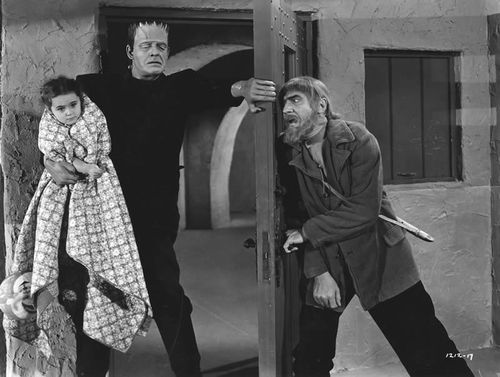
As Ygor talks with the girl, the Monster wanders off when he sees a little girl (Janet Ann Gallow) being bullied by the little boys. He helps her retrieve her ball, which the boys had tossed onto a nearby roof. In the process he manages to panic Vasaria’s townspeople and break enough bones to quickly make Vasaria as unhappy a town as the one he recently left. Low angles with the camera looking up at the towering Monster—showing the little girl’s point of view—increase his menacing presence.

From this movie onward the Frankenstein Monster becomes a scene prop of immense proportions. By the time Glenn Strange takes over the role in House of Frankenstein and Abbott and Costello Meet Frankenstein, the Monster is relegated to being a creepy, big, dummy-like figure; usually strapped to an operating table, around which, indirectly, much of the action occurs. It is this mute, inert body, with arms outstretched in front of him when he does occasionally walk (attributed to Lugosi’s blind Monster performance in Frankenstein Meets the Wolf Man) that gives us the iconic image of Frankenstein’s Monster prevalent in the 1960s up to today.

The plot device of restoring the ailing Monster’s vitality by electrically recharging him, introduced in Son of Frankenstein, now goes one step further here, where it becomes a matter of recharging him before exchanging his abnormal brain with a normal one. Re-energizing and brain-swapping will continue as the main modus operandi for the Monster in Frankenstein Meets the Wolf Man, House of Frankenstein, House of Dracula, and Abbott and Costello Meet Frankenstein, as well as the du jour blueprint for countless future spookshow skits involving mad scientists and Frankenstein Monsters—or plain old gorillas. (For a deliciously goofy example of the gorilla variety see the Three Stooges 3D short, Spooks!)

This shift from Boris Karloff’s misunderstood Monster yearning for acceptance and companionship to Lon Chaney Jr’s mute, lumbering Monster, now weak and semi-conscious, lessens the complexity of the storyline for easier reuse and allows any actor of the right size to mimic the role since it has few emotive requirements, with both conditions important for keeping the budget low and the production simple.


The brain-swapping routine is a hangover from Curt Siodmak’s Black Friday script, facilitating a startlingly gruesome moment when Bohmer wheels a bottled brain directly into the camera lens. (Jonathan Rigby, American Gothic: Sixty Years of Horror Cinema)


There is also a more important thematic shift in the Monster’s relationship with his world. This theme, begun in Son of Frankenstein and developed further here, either accidentally or subconsciously, as a result of Universal moving the series to B production status, contains layers of meaning not usually discussed when The Ghost of Frankenstein and House of Frankenstein are mentioned.

And what is this theme, pray tell?

Meet the Horror Bloggers:
Hayes Hudson’s House of Horrors

Zombie hayes Many fans of horror, amateur and professional alike, have devoted themselves to blogging about the thrills, chills, and no-frills side of the genre as seen in cinema and print. In this ongoing series that highlights the writers behind the blogs, we meet the unique personalities and talents that make the online horror scene so engaging. Up close and personal. In this installment, Hayes of Hayes Hudson’s House of Horrors tells us how PG-13 saved his horror life.


My passion for horror began back in 1988. I was at my local video store. I was 12 years old. The household rule was when I went to get a movie, I could only get a PG or PG-13 rated movie, no R. I would always go straight to the Horror section to see all the great box art and dream of a day when I could view all these movies.

Then I saw it…..most all the stickers on the plastic slip cases were red with an R on them…but this one stuck out. It was an orange sticker with a PG-13 on it! Could this be? The film was EVIL DEAD 2: DEAD BY DAWN and had obviously been put in the wrong slip case. Probably by some teenager working at the video store who didn’t watch what he was doing…..or just didn’t care!

I had never heard of or saw, of course, the first EVIL DEAD film, but that didn’t matter. I showed my mom the sequel had a PG-13 sticker on it so it was fair game. She rented the film for me and I was never the same. It was unlike any film I had ever seen and remains my favorite Horror film to this day. From then on I was hooked on Horror and remain a loyal fan of the genre.

Earlier in the year, I was watching more and more horror films, but didn’t have anyone to share the joys of these films with. My wife HATES horror movies, and most of my friends really aren’t into them (except a select few), so I decided creating my own horror blog would be a great way to discuss news items and movies I watched…even if it was just to a small group of people. It has been fun to watch the blog steadily grow and I hope it continues to grow and become one of the best horror blogs on the net! I try to update it daily, so there is always a reason to check it often!

I hope you all enjoy it!

Most Regrettable Horror Movies Of 2009

Warningsign While others pound their chests proclaiming the top ten best horror movies of 2009, I thought I would take a different approach. Frankly, top ten lists are a dime a dozen these days. And why only ten? Who do we blame for limiting the best to only ten a year? I love reading these lists, though, but only when my favorites make the list (which I suspect is a habit we all share).

But what about all those regrettable horror movies you and I wasted time and money seeing in 2009? Now we’re talking. Not the worst movies or completely bad movies necessarily, but movies that are most regrettable because they zigged when they should have zagged, leaving me, and possibly you, with a sour taste in our mouths in spite of all the popcorn and soda eaten to make up for the disappointment. In a word, those movies that looked so promising but let us down.

I should say ‘let me down,’ since this is my most regrettable list for 2009. Maybe it will be yours, too.


1. The Collector

It came and went without collecting much of an audience. Torture porn horror hit its zenith in this slick nihilistic, but derivative, terrifying vision. In combining Cube-like lethal traps with a hint of Saw-styled ingenuity and malice, and yet another relentless masked-slasher victimizing a family in unsavory, bloodily grisly ways, Marcus Dunstan and Patrick Melton (Feast) do their darnedest to pulverize the audience with fears of helplessness, torture, and death. They almost succeed, but choose to go the usual horror franchise-building byway at the end with a negative payoff.

2. Friday the 13th 

Jared Padalecki (Supernatural) is the only reason I saw this movie. I like him. I like him in this movie. I hate everything else. Remakes can be a dice game to begin with, but trying to remake and re-imagine an icon of horror means you gamble on what stays and what changes. In this case, the gamble didn’t pay off. What changed but shouldn’t have is the mystery and uncertainty about Jason. What should have changed but didn’t are the pick-a-number victims wearing “kill me, I’m stupid” signs on their butts.

3. The Haunting in Connecticut

A haunting without ghosts? How novel. While director Peter Cornwell and writers did manage to startle me twice, this movie has more in common with Tobe Hooper’s energetic spookfest Poltergeist than the lingering, atmospheric scares in Lewis Allen’s The Uninvited or Robert Wise’s The Haunting–but not enough in common to make it as good. A missed opportunity to create real fright instead of resorting to the usual special-effects and grisly spookshow makeup theatrics; less experienced horrorheads will enjoy it. Those with more experience, like me, will nitpick. Such is life.

4. The Last House On the Left

At least Ingmar Bergman put God squarely in the middle of his story, forcing guilt and shame on the parents who mete out vengeance to their daughter’s killers. You will not find emphasis on a divine presence in this latest incarnation of a story that really did not need to be retold. No guilt or shame, either. There is lots of ungodly loud, screeching music though, like bones dragged across a chalkboard. Unless you are entertained by the  creative ways directors and writers emphasize these thematic elements, there is not much here for you. But if you are, you will especially enjoy the totally gratuitous ending involving a microwave and a deliberately paralyzed sadist. If you’ve seen Gremlins, you know what to expect.

5. Trick ‘r Treat

I regret this movie didn’t make it into the theaters. It should have.

Comic Book Review: The Ghoul 1

The ghoul 1 Zombos Says: Good (But more ‘comic book’ needed)

I’d worked with the Bureau, hell, since its creation in 1908. They found me hiding in the sewers of old underground New York and instead of hunting me or trying to make a show of me like so many others had before, they took me in and offered me a job. (Steve Niles, My Ghoul)

With only 16 pages in this $3.99 comic book devoted to The Ghoul’s illustrated adventure, a 5 page continuing text story, My Ghoul–peppered with three small graphics–and 10 pages devoted to IDW ads and news, it took a lot of effort for me to read this one even if Steve Niles and Bernie Wrightson are the perpetrators, and the gimmick is one very big special agent for the supernatural arm of the FBI.

You know the drill: mysterious big guy with attitude (The Goon, Hellboy, insert your favorite here), who usually works for a ‘secret’ organization and packs muscle–some wit, but better at relying on the muscle–and enjoys kicking monster and freakazoid butts too big for regular folk to handle. Leaves all the thinking to the small guys, who, in this case, would be rolled into one Lieutenant Detective Klimpt. Klimpt does the cerebral work while the Ghoul does the muscle work. Both wear trenchcoats. The Ghoul’s is tailor-made and would probably make a good emergency tent if the situation warranted it.

Okay, so I’m spoiled. I expect a big comic book when I buy one, and I expect big names to deliver big things when charged a big price for the issue. Niles and Wrightson are big names. Only Wrightson fully delivers the goods; he gives the irritating, ill-mannered Ghoul more than just enormous size and a trenchcoat. I won’t say heart (or even gruff charm) because Niles hasn’t written that in yet, but Wrightson’s characters and settings evoke more noir than Niles can muster in his story and dialog. Maybe because Niles is on auto-pilot with this first issue. Maybe he’ll get the gas pumping in issue two.

Okay, I admit this is a pet peeve of mine; comic book format implies an illustrated story between the covers, not ads or text-stories that fill up half the pages. Niles’ My Ghoul story is important to read as it provides much background to the Ghoul’s character; but it should have been illustrated instead: comic book, right? I would rather see and read this background story in comic book format.

As for the current story, Klimpt calls in the extra muscle for a hunch he has on a case–more of a theory as he calls it. While the Ghoul searches for some munchies and mugs a sour demeanor throughout their first meeting, Klimpt fills him in on his theory. It involves the Atwoods and their three generations of “uncanny actresses.” Only the three generations may not have involved so many dames and there may be more than just three generations. That easily tops the ‘uncanny’ part. Tom Smith provides lots of evocative colors, creating ample shadows and light sources for Wrightson’s characters to breath in.

Before Klimpt makes a move to investigate further, the Ghoul needs to take care of business. Seems it’s a special night; the type of night devils and beasties roam the earth unfettered from their tour duty in Hell. The Ghoul needs to do some tour duty of his own. The last panel shows him holding a mother, son, and daughter of a gun even Hellboy would drool over.

Maybe I’ll stick around for issue two. I’m a pushover for big guns, sultry dames, and demonic monsters mixing it up.

Meet the Horror Bloggers:
Scared Silly

Paul Castiglia

Many fans of horror, amateur and professional alike, have devoted themselves to blogging about the thrills, chills, and no-frills side of the genre as seen in cinema and print. In this ongoing series that highlights the writers behind the blogs, we meet the unique personalities and talents that make the online horror scene so engaging. Up close and personal.

In this installment, Paul Castiglia from Scared Silly: Classic Hollywood Horror-Comedies tells us why he finds so much humor in all that horror.


The process of me becoming a “monster kid” turned out to be a lifelong affair. There were several factors that led to my love of horror movies in general and horror-comedies in particular, and by the time those influences merged together I became that “monster kid.”

Well, to be more precise, that “monster man-boy.” I’ve never completely grown up, and I don’t plan to, either. I have no middle name, but if I did, it might as well be Pan. That’s not the only caveat. When I say “factors” I really mean TV. And when I say TV, I mean movies, TV shows and cartoons in particular.

I was a child in the 1970s, when movies and TV shows from past decades were routinely rerun, especially in the New York tri-state area. I grew up watching the classic comedians on TV, particularly Laurel & Hardy and Abbott & Costello; and I grew up watching a lot of cartoons.

Initially, I was deathly afraid of the monsters. The intro’s to Chiller Theater, Fright Night, and other monster movie broadcasts were avoided like the plague, and if I did happen to see part of one, or a commercial for a first-run horror movie, that was
enough to inspire nightmares through the night for me.

Comic Book Review: Victorian Undead 2

Victorian Undead 2 ZC Rating 4 of 7 (Very Good)

Capital. Simply capital. With issue 2 of Ian Edginton and Davide Fabbri’s story pitting Holmes and Watson against a horde of the undead, the mystery deepens as more threads of this weird skein of malevolence, plotted by a criminal mastermind, are woven.

For Sherlockians, there are a few pleasant surprises in store. A certain relative of Holmes leaves the Diogenes Club to put in a timely appearance, and a certain Colonel of ill-repute (bad heredity according to Holmes) has the Great Detective and his Boswell squarely in his gunsight.

Edginton’s pacing and dialog, while not as flamboyant or outrageous as Robert Downey’s Sherlock Holmes, ratchets up the tense situation methodically, providing a lively encounter with mobile corpses in the London Underground while introducing important new players into this deadly game of hide and go seek; for what reason are the undead being created and stockpiled? (I wonder if Edginton’s influence for this came from reading Jonathan Maberry’s Patient Zero?)

There is a well-toned classic horror movie sensibility to how Edginton and Fabbri lay out their story. I still find Fabbri’s art too clean; his layouts are quite good, but perhaps a touch of  Downey’s Holmes’ flamboyance would sharpen the edginess. There is a bit of that stiff upper lip overdone here. Edginton and Fabbri’s splash-page finale is superbly and quietly melodramatic, showing the Napoleon of Crime at the heart of this undead conspiracy.

Providing much of the atmosphere for this issue is Carrie Strachan’s colors, especially when Holmes, Watson, and zombies meet underground. More attention to Sir Arthur Conan Doyle’s literary details would be appreciated: Sherlockians may gasp in horror when they see Holmes’ old mouse-colored dressing gown replaced with a bright red and gold-cuffed one.

But this series, so far, is the one I would have liked to see onscreen. Even with Robert Downey. I daresay even Johnny Depp playing Holmes, directed by Tim Burton, mixing it up with zombies, would be exquisite.