From Zombos Closet

Meet the Horror Bloggers:
Monster Land

Monster_scholar Many fans of horror, amateur and professional alike, have devoted themselves to
blogging about the thrills, chills, and no-frills side of the genre as seen in
cinema and print. In this ongoing series that highlights the writers behind the
blogs, we meet the unique personalities and talents that make the online horror
scene so engaging. Up close and personal.

In this installment, monster scholar Jeanette Laredo of Monster Land reveals how she overcame her fear of horror movies and discovered the rich vein of horror literature.


My love affair with horror cinema is a fairly recent one and unlike some of my fellow horror bloggers, I wasn’t really exposed to horror films as a kid. I was never traumatized by Linda Blair’s spinning head or haunted by nightmares of Freddy Krueger and his nifty bladed gloves. Instead I was raised on Nick at Night’s weekly lineup of wholesome shows like Mork and Mindy, Dick Van Dyke and I Dream of Jeannie. The nearest I got to experiencing horror in my youth was watching Goosebumps, Are You Afraid of the Dark? and the odd episode of Unsolved Mysteries.

I got my first real brush with horror my senior year of high school. I was taking dual credit courses at a community college when I met my best friend Stacy. Stacy was a theater student and an avid fan of horror, something that struck me with awe and admiration. I remember once she was reading Poppy Z. Brite’s Lost Souls back stage when another actor asked to take a look. She handed it over cool as anything at a time when I was embarrassed to be seen reading Laurel K. Hamilton in public.

Stacy tried many times to lure me to horror’s dark side with films like Re-Animator, Evil Dead and Night of the Living Dead, but I refused to watch anything more hard core than Tim Burton’s Frankenweenie.

That was until we went to a screening of Rob Zombie’s House of A Thousand Corpses. I fought the urge to bolt as the lights went down in the crowded theater and the screen in front of me filled with bloodthirsty psychos, rotting corpses and killer clowns. I watched the movie from between clenched fingers and tried not to scream uncontrollably as Dr. Satan vivisected his teenage victims. I don’t remember getting home or crawling into bed, but I lay awake half the night petrified that the Firefly clan was going to get me.

Needless to say, my relationship with the genre was one of love/hate, and for the next few years I avoided horror with exception of a few films like Saw and Hostel. Nerdily enough, it was my academic career that turned horror around for me.

My current appreciation of horror stems from my academic experience with two fantastic professors. As an undergrad, my interest in monsters flowered thanks to Barbara Vielma and her classes on the Literary Vampire and Monsters in Literature. I had hit the monster jackpot and I devoured the works of Frankenstein, Varney the Vampyre, Dracula, Jekyll and Hyde and The Beetle. I made up my mind then that I wanted to study monsters and I immersed myself in exploring their stories and the fears they represented.

This love for monsters in literature was translated into film when I took a graduate class with Harry M. Benshoff, author of Monsters in the Closet: Homosexuality and the Horror Film. The class was Gender and Sexuality in the Horror Film and it made me realize that there was so much more to horror than just fear. I think the light bulb went off when we were watching Peter Jackson’s Dead Alive as an example of a postmodern horror film, complete with in-jokes and over the top gore. As I watched the scene where Lionel dispenses of the zombies with a lawn mower, it was like the magician’s trick had been revealed and I didn’t have to be afraid anymore.

In that way my analysis of horror texts can be considered my own special coping mechanism. When I found that I could examine horror instead of simply being scared by it, I felt I could face the monsters instead of losing sleep over them.

Monster Land was born out of this impulse, as well as a desire to think critically about horror films and literature. Through the wonders of the Internet, including e-mail and Twitter, I have become part of a large community of devoted horror fans who have made me feel at home in my study of the genre. The amount of support I’ve received from readers and other bloggers is staggering, and I’m constantly amazed that other people care about what I have to say. So stay tuned monster devotees, because there’s plenty more where that came from.

Ghost In the House of Frankenstein Part 3
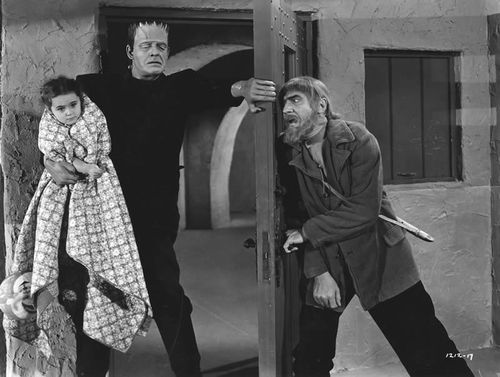
Son of Frankenstein (1939)

BORIS KARLOFF son of frankenstein
Part 2: Bride of Frankenstein (1935)

“Your pants are
talking,” said Wally the Bat.

“What…oh.” I
reached into my pocket for the two-way radio.

“Zoc? Zoc? Where
are you?” It was Zombos’ voice. He sounded frantic.

“Yes, what is it?
I'm still…” I looked at Wally. “…I’m still in the attic.”

“It is your—” 

A bolt of
lightning flashed close to the mansion, quickly followed by a thunderous boom.
It shook the dormer window open again.

“What’s that? I
didn’t hear you,” I said through the static.

The door to the
attic flew open. A tall, slim silhouette glided ominously through the door
frame and headed toward me.

“It is your
sister!" said Zombos. "I tried to warn you. She is—”

“Iloz! Where the
hell are you?” she loudly asked. "This place is a mess. What the hell is
taking you sooooo long. Ouch!" She tripped in the gloom. "Where the
hell are the lights? I can't see a thing."

Wally the Bat,
startled, squeaked as he rapidly unfurled his wings. “Time to go! It's been a
real pleasure.”

He flew out the
dormer window. I closed it behind him, wishing I could do the same. My sister
Trixie was coming closer.

 "You're all wet! Well,
don't stand there like a cow," said Trixie. "Everybody's waiting for
the birthday boy." She took me by the arm and alternately pushed and
pulled me downstairs.

"Here he
is!" announced Trixie as she pushed me into the drawing room. Everyone was
gathered around Chef Machiavelli and his serving cart. He held a large cake
knife poised at the ready. My birthday cake shimmered beneath the flames of
numerous red candles. Ace of Cakes would have been jealous. 1313
Mockingbird Lane was represented right down to the crooked bat weather vane.

"I don't
recall the Grim Reaper appearing in any Munsters
episode," I said, noticing the hooded scion of death standing, scythe
poised at the ready, on the little dilapidated porch. 

"The Grim
Reaper is my idea," said Trixie. "I thought you would adore it. Well,
go on. Hurry up and blow out the candles."

"Marilyn
Munster I adore, Grim Reaper not so much. Don't rush me. I'm savoring the
moment. You don't turn fifty-two more than once, you know." I sucked in a
long breadth, took aim at the little plastic Grim Reaper, and blew out the
candles. He held fast. Damn.

"How does it
feel being fifty-two?" asked Zimba, pulling a candle out to lick the
icing.

"A lot like
fifty-one, only older," I replied.

The number fifty-two: it's
the atomic number of tellurium. It's one of the tombstones in
 Goth: The Game of Horror Trivia. The Mayan Calendar moves through a
complete cycle every fifty-two years. At age fifty-two, Alfred Hitchcock
directed
 Strangers on a Train. At fifty-two, Boris
Karloff played the Frankenstein monster, in earnest, for the third and last
time in
Son of Frankenstein.

"What were
you doing stumbling around up there?" asked Trixie as she helped remove
the candles.

"Zombos
thought he left his–"

"Oh, let us
not start this again," said Zombos. "I clearly remember I did put it—"

"Hush,"
said Zimba. "You'd forget where your own head was if it wasn't bolted
on." She pulled out the last candle. "Let's cut the cake!"

"I can help
with that," volunteered Trixie. Before I could stop her she snapped her
fingers. Instinct took over and I ducked just in time. The cake split open down
the middle, sending the Grim Reaper high into the air along with most of the
cake's hazelnut icing. Zombos was standing closest to the calamity. Zimba
handed him a napkin to wipe the icing off his glasses as he removed the Grim
Reaper, now stuck in his hair.

"Oops. Sorry.
I thought I had that spell down pat." My sister's witchery skills always
did leave much to be desired.

"So. How  are those lessons coming along at
the Witch Finders School of Cauldronic Arts? asked Zombos.

"Never mind,
dear," said Zimba. "No harm done." She gave Zombos her always
persuasive stare-of-Medusa and he kept quiet. "Let's get comfortable by
the fire while Rudolpho puts more frosting on the cake."

Only Zimba called
Chef Machiavelli by his first name. Mostly because only she could keep a
straight face while doing so. Rudolpho wheeled the cake back to the kitchen as
we made ourselves comfortable by the fire.

Lightning still
flashed now and then across the large windowpanes, and streams of water ran
pell-mell across the glass. The roaring flame on the grate lulled me with
thoughts of torches held high by beleaguered villagers chasing down the
Frankenstein Monster, again and again…


…Lightning,
dreary, near endless, drizzle, and beleaguered people play their important parts
in all the Frankenstein movies. It took
four years after Frankenstein to make the lonely Monster a reluctant mate
in Bride of Frankenstein, and another four years for Wolf Von
Frankenstein to take on his father's less than stellar work habits in Son
of Frankenstein
to restore
the Monster's health.

Boris Karloff
returns as the Monster, but he is a ghost of his former self, playing a lesser
role as foil to Bela Lugosi's
indelible performance as another equally undying monster, Ygor. Finally, the
Monster has found a friend, although a homicidal miscreant one with a penchant
for black humor.

With Basil Rathbone as the effusive Wolf Von Frankenstein and Lionel Atwill as the studious Inspector Krogh playing to
the rafters, Lugosi's Ygor takes center stage this time around. Karloff
realized his beloved creation had become just another fixture in the mad
scientist's lab, like the glassware and electrical apparatus, providing the means
but no longer the method to an end: Frankenstein's Monster, truly given life by
Karloff the Uncanny's emotive portrayal, had been reduced to mere appliances
and neck bolts anyone willing to undergo the grueling makeup process could
wear.

The humanity and
soul-stirrings of Frankenstein's creation were not the only things left out in
subsequent movies. Any dichotomy of nature versus nurture, dialectic regarding
the balance between responsibility and determinism, and all displays of
sympathy gave way to a plot gimmick that begins in Son
of Frankenstein
and
continues through Abbot and Costello Meet Frankenstein:
since the monster's brain is bad, he is bad; replace his brain with a good one
and he becomes good. But first, like a drained rechargeable battery, he must be
powered up to full strength through his bolt-like electrodes before the operation
can take place.

The role of the
Monster was not the only thing that changed.

Son of Frankenstein stands as the bridge spanning the
ambivalent melancholia and mania of James Whale's and Todd Browning's Gothic
night sweats to the slick-slacks, neatly cleaned-and-pressed, B budget trimmed
finery of Universal's front-office controlled monster package for a new decade
of movie-goers versed in the realities and hardships of World War II. But it’s
an impressive bridge, nonetheless, thanks in large part to four consummate
actors playing horror for all it was worth and then some.

The placeless-ness of Universal Studios' Grimm's fairy
tale-like world of monsters and madmen is strongest here. The train that Baron
Wolf Von Frankenstein and his family travel on to the cursed village of his
father—which, oddly enough, is now named after the man who brought so much
misery to it—seems modern enough; until it passes through a particularly dark
and dreary landscape of withered, gnarled trees and the Baron and his family
arrive at their destination. Mel Brooks in Young Frankenstein plays off
this stark change from present day to not-quite-sure-when-or-where for laughs,
but it is this blurring of past and present, an abstract recognizability, which
makes Universal's horror canon so appealing, even though it was probably driven
more by script and budget and global market necessities than artful construct.

In these first few
minutes we've crossed into a distorted, unhealthy landscape and unpleasant
climate, where technological and agrarian artifice mingles with the arcane;
where people dress in both contemporary and quaintly antiquated, but
nondescript, clothing, and where mundane laws of continuity from movie to movie
no longer need apply. Here be villains, heroes, and those caught between the
two, walking through shadows, strutting and fretting their fears, triumphs, and
downfalls on a timeless stage that leers at the face of convention.

Only in this
peculiar environment can art director Jack Otterson's team compose an
architectural chiaroscuro of overgrown, expressionistic buildings more suited
to a Max Fleischer cartoon than a sane town, and fill them with dark cavernous
rooms containing overbearing archways, oddly intersecting angles, and
recklessly sprawling wooden staircases without handrails. Austere furnishings
accentuate the cheerless emptiness of Castle Frankenstein, in contrast to the
extravagant furniture and dressings in Frankenstein and Bride of Frankenstein.
Outrageously large commonplace artifacts, like the metal knocker that Inspector
Krogh pounds against the front door to announce his arrival, complement the
surreal dreamscape of this isolated fiefdom.

The villagers meet
the train, huddling under a sea of oversized black umbrellas, in the pouring
rain, waiting to see—not greet—the new face of their fear. They quickly
dissolve away as the Baron stumbles across ill-chosen words of praise for his
father. Receiving a brusque welcome by the town council, his father's chest of
papers is quickly dumped into his hands. Only Inspector Krogh is somewhat
cordial. He realizes the danger Wolf
Von Frankenstein is in: the intoxicating allure of power that comes from
dabbling in forbidden science; a devastating family trait. Driving up to the
estate, a skulking Ygor is briefly seen in a flash of headlights as the motor
car pulls up to the front door; a portent of bad things to come.


In the minds
of many horror aficionados, [Lionel] Atwill's greatest performance came in a
supporting part–as the unforgettable, wooden-armed Inspector Krogh in Son of Frankenstein. Constructed with
equal parts bottled rage and gallows humor, Krogh ranks as the most completely
assembled supporting character of Universal's entire Frankenstein series
(unless you count Bela Lugosi's Ygor, who became the de facto star of Son and Ghost of Frankenstein). Krogh also remains the only hero from
the entire canon of Universal horror classics who's as much fun to watch as the
studio's monsters and mad scientists. (Mark Clark, Smirk, Sneer and Scream: Great Acting in Horror Cinema)


Falling under the
black shadows of Frankenstein's legacy, the surrounding, bog-filled
countryside, accentuated by Hans J. Salter's sumptuous music, reflects more
death than life. Through the mist-covered tombstones tilting left and right—much
like Ygor's teeth—the hanged but still kicking shepard prowls, gleefully
playing a dirge on his horn to annoy the already agitated villagers. These
moonlight spookshow tableaus move to the forefront of Universal's later
efforts.

 In Philip J. Riley's SON OF FRANKENSTEIN: Universal Moviescripts Series Classic Horror
Movies Volume 3
, it’s mentioned director Rowland V. Lee made sure
to use third-billed Bela Lugosi as much as possible after the studio cut the
former Dracula star's contracted
weekly salary in half by insisting all his scenes be shot in one week. Not in
the original shooting script to begin with, the character of Ygor was hastily
crafted by Lee and writer Willis Cooper as production started, but it was
Lugosi's character-acting skills that fleshed out Ygor with wicked panache. Not
much of the finished movie comes from the initial scripting either. Scenes were
written throughout the shooting schedule, resulting in a somewhat uneven flow
in the action. Watching the glee with which Lugosi, Atwill, and Rathbone chew
on the scenery tends to hide this unevenness, however.


Bela Lugosi, originally signed to play a
police inspector in the movie, had the role of a lifetime improvised on the set—the
broken-necked, snaggletoothed, and demented Ygor. Gone completely was any hint
of Dracula; here, for virtually the only time in Hollywood was Lugosi as the
versatile character actor he really was. Unfortunately, Hollywood paid little
attention, and would never extend Lugosi such an opportunity again. (David J,
Skal, The Monster Show: A Cultural
History of Horror
)


Ygor, who has been
using the monster to do his revengeful dirty work, insists Wolf Von
Frankenstein revive his only friend, made comatose by a lightning bolt strike
(although it is a lightning bolt the monster seeks to innervate
him in Ghost of Frankenstein).
Frankenstein's son can’t resist the challenge. Soon the villagers are throwing
rocks at the large boxes of equipment heading for the watchtower laboratory.

Wait a minute; wasn’t it blown to
smithereens in the last movie?

Yes, it was
reduced to rubble in Bride of Frankenstein, with the
Monster buried deeply under it.

Well, if you are going to break that
continuity, why not go big time and throw in a boiling pit of sulfur, that’s
been around since the Romans, in the middle of it, and how about a split-level
design for the lab? And put it right next to Castle Frankenstein so the Monster
and Ygor can easily prowl around using secret passages running from the lab to
the castle.
 

Okay. Done.

The Monster is
revived through Kenneth Strickfaden's quintessential electrical
phantasmagorical high amperage light show of pyrogeysers, crackling and arcing
away. Before Wolf can say "why haven't the sulfur fumes knocked me
out?" the Monster is back on his eighteen-pound asphalter boots and
kicking up mayhem at Ygor's bidding.

After trying to
make friends and woo a lab-ordered bride, Karloff's Monster no longer seeks
understanding; he is fed up with people screaming at the sight of him, shooting
at him, and chasing him with flaming torches. Passing in front of a mirror he
pauses to despise his visage (or perhaps it is the woolly vest he despises, a
holdover from the color tests, which now replaces his iconic jacket?). He hates
what he is and not even Dr. Phil can help him now. Misunderstood and feared,
after being treated as a monster for so long, he now acts accordingly.

The hunt for a new
brain begins with little Shirley Temple cute Peter Frankenstein (Donnie
Dunagan), Wolf's son. The monster takes a liking to Peter–the boy reads fairy
tales to him—and eventually figures out that if he had Peter's brain, perhaps
he would be as sweet and innocent and fun to be with; still awfully big and
creepy, but fun to be with. Of course, Donnie Dunagan's grating Southern drawl
should have given the monster pause for concern.


Corny. And I had a Southern accent! With
this dignified European cast, they had this little kid in there with this loud
voice. They kept saying "Speak up!" because I didn't speak that loud
then…And as you speak up, your accent is always accentuated. So here's this
little curly-haired jerk runnin' around there with this very deep Memphis-Texas
accent (laughs)! They had the courage to do that! (Dunagan interview in Universal's Horrors: The Studios Classic
Movies 1931-1946)


Inspector Krogh
begins to suspect foul things are afoot when town council members start turning
up dead while Ygor brazenly plays his horn in public. Wolf becomes increasingly
high-strung—astounding, really, given Rathbone's already energetic delivery—becoming
more ill-tempered each time Krogh pays a visit. Both Rathbone and Atwill,
classically-trained British actors who could intentionally overact, play off each other,
with Atwill slowly simmering and Rathbone rapidly boiling. As the villagers
once again ready their torches, Krogh's impatience with Wolf's supercilious
attitude reaches fever pitch. In answer to Wolf's defiant question to name one
person who the Monster has killed or hurt, Krogh matter-of-factly recollects
his own horrific experience.

Here’s the scene as
written in the movie script:


Wolf: Do you
honestly know of one criminal act that this poor creature committed? Did you
ever even see him?

Krogh: The most
vivid recollection of my life.

[Solemn instrumental
music]

Krogh: I was but a
child at the time, about the age of your own son. The monster had escaped and
was ravaging the countryside…killing, maiming, terrorizing. One night, he
burst into our house. My father took a gun and fired at him…but the savage
brute sent him crashing to a corner. Then he grabbed me by the arm.

[Thud] Inspector
Krogh slams his fake arm against the wall, a vacant look on his face.

[Tense
instrumental music]

Krogh: One doesn't
easily forget, Herr Baron, an arm torn out by the roots.

[Pause] Wolf is
stunned, humbled.

Wolf: No, I…

Krogh: My lifelong
ambition was to have been a soldier. But for this…


Atwill's little
bits of business as he remembers—he pushes his monocle between the wooden
fingers of his prosthetic arm and casually polishes it with a handkerchief—make
this scene a show-stopper. The sudden thump as he slams his useless wooden arm
against the wall in disgust punctuates the intense revelation. Krogh, in spite
of his loss, still has a sense of gallows humor: during a heated game of darts
with the Baron, he uses his wooden arm as a convenient dart holder. If you’ve
seen Young Frankenstein or Dr.
Strangelove
 you understand
how influential Atwill's Inspector Krogh performance has been.

The dart game is
interrupted by the disappearance of Peter and a search ensues. Inspector Krogh
finds the secret passage that leads from Peter's room to the laboratory, while
Wolf heads to the laboratory by other means.

When Ygor is
gunned down, Karloff has one last moment of glory with the Monster legacy he
created: realizing his only friend is dead (until the next movie, that is), he
vents his sorrow. With Peter now under foot—the monster's left one—Inspector
Krogh has his wooden arm torn off before
Wolf grabs hold of a chain and swings into the Monster, sending him screaming
into the boiling pit of sulfur.

All's right with
the village now.

Wolf deeds over his
castle and estate to the cheering villagers before leaving the Village of
Frankenstein for good. Perhaps they’re happy because the Monster pays a visit
to the next town over, for a change, in Ghost of Frankenstein.

Ghost In the House of Frankenstein Part 2
Bride of Frankenstein (1935)

BORIS KARLOFF frankenstein Zombos Says: Sublime

It took four years, rewritten scripts, and lots of coaxing to get the reluctant James Whale to direct Frankenstein‘s sequel, Bride of Frankenstein. Karloff, who acted in over eighty movies before finally hitting stardom in Frankenstein, in spite of sustaining severe back injuries manhandling Henry in the first movie, was eager to reprise his star role. Dwight Frye, whom Whale liked very much, definitely dead after the first movie, was given a new role—sort of. He plays Karl, the murderous, club-footed assistant to Dr. Pretorius (Earnest
Thesiger).

Once again, Frye takes a meager role and embellishes it to perfection. Colin Clive is back as Henry Frankenstein, more morose and unbalanced than in Frankenstein, and still looking for peace of mind after his near fatal fall from the windmill. Clive broke his leg just before filming began, forcing him to be seated most of the time in his scenes (Tom Weaver, Michael Brunas, Tom Brunas, Universal’s Horrors: The Studios Classic Films, 1931-1946).

It is Ernest Thesiger, however, as the effete, nefarious Dr. Pretorius who does most of the instigation, and a good share of scene stealing, this time around. While Claude Rains and Bela Lugosi may have been considered for the role, Whale preferred Thesiger as the pompous, perverse mentor.

Thesiger’s Pretorius is morally superficial, whimsically condescending, and deeply sinister; a gentleman dabbling in dark alchemical arts. He knows he is naughty and he revels in it. He is a hedonistic Baroque patriarch to his own dark morality and desires, reflecting Whale’s own drive toward self-expression, self-destruction, and discomfort from his commercial directorial success, and his gayness.

To entice Whale back to the laboratory he was practically given carte blanche to direct his way, which he did by greatly loosening
conventionality with his caustic wit tipped off by derision or having to succumb to commercial necessity, and by an unbridled flair for pushing boundaries; all of which combine to produce a less serious and less sedate movie than Frankenstein, but one far grander.

Bride of Frankenstein borders on the outrageous; part parody, part satire, it is a reluctant parable touched with fantasy that periodically
explodes into quintessential horror theatrics, providing Whale with a lucrative vehicle to poke fun at domestic relationships, the budding horror genre he helped foster, and the freedom to allow him to lay bare his inner struggle between his homosexuality and society’s ambivalence toward it. Henry, the Monster, Elizabeth, Pretorius, the townspeople, all represent parts of Whale’s tag team match with his inner demons, yearning for, while frustrated with, a social conventionality he can never attain, but still desires deeply. Bride of Frankenstein celebrates the maverick, the rebel, the outsider, the creative being who dares to counter mainstream culture and its prissy morality, no matter what the personal cost” (Garey J. Svehla, Midnight Marquee Actors Series: Boris Karloff).

Whale’s insistence on having the Monster speak, albeit rudimentarily, did not sit well with Karloff who felt a speaking monster would
lose the audience’s sympathy. Time appears to have settled this point in Whale’s favor. Karloff’s guttural growls and halting speech bring greater depth to the Monster’s soul as he reveals his distrust of the living and his need for companionship. Mentally and emotionally a child in the first movie—inquisitive, innocent, and in need of guidance—he is now more mature and although still inquisitive, has learned caution and guile to satisfy his wants.

Punctuating this arty mix of the fantastic, Franz Waxman’s original music reflects the different moods of scene and character, providing an alternating exuberant melodic and sinister harmonic accompaniment, lighthearted one moment, darkly portentive the next. From the whimsical yet ghoulish bone-tinkle of the dance macabre, heard while Dr. Pretorius is in the crypt, to the Monster’s imposing entrance, Waxman’s notes play across a spectrum of charnel creepiness to mocking crescendo as they resonate cynicism with a grin during the wedding ceremony as Bride and Monster meet for the first time.

A precursor to the now de riguer techniques employed for continuing a commercially viable horror franchise, Bride of Frankenstein begins with a recounting of the first movie’s ending, told through the artifice of saucy drawing room chit-chat between Romantic poets Lord Byron (Gavin Gordon), Percy Shelley (Douglas Walton), and Frankenstein‘s real creator Mary Shelley (Elsa Lanchester), whose ample bosom and double entendres caused much concern with the Production Code censors.

Prompted by Byron (in florid speech filled with rolling ‘R’ puffery) for more of her story, she tells them how the Monster survives the fire. As the flashback takes form, we leave the romantic trio in their drawing room—the past—and return to the windmill—the present—where little Maria’s parents find out why it’s a bad idea to lag behind when everyone else has gone home.

Boris Karloff, now successful in his acting career and able to eat regularly, is heavier in body and face than his first appearance as the Monster. The way in which he reappears, and the hysterics dramatis of Minnie (Una O’Connor) signal Whale’s intent to make Bride of Frankenstein a more fanciful excursion into the macabre than his first movie. Whale had a fondness for O’Connor and allowed her
burlesque-styled antics to overshadow (self-destruct?) more serious scenes.

Universal makeup artist Jack Pierce paid special attention to the Monster’s appearance in this movie. He altered his 1931 design to display the after-effects of the mill fire, adding scars and shortening the Monster’s singed hair.

As the monster prowls the countryside again in search of acceptance, Elizabeth (Valerie Hobson this time around) and Henry are lounging about their incredibly large bedroom (even Donald Trump would be jealous). Elizabeth, always the stronger and more resolute one, though directed toward more melodramatic acting, is distraught as she tells Henry how she senses Death lurking in the dark corners. Henry, ignoring her fear, ponders how his meddling in life and death must be part of some divine plan.

After all the death and heartache caused by his hubris against the natural order, now he seeks divine succor and intervention?

Overcome with worry and Henry’s indifference, Elizabeth swoons as Dr. Pretorius makes his bold entrance, immediately ingratiating himself between her and Henry. The gaunt, arrogantly tousle-haired doctor has been experimenting with creating life also, and insists on showing Henry his accomplishments that very minute. Over her objections, Henry is soon impatiently sitting in the doctor’s apartment.

Dr. Pretorius disappears into another room and returns carrying a large chest. Dressed in clothes that could be mistaken for those of an alchemist or a cleric, he pulls glass cylinders from the chest. In a display of special effects that are still impressive today, each one is shown to contain a miniature person he’s grown ‘from seed:’ a King, a Queen, an Archbishop, a Devil, a Ballerina, and a Mermaid.

The shooting script called for a seventh figure, a baby——already twice as big as the Queen, and looking as if it might develop into Boris Karloff. It is pulling a flower to pieces. Wisely, Whale dropped both the baby and the script’s self-conscious flippancy. Pretorius is a manipulative God figure who gave these beings life, determined their identities, and controls their actions. He is archly disdainful of them, which is revealing of Pretorius and probably of Whale, who conceived of them in the first place (Paul M. Jensen, The Men Who Made the Monsters).

Over gin (Pretorius says it’s his only vice), the two argue, but Pretorius finally persuades—actually inspires—Henry to make a female because Pretorius’ seed process for growing pocket-sized people lacks Henry’s ability for stitching together the seven-foot tall variety. Given the homosexuality of Thesiger, Clive, and Whale, this tete a tete over procreation is ripe with layers of innuendo, or not, depending on how you are inclined to view it.

In a separate story thread from Pretorius’ and Henry’s pursuits, the Monster, trying to befriend a shepherdess in an idyllic pastoral landscape, causes her to almost drown. She screams as he tries to help her, inciting the exasperated villagers to chase him, again, from this paradise into a forest of starkly barren tree trunks. The villagers eventually overpower him and truss him up in symbolic crucifixion fashion, which Whale captures in an elaborate series of close-ups, midshots, and farshots, then cart him off to the town dungeon, where he is chained to a garroting chair with massive links of iron.

Oddly, although he was overpowered by the villagers initially, he breaks free of the more restraining chains and goes on a murderous rampage, which Whale softens by showing a series of random deaths after the fact. Hungry, the Monster stumbles into a gypsy campsite and, having no quarrel with them, uses his hands to beg for food and a warm seat by their fire. The attempt is a futile one and they
drive him away. Now more tired and hungry, he makes his way through the woods until he hears serene music and follows it to a small cottage. Looking through the window like a curious little boy, he sees an old man playing a violin. He barges into the cottage with a growl, but this time there’s no fear at his appearance. The old man is blind and as much an outcast from society as the Monster. Fortune through a man’s sightless eyes finally brings respite.

In a touching scene that carefully skirts becoming maudlin, both outcasts tearfully rejoice in each other’s company. Rembrandt lighting illuminates the faces of the old  man and the Monster, and flickering light cast by the fireplace frolics across the cabin’s walls in a meticulous composition of shadow and emotional substance, music and motion. In the days (weeks? the duration is not clear)
that follow, the monster learns to speak a few basic words and enjoys wine and a good cigar, though his first energetic puffs on it make him even greener than he usually is. For the first and only time he is happy. It doesn’t last, of course.

Huntsmen spoil his joy with their calamitous entry and the Monster is once again being chased by exasperated, torch-wielding, villagers. After toppling a religious statue in disdain, he finds sanctuary in the crypt where Dr. Pretorius is having a grand old time among the bones. Over wine and a good cigar (Pretorius says smoking is his only vice), they hatch a plan to force Henry to make a female companion.
Karloff has his most introspective lines here. The tortured soul of the Monster is revealed. Between his studied pantomime and simple, carefully spoken words, he makes us forget the killings and elicits our sympathies. Without his spoken words this scene would be greatly weakened.

Following Pretorius’ direction, the Monster kidnaps Elizabeth, forcing Henry to acquiesce. After Karl produces a fresh heart through murder, the kites are once again prepared for the approaching storm to harness the cosmic energy of life. Whale alternates between a series of rapid close-ups and farshots, keeping actions lively between the laboratory and roof-top preparations.

Exhilarating electrical flashes, smoky sparks, and zapping, buzzing noises erupt. Slanted close-ups (Dutch shots as they’re called) showing Henry and Pretorius—their faces lighted from below to create shadows obscuring their faces, intensify the already feverish cranking of levers and twirling of dials while the body is raised to the storm in this highly charged atmosphere of expectation. Karl is suddenly killed by the impatient Monster after he sticks a flaming torch in his face (it seems dying a horrible death was part of Frye’s role requirement).

With much anticipation the body is lowered after absorbing the life-giving energy from the heavens. The cosmic diffuser is raised and her bandages are unraveled. “She’s alive!” cries Henry, Waxman’s music building to his words. Pretorius preens and says “the bride of Frankenstein,” to wedding bells mockingly ringing at his words.

After the delicate balance of humour and horror showcased in The Old Dark House and The Invisible Man, Whale was perfecting in Bride of Frankenstein the then unknown quantity called ‘camp’, and for the most part the results are a delight. But, faced with Pretorius’
miniature creations, one becomes aware of a director who is out of control. Ambivalent about directing the movie in the first place, he condescended to do so only on his own terms—and those terms occasionally included a frank display of contempt for his material (Jonathan Rigby, American Gothic: Sixty Years of Horror Cinema)
.

Elsa Lanchester’s wildly elongated hairdo (copied by Matt Groening for Marge Simpson) , flowing white gown mimicking a wedding dress, and hissing response to the Monster saying the word “friend” as he moves closer is a hoot on one hand, yet a stark, sad moment of brutal rejection for him on the other. She turns to Henry instead. The Monster presses his intentions, but soon realizes she hates him like
everyone else. Rejected, he falls backward, stumbling upon a lever the size of a baseball bat that can blow up the laboratory when pulled (who the hell puts a lever the size of a baseball bat like that in easy reach?). He tells Henry and Elizabeth—she shows up just in time to be blown up—to go. Pretorius is not so lucky. The Monster pulls the lever and blows himself, Pretorius, and his lamentable bride to atoms, telling them “we belong dead.”

But this horror franchise has only just begun and monsters never truly die in horror movies that show a profit. Praise James Whale or curse him, his demons eventually overwhelmed him; but before they did, his struggle against them produced two fright movies that still remain daring, perplexing, and defiant of convention. Without Whale to helm the next entry in the Frankenstein saga, Karloff becomes a caricature of the Monster, and is upstaged by an actor who, though a Hollywood outcast, is struggling against his own demons, and in
so doing creates an unforgettable fiend more monstrous than Frankenstein’s creation.

Six Other Movies To Watch
On Halloween Night

DeadbirdsSure, you know all the usual horror movies we watch and recommend for Halloween viewing. But what about those other movies? You know, the ones a little harder to come by, not often mentioned, and spoken about in words that end with a self-deprecating laugh.

Well, I will not apologize any more. These movies are creepy fun for a Halloween night, after you have eaten your twelfth candy bar and littered the floor with candy corn as you rummage deep into your trick or treat bag looking for the dark creamy stuff instead.

Make sure to watch them with others, though. It is no fun laughing in the dark, all alone, on Halloween night. You never know who is listening.

Spookies (1987)

If you are looking for the perfect second-half of a double bill Halloween show with Plan 9 From Outer Space, look no further. Spookies is a film to be savored for its underdone acting, overbearing dialog, and incoherent story. So rarely do horror films reach the pinnacle of hilarious “what the f*ck” ineptitude this film achieves so easily.

The Video Dead (1987)

It starts off innocently enough. The Hi-Lite delivery service delivers an unmarked crate to an unsuspecting writer. We know he is a writer because he is sleeping the day away, surly, and says he does not even watch television. He must be a blogger, too. Over his protests they leave the crate in his living room. He manages to pry the crate open and plug in the battered, rotary channel dial, black and white television set. He checks to see if it works, but only one show comes in clearly no matter which channel he turns to. The show is Zombie Blood Nightmare and not much happens in it except for zombies continuously staggering around in the woods.

Shrooms (2006)

Hack and slash, and run run run…to Glen Garig. The one place in the forest they really shouldn’t be going is where they wind up. Before that, everyone is screaming at the top of his or her lungs for everyone else. So my question is this: when being stalked in the forest, can anyone hear you scream? Based on this movie the answer is no. As panic sets in, Tara manages to do a Looney Tunes into a tree, face first. While I think Elmer Fudd had better timing, she’s not bad at it.

Scarecrows (1988)

Escaping in a hijacked plane with the pilot and his daughter, after a robbery worth millions, a para-military bunch is double-crossed by one of their own; a very nervous guy named Burt. He jumps out of the plane with the big–and heavy–box that holds the robbery money, with apparently no plan on how he’s going to carry it once he is on the ground. Being the dumbest of the bunch, he is murdered first; but not before he happens upon the Fowler residence, nestled snuggly amid lots of really creepy-looking scarecrows perched all around the wooden fence encircled with barbed-wire and lots of warnings to stay away. The weird weathervane on the roof, with the pitchfork and pteradactyl, is a clear sign this old homestead is more deadstead than homey.

And for more serious scares…

Uzumaki (2000)

Taken from the three-volume manga by Junji Ito, the town of Kurozu-cho is beset by spirals spinning into the lives of the townspeople, driving them to madness, bizarre change, and gruesome death.

Dead Birds (2004)

A horror story set in the Old West. Bank robbers flee to a lonely house in the woods. But they are not alone. Strange things lurk in the shadows and under the bed, and when they think they are free from danger, it becomes the most dangerous time indeed.

Ghost In the House of Frankenstein
Frankenstein (1931)
Part 1

BORIS KARLOFF
ZC Rating 6 of 7: Classic

Shadows were everywhere. Ominously large shadows mingled with mysteriously short ones. As I tripped and groped my way through them, the dank, dust-laden air irritated my nose and throat. Lightning flickered occasionally, revealing the shadows for what they were–only briefly, gone in an instant–leaving a faint mental snapshot behind, confusing me even more.

“Did you find it yet?” squawked a petulant voice in the darkness.

Startled, I dropped the two-way radio and banged my head on the sloping attic roof as I stooped to pick it up. Rubbing my head, I tapped my foot along the floor, hoping to find Zombos’ blasted new toy. I found it. I pressed the talk button.

“No, I’m still looking,” I whispered.

“What? Why are you whispering?” he asked.

Good question. I cleared my throat. “The dust…I’m still looking. The lights are out and I can’t see a damn thing. Are you sure you left it up here?”

“Yes. Of course I am sure. I definitely remember I put it–what? Oh? But I thought–oh. Never mind then, Zimba found it. You can stop looking.” He clicked off his radio.

Lightning flashed through the dormer window as I stood in the darkness, desperately searching for reasons why I should remain valet to the once renowned B-movie horror actor, now known only by a few remaining–and just as decaying–fans. Thunder rumbled in the distance. I sighed and began the arduous journey back through the clutter of shadows towering and tilting across the west attic’s floor.

Suddenly there came a tapping, then a frantic rapping on the dormer window behind me. At first I thought it was a tree branch blowing in the wind but realized no trees were high enough to reach the mansion’s attic. I went to the window. A lightning sprite lit up a large flittering shape outside. Thunder rumbled, shaking the window’s broken latch open. A spray of water blew into my face as a flopping ball of wetness and blackness rolled onto the floor. Startled, I tripped over something in my surprise and fell backwards. The ball unfurled into wings. It was the largest bat I had ever seen.

“Damn, it’s a night only Frankenstein could love,” said the bat, shaking his wet wings. “Hello, might you hand me that please?”

I stood there. My lower lip hung an inch lower than my upper one. I reached into my pocket to see if I had left the two-way radio on. Nope. I then felt my head to see if I was bleeding or had a bump suitable for hallucination. Nope. I still stood there.

“I say, if you would, I’d appreciate it greatly.” The bat pointed the tip of his right wing at my left foot. I looked down and saw a small Al Capone slim cigar sticking out from under it. I lifted my foot and used the tip of my shoe to roll it to him.

“Ah, many thanks,” he said. He folded his wings together and used their tips to pick up the cigar. “You don’t happen to have a light?”

I checked the two-way radio and felt my head again. Still nope.

“I’m Wally,” he said.

“Wally…the bat,” I mouthed the words without a sound. I stood there looking at him. He looked up at me. We looked at each other for about a half-minute. “We don’t allow smoking in the mansion,” I finally said.

“Yes, well, it’s soggy and flat anyway.” He dropped the cigar and flicked his wings, sending droplets of water across my patent leathers. “Sorry about that. I must say, this is the most cluttered attic I’ve ever been in.”

We looked at each other for another half-minute or so.

“Is that an English accent?” I asked. Bat hallucinations speaking with English accents always fascinate me.

“I hadn’t noticed myself. Must have come from my hanging out at Oxford.” He flicked his wings again. “Sorry. Force of habit.” He puckered his lips as if he were whistling. We continued to look at each other in silence.

My mind began to wander. I, understandably, at a loss for words, and Wally the bat looking, forlornly it seemed, at his wet flat cigar. An odd night indeed and one more suited to mad scientists. My thoughts meandered around English accents, lightning storms, undead monsters, their reluctant brides, and other times…


…While our dull yellow eyes may no longer be shocked or horrified by James Whale’s Frankenstein, we are still thrilled by it. Perhaps it is the gothic-expressionism in its scenes alternating between light and dark, or perhaps it is the funereal sounds, the crackling electrical arcs from infernal machines, and the thundering, stormy nights that keep us coming back for more. Then again, it could be the story’s scintillating pace, filled with luridly atmospheric, yet poetic, macabre images, and vivid–now archetypal–characters revealed through Wale’s inquisitively roaming camera. Whatever the reasons may be, one thing is certain: Frankenstein solidified Universal Studios’ unique brand of talking-onscreen horror, which began with Dracula, and threw open theater doors everywhere to let in more monsters, madmen, and mayhem than you could shake a flaming torch at.

Mischief and madness are afoot in the sleepy town of Goldstadt, somewhere in Europe. Or is it Europe? Both locale and time period are unclear. English accents mix with American ones, and architectural styles mingle haphazardly. But one thing is certain, or should we say two? During a late-night funeral service, two odd-looking men wait behind a wrought iron fence, just out of sight. Like little school boys ready to play a nasty prank, they can barely contain their impatience until the last clump of earth is tossed with a heavy thud onto the coffin-lid. As the gravedigger leaves, they rush to the newly turned earth to retrieve the fresh corpse. Under the stony gaze from the Grim Reaper statue wildly tilting behind them, Henry Frankenstein (Colin Clive) and Fritz (Dwight Frye), his hunch-backed, unkempt assistant, gleefully cart their prize away.

But their night’s work is not yet done. Coming across a gibbet at the crossroads, Fritz reluctantly climbs the shaking hangman’s post and cuts the body loose. Henry is disappointed. The neck is broken of course, thus ruining any chance for a useful brain. He sends Fritz off to snatch one from the local Goldstadt medical school.

Dwight Frye played Renfield in Dracula so well he became typecast in the role of the manic, misfit, mad scientist’s–or evil vampire’s–assistant. His kinetic Fritz in Frankenstein sealed his fate, but it remains the performance of a lifetime. With his stubby cane, woefully too short to do much good, his crippling hunchback and skittering walk, and his tremulous speech, he is pitiable and contemptible at the same time; a character whose look and mannerisms will become copied and parodied in countless spookshows and movies.

At the medical school, clumsy Fritz drops a perfectly good brain when he frightens himself. The only other brain conveniently pickled close by is the one from a psychotic killer, conveniently labeled “ABNORMAL”. Oh, well, what’s an illiterate hunch-backed, demented assistant to do?

As Henry toils away the midnight hours blaspheming against God with his body-parts suturing, his fiancee Elizabeth (Mae Clarke) is worried. In one of Whale’s signature close-up compositions, he introduces her and Victor (John Boles), Henry’s rival for her affections, filling ordinarily static dialog with movement and tension, keeping the pace trotting inside and outside the laboratory. Elizabeth insists she and Victor see Dr. Waldman (Edward Van Sloan), Henry’s former professor, to find out why Henry is acting strangely.

In their meeting with Dr. Waldman, the more properly starched doctor tells them about Henry’s unhealthy, heretical habits, like trying to create life out of dead bodies. Dr. Waldman is Henry’s moral and societal conscience, the polar opposite of Henry’s other teacher, the amoral–but fun-loving–Dr. Pretorius in Bride of Frankenstein. Like Dwight Frye, Edward Van Sloan also became typecast. He became the perfectly knowledgeable, morally upright, and strong-willed man of reason and science for any occasion, no matter what his other acting credits said.

There’s a wonderfully quirky embellishment made by Frye as the trio of Waldman, Elizabeth and Victor knock on the front door to the old watchtower, Henry’s laboratory, at night as rain pours down. Both Fritz and Henry are busy preparing for the storm’s full electrical fury and they can’t be bothered with visitors at such a critical time. Hobbling down the long, steep flight of stairs framed by the tower’s walls, sloping in odd, off-plumb angles high up into shadows, Fritz hurries to the door, dismisses them brusquely, then hurries back up the steps, pausing ever so briefly in his frenzy to pull up a drooping sock while juggling a lantern and his useless cane: a brilliant, toss-away move that belies the childlike in Fritz, caught between his gnarled adult body and ambiguous soul.

Eventually Henry realizes who’s at the front door and comes down to let them in. In another signature use of his dynamic lens, Whale follows Henry, passing the camera’s view across–and seemingly through–the wall separating the lab from the stairway in one fluid motion. Henry invites them in to view the creation of the Monster; and what a creation it is! Kenneth Strickfaden’s awesome electrical apparatus sparks and arcs and crackles with brilliance as the body, stitched together from dead tissue, is raised to the heavens during the height of the storm. In a crescendo of lightning flashes, electrical discharges, crashing thunder, and anxious faces, the body is brought back down. Slowly, the lifeless hand is lifeless no more, and Henry utters the formerly censored words, “Now I know what it feels like to be God!”  Frankenstein’s Monster coming to life proves Henry’s scientific skills, but what follows his triumph really needed more of his parental ones, which he was sorely lacking.

Is the Monster really evil or is he just misunderstood? Henry and Waldman argue this point, and whether to keep the Monster (Boris Karloff) alive. Everything quickly goes wrong when the Monster makes his first onscreen appearance. First you hear clumping footsteps ascending the stairs, then the door slowly opens as he enters, facing backwards. Slowly he turns around, and two zooming close-ups reveal Jack Pierce’s creepy cotton and collodion makeup that surely must have made hearts skip a beat in 1931. Directing the Monster to sit, Henry opens the skylight to let in sunlight. The Monster reaches upward, attracted by the sudden brightness, trying to touch it. When Henry closes the skylight, the mute Monster again expresses want with his hands. Karloff’s pantomime performance is poignant. Perhaps Waldman is wrong and–damn, what’s Fritz doing with that torch?

As the composure of the Monster turns from fear to frustrated rage, so does Henry’s reason begin to shatter and Waldman presses his argument to destroy the blasphemous creature. Like all mad scientists, Henry was only interested in the experiment, not its consequences. Fritz should not have mistreated the poor thing, though. Fire, whips, chains, such abuse is bound to make any monster inordinately angry (and more monstrous).  A long scream of terror later, Fritz is found hanging by his own overly used whip. Making matters worse, Waldman becomes choked up over his work–the Monster throttles him to death–before he can disassemble Henry’s patchwork creation. Henry meanwhile has succumbed to exhaustion, disappointment, and doubt.

The Monster strolls out the front door and goes wandering the countryside looking for understanding, but finds none. Each peaceful moment is ruined by skittish villagers, or his blundering and uncontrollable anger. In one scene previously lost to the censors, but eventually restored, his happy moment of play with little Maria (Marilyn Harris) is cut short when he runs out of flowers to toss on the water’s surface. He innocently tosses her in to see if she will float like the flowers, but not being a water lily, she doesn’t. This, naturally, upsets the villagers.

With Henry back on his feet and ready to marry Elizabeth, their wedding day is marred by little Maria’s death and the Monster’s sudden attack on Elizabeth. Beginning with Maria’s father’s solemn walk through the singing and dancing villagers, carrying her small limp body, followed by the hasty assemblage of torch-wielding mobs to hunt down the Monster, leading to Henry’s confrontation with his now loathed creation, the movie moves to its incendiary climax at the old windmill. Henry and Monster have a dad and son reunion that leaves both apparently dead and theater audiences clamoring for more.

Never say die when boffo box-office receipts are involved.

Meet the Horror Bloggers:
The Drunken Severed Head

Drunken Severed Head Many fans of horror, amateur and professional alike, have devoted themselves to
blogging about the thrills, chills, and no-frills side of the genre as seen in cinema and print. In this ongoing series that highlights the writers behind the blogs, we meet the unique personalities and talents that make the online horror scene so engaging. Up close and personal.

In this installment, Max Cheney of the Drunken Severed Head proves he’s more than just a pretty face when it comes to horror.

I am a Siamese, or conjoined twin. My other half, separate–and certainly unequal–but seamlessly connected to my self via an e-thereal broad band, is a drunken severed head named Max. We share that first name–I am Max Cheney, Jr., and I love the weird and macabre.

My love for horror started when in 1964, when I was three. I was given the 5-inch high monster figures “Pop Top Horrors” to play with. Cast in Halloween-orange plastic, they were different from other solid figures, as they had detachable heads that could be popped on and off. I had great fun switching the heads! Making an impression on me that same year was being taken to see The Evil of Frankenstein
which featured a toy-like makeup design for its Frankenstein Monster. I learned from watching that film that being scared could be fun. Being born (prematurely) into a blended family, with parents whose marriage was always filled with problems, I was always an anxious kid. Finding a form of anxiety that was thrilling was a revelation!

The following year, I was watching the programs “Milton the Monster” and “The Munsters,” both featuring Frankensteinian monsters, and I adored both shows. As a present for my birthday in 1965, I was given a Herman Munster talking puppet. That set me for life as a fan of monsters, but of the classic Universal Frankenstein’s Monster especially.

Interview: Classic Hollywood Horror-Comedies
With Paul Castiglia

BorisBoogie Paul Castiglia has been writing and editing comic books and pop-culture articles for 20 years, most notably overseeing the Archie Americana paperback series of classic Archie Comics reprints. His past forays into horror-comedy include providing a chapter for the book MIDNIGHT MARQUEE ACTOR SERIES: VINCENT PRICE covering Price’s comedic horror films with Peter Lorre, and writing the comic book based on the animated series Archie’s Weird Mysteries. He has also edited the upcoming Archie Comics Haunted House trade paperback collection of spooky stories.

Paul’s blog, Scared Silly, will post its first review at midnight tonight, kicking-off his adventure writing about classic horror comedies for his upcoming book, Scared Silly: Classic Hollywood Horror-Comedies.

Here’s my interview with Paul to wet your appetite.


How does a writer and editor for Archie comics wind up doing a book on classic horror-comedies?

Simple, I’ve always been a fan of the horror-comedy genre, and I’ve always wanted to read a book that provided an overview of the entire genre. Since none existed, I figured the only way I’d be able to own a book like that would be to write it myself!

It really goes back to my childhood. I was a child in the 1970s, when movies and TV shows from past decades were routinely rerun. I grew up watching the classic comedians on TV, particularly Laurel & Hardy and Abbott & Costello; and I grew up watching a lot of cartoons. Both of those pastimes fed into my love of comic books.

Originally I was scared of films like “Abbott & Costello Meet Frankenstein” (heck, when I was real little I was also scared of Herman Munster!), but ultimately the comic relief alleviated the scares and somewhere along the line I developed a particular fondness for the “spooky” comedies.

This fondness served me well when it came time to write the “Archie’s Weird Mysteries” comic book series (based on the TV cartoon of the same name) and a chapter in a book about Vincent Price films covering the horror-comedies where he was teamed with Peter Lorre.

Ghost chasers Horror and comedy seem to be opposites; so why do you think horror-comedies have always enticed audiences?

Psychologists will tell you that the difference between a laugh and a scream is slight. In fact, sometimes people laugh when they should be screaming. “Nervous laughter,” they call it. Both are a form of release, and when combined they make a formidable pair: what better way to relieve the tension of just being scared than with a laugh right on top of the scare?

In the end, it goes back to the basis of all stories – the idea that being a hero means conquering a problem. If you can laugh at your fears, you are that much closer to conquering them.

Trick or Treat (1986)
Wicked Rock and Roll

Trick or treat

Zombos Says: Good

Metalheads, demonic forces, wicked rock and roll, an intimidated outcast teen, and the 1980s seem to go together in horror movies like Honey Nut Cheerios and fat-rich milk. I don’t know if Eddie Weinbauer (Marc Price) likes Cheerios, but he does
like heavy metal rocker Sammi Curr (Tony Fields). Idolizes him in fact. Sammi does things Eddie dreams of doing if he had the chance. When Sammi goes and dies in a hotel fire, Eddie, disheartened, heads off to school to face his typical day of being emotionally bullied by the in-crowd; the pretty faces, lithe bodies, why-do-you-listen-to-that-crap and why-can’t-you-be-like-one-of-us crowd. His day is made worse when jock Tim (Doug Savant) precipitates Eddie’s sudden appearance, without his very important shower towel, in the girl’s gym class. Luckily for Eddie this is the pre-YouTube, Facebook age, so it was just a Polaroid of his butt making the hallway rounds later.

Sammi, before he became famous, was bullied and intimidated for being different, too. He even graduated from the school Eddie goes to. Both have a lot in common, but it’s Sammi’s death that brings them face to face. But at a price of course; this is a horror movie after all.

Eddie’s deejay buddy Nuke (Gene Simmons) perks up his down day with the master recording of Sammi’s last, unreleased, album. Nuke already has it on tape and is going to play it at midnight. Later, when Eddie falls asleep listening to it, he dreams about Sammi’s death. He wakes up to the record repeating some odd words and, on a hunch, tries the old trick of playing the record backwards (now it is an old trick; back then it was fairly new). Eddie realizes Sammi is speaking to him; really, not philosophically. There is no psychological subtlety here, no maybe it is just Eddie going off the deep
end
. Trick or Treat keeps its Black Sabbath evil straight as any self-respecting 1980s heavy-metalized horror movie should.

Sammi is anxious to get even for all the bullying he had to deal with in school. Eddie wants revenge for all his mistreatment. It’s a match made in Hell and both hook up for some payback; only Sammi plays a lot rougher than Eddie and for cemetery-keeps. When Eddie balks after almost killing Tim in shop class, Sammi pays him a fire and brimstone visit, powered by the amperage in Eddie’s stereo.

Ozzy Osbourne puts in a brief appearance as televangelist Reverend Aaron Gilstrom, a crusader against the bad influences of heavy metal music. Brief because, as he appears on Eddie’s television set during Sammi’s sudden visit from the grave, Sammi reaches into the screen and pulls him out by his Holy Roller neck in a 1980s special effects kind of way.

Not only does Sammi look heavy metal rock and roller musician bad, he is bad.

Eddie realizes he may have misjudged his idol a bit, and with the Halloween school dance about to start, needs to act fast to stop Sammi from exacting his revenge. Powering the dead rocker is his music played from a cassette tape (how many of you remember cassette tapes?).

A seductive scene in Tim’s car involving his girlfriend and Sammi’s hot music allows for 1980s puppet-demon and melted ears special effects. Eddie deals with the evil cassette, but Nuke has his reel to reel tape set to go at midnight, and Sammi has set up a mystical force field around the machine at the radio station.

Bummer.

As I recall, there were times I wanted to do to my tapes what Eddie does to Sammi’s cassette—and do not get me started on those really evil 8
Track cartridges.

Eddie gives the task of destroying the cassette to his only friend, Roger (Glen Morgan). Sammi pays Roger a visit and, well, you know where this one is going. The cassette winds up at the school dance, allowing Sammi to appear for a song accompanied by lethal pyrotechnics. Eddie’s sort-of girlfriend, Leslie (Lisa Orgolini), helps him fight Sammi. Both split up; Leslie tries to destroy the reel to reel tape player before midnight and Eddie goes for a hectic drive with Sammi.

Although the scariest things in Trick or Treat are the 1980s hairdos and being reminded of those nasty cassette tapes, Sammi is a cool rock and roll villain, the story is low-key horror fun, and the music is heavy-metally sharp. Eddie’s character is one many of us can relate to and his idolization of Sammi mimics our own glorification of our rock and roll gods.

And playing records backwards is really cool to do, especially on Halloween, too.

Meet the Horror Bloggers: No Room In Hell

matt hirsch

Many fans of horror, amateur and professional alike, have devoted themselves to
blogging about the thrills, chills, and no-frills side of the genre as seen in
cinema and print. In this ongoing series that highlights the writers behind the
blogs, we meet the unique personalities and talents that make the online horror
scene so engaging. Up close and personal.

In this installment, Matt Hersh of No Room In Hell reveals the deep dark truth of good horror: it’s all about the high from fear.


I lay in my dark bedroom, paralyzed with fear and certain that Jason Voorhees was going to climb up the stairs at any moment and throw me out the window to my death. I was 10 – old enough to rationalize that this couldn’t really happen but young enough to still hold on to my childhood fears. Maybe I shouldn’t have watched Friday the 13th: Part V that day.  But that was pretty typical for me back then. I was both fascinated with and terrified by horror films for as long as I could remember. I played a game of limbo with them, avoiding them like the plague for fear of nightmares but also sneaking a peak with morbid curiosity whenever one was on television.

Halloween Pumpkin Carving Tricks and Tips

Monsters When it comes to pumpkin carving, Pumpkin Masters Pattern Books are the black cat's meow. My favorite one, hands down, is the Universal Studios Monsters Carving Pattern Book put out in 2003.

Patterns for Dracula, Frankenstein Monster, Bride of Frankenstein, Wolf Man, Mummy, and Creature From the Black Lagoon, make for quite the monstrous jack o' monsters patch indeed. Sadly, the book is long out of print and nearly impossible to scare up a copy.

So here are three patterns from the book to wet your pumpkin king carving soul.

Just Download Pumpkin_Masters_Monsters (Frankie, Gill Man, and Wolfie) and print out the patterns. This is a PDF document around 7MB.


Movie Review: Idle Hands (1999)

Idle handsMick: Wait a minute. If you chop off your right hand, how are you going to chop the other one off?
Anton: Oh no, man, the lefty’s a keeper. I mean, I guess it wasn’t idle enough.
Mick: Really?
Anton: Oh yeah, I mean, I hit the remote with it, light up with it, relieve a little tension. No, this is the answer.

Zombos Says: Very Good

Five dexterous digits with a penchant for murderous mayhem provide the Halloween scare-comedy hijinks in Idle Hands. Piling on cliches and nuances from movies like The Hand, Beetle Juice, Scream, and most teen-slacker-slasher romps, Anton has his hands (hand?) full trying to keep from killing everybody in arm’s length. He is the kind of kid who lives in the attic, spends all day lounging around and smoking pot, and does not worry when his parents go missing until after a few days go by; he is the perfect plaything for an ancient demon who takes the old adage–idle hands are the devil’s playthings–seriously, and enjoys possessing those in need of a helping hand: murderously helpful, yes, but still very motivating for Anton (Devon Sawa).

Idle hands Anton’s two friends, Mick (Seth Green) and Pnub (Elden Henson) are not very helpful when Anton discovers his dead parents. Mick and Pnub are distracted by a booty-bounce music video as he frantically points to the two bodies lying in front of the television. When they finally do notice, they are a bit slow in putting the pieces together when clues point to Anton as the murderer.

His hand takes over before they can tell anybody about it. Anton tries to bury the mess in the backyard, but his dead friends, deciding the distance to the “white light” was too far, and finding the celestial music “kinda uncool, like Enya,” not very enticing, decide to come back as his undead friends. They would easily fit into the Beetle Juice waiting room: Mick has a broken bottle stuck deep into his cranium, and Pnub’s head is hanging free and easy–but not in that really good way; and both are very zombie-gray and disheveled. They do not hold a grudge after being murdered–finding undeadness kind of cool–and lend a helping hand.

Anton decides his offending right hand must go and finds the biggest meat clever in the drawer after the bagel slicer fails to do the job. Gory sight gags splatter the humor as the now liberated hand takes a fancy to Anton’s new girlfriend Molly (Jessica Alba). While Mick and Pnub go for the antiseptic and ouch-less band-aids, Anton tosses the nasty fist into the microwave for broiling–remember the kitchen scene in Gremlins?–but Mick and Pnub, in dire need to heat up their burritos, let it loose again. Unperturbed, they sit down to enjoy their burritos. Mick improvises with duct tape when Pnub’s burrito oozes out of his severed neck.

While Anton and his undead, but cool, friends cope, a Druid priestess (Vivica Fox) from a long line of Druid priestesses, is racing to Anton’s town in her vintage Airstream touring coach to kick-ass the evil. When she arrives she, of course, heads to the bowling alley. Druid priestesses must stay in shape by bowling. While there she meets Randy (Jack Noseworthy), Anton’s friend. Randy’s name fits him like a glove. He immediately believes her story about the ancient demon possessing idle hands and tells her about Anton.

Everyone–and hand–meet up at the Halloween school dance for the showdown. The hand, after sharpening its fingers in a pencil-sharpener, is ready to take them all on as it gropes toward taking Molly to hell at midnight; that’s midnight Druid time so there’s not much time to spare. The desperate battle to save Molly, and stop the hand’s plan, moves from shop class, where hand puppets are a natural for malicious use by the hand, to automotive class, where Molly is bound to the hood of a car on a hoist that is edging closer to the ceiling by the second. In the midst of fighting for the hoist’s controls, the boys notice “Mighty Joe Bong,” a wickedly welded, muffler-styled cannabis smoker–the students in shop class learned their skills very well it appears–and light up for a toke to bolster their strength. In-between, the often used cliches of a people-fitting air vent escape and big whizzing fan-blades blocking the only way out provide the light-hearted suspense.

Christopher Hart lends his handy talents as the nasty demon-possessed hand. He is a natural; he played Thing in the Addams Family films. Talk about typecasting.

Meet the Horror Bloggers: Dimension Fantastica

James wallestein Many fans of horror, amateur and professional alike, have devoted themselves to blogging about the thrills, chills, and no-frills side of the genre as seen in cinema and print. In this ongoing series that highlights the writers behind the blogs, we meet the unique personalities and talents that make the online horror scene so engaging. Up close and personal.

In this installment, James Wallestein of the Spanish-language horror blog Dimension Fantastica tells us about his passion for a genre that knows no borders.


Hello, my name is James Wallestein and I live in Dallas, Texas. I write a horror cinema blog in Spanish. Maybe this sounds odd, but I always thought that someone needs to write in Spanish about fantastic cinema for a country with 40 million Spanish speakers!

Personally, I believe it a matter of my DNA to love horror and fantastic cinema. My dad taught me to read at four years old, and he is a fanatic for fantastic cinema and the comics. I grew up reading hundreds of comics (filling all the corners of our apartment) that my dad bought: The Fantastic Four; Conan; X-men; Flash Gordon; Superman; Batman; Spiderman, and more…I remember the great art of Jack Kirby with fascination.

At five years old my dad took me to see Jaws and it was a shock. I was terrified with this damn white shark. Later, in 1977, my dad took me to see Star Wars and Orca, the Killer Whale (pretty impressing for me was the scene of the abort with the baby whale). My dad has a big love for fantasy in his DNA, and therefore he transferred to me his passion into my genetic code.