From Zombos Closet

Funny Caption Time: Hey, Abbott!

Rummaging through a pile of photographs from Professor Kinema, I was stymied by this one of Abbott and Costello.

Zany? Yes. Nonsensical? Yes. Perfect picture for a funny caption? Certainly. So add your funny captions to the comments section already!

0071_001

Diabolical Professor Kinema Reflections
On Diabolique (1955)

les Diaboliques

by Professor Kinema

Underneath the opening credits is an image of something dark and murky. It is revealed to be a mud puddle in the courtyard of a seedy boarding school for boys just outside of Paris. The dark and murkiness establishes a motif and sets the tone for the story to follow, a tale of mental as well as physical abuse, a plot of murder gone wrong, and all the diabolical intrigue that follows. Much of the cinematic imagery mirroring these elements consist of dimly lit interiors, long shadows and grey exteriors.

Reaching into international film history, one can see the influences for les Diaboliques. A true autéur, director/screenwriter Henri-Georges Clouzot exercises a masterful control of the extreme darks and lights which hark back to the German Expressionism (with surrealism touches) of works like Cabinet of Caligari (1920), Nosferatu (1922) and Warning Shadows (vt, Schatten – Eine nächtliche Halluzination, 1923). The movie’s key shock scenes are the drowning of the abusive husband, his ’dead’ body being transported from the apartment to the swimming pool and his eventual rise from the dead – with totally blank eyes. This is all accomplished in the truest sense of film noir intermingled with heavy doses of le Grande Guinol. The title is translated as either ‘The Devils’ or ‘The Fiends.’ All involved in the diabolical plot can be defined as devils or fiends, for sure. With the retitling for the US release, Diabolique, there is an emphasis on an intangible plot element; something diabolical is going on here. In either interpretation, the title works.

Diabolique The thematic element of placing the setting at a boy’s boarding school, that has definitely seen better days, is reminiscent of Jean Vigo’s Zero de Condiute (Zero For Conduct, 1933). As pre-teen and teenaged schoolboys do, they laugh, joke around, complain, and yet are reluctantly obedient to their adult supervisors. This is played out among these same adults who are experiencing emotional turmoil. While plotting the intrigue that would go with a murder and it’s sinister aftermath, they must function in their every day routines as educators and administrators.

This play between what we, the audience, are shown, what we are told, and, consequently, what we are led to believe is the essence of the suspense of the story. Along with the fragile Christine and stoic Nicole, all present are also victims of the abusive and insulting headmaster Michel. If ever a character in a story was being groomed for elimination, it’s this slick, chain-smoking lothario: students and staff are compelled to dine on bad fish; Christina is humiliated by being forced to swallow this very same bad fish with everyone looking on. Yet, being adolescents, the students rebel by ending up not eating their meal, instead using it for an impromptu food fight. Rebellion is definitely in the works, but it’s not only the students who rebel.

Because of her weak heart, Christina’s physical state is established early on as a ‘petite ruin.’ The question as to whether or not she and Nicole truly managed to murder Michel, or if he’s ‘risen from the dead,’ causes much on-screen tension. Two interesting exchanges containing ‘death’ lines occur in les Diaboliques.

Christina to Nicole: “If only I could die and not see him any more.”

Michel: “Why don’t you dear? Go and die. We‘ll bury you, and good riddance”

Christina and Nicole arguing whether their victim Michael is truly dead:

Nicole: “There’s an explanation for everything, there are no miracles”

Christina: “Each time I shut my eyes – I think I see him come in.

Nicole: “Will you be quiet! He must be in a pretty state by now.”

Christina: “If he’s dead!”

Nicole: “I’ve seen dead people before. Michel is very dead.”

Red Riding Hood (2011)
Hoodwinks Audience

red riding hood movie

Zombos Says: Fair

“I still want my money back,” insisted Zombos. He gets like that when we see a movie he doesn’t like.

“Fine, then,” I relented. Here’s your six dollars. But I’m not paying for the popcorn and Junior Mints. You ate most of those anyway.” Zombos folded the money and pocketed it, then rushed back to the concession stand. Probably to buy more Junior Mints. While I waited
for him, I thought through my impressions of Catherine Hardwicke’s Red Riding Hood.

A child’s imagination of fairy tale prettiness infuses everything. Clothes, people, the surrounding medieval forest, it’s all colorful, cheerful, and naively pretty. Clothes are clean and neat, people are clean and neat, and the village is clean and neat. No Dark Ages grunge or
malaise to be found here. Cindy Evans’ television series costuming (the way rustic villagers in Stargate SG-1 episodes are dressed, for example), reinforces this lightness. And although snow is falling and winter is upon them, no one is bundled up against the chill. No frosty-breath comes from mouths and the ladies’ bosoms are bared for spring, especially Valerie’s (Amanda Seyfried). When Grandmother (Julie Christie) gives her the red-hooded cloak, it’s a fashion statement, not a garment to wear because it’s cold.

The Village of Daggerhorn has been beset by a killer wolf for many years, yet the village is happy, a thriving place with everyone well-adjusted, immaculately groomed, and nattily attired. The forest is happy with its bright fields of flowers, and the village idiot is happy, and
as pretty and well groomed as everyone else. He doesn’t act too idiotic, either, just enough to be adorably off.

Father Auguste (Lukas Haas) is the only one who is dour and shows concern. He has sent for the witch and werewolf hunter Father
Solomon (Gary Oldman playing Gary Oldman). Father Solomon’s prior experience with a werewolf left him traveling around in an armored carriage with heavily armed guards. Arriving in the village, one guard, sitting atop the carriage, keeps aim with his crossbow, sweeping it back and forth as if he expects trouble any second. It looks pretty silly. Solomon also travels with a large, hollow, bronze elephant, with a door in one side. He locks people he doesn’t like in it and lights a fire underneath to torture them.

This is as medieval as it gets.

Before Father Solomon arrives, Valerie’s sister is killed by the wolf, sending the men off to hunt it down. They find a gray wolf, kill it, bring its head back, and show it to Father Solomon, claiming he’s not needed. He disagrees and gives them the standard rundown on
werewolfism. They ignore him and hold a rave party instead (or what would be the equivalent of one, I’d guess, for medieval times). The computerized werewolf shows up, chews up the scenery and townsfolk, and speaks to Valerie before he leaves. She notices his big brown human eyes as he tells her to run away with him or else he’ll put the bite on the entire village.

Valerie now has a difficult decision to make. Run away with the darkly handsome, tousle haired, woodcutter Peter (Shiloh Fernandez), or stay and marry the handsome, tousle haired blacksmith Henry (Max Irons), or run away with a real stud, the tousle haired werewolf with big brown eyes. There is no tension or suspense produced by her difficult decision: Hardwicke’s tone is non-committal, David Johnson’s story is vapid, and Seyfried’s performance is overshadowed by her hooded cloak. I had a more rewarding time at the concession stand making up my mind between Junior Mints and Reese’s Pieces.

The romance turns into a whodunit as Valerie stares into people’s eyes, wondering who (maybe whom?) the werewolf is. When the revelation comes it’s like an ending from an Agatha Christie mystery.

Come to think of it, I want my money back, too.

Ghost in the House of Frankenstein Part 6
House of Frankenstein (1944)

House of Frankenstein
Zombos Says: Very Good

Despite its all star cast, and the return of Boris Karloff to the fold, the movie was the silliest and dullest of the entire series. In its non-stop and methodical rushing through stock horror sequences, it approached the standardization of the “B” Western, and even lacked the kind of bravura dialogue that at least can provide a pseudo-Gothic veneer. (William K. Everson, Classics of the Horror Movie)

Although Everson pans House of Frankenstein, this second monster rally from Universal’s production treadmill is not silly or dull, and steps lively through its “stock horror sequences” of brain-swapping mad science, murderous hunchbacked assistants, and star-crossed
lovers, all with a patina of Gothic-noir finesse. It’s slick-slacks, neatly pressed and sharply creased, and while it does not dwell deep in meaning, House of Frankenstein remains a well-directed, entertainingly acted, and visually appealing Universal-style horror movie.

But John Carradine’s portrayal of Dracula is another matter.

Except for his glowing, mesmerizing, ring providing most of the vampire’s menace—it offers a glimpse of evil shadows moving furtively in a nightmare world—Carradine’s Big Bandleader accoutrement and eye-pop stare brimming from under a silly, tilted top hat and short opera cape dandily draped across his shoulders, do their best to murderlize the spookshow tone entirely. At least Dracula’s early demise in
the movie lessens our burden of having to suffer Caradine’s ham and corn buffet for long, and frees Larry Talbot (Lon Chaney Jr) to pine away and lament his lycanthropic curse, which is really the main storyline anyway.

Perhaps Universal was banking on the audience appeal for the Frankenstein name, but House of Frankenstein and the subsequent House
of Dracula
are two peas in a pod, and should have been named House of the Wolf Man and Sublet of the Wolf Man respectively.

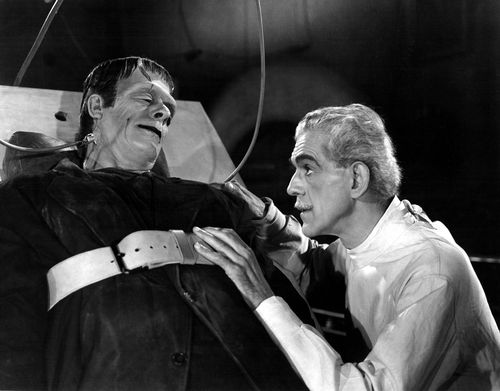
Maleva the gypsy is no where to be found; and the Frankenstein brothers, daughters, and baronesses are gone, too. The Monster (Glenn Strange) remains; more lifeless than ever in body and spirit, but still recognizable dressed in those defining neck bolts. Erle C. Kenton’s patent leather direction, Hans J. Salter’s mood-rich music (along with Paul Dessau), and the creative best from the art and set decoration B movie crews with what’s at hand all funnel through a lean filming schedule and penny-pinching budget to stir shadow, menace, and monsters briskly when the lightning strikes again.

Imprisoned mad Doctor Gustav Niemann (Boris Karloff) escapes the dark, dank prison cell he’s in, along with the homicidal Daniel (J. Carrol Naish), a hunchback outcast dreaming of a straight and handsome body. Niemann’s incessant raving about brain transplants, swapping human brains with dog brains, and getting even on those who locked him up appeals to Daniel, who buys into the bad doctor’s
promise to give him a better body.

And isn’t that what the Frankenstein franchise has always been about? A yearning to be better at science and medicine; a yearning for a better existence; a yearning for a better companion; a yearning for a better brain; and a yearning for a better body?

Daniel follows the Doctor when a lightning bolt blasts open an escape route for them through their dark prison’s massive stone walls, hoping Niemann will place his brain into that better body. As the rain pours down, they chance upon Lampini’s (George Zucco)
traveling sideshow of horrors. Lampini’s reluctance to take them where they want to go ends abruptly between Daniel’s tightly gripping hands, shown through a flash of sudden terror in Lampini’s eyes, Daniel lurching menacingly closer with those outstretched hands, and a gurgling cry as Niemann smirks in quiet satisfaction.

With plans for revenge on those who imprisoned him, and a driving desire to find the life and death secrets of Frankenstein, Niemann assumes Lampini’s name and travels to Visaria ( or freel free to insert your own village name here since continuity went out the door with Lampini’s body).

Bela Lugosi was originally slated to play the role of Dracula, but the movie’s shooting schedule was dependent on the presence of Boris Karloff being released from the stage tour of Arsenic and Old Lace (1944). Shooting was delayed, and John Carradine was cast instead of Lugosi, who had a prior engagement: ironically, playing Karloff’s “Jonathan Brewster” role in another touring company of Arsenic and Old Lace (IMDb entry on House of Frakenstein).

In the mold of Bride of Frankenstein‘s Pretorius, Niemann is a maniacal scientist bent on one-upping Frankenstein. Brain-swapping becomes modus-operandi, raison d’être, and bargaining chip for Niemann as he pursues his revenge, first on Burgomeister Hussman (Sig Ruman), with the help of Count Dracula.

Early drafts of the story reportedly involved more characters from the Universal Stable, including the Mummy, The Mad Ghoul, and possibly The Invisible Man (Wikipedia), but the only monster to remain in Lampini’s traveling horror show is Dracula. Curiously,
he is not the vampire late of Whitby Abbey, or even the vampire last seen burning to ashes in Dracula’s Daughter. No continuity from there to here is intended.

The skeletal remains of Dracula, with a stake embedded deep into its ribcage, is pure spookshow dramatics parlayed into a rapidly unfolding and stylish vignette of terror for Hussman, kicking off Niemann’s revenge with a flourish. It begins with the piecemeal reconstitution of Dracula’s body and clothes when Niemann pulls out the stake in a huff after meeting the Burgomeister. With his threat
of the dreaded stake poised to strike again, and his promise of fealty to the Lord of the Undead, Niemann convinces Dracula to help him.

In quick succession, Dracula ingratiates himself to Hussman, seduces and hypnotizes Hussman’s Americanized (meaning perky and hip) granddaughter-in-law Rita (the effervescent Anne Gwynne), turns into a large bat to kill Hussman (done with a nifty animated transformation capped by a neck attack shown in silhoette), and is discovered by Hussman’s son Karl (Peter Coe) who realizes what’s happening and sounds the alarm to Inspector Arnz (Lionel Atwill).

With the inspector and his men in hot pursuit on horseback, Dracula, in turn, chases after Niemann and Daniel as they race away with his coffin in Lampini’s wagon. With the sunrise moments away, Niemann directs Daniel to dump it. Unable to reach his daytime sanctuary in time, Dracula is reduced to a skeleton once again. His hypnotic influence over Rita ends when his ring falls off his boney finger.

Economically directed and succinct in execution, it’s still exhilarating and entertaining with flair, and certainly not the script calamity it’s purported to be in many critical analyses. Carradine projects a more energetic Dracula when he’s not staring with widened eyes or donning his tophat, but he doesn’t have Lugosi’s seductive and menacing silent presence, or malevolence when in motion, which, arguably, could be considered a hindrance to the faster pace of action here.

Continuing to Visaria, they rest at a Gypsy campsite, where Daniel comes to the aid of a girl being whipped. He insists they shelter her
and Niemann reluctantly agrees. Daniel’s infatuation with the playful Ilonka (Elena Verdugo) is not returned when she sees his hunchback, making him more impatient to receive the new body promised to him by Niemann.

And the one he wants is already occupied by Larry Talbot.

Photograph of Glenn Strange as the Frankenstein Monster (with Boris Karloff) courtesy of Dr. Macros High Quality Movie Scans.

Mexican Lobby Card:
La Maldicion De La Llorona

La Maldicion De La Llorona  (The Curse of the Crying Woman) lobby cards are unusually subdued in their illustration (for a Mexican horror movie lobby card, that is), and imply a Gothic tone and romantic mood for this story of evil witches, dark spirits, and spooky mansion surprises. These two action-filled picture inserts, on the other hand, cry supernatural terror and woman in peril.

la maldicion de la llorona mexican lobby card(lobby card courtesy of Professor Kinema)

Mexican Lobby Card: Dungeons of Harrow

A motif found in the majority of horror movie poster and lobby card artwork for any country: the female victim. The strategic dappling of blood across her ample bosom accentuates the terror of helplessness. I doubt Dungeons of Harrow (1962) brings, as the lobby card states, all the suspense as the major productions of Alfred Hitchcock. I don't think suspense is the key audience attractor here.

Calabozos Del Horror Mexican Lobby Card(lobby card courtesy of Professor Kinema)