From Zombos Closet

Comic Book Review: Swamp Thing # 1
Raise Dem Bones

20110908095040_001 ZC Rating 4 of 7: Very Good

Frankly, I consider DC's The New 52! reboot a brilliant, but cheesy, marketing gimmick to boost sales. It will certainly do that, but I doubted much good would come out of freshening up the staple titles that make or break the House of DC every month, so I hadn't planned on picking up any of the number one issues; until I received a review copy of Scott Snyder and Yanick Paquette's Swamp Thing in the mail. Did it hit its mark? Sure did. Will I want to continue reading it? Sure will. I think you will want to, too.

Scott Snyder writes his stories by cutting between locations, situations, and people to build his plot's events. He's been damn lucky to have artists who seem to relish all that jumping around and keep up with him, but also add to his narrative in ways–framing, angles, positions of characters–he probably didn't even think of. Snyder's a very cinematically-minded writer in how he makes his stories build, and they have a completeness between issues, with clean, integral dialog, and visually important actions capping neatly at the given page length.

You get that sense of completeness reading this first Swamp Thing issue, Raise Dem Bones. We see birds dying in Metropolis, then bats dying in Gotham, then fish dying in the ocean in the space of 3 pages, switch to a disillusioned Dr. Holland doing a construction gig in Louisiana, and then visit an archeological dig in Arizona. It's the mastodon bones in the dig in Arizona that kick things into horror gear, and the 3 men who return to the dig at night get their necks all bent out of shape with what they find. Paquette doesn't really panel his art, it just wraps around and across the pages, word ballons and narrative blocks  like a rich vine. Snyder's dialog exchange between Dr. Holland and Superman, and the narrative embellishment to scenes are just enough, just right, and meld with the artwork. Or does the artwork meld with it?

Either way, this series is off to a very good start.

My Halloween: Scott M. Baker

Halloween 4Five questions asked over a glowing Jack o'Lantern, under an Autumn moon obscured by passing clouds…in between mouthfuls of candy corn…with author Scott M. Baker (The Vampire Hunters)…

Why is Halloween important to you?

It’s the one day of the year where everyone wants to be scared. It gives those who ignore the genre for the other 364 days of the year an opportunity to know the thrill and enticement us genre fans experience daily.

Describe your ideal Halloween.

My ideal Halloween would be to own a home with a large enough front yard to set up a really awesome nightmare display. I dream of having desiccated zombies crawling out of the dirt along the driveway, corpses hanging from the tree, a giant spider precariously perched above the front door, and anything else my twisted imagination can dream up.  In my hometown lived a guy who used to deck out his house with so many Christmas lights that people would drive from miles around just to see it; I want people to do the same for my Halloween display.

What Halloween collectibles do you cherish, or hate, or both?

I like most of the Halloween decorations I put up around my place. The vampire bat with the four-foot wingspan that hangs over my garage. The decaying skeleton torso I hang from my bedroom window. The life-size Angel of Death I hang from the door knocker.

The collectible that is nearest to me is a simple ceramic skull that I set up on the dining room table every year. Back when I was a kid, my Aunt Bobby made it for me in art class because she knew that, as a Monster Kid, I would appreciate it. Today it wouldn’t scare a three-year-old, but that doesn’t matter. It reminds me of my aunt, who passed away almost ten years ago, and how she was one of the many family members who encouraged that weird little kid who loved monsters.

When was your very first Halloween, the one where you really knew it was Halloween, and how was it?

I don’t remember my very first Halloween. I do remember, however, Halloween as a kid in general. A few weeks before the holiday, my parents would take me to the costume section of the local department store to choose what I wanted to be that year. Back then, the costumes came in small boxes and consisted of a cheap, flimsy, overall-type outfit with an accompanying plastic face mask with eye holes so small they scraped the hell out of your lids. (You Monster Kids out there know exactly what I’m talking about.) Then on the hallowed night I would go out and prowl the neighborhood, where I thought I was the scariest/coolest monster on the block, and return home to eat myself into a self-induced sugar high.  I miss those simple times.

What's the one Halloween question you want to be asked and what's your answer?

Q: What would be your ultimate Halloween costume? A: I would want a make-up artist to deck me out as a rotting zombie with the whole nine yards: grotesque, oozing neck wound; ripped open abdomen with the obligatory intestines hanging out; and torn up face with exposed jaw.

I also have a standing invitation from a close author fiend to go out one Halloween with her and her daughter as Gomez, Morticia, and Wednesday Addams. I’m hoping to cash in on that someday.

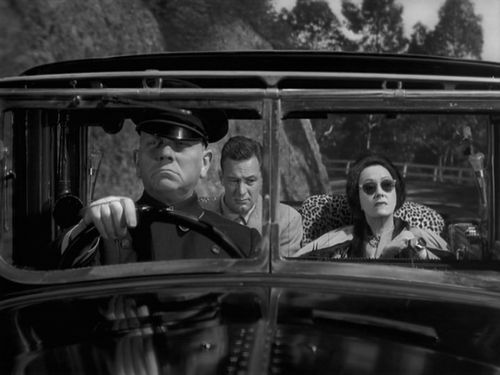
Sunset Boulevard (1950)

Sunsetboulevard
Zombos Says: Sublime

Well, this is where you came in, back at that pool again, the one I always wanted. It's dawn now and they must have photographed me a thousand times. Then they got a couple of pruning hooks from the garden and fished me out… ever so gently. Funny, how gentle people get with you once you're dead.

I've watched Billy Wilder's Sunset Boulevard about 4 times, give or take, but this is the first time I've paid attention that there are no knobs on the doors–no locks–just round holes where they should be. But I'm getting ahead of myself. I better explain why I'm writing about a non-horror movie before you diehard fans de-Twitter me or minus me from your Google+ circles or deface my Facebook page because I insist on talking about a non-horror movie you really must see. Here's why: the story's narrated by a dead guy, the one you see floating in the middle of the pool at the beginning. How can you not love a story narrated by a dead guy? And he's not even a zombie. He's just really dead. How refreshing. 

Why he winds up that way involves a forgotten Hollywood mansion where a forgotten silent film star dwells in a forgotten world of ignorant opulence (maybe not so forgotten). She dreams of returning to the big screen, shutting out any daylight that might wake her up. Those absent door knobs are missing from the big, ornate, doors in her old, brooding mansion. Maybe they were removed, one by one, over the long years, but they most likely were taken off all at once, after she became suicidal. A lot. It's a mystery, really, as to what depresses her so much: is it really the lack of a movie contract or a lover or her lost audience? Oddly enough, it's the only mystery in this noir crime story with the dead guy floating in her swimming pool, and her first husband (Erich von Stroheim) living with her as butler and chauffeur, and with her "waxwork" friends (like silent film comedian Buster Keaton, playing himself) showing up every week to play a quaint game of Bridge and reminisce. Desperation leads the soon to be corpse to this place and desperation keeps him there; not his, but Norma's.

Let's start with the corpse, Joe Gillis (William Holden). He's a down and out script writer–was, rather. Before he wound up in the pool Norma adopts him as her kept man, mostly because he's a good writer and she has a lousy script for him to fix, but also because he's handsome and she's lonely without an audience. With one leg in Norma's world and the other back at the movie studio with the younger and saner Betty (Nancy Olson), Joe's precarious ambitions start sparking from the friction between the carefree luxury he gets from Norma and the inspirational boost he gets from Betty: she collaborates with him on a script with real potential. And Betty falls in love with him, even though she first fell in love with Joe's friend Artie (Jack Webb). That icing on the cake drips guilty all over Joe when Norma attempts suicide over his interest in Betty because it screws up her affair with him. He likes the money Norma lavishes on him–wouldn't you? He likes the attention lavished on him by Betty–ditto? Which way to go is the tough call he needs to make eventually: live in Norma's made up reality or Betty's real future one? That swimming pool sure is inviting. Lounging by it all day can be intoxicating. 

 Sunset Boulevard's not only about Joe's predicament (lucky bastard, we should all have that kind of quandary), it's about a decadent past, present, and future Hollywood Wilder and fellow scripters (Charles Brackett and D. M. Marshman Jr) penalize everyone in the movie with. It's about fickle celebrity, art versus cash, and the futility of holding out, lounging by the pool when you shouldn't, and not taking a dip when you really ought to. It's all about Norma–but not really, and it's all about Joe–but not really. It's introspective, witty, urbane, and accusatory. 

The other mystery–wait, I said there was only one, didn't I?– is how Billy Wilder got away with it. A lot of people in this movie play themselves or barely cover up the fact: Gossip columnist Hedda Hopper zings as Hedda Hopper; Erich von Stroheim, who plays Norma's former husband now devoted servant, Max, reveals he directed Norma and compares himself to real life directors Cecil B. De Mille and D. W. Griffith.  Stroheim not only directed Swanson in real life, he also got pushed aside when talkies took over, a promising director in real life ignored when it wasn't convenient to pay attention to him. A lot of silent film stars were pissed, too. They saw Norma Desmond from the inside out and the sight was too close for comfort. Wilder went with dark humor and let everyone in on the joke, ironically plays it near parody to make the situation more realistic, and grandly delivers brutal honesty. It's surprising he didn't wind up floating in the pool, too.

Joe's observations are bitingly sarcastic, funny, and sadly true; Norma's delusion is bitingly crazy, funny, and sadly false. When she finally does get a call from the studio it's about the Italian antique car (an Isotta-Fraschini) she is chauffeured around in: they want to use it in a shoot.  Cecil B. Demille (playing himself) doesn't tell her she's not wanted when she comes to the studio her movies helped keep solvent, he's more understanding; but even he knows she will never do another picture and her script reads like a bad silent movie. Norma's past her prime and those exaggerated silent movie gestures she lives and breathes all the time are so not-the-drama anymore. 

The music plays on while Norma and Joe celebrate New Year's Eve dancing across the mansion's empty floor, just the two of them, dressed to the nines. Even when they aren't dancing the musicians keep playing. It's just them, Norma, Joe, and Max, who knows she's two notes short of a full stop. Max directs the musicians to keep playing. He directs Norma's delusion. He knows all she has left is her delusion of returning to the screen. Without it she becomes nothing so he protects her fantasy to the end. He definitely removed all the door knobs. I wonder where he keeps them?

Franz Waxman's (The Invisible RayBuck Rogers ) score and John Seitz's camera (Invaders From MarsWhen Worlds Collide) bow tie Hans Dreier's (The Uninvited) and John Meehan's (Cult of the Cobra) darkly addressed package of desire, decadence, and demise with a tidy knot, ready to be untied by Norma in ghoulish fashion.  She finally gets the close-up she's been hoping for, although not in the way she planned. We get a classic movie about dreams and delusions, and how the difference between both is pretty small in Hollywood.

The bed in the shape of a swan that Norma Desmond slept in was actually owned by the legendary dancer Gaby Deslys, who died in 1920. It had originally been purchased by the Universal prop department at auction after Deslys's death. The bed appeared in The Phantom of the Opera (1925) starring Lon Chaney. (from the Wikipedia entry on Sunset Boulevard)

Halloween 2011: Doctor Dreadful Zombie Lab

You know it's Halloween time when Doctor Dreadful and Creepy Crawlers hit the toy shelves. I screamed with delight seeing this Doctor Dreadful Zombie Lab at TRU: eat bubbling brains; drink zombie barf; slurp slimey bugs; PLUS Zombie Skin!  The Stomach Churner isn't too shabby, either. Parents, it's yummy fun.

dr. dreadful zombies

dr. dreadful zombie lab

doctor dreadful stomach churner

Professor Kinema’s
Gimme A Movie Gimmick Time

Hypnotic_eye from Professor Kinema


The recent release of Spy Kids: All the Time in the World in 4D (the entire film's title) harks back to the days of the bogus promotional gimmicks. This is all presented in 'Aroma-Scope.' A check of the film's official web page doesn't give an explaination as to what 'Aroma-Scope' can be. Maybe the alleged 4th dimension contains a variety of aromas? We're also informed that, via the film's posters, 'the 4th dimension is free!'

Here are a few other 'technical innovation' favs that come to mind:


Encino Man  (1992) – was promoted, in print, as 'A Chillin' New Comedy in Full Neandervision.'

Blood Sucking Freaks (aka The Incredible Torture Show)  (1978) –  was filmed in 'Ghoul-O-Vision.'

Swingtail (1969) –  was in 3D and 'Cosmovision.'

The Incredibly Strange Creatures Who Stopped Living and Became Mixed-Up Zombies!!? (1964) — was filmed in 'Bloody-Vision,' and 'Hallucinogenic Hypnovision.' The latter was a spinning black wheel with a white spiral on it. It appears when Madame Estrella hypnotizes her victims. On posters it was hyped as presented in 'TerrorRama.'

The Hypnotic Eye (1960) — patrons were given Hypnotic Eye Balloons to enable them to enjoy the thrills of 'HypnoMagic.'

Orgy of the Dead (1965) –  was 'in Gorgeous and Shocking Astravision and Sexicolor.'

X, the Man With X-Ray Eyes (1963) –  was in SpectaRama.'

House on Bare Mountain (1962) –  was in 'Rawcolor and Sinscope.'

Konga (1961) —  was in 'Spectamation.'

Horrors of the Black Museum  (1959) – was in 'HypnoVista (You Can't Resist It!).'

The Angry Red Planet (1959) —  was in 'Cinemagic.'

The Smallest Show on Earth (1957) –  was in 'Upside-Down Scope.'

The Case of the Mukkinese Battle Horn (1956) –  was filmed in 'Schizophrenoscope.'

And the ultimate (or minimalist) technique hype:

(The Adventures of) Rat Pfink a(nd) Boo Boo (1966) — was filmed in 'Regularscope Black & White.'


My Halloween: C. Michael Forsyth

PirateFive questions asked over a glowing Jack o’Lantern, under an Autumn moon obscured by passing clouds…in between mouthfuls of candy corn…with author C. Michael Forsyth (Hour of the Beast)…

Why is Halloween important to you?

It’s the one day of the year when adults are allowed to play make-believe.

Describe your ideal Halloween.

A great big house party where everyone comes in costume and scary movies are playing on screens in every room.

What Halloween collectibles do you cherish, or hate, or both?

Mnnn, I don’t collect much…does a flexible skeleton you can hang from a noose count?

When was your very first Halloween, the one where you really knew it was Halloween, and how was it?

I must have been about seven and was wearing a rubber Frankenstein mask. It was awful because I could hardly breathe or see through it without my glasses, which didn’t fit properly under it. Still hate the smell of those darned masks.

What’s the one Halloween question you want to be asked and what’s your answer?

Q: What’s your all-time favorite Halloween costume?  A: I’d have to go with Zorro. What man doesn’t think he looks dashing with a black cape, mask, and a piece of cold steel (okay, plastic) in his hand?

Finding a Publisher or Agent Part 3
By Scott M. Baker

Author Scott M. Baker continues his series on writing…

I have my query drafted and ready to send out. Where do I find publishers and literary agents to submit it to?

Here is where I date myself.

When I first became interested in writing, the Bible of the publishing industry was The Writer’s Market. Without the latest edition on your desk, your chances of getting published were slim. However, relying on The Writer’s Market today is about as antiquated as drafting your manuscript on a manual typewriter. The publishing industry has an increasing number of small independent presses, many of which deal exclusively in electronic media. These houses open (and sometimes close) at a mind-boggling rate. The good news is that keeping track of who’s who in the market has never been easier.

I use five methods to keep track of the market. More are available, but these are the ones I primarily rely on. [NOTE: If I happen to mention a particular service, that should not be taken as an endorsement of one product over another, or as an indication that other products are not as good. I’m merely stating my preferences. Each of you should do your own research and find services that best work for you.]

1– Internet-based publisher digests. There are several out there that encompass all markets and genres, but I use Duotrope (http://www.duotrope.com/). Duotrope allows you to narrowly define your search parameters to provide listings based on genre, type of publication (short stories, novellas, or full-length novels; print or electronic publishing), length of work, submission guidelines, and other criteria. Each listing also contains a link to that publisher’s homepage so you can get the most up-to-date information. One feature about this service I particularly like is that you can sign up for Duotrope’s weekly e-mail update that lists those markets that are open to submission, updates those which are dead or closed to submissions, and provides a list of upcoming anthologies by theme. Several of my earlier works were placed with publishers I discovered on Duotrope.

2– Conventions. Though less readily available then the first two, writers and genre conventions are among your most valuable resource. Publishers use these conventions to seek out new talent, so they are most receptive to hear what you have to offer. Practice your verbal pitch. You want to have a pitch that hooks a publisher in the first few sentences, but doesn’t sound over rehearsed. And be prepared in case the publisher starts asking detailed questions about your work or you. I have seen a lot of authors nail that opening pitch and get all tongue-tied during the follow-up talks. Remember, nobody knows you and your book better than you do. And if you find a publisher who wants to see more of your work, contact him/her the moment you get home, reminding him/her in your cover letter that you just met at the convention and you are sending along the material he/she asked you to.

3– Your local bookstore. You can find a wealth of information here. Check out new arrivals to see which houses have published books in your genre, and use that as a starting point for your research. Also remember to check out the acknowledgement page, for you often get the names of editors and literary agents to contact.

4– On-line review sites: Like your local bookstore, genre review sites give you ready access to the latest works being published. And the best part is you can check out potential publishers while dressed in your ratty clothes and seated on the back deck smoking a cigar.

5– On-line forums and groups. These can be extremely helpful if you join the correct ones. You want to find forums/groups populated by aspiring and/or new authors who are serious about their craft. Publishers and editors often cruise these sites searching for new talent, and if they are impressed they may contact you offline and ask you to submit. There are also forums/groups where publishers actively seek out authors. That is how I sold “Dead Water.” And don’t forget Facebook. My latest short story about steampunk zombies is sitting with an editor I met via a Facebook group that was seeking submissions for a steampunk horror anthology. (These forums/groups are also invaluable in helping you market your book, which I will discuss in the next blog posting.)

All right, ladies and gentlemen. For those of you who have been reading this blog series from the beginning, you have enough tools available to write your novel. You’ve abandoned family, friends, and pets to make the time to write and have spent the last year drafting and editing and revising and re-editing and re-revising and re-re-revising your work. You’ve sent out an endless stream of query letters, suffered through the flood of rejections (or worse, the annoying lack of responses from publishers), but you have prevailed and finally found someone to publish your work.

Congratulations!

Now the hard part begins.

NEXT: Marketing Your Book and Yourself