From Zombos Closet

American International Pictures
The Golden Years
Book Review

American International Pictures The Golden Years book coverZombos Says: An enjoyable, informative read.

Gary A. Smith presents a chronological rundown of the American International Pictures’ offerings from 1954 to 1972. The format of American International Pictures: The Golden Years, takes a little time to get used to as Smith combines various sources of information to paint an interesting production history using articles and reviews from trade publications like Boxoffice, The Hollywood Reporter and Showman’s Trade Review, excerpts from the movies’ pressbooks, critical reviews from The New York Times, Variety, and other newspapers, and quotes from notable creatives involved with AIP like Roger Corman, actors, and other key players involved with production and distribution (from personal interviews provided by Mark Thomas McGee who wrote Fast and Furious: The Story of American International Pictures).

Smith, in his introduction, states he wanted to trace the history of the company through their continual use of publicity, and that not every movie is covered. What really stands out through all this movie by movie, year by year, rundown is how AIP evolved with the audience’s social tastes, and how they always kept their core audience (teens and drive-in crowd) front and center when bringing movies, either domestic or foreign, onto their yearly release schedule.

Under their initial American Releasing Corporation (ARC), with offices in the Lawyer’s Building “not far from Hollywood and Vine,” James Nicholson and Samuel Arkoff struck a deal with producer Roger Corman to distribute his third movie, The Fast and the Furious. And so it began.

Roger Corman (Producer): “I had offers from Republic and Columbia to distribute The Fast and the Furious, but I saw that I was in a trap. If I had to wait for each picture to pay off, I would be making one movie a year. So I gave the picture to Jim [Nicholson] with the stipulation that I would not have to wait for the picture to be released to get my money and I wanted a commitment for two more pictures.”


Doc Savage Mexican Lobby Card

Here’s the Doc Savage (El Hombre de Bronce!) Mexican lobby card for the George Pal low budget and campy movie that didn’t properly envision the popular pulp hero who was the forerunner to the modern superhero. Ron Ely was a perfect choice, however, to play the man of bronze. Clark ‘Doc’ Savage Jr. was the first to have a Fortress of Solitude in the Arctic wastes, a place where he pursued his polymathic learning and meditations. Rich like Bruce Wayne, Doc lived on the 86th floor of a New York skyscraper and had five expert friends (a lawyer, an industrial chemist, an archeologist, an electrical wizard, and a construction engineer) to aide him on his adventures. His stories appeared in Street and Smith Publications, on radio, and in the comics during the 1930s and 1940s. Doc’s popularity faded for a while until Bantam re-issued their 1930s paperbacks beginning in 1969 with the awesome James Bama covers. The newfound interest for pulp heroes and serial movies pervaded the 1970s comic conventions and monster magazines too, leading to new fans discovering his exciting adventures.

Doc Savage Mexican lobby card

Motorcycle Gang and Sorority Girl (1957)

AIP used the cool folder-styled pressbook to hype this double bill, Motorcycle Gang and Sorority Girl. When you opened the folder, nestled in a pocket (the red stripe at the bottom) would be a two-sided press sheet for each movie. I picked up this nifty item from Professor Kinema recently. I’m a sucker for the folder-styled pressbooks, what can I say? Motorcycle Gang was directed by Edward L. Cahn and Roger Corman directed Sorority Girl.

Roger Corman (Producer-Director): “AIP had developed the script and it had to be rewritten rather hurriedly. Because I was a partner in the film with AIP, I questioned some of the construction costs. I decided to rent a house and use it for the sorority house and saved a great deal of money. The lead in Sorority Girl was Susan Cabot, who was a very dedicated method actress from New York.” (Smith, Gary A.. American International Pictures – The Golden Years . Bear Manor Media. Kindle Edition)

…I remember there was an extremely emotional scene she [Susan Cabot] had to play around a swimming pool with an actress playing her mother. I was going to shoot the scene in a medium shot and a close shot. Utilizing what I had just learned in the class [Jeff Corey’s acting class]. I talked about the scene with Susan and we did the first take in a medium shot. And she was brilliant. She was really wonderful. The crew applauded and I went over and congratulated her. Then we set up for the close shot and although she was good, she was never able to reach the level of intensity she had in the medium shot. Of course, what you want is the close shot for the most emotional part of the scene but I left more of the medium shot than I had planned to. I learned a lesson and that was to let the performers know they needed to save something for the close shot and not use all of the emotion for the medium shot. (McGhee, Mark Thomas. Roger Corman: The Best of the Cheap Acts. McFarland Classics)

Double Bill pressbook for Motorcycle Gang and Sorority Girl

The Three Musketeers (1948)
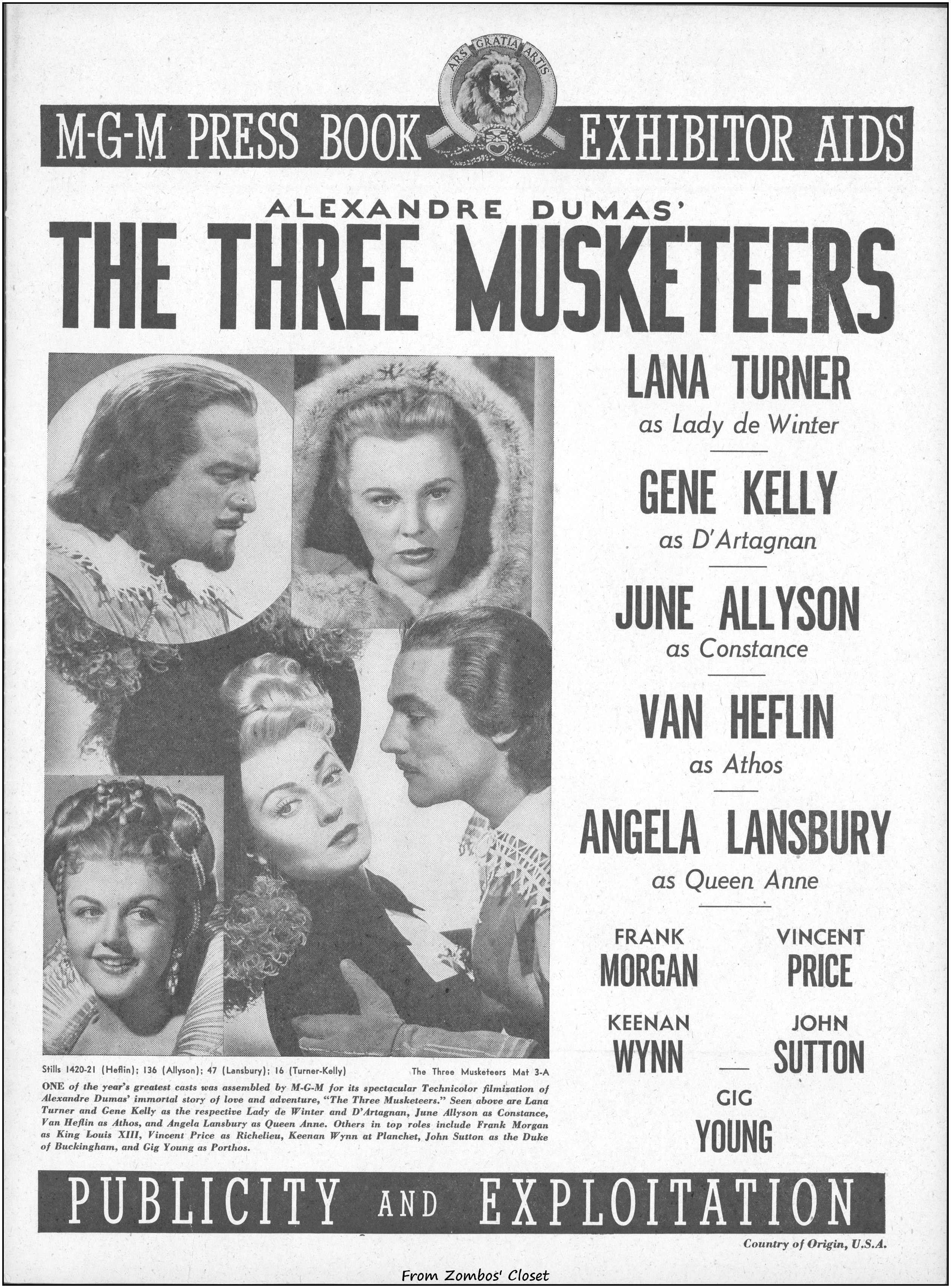
Publicity and Exploitation Pressbook

A classic swashbuckling take on the Alexandre Dumas novel, The Three Musketeers is an exhilarating ride. Gene Kelley has a field day with all the athletic swordplay and derring-do. Director George Sidney makes it a rousing, light-hearted, romp in sumptuous technicolor. With Vincent Price, Van Heflin, Lana Turner, Angela Lansbury, and June Allyson, how could you go wrong? This was Lana Turner’s first color feature, although she didn’t want to do it. After a suspension and some convincing, along with a stronger rewrite for her character (Countess de Winter), she joined in the fun. According to TCM’s notes, Robert Taylor, Ricardo Montalban, and Sidney Greenstreet were set to play the three musketeers at some point before the final cast was set. Due to a broken ankle, Kelly did his fencing scenes toward the end of filming. All told, it was a money-maker for MGM.

This is the separate Publicity and Exploitation section of the main pressbook, of which I’ll post soon. As usual with MGM pressbooks, it was printed on newspaper sheets, one-sided, so I’ve raised the white balance to approximate how it looked before age and acidity set in.

Three Musketeers 1948 pressbook

Holt of the Secret Service Movie Herald

I posted the Columbia serial pressbook previously. This is the theater herald. Heralds were given out to patrons at the movie theater (or could be distributed through local newspapers), usually before the picture ran, to promote attendance. Heralds came in various sizes and this one is rather long to grab attention. Theaters would print their location on the herald, so room was left for that either on the back side of a one-page herald or on the last page of a four-page one. Heralds were one printed sheet and, depending on the size, could be left unfolded (making two pages) or folded (making four pages). Spanish movie heralds differed from the English theater heralds mostly in size. English heralds leaned to larger sheets while the Spanish heralds were pretty small, pocket-sized, you could say, and two pages. But some of the art on the Spanish heralds is really awesome, like on their lobby cards.

The oldest herald in my collection, so far, dates from 1926 and was for a stage play called The Cradle Snatchers (with a third-billed Humphrey Bogart). For an example of a Spanish herald see The Lady and the Monster. Heralds also came in tabloid size and comic strip style! See Invaders from Mars for an example.

I’ve posted a lot of heralds so do a search on “herald” and experience the art of printed promotion.

Holt of the Secret Service movie herald

Mad Max Beyond Thunderdome (1985)
Pressbook

The third entry into the Mad Max franchise, Mad Max Beyond Thunderdome boasts a good soundtrack ,Tina Turner, and a chart-topping song, We Don’t Need Another Hero. It also boasts one of the rare times that critic Roger Ebert awarded four stars to a science fiction post-apocalyptic actioner. Like he said, “the fight between Mad Max and Master-Blaster is one of the great creative action scenes in the movies.” This Columbia-EMI-Warner British pressbook isn’t too shabby either. You wouldn’t think a movie like this would get promotional items like a crossword, maze, word search, and spot the difference newspaper competitions, but there you go. At a $10,000,000 cost, the movie netted $36,000,000 at the box office, though less money than its two predecessors. Its effect on popular culture in general, and the apocalyptic, dystopian, and wild hairdos in future movies? Priceless.

Mad Max Beyond Thunderdome 1985 pressbook

Movie Star, American Style (1966) Pressbook

LSD was all the rage in the 1960s. This acid-trippy comedy, Movie Star,  American Style or; LSD, I Hate You, however, was about Dr. Horatio and his LSD therapy for Honey Bunny (Paula Lane) and assorted other spaced-out patients. Unhinged comedy ensues, with a tinted acid trip sequence to fulfill the LSD requirement. One would think AIP came up with this one but they didn’t. The 1960s and 1970s produced much ‘looser’ storylines in movies as television kept the candle burning for purity and social stability (for the most part: there were exceptions). Those two decades though, in the movies, were anything but pure and socially stable. They were great, however, for cheeky stuff (or horror), and adult themes finally making their way to the silver screen. What’s really wild? The tie-in to Streamline Trailers. The tie-in to bedding is pretty funny too. Robert Strauss (he played Animal in Stalag-17), was adept at comedy and drama, with a unique voice and face that could be menacing or comical at the drop of a hat. He was a familiar face on television in the 1960s and 1970s, aside from his many movies.

Movie Star American Style or LSD movie pressbook

The 27th Day (1957) Pressbook

An intriguing movie from the cold war era (or rather, the first one), The 27th Day involves an alien from a dying planet giving five persons the ability to destroy human life on a massive scale. Is it a test? Is it a trick? Directed by William Asher, who did a lot of television-episode directing for I love Lucy and Bewitched, and a screenplay by John Mantley (author of the novel), who went on to write for Gunsmoke, The Wild Wild West, and Buck Rogers in the 25th Century, the story has themes of global destruction, communism, and political tensions that are still relevant today. William Asher also directed the AIP beach party films of the 1960s and a forgotten slasher called Butcher, Baker, Nightmare Maker 1981 (check out Moria for more information). The one shot of the alien spaceship interior is taken from Earth vs. The Flying Saucers (both that movie and this one were produced by Columbia).

the 27th day movie pressbook

Terror at Black Falls (1962) Pressbook

It Came From Hollywood rides into town with this pressbook for Terror at Black Falls, which was shot in 1959 but hit theaters in 1962. You would be surprised how many westerns use the word ‘terror’ in their title.  Gary Gray had this to say about the picture (from Growing Up on the Set: Interviews with 39 Former Child Actors of Classic Film and Television, by Tom and Jim Goldrup):

The last movie Gary worked in was Terror at Black Falls, which was filmed on location in Scotland, Arkansas. “Kind of an arty western, released back in Arkansas then disappeared. Richard Sarafian had written, produced and directed this show. It was in black and white; the budget was nothing. The film was a lot of fun, and there were some good actors in it like House Peters Jr. and Peter Mamakos. I remember an old guy who lived there, about 98 years old and blind at the time. He’d never been over ten miles away from Scotland. They had just gotten some indoor plumbing in some of the places. The people of Scotland, Arkansas, couldn’t have been nicer.”

While the movie was low on the dollars, the poster art is still wonderful. How many times has a movie survived solely on the lead-in provided by the poster art? Of course today you have word of mouth (aka the big-mouth of social media) to either sink or swim a movie.

Terror at Black Falls movie pressbook Terror at Black Falls movie pressbook Terror at Black Falls movie pressbook Terror at Black Falls movie pressbook

Destroy All Monsters
Movie Radio Spots!

Destroy all monsters movie poster

Don’t touch that dial, this just in from Granny…

Greetings, my children…

Here’s a question for you: What’s better than one or two giant monsters in one movie? The answer? Eleven!!

Yesireebob, Toho really outdid itself when it released its all-out monster spectacle Destroy All Monsters in 1968. Developed as a kind of finale to the whole Godzilla series due to declining box office receipts, the producers thought, “Why not?” and decided to go out with a bang, and developed a story that would feature most of their famous giant monsters.

What a collection! The monsters featured include Godzilla, Anguirus, Rodan, Manda, Kumonga, Varan, Baragon, King Ghidorah, Minilla, Mothra, and Gorosaurus. The final battle of the good-guy monsters against King Ghidorah set at the base of Mount Fuji tasked the costumed performers and the wire-specialists to the hilt. It was spectacular and every monsterkid’s dream.

Aside from the giant monsters, the movie featured spaceships, flying saucers, female aliens, mind control, a moon base, and great miniature and special effects work. You all know my appreciation for Toho’s great miniature department, and the scene of Gorosaurus rising up from underneath the Arc de Triomphe in Paris is one of the best anywhere! The way the miniature breaks apart and topples amazes me every time I see it!
American International Pictures released only four radio spots for the American release and they are really good, although they only highlight four monsters, not the eleven fans get to eventually see. Each of the four destroys a city before teaming up against Tokyo and the radio spots reflect the excitement.

So, while you are listening, visualize the chaos and destruction, and let your battle-cry be, “DESTROY ALL MONSTERS!”


Destroy All Monsters 30 and 60 seconds radio spots!


destroy all monsters movie ensemble of monsters
The monsterific cast. Haruo Nakajima as Godzilla leads the other performers in the classic battle royale finale.
Destroy all monsters arc de triomphe scene
Gorosaurus rises up beneath the streets of Paris to topple parts of the famous Arc de Triomphe. The incredible miniature breaks apart in a most realistic way, depicting the sheer mass of the structure.

Do you have any radio spots you would like to share? Contact Granny (Gary Fox) at [email protected].

The Comics Code
20 Years of Self-Strangulation?

Here’s an interesting read for you older comic book geeks (like me) who remember the days of the comics’ code and its impact on both the comic and magazine racks. This article is taken from Inside Comics, issues 3 and 4, 1974. For you newbies, the Comics Code Authority (CCA) was formed in 1954 as a voluntary alternative to government regulation of the content in comics. It followed after a “moral panic” arose over the graphic violence, sexuality, gruesome horrors, and the supposed effect on juvenile delinquency, that comics packed in every issue.  Said panic was promoted by one Fredrik Wertham, a psychiatrist, who wrote a book called Seduction of the Innocent. While he came to be reviled by comic book fans, it should be said that he was a progressive shrink who treated poor black patients at his Lafargue Clinic (from Wikipedia), and “his institutional stressor findings were cited when courts overturned multiple segregation statutes, most notably in Brown v. Board of Education.” So he wasn’t all that bad, just misguided about comics.

EC Comics (which is now legendary for the horror titles it put out during the 1950s), and William Gaines, its publisher, took the ire of the senate judiciary subcommittee’s hearing to investigate juvenile delinquency after Wertham provided his light-the-bonfire testimony. As noted on CBLDF.org:

As for Gaines himself, the hearings changed his course forever: Gaines’ deep resentment of Wertham’s assertions and the impact of the Senate hearings colored his attitudes towards publishing. To escape the regulation of the Comics Code (and the dwindling comics sales he saw after the code was enacted), Gaines founded Mad magazine, encouraging cartoonists to lampoon authority. The magazine became a powerful influence on cartoonists and activists in the years to come.

Ironically, while the comics code “tidied-up” comic books, as one newspaper article of the time wrote, it forgot about the magazine rack. Magazines were not covered by the code. The horror, adult themes and images, and, frankly, the more entertaining aspects of storytelling moved over to the larger size format and into titles that included Creepy, Eerie, various Marvel horror and superhero titles, Skywald “horror mood” titles, and, continuing the irony, a reprinting of many of the 1940s and 1950s horror stories that spurred the comics’ code into existence in the first place (albeit in chilling black and white instead of color).

By 2001 Marvel dropped adherence to the comics code as it lost its relevance in the real world that it forced comics to hide from. But even before that, in 1971, Marvel ignored the somewhat confusing comics code rules with issue 96 of The Amazing Spider-Man, which contained a story about drug addiction. For the first time the code’s seal of approval did not appear on that issue. I can’t tell you how thrilling that was for me, and many comics fans of the day, to finally see that. We buzzed about it in the neighborhood for weeks.

Stan Lee made the decision to run with the issue without the code after the Nixon Whitehouse asked Marvel to do an anti-drug story. Lee went to the code people for approval and was turned down.  Go to CBR.com for more information.

The Comics Code from Inside Comics Magazine The Comics Code from Inside Comics Magazine The Comics Code from Inside Comics Magazine The Comics Code from Inside Comics Magazine The Comics Code from Inside Comics Magazine The Comics Code from Inside Comics Magazine