From Zombos Closet

Comics Book Review: Ragemoor 1

20120326124257_001Zombos Says: Very Good

While I now only read graphic novels and trade paperback compilations of comic books–usually, anyway –this first issue of Ragemoor drew my attention because of Richard Corben's involvement.

Any Eerie, Creepy, and Heavy Metal magazine reader knows the name well. That this issue is also printed in brooding black and white only heightened it's appeal for me. And with writer Jan Strnad (who also wrote for Warren Publishing), the mood is assuredly sinister, the tone Gothically charged, and the foreboding future hinting at ancient monstrosities biding their arcane time until the moment's ripe for terror.

This first issue introduces the blood-drenched history of the rambling edifice as Herbert futilely warns his Uncle and companion to not spend the night at Castle Ragemoor, whose walls are alive with malevolent purpose and mystery. Herbert blames his brother's madness–he wanders the halls naked, peeing on the walls–on the castle's evil influence. His uncle thinks it all poppycock, mostly because he's looking to inherit the place after having Herbert committed.

After being shown to their rooms by Herbert's lone servant, Bodrick, his uncle and companion learn how dangerous the castle can be as parts of it come alive with a vengeance.

Corben's art is vibrant and propels the story's menace. Strnad's words explain only a little, leaving much more to be revealed, and allow Corben to show the dread. With Ragemoor's grinding movement of stones in the dead of night producing new rooms and longer hallways, what else may happen to Herbert and his future guests  is uncertain, but certainly will be deliciously deadly.

Magazines: HorrorHound 34
Dark Shadows, Lee, Hammer DVDs

Zombos Says: Very Good

For Dark Shadows fans, Horrorhound34HorrorHound issue 34 has two very interesting articles on the original soap opera series and its creator, Dan Curtis. There's also a bland, Extra-depth, interview with director Tim Burton that eschews any meaningful exploration of his motivations or intentions in reimagining the series into a Beetlejuice-styled quirky mix of humorous vampire Gothic. Burton even pretends to not know his movie's being referred to as comedy Gothic, and seems reticent to acknowledge how different his approach is to the original series. Unfortunately, the interviewer lets Burton's answer-pablum remain fluffy, which left me unsatisfied. 

Jessica Dwyer's mind-boggling retrospective on Dark Shadows not only covers the many rich–and confusing–storylines the show ran through during its 6 year run, but liberally illustrated throughout her article are the comic book covers, paperback covers, toys, bobble-heads, model kits, and other mechandise the show's popularity produced. She also gives a concise television and movie production history for Dan Curtis in her second article, The Man Who Built Collinwood, which is essential reading for younger fans who may not fully appreciate Curtis's influence on horror television and the vampire romance theme he solidified with Barnabus Collins.

In addition,  Christopher Lee (he plays the manager of the Collins fishing fleet in Burton's movie) is highlighted in a movie retrospective compiled by Aaron Christensen, which neatly bookends Nathan Hanneman's Hammer on DVD list. As Christensen's title alludes to, Lee's movie range contains "the good, the bad, and the Ughhhh, Lee." I won't admit its good or bad, but one of my favorites covered is Mario Bava's Hercules in the Haunted World

All in all, a very good issue to spend a few hours with.

Graphic Book Review: The Black Forest

Tbfmonsters

Zombos Says: Very Good

Hankering for an old-styled, light-hearted, comic book classic monster fest? Livingston, Tinnell, and Vokes may have one for you in The Black Forest graphic novel.

The story takes place in 1916 during the Great War, and the German army, through an especially evil scientist, is trying to find a way to revive dead soldiers (yes, zombies!). Holed up in the Black Forest in Graf Orlock’s castle no less, the especially evil mad scientist feverishly toils away using Dr. Frankenstein’s crib notes of life and death for his experiments, and the Monster to aid him.

Enter our valiant but foolhardy American hero, Jack (not sure why every valiant but foolhardy American hero is always named Jack or has a monosyllabic name), and Archibald Caldwell, magician and occultist, who, like real-life magician Jasper Maskelyne during World War Two, uses his special skills to assist British Intelligence in the war effort.

The black and white panels are reminiscent of Harvey Kurtzman's comical characters combined with a dash of Gene Colon's fluid and dynamic panels. This is another graphic novel that cries out for a magazine-sized format to fully appreciate the artwork. It needs a few more pages, too, especially the monster battle royale toward the end between the Frankenstein monster, the werewolves, and the vampire Graf Orlock.

There are Alan Moorish bits throughout, like Caldwell’s ability to regurgitate lock picks he has swallowed, a skill Houdini put to good use, and Caldwell’s dead wife is pickled upright under glass, in a panel very similar to the scene in The Black Cat, where Vitas Werdegast’s wife is preserved by his arch nemesis, Hjalmar Poelzig, the evil cult leader. Boy, these evil guys all think alike, don't they?

The adventure is written in a pulp-style and is fast and furious. I highly recommend it to anyone who likes a ripping good yarn with classic monsters, evil scientists, and heroines in need of rescue.

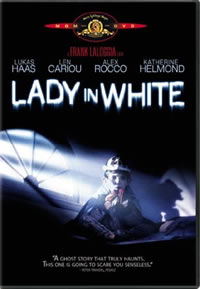
Lady In White (1988)

LadyinwhiteZombos Says: Very Good

As the sun waned, I moved into the study and popped the Lady in White into the DVD player. After our Hostel experience, I wanted Zombos to watch a more
subtle and traditional horror movie: one that treats murder and depravity in a respectable and nostalgic way.

It’s 1962 in Willowpoint Falls, and in the opening montage, director Frank LaLoggia introduces us to the small town during Halloween, and to the Scarlatti family’s eccentricities. Told as a flashback by the older Frankie Scarlatti (played by LaLoggia), we see the story lightly filtered through his memories as the sensitive young Frankie (played by the big eyed and big eared Lukas Haas) let’s two bully boys trick him into getting locked into the classroom’s foreboding cloakroom. All alone, and a stone’s throw away from a cemetery to boot, Frankie soon falls asleep on the top shelf of the closet, by the window.

An in-camera time lapse shot, done through the half-moon window of the cloakroom looking onto the cemetery, reminded me of a similar effect used in Hammer’s Horror of Dracula, where the sunlight rapidly fades to darkness as seen through the tomb’s window. Darkness is not a good thing when facing vampires or when locked in ominous cloakrooms on Halloween night, to be sure.

When 10 o’clock rolls around, it’s quiet, darker still, and also time for the murder mystery and ghost story to begin. Right off the bat I can identify with Frankie: he’s wearing a black cape
and a Bela Lugosi mask. In a later scene in his bedroom, he also has the Aurora monster model kits displayed in all their magnificence.

That certainly brings back memories for yours truly. But I digress.

An eerie reenactment begins as Frankie wakes up from a bad dream involving his dead mother. A cold blast of air enters the room, along with the ghost of a little girl, laughing and
playing. An interesting touch here is that this is not an atmospheric haunting, where events merely play over and over again, but the ghost of the little girl responds to Frankie’s presence in the room. She seems as startled to see him as he is to see her. But past events must still play out, and soon she is callously murdered by a shadowy adult figure.

Using a black screen process to create the transparent apparition of the girl, the scene is a harsh contrast to the lighter tone presented earlier in the movie, and sets up the next, more
violent scene, where young Frankie finds himself in the unenviable position of sitting on the top shelf of the cloakroom when the real child-killer enters, looking for something that he had dropped into the floor grate after strangling the girl.

The killer realizes he is not alone and shines his flashlight onto the small black caped form, wearing the Bela Lugosi mask, sitting in the corner of the top shelf. Frankie tries to escape,
but quickly has the life nearly choked out of him. An effective out of body experience has Frankie meet Melissa Ann, the ghost of the little girl so cruelly murdered long ago. He finds out she is trying to find her mom. Frankie is brought back to consciousness and he is soon delving deeper into this mystery for us.

True to form for the 1960s thematic, the school janitor, an African-American, is found drunk in the basement and is immediately blamed for the attempted murder of Frankie and the murders of 11 other children, including Melissa Ann, who was the first.

Reminiscent of To Kill a Mockingbird, the movie maintains a good balance between the fanciful, Frankie’s adventure with the ghostly Melissa Ann against the blue-lit night scenes in the fairy tale stylized woods, and his coming of age and the painful loss of his mom. This theme of loss is borne also by the ghostly Melissa Ann who is looking for her mother, the ghost of her mother who is looking for Melissa Ann, and not to give too much away, one sister mourning the loss of another.

LaLoggia, who oddly enough grew up in an urban environment, creates a charming small town nostalgia and through the use of carefully controlled colors and lighting brings the hues of autumn inside to his interior scenes. The pharmacy window decorated for Halloween and the classroom scene where Frankie reads his monster story to the class is filled with shades of orange, yellow and the various colors of crisp autumn leaves.

In stark contrast, he uses reds and blues to denote the darker side of this story, and effectively uses dimmer panels to bring the light down or up to transition between important story
points in the scene. The overall mood of the movie changes from charming to alarming and back to charming as the story unfolds to its incendiary ending atop the cliffs by the white cottage. LaLoggia’s simple, old-time, approach using in-camera effects combined with basic process shots build his story in an economical but creative way. Like a good ghost story, simple elements combine to create an ethereal dread, making Lady in White a memorable movie.