From Zombos Closet

Book Review: Zombie Island
A Shakespeare Undead Novel

Zombie islandThe play's the thing, and in Lori Handeland's Zombie Island: A Shakespeare Undead Novel, that play would be The Tempest, wherein Prospero's  temperate isle becomes the fertile ground for raising zombies, or tibonage as they are known by necro-vampire William Shakespeare and his fair chasseur (zombie hunter) amour, Kate. This is the second book in Handeland's adventures of the vampiric Bard and his beloved Dark Lady of the sonnets, but stands alone well enough to keep you happily marooned, along with them, for its 250 and some odd pages.

The zombies are as balmy as the island's weather, so this is not a tome for hardcore gore fans. With the undead's constant "Brrr!" murmurings, they're the all- the-brains-you-can-eat phenotype of walking dead risen up from the shipwrecked and doomed crews Ariel's tempestuous storms swell onto the shore.

Ariel, the magical spirit Prospero freed from a tree, is bound to his bidding, although she hates killing so many innocent people for Prospero's mad dream of retaking his lost throne. Ariel's feminine gender here–in Shakespeare's play Ariel is a man–plays an important part: she's blue, fetchingly flies around naked, although invisibly, gives off impressive sparks when angry, and yearns for an emotion she doesn't understand. Calaban helps her with that, but he's all paws and razor claws which presents some tactile issues to surmount.

Emotional and tactile interlocutions abound as much as the zombies, providing the true bite and sustenance on Zombie Island. This is a love story: Prospero loves to have more zombies; the zombies love to have more brains (to eat); Shakespeare loves to hold Kate within his arms; and Kate loves for Shakespeare to hold her in his arms.

She also loves to kill zombies, and that's why she finds herself, at Ariel's scheming, on the island. Ariel creates the zombies, she wants Kate to kill the zombies. All works as well as could be given the circular reasoning of one magical sprite desperate to stifle Prospero's plans, but Shakespeare's unexpected arrival on the island, while at first beneficial, becomes problematic. Being a necro-vampire, he can easily raise the dead into zombies at the full moon. If Prospero finds this out it could thwart Ariel's plan.

Handeland intertwines Shakespeare's familiar words with his vampire counterpart's visions, emotions, and speech into breezy reading through the chapters. All players are directed with their needs, tempers, spleen, and desires foremost, and with romance while zombies go about their business. There is no strutting to fret about here; only a simple and enjoyable tale of love and zombies' labors gained and lost. Just add a banana daquiri or coqui, sip it while stretching idly on a tropical beach as you pause between Zombie Island's chapters, and read on. 

A courtesy copy was received for this review.

Dark Shadows (2012)
No Dark, No Shadows

ScreenHunter_16 May. 14 11.02

Zombos Says: Fair

Listen to Movie Review

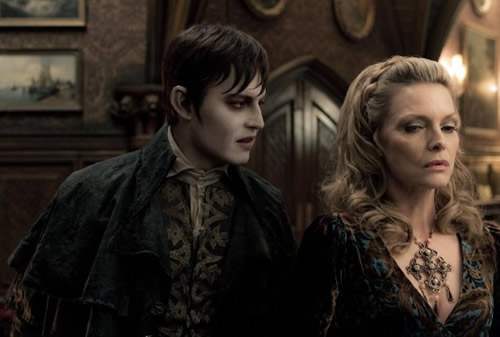
Up until that big letter “M” appears on screen (trust me, you can’t miss it), Tim Burton and Seth Grahame-Smith’s incarnation of Dark Shadows broods deeply in its Gothic sensibility of ill-considered trysting and vengeful witchcraft. Then it falls apart, leaving Johnny Depp’s Barnabus Collins a floundering vampire fish out of suitable waters. With strikingly lifeless humor (“gonzo comedy” Burton? Really?), no serious bedevilment to beguile us, no involving supernatural romance to entrance us, and no fully realized characters to relate to, this amalgam of familial oddities and cobbled scenes such as Barnabus carrying an umbrella and wearing dark sunglasses in the sunlight, Barnabus calling Alice Cooper the ugliest woman he’s ever seen, Barnabus showing much more energy for revitalizing his family’s fishery business instead of wooing the reincarnation of his lost love, Josette DuPres, for whom he had jumped off a cliff to kill himself after she plunged first, and Barnabus mesmerized by a lava lamp filled with bobbing red wax, well, it all amounts to a perfect example of what “stupid creative license” is all about.

The costumes are pretty, the Collinwood Mansion divine–it has more substance than anyone living in it–and Depp’s performance is perfectly primed for chilling connivance, but none of these are knitted into a continuous thread: there is no clever campy humor, no attunement to 1970s grooviness, and no seriously despairing cursed vampire to propel the story’s purpose. Burton shows us everything but Grahame-Smith tells us nothing. Whatever Gothic horror romance the original television series had in its rich storylines, none of it shows up here. If you’re a fan of the original series, you probably won’t like this lackluster interpretation; if you’re new to Dark Shadows you won’t find enough to understand why the original was so important to horror fans and the genre.  Simply put, nothing is added, but much is taken away.

And then there’s the werewolf.

It pops in at the end with a quick explanation, just to spice up the showdown between Barnabus and Angelique (Eva Green). She’s the saucy witch who cursed him back in the 1700s because he refused to love her. She’s still around, running the Angel Bay Fishery that put the Collins’s out of business. Their battle, the movie’s ending, is as well envisioned as the movie’s beginning, before that big “M” I mentioned before appears, to lead us into the interminable middle portion of churning indecisiveness, wasting the talents of Jackie Earle Haley as Willie Loomis and Bella Heathcote as Victoria Winters.

The story has Barnabus accidentally dug up and freed from his iron coffin where Angelique entombed him. He makes his way back to Collinwood Manor, after putting the bite on a vanload of hippies, and finds his former home is now rundown and its inhabitants in the same condition. There’s matriarch Elizabeth Collins Stoddard (Michelle Pfeiffer) who keeps her knitting in a secret room; Dr. Julia Hoffman (Helena Bonham Carter), who, although she was hired to treat young David Collins’ (Gulliver McGrath) delusion of seeing the ghost of his mother, three years later she’s a failure and seems to do nothing but drink a lot and sponge off the Collins clan (so I wonder why she’s still at Collinwood); Roger Collins (Jonny Lee Miller), is the ne’er-do-well of the family; and tuned-out, groovin’ to the music, is Carolyn Stoddard (Chloe Grave Moretz) who hates her family and wants to move to New York just to spite Elizabeth.

Carolyn’s the one Barnabus turns to for advice on how to woo Victoria in such modern times (1972). A centuries old vampire seeking advice from an ill-behaved and spoiled girl isn’t very funny. She also gives advice on who Barnabus should have for entertainment at his Grand Ball, the event he wants to throw to flaunt the rebirth of Collinwood to the townspeople of Collinsport. She recommends Alice Cooper. Sure, why not? When you’ve got nothing in the script that works, Alice Cooper’s a sure bet to pad some minutes around.

The money to refurbish Collinwood to its former glory is revealed by Barnabus the night he returns: stairs underneath the fireplace lead through a mirrored passageway to a treasure room. As Barnabus leads the way carrying a lantern, Elizabeth sees the lantern reflected in the mirrors, but not Barnabus. (A similar scene can be found in Mario Bava’s Black Sunday.) Realizing Barnabus is actually who he says he is, Elizabeth keeps his secret. The banter he has with the Collins clan when he shows up at breakfast for the first time is as colorless as his pasty face. Dr. Hoffman sobers up enough to become suspicious and hypnotizes Barnabus to learn the truth. Of course, with Barnabus dressed and looking like Nosferatu, it’s not a stretch for them or us.

Ghosts do roam the halls of Collinwood Manor.  If only the spirits of Gothic mystery and romance roamed there as well. But there’s no ghost of a chance for that in this movie.

Professor Kinema Takes a Trip to LA

On a recent trip to California, Professor Kinema was kind enough to pick up a fitting souvenir for me. I’m wearing it in the photo, standing in front of–what else?–a closet. Every now and then I like to let my lucha libre out.

me wearing a lucha libre mask
The professor also paid a visit to the mecca of forgotten movie videos, Eddie Brandt’s Saturday Matinee in North Hollywood. Here are his pics to familiarize yourself with this important bastion of VHS treasures (and trash, too!).

Eddie Brandts
Eddie Brandt
Eddie Brandt
EddieBrandts04
Eddie Brandt

Zombie Tarot Deck

A smart retro design of classic  zombie and 1950s motifs across these 78 cards, based on the Rider Waite Deck, make this zombiefied Tarot Deck perfect for Tarot Card readers who love the undead, and horror fans who love to give and receive unique zombie gifts.

Replacing the Coins/Pentacles suit with Hazards (although each card’s meaning is the same), the deck maintains the Major Arcana cards (like The Fool,  The Priestess, and The Magician, Strength, etc.) and the Minor Arcana suits (Swords, Wands, Cups, and Hazards). A small booklet of instruction is included, but read it more for the zippy zombie slant than for really learning how to do readings with the deck (see the blurb). There are plenty of books available on the meaning and reading of tarot symbolism.

Strength Card– Your strength comes from within; you’ve stared down the zombie horde and they blinked first. Or they would have, if only they had working eyelids. You’ve learned to trust your instincts and stay on your chosen path. Use that same resolve to cowboy up when the zombies get their second wind.

By the by, the turbanned-zombie face peering out from the box is Alexander, a vaudeville Mentalist back in the 1920s. His tagline was “The Man Who Knows.” He retired in his forties, quite rich from his stage act, and in his retirement explored the spiritual realm.

I highly recommend you explore your own spiritual horror realm with this neat zombie tarot. I’m hoping a zombie Quija is just around the corner.

zombie tarot cards

A courtesy deck was provided for this review.