From Zombos Closet

La Invasion De Los Muertos (1973)
Mexican Lobby Card

La Invasion De Los Muertos screams 1970s by the look of this lobby card. Zovek looks like he's channeling Billy Jack. Here's the lowdown from The Zombie Movie Encyclopedia by  Peter Dendle: 

There's no real explanation for the unhappy catastrophe afflicting the Mexican countryside–just a lot of talk of the mysteries of the cosmos and shots of a starry sky. Whatever's to blame, the dead return from their moldy coffins with blank stares and a thirst for murder. Congregating in large groups, they choke and maul their victims and then tip over the furniture for good measure…Most interestingly, these zombies have an unprecedented fetish for vehicles: they hover around a bulldozer, and make off with any car or truck the keys have been left in.

La Invasion De Los Muertos Mexican Lobby Card


Book Review: Portlandtown
A Tale of the Oregon Wyldes

Zombos Says: Good

The gifted Wylde Family runs a bookstore in Portland, Oregon, a soggy place most of the time, both inside the bookstore (I’ll get to that) and outside the town. The mayor wants the rain festival to be very wet, which complicates matters as zombies invade the flooded town (I’ll get to that also). I won’t get to why the mayor and the town celebrates rain, but you’ll be able to figure that one out on your own.

Joseph Wylde is legally blind, but he still see’s more than most other people, and his wife Kate has the uncanny ninja ability to make herself unseen. Author Robert DeBorde doesn’t explain these abilities much, but they come in handy when Portland’s mayor comes calling with an odd matter or mystery for them to work on, knowing they are a unique pair of sleuths who can handle the unusual. They’re like a Wild West version of John Steed and Emma Peel in The Avengers television series, without their eccentricities.

While the mayor is preparing for the rain festival he asks the Wyldes to investigate the mysterious storm totem statue he’s acquired, hoping it will unleash a steady flow of droplets for the festivities and make him look like a demi-god as he calls forth the rain with it. He does, it does, and he ends up looking less a demi-god and more a horse’s behind, but the torrential result provides the rapid climax to Portlandtown: A Tale of the Oregon Wyldes. Unfortunately for the Wyldes, early experiments with the storm totem while in the bookstore prove successful.

Kick and Maddie, the Wylde kids, are Hardy Boys and Nancy Drew-ish spunky, and lend a hand as needed when not helping to run the bookstore. Their family business becomes very lively when the walking dead come to town. The zombies are courtesy of one formerly dead gunman who comes back to settle an old score and rack up a few new ones. He’s the Hanged Man, and aside from the spellbook he uses to come back to life, he also brandishes a handgun that doesn’t need to be reloaded and doesn’t miss its target. The gun’s handle is also colored red–some say it was stained red from the blood of its victims. Kick and Maddie wind up playing bobbing apples to the zombies dunking for them in the flooded streets of Portland, providing much of the energy of the novel’s showdown between the marshall who put him six feet under, and the Wylde family member who helped (and barely survived the ordeal).

The marshall is Jim Kleberg, Kate’s dad, and his memory of past events, and how he wound up keeping the deadly handgun, come to light slowly, through flashbacks and remembrances. As he remembers piecemeal, more graves are dug up, more dead rise, and various characters who aren’t overly fleshed out in this first entry in the series come into play.

The spellbook belongs to Andre in San Francisco, who, with his mysterious female assistant, fight supernatural monsters like the Hanged Man. Not lost on Andre is his culpability in creating such a monster, so guilt drives him as much as his duty. The sorceror’s cookbook appears to contain enough promising evil spells for future novels, so let’s see what DeBorde can cook up using it. How Andre and the Wyldes mesh is not fully explained here, leaving much room for backstory in a subsequent novel.

A rousing shootout at a traveling carnival sideshow when the Hanged Man reanimates, after reluctantly being sold to the proprietor as an attraction, perks up the middle of the story, and the Hanged Man’s unsavory ability to raise the dead as he passes near them creates a modicum of suspense. I’d expect townsfolk would be more alarmed and more confused when their relatives come back to bite them, but DeBorde keeps it low-key and never capitalizes on the gruesome or kinetic potentials of having so many feisty undead lumbering around.

Keeping his words between young adult in tone and historically informed but not preponderantly so, DeBorde doesn’t pile up events or action quickly, and his fairly straight trail of characters’ bad decisions (like digging up the Hanged Man in the first place) and wicked intentions (what the Hanged Man does directly and indirectly because he’s so darn bad), is easy enough to follow. His paragraphs and interludes can be bland at times, or quaint–take your pick, but DeBorde provides clean starting and ending points with some keystones left unturned in-between.

Writers with a hankering for continuing series tend to do that. The only advice (or hope) I’ll mention is that the second novel in the series, should it come to that, better switch from sarsaparilla to whiskey. Reanimating Readers will need something stronger to mosey down this trail again.

Mexican Lobby Card: The Human Duplicators

I don’t believe Lon Chaney’s Phantom of the Opera appears in The Human Duplicators, but this card makes effective use of his horrific face. Richard Kiel (Jaws) also stands out as the monstrous villain holding one victim’s head while dangling another barely dressed victim from his massive arm. Surprisingly, this illustration is taken directly from the American poster, and is not a figment of some underpaid, but highly creative, Mexican artist’s mind (just an American one).

Humanoides Asesinos Mexican Lobby Card

John Dies at the End (2012)
No Spoiler There

John-dies-at-the-end-movie-image
Zombos Says: Very Good

Major spoiler here, sorry, but John (Rob Mayes) doesn’t die at the end of John Dies at the End. He actually shuffles off his mortal coil somewhere in the middle. But being under the influence of the mystical “soy sauce” does have its perks: he can make phone calls from the afterlife, no cell carrier needed, and he can see forwards and backwards and slantways in time, which can be a head trip in itself for a guy who’s already a few Froot Loops short of a full bowl. For the rest of us, better pay attention because linear is not a working adjective here.

Also out of step is his partner in supernatural investigations and fumigations, Dave (Chase Williamson), but Dave’s more practical. He changed his last name to Wong so he’d be harder to find. Until the soy sauce chooses him. The drug either likes you or kills you, and that’s on a good day, but it seems to have a grand-scheme-plan in mind for John and Dave. With all the time-tripping, reality-tripping, and dimension-tripping going on, they have their hands full and need all the soy sauce and dumb luck available to stay alive, even if they’re dead now and then. A garden shed full of weapons and other useful artifacts in their fight against the weird incursions into their small Illinois town provides additional help. So does the ability to see things out the corners of their eyes, like big long-legged bugs clinging to ceilings,  when nobody else can.

Think Stoner movie like Altered States, but instead of isolation tanks or cannabis smoke, the highs come from soy sauce, a mind-expanding, reality-trashing, hypodermic-delivered drug that’s a little X-Files black goo, a little Prometheus‘s black goo, and icky black goo in general, but with more short hairs and a meaner attitude spiking it. It can even morph into flies to make you say ahh and take your required dosage when needed.

Don Coscarelli directs this wild trip of a movie by capturing the wild trip of the novel’s events and temperament, visually and semantically, although obfuscation by everyone involved is the norm for both novel and movie. Lots of quirky visual effects like flacid doorknobs you’d go blind touching, a smart one-eyed monster with a lot of tentacles and world-domination on its mind, flesh eating gnats with human hosts on their hive-collective mind, and an absurdity-breaching, brilliantly executed, animated cartoon gorefest,  showing what happens when giant spiders meet unlucky people, stretches this budget’s limitations to the max.

Loony tuned? Yes. But Coscarelli knows how to mix practical and computer effects for that cult movie affect with whatever small budget he’s given and still emote effectively through all the zaniness. One wonders what other mysteries, left unexplored, might have dazzled us with him given a little more production pocket change. Yet more money gets siphoned into empty tanks like Texas Chainsaw 3D, while creative edge-pushers like Coscarelli  get bubkiss.

Talk about absurdity.

Where the goo comes from is a mystery, but Robert Marley (Tai Bennett), the Jamaican with the drugs, taps into it with bad results. Once people start tripping with it, doors to other dimensions open up and things that were waiting for the opportunity can now step over the threshold. This is the premise of both novels, John Dies at the End and This Book is Full of Spiders. Thwarting the monstrosities plotting our demise is not only John and Dave, but super psychic and gadfly to the other-worldly menace, Dr. Marconi (Clancy Brown). He can  destroy freezer meat monsters with a phone call, and he handles Russian weapons of mass destruction, needed in a timely fashion, with ease. Dave’s one-handed girlfriend Amy (Fabianne Therese) also plays a key role by using her missing hand.

Everything’s told in flashbacks as Dave meets up with Arnie (Paul Giamatti), a corduroy suited reporter looking for an interesting story, in a chinese restaurant that’s empty except for the limping waitress and one other patron. Arnie doesn’t buy what Dave’s selling until he learns how to look out the corner of his eye.

Alien nastiness, alternate Eyes Wide Shut worlds, a truck driving dog, an attacking mustache, and the inimitable Paul Giamatti make for a fun time in this cult movie. If Coscarelli doesn’t get more money or the go ahead to do the next novel in the series, This Book is Full of Spiders, I’m going to be very disappointed. Horror movie romps like this are too few and too far between.

Storage 24 (2012)
Alien Storage Hunters

storage 24 on imdb
Zombos Says: GOOD (but last third of movie keeps if from scoring only FAIR)

I don’t understand why the insectoid creature (gooey droppings, menacing mandibles)  in Storage 24 sticks around. After a military plane crashes near a 24/7 storage building in London and it escapes from its cargo container, it stays in the building. Power fluctuations cause lights to go on and off and the electronically controlled gate to drop down, trapping people inside, but the creature bends metal and pummels mortar into powder fairly easily, so I’m at a loss to explain why it sticks around to attack these people, one by one, in tried-and-true horror movie sequencing (or should I say black-and-blue sequencing to be more accurate?). Of course I realize you wouldn’t have much of a movie about a monster in a storage facility if it did leave, but I’d expect to see a little more motivation built into the storyline. Critics like me can be annoying like that.

Of those who want to leave the building, there are: Charlie (Noel Clarke) and his recently ex-girlfriend Shelley (Antonia Campbell-Hughes); Charlie’s best friend Mark (Colin O’Donoghue); and Shelley’s best friend Nikki (Laura Haddock). Also trapped and providing the real potential for red-shirt landing party status, shown in gory closeups, are the storage facility’s front office crew and a creepy unshaven fellow hiding out from his wife by living in a storage unit on the fourth floor. Sure, Charlie and friends can get killed, too, but they need to stick around for most of the running time to keep us invested in the drama, right? Besides, we all like Noel Clarke because he’s been on Dr. Who, so there’s a good reason not to piss us fans off by killing him willy-nilly. He didn’t get the girl in Dr. Who, either, so why beat on the poor guy?

While the creature stays in the building, the men driving in the black SUVs pulling up outside, shortly after the plane crashes, don’t bother to.  Director Johannes Roberts and writers Clarke, Fairbanks, and Small keep the budget well under budget by moving monster, people, and calamity between the storage building’s narrow hallways and tight units. There are no expensive military ops to gung-ho through the storage units with automatic weaponry blazing and macho quips of scrappy do’s and don’ts while they fight and flight. Instead, Charlie  alternates between feeling sorry for himself, being mad at Shelley for ditching him, and working up his anger because she’s tossed him out of her life. It takes him and the others a fairly long time to realize there are more important things in life, like staying alive, especially when screams ensue and people go missing.

As we stay inside with them and the creature, half-way in I wished the writers had seen some American storage unit reality shows like Storage Hunters or Auction Hunters (note the dramatic use of “hunters” in each title).  The UK writers would have realized the wild and dangerous things to be found squirreled away in storage that could provide more fire-power, or survival assurance, for Charlie and company. After Charlie and Mark knee and elbow their way through HUGE air vents (yes, another independent movie takes the shortcut and budget-wise approach for moving characters around cheaply), they only find a crowbar, a few fireworks, and a battery-operated toy dog. Their finds are put to very good use later on, but I was hoping they’d find a grenade launcher or mini-canon. Given the crazy things these shows find in storage units here in America, it’s a let-down to find the Brits are so damn sensible. They should have shot this movie in Texas.

Two-thirds in, the movie finally moves from Charlie’s relationship troubles amid intermittent terror to their creature relationship troubles and continuos terror. Shelley is wrong about Charlie: he may not make her laugh anymore or be very exciting, but he knows how to pluck up when death is a storage unit or two away.  A few well-timed, deadpan delivered, quips from Charlie perk up the otherwise by the numbers action, and the camera’s movement is handled well, especially when the practical makeup and CGI effects mingle. Everyone does the usual dumb-ass actions when confronted by the usual horror-movie-unknown to keep us properly stupefied or mortified.

Not sure if the ending is a good idea, as it cuts into “first” ending (the resolution of the soured relationship and creature menace), but it could make for a fun sequel if the right budget is allocated. Some will lambast Storage 24 for its heavy-handed male-centric view on the relationship breakup, though there is a nice twist with who actually turns out to be the unexciting/you-don’t-make-me-laugh-anymore type. It certainly isn’t Charlie.

Texas Chainsaw 3D (2013)
When a Chainsaw is Not Enough

001 130110
ZC Rating: Fair

Listen to Movie Review

Here are some of the takeaways for me after seeing Texas Chainsaw 3D: make sure to read important letters left to you by dead relatives before you move into their mansions; don’t jump in open caskets in graves in cemeteries you’re not familiar with; women went bare tummy, wore tight jeans held up by wide belts, and traveled in VW mystery machines in the 1990s; stay away from meat packing facilities that have been shut for over 20 years and still have electricity and machinery in perfect running order; don’t look through your cell phone camera when walking in strange hallways filled with dead things; and finally, don’t pay for 3D when 2D sucks just as much.

Now that I’ve gotten those takeaways off my chest, I do have a few nagging questions after seeing the movie, too. For one, why doesn’t the sheriff shoot? For another, why does Heather stay?

There are a lot of things in Texas Chainsaw 3D that irked me; the gore factor is high and palpable (or pulpable, to be more descriptive) without that freakish energy powering up from the drive-in trashy grit and hillbilly inbred insanity the original sparks with.

Another disappointment is how the promises made during the opening scenes highlighting the original’s backstory go unfulfilled. A baby girl is taken after the Sawyer family is killed by local vigilantes fed up with all the Sawyer craziness bringing attention to the small town of Newt, Texas. That girl grows up to be emo Heather (Alexandra Daddario), who creates morbid art from bones, likes slicing meat at the supermarket she works at, and dresses for a different time period than this movie’s situated in.

Or maybe I’m confused. Is she twenty-something or near-forty-something? What time period does this movie take place in anyway?

The creatively commercial, but ill-advised, use of a cell phone would place everything in the present, but Heather’s sexy bare tummy throughout the movie, and the beat-up Scooby Doo-style VW van (it’s like 1974 all over again), and the hitchhiker pickup scene (people still pick up total strangers?) are retro-fits to another decade. Doing the math while basing the total on the original Texas Chainsaw Massacre of 1974 starting point, Heather is either nearing 40 but looks smashingly nubile for her age, or she’s really in her early twenties and a Dr. Who type time-warp bubble allows a modern and over-priced cell phone to co-exist with her in the 1990s.

It’s a wonder they didn’t manage to shoehorn in a plot-use for Michelob, with Heather rolling a cold, wet one across her bare stomach while she’s meeting up with the family lawyer (Richard Riehle) in the bar; or at any other time since she never wears a shirt completely buttoned or large enough to cover her mid-section.

Oh, right, about Leatherface…time-warping, sexist clothing, and product positioning aside.

Jed (Dan Yeager), who still wears his polyester clothes from the 1970s, hasn’t aged at all. Sequels will do that to you. Like the equally ageless Jason in 2009’s Friday the 13th reboot, Jed now has a whole bunch of rooms and hallways to tenderize and skewer his victims in. We see the curious and grisly furnishings while an unwise sheriff holds his gun and cell phone prominently in front of him as he walks through the “catacombs” to his doom.

Spoiler? Are you kidding? How long you been watching horror movies?

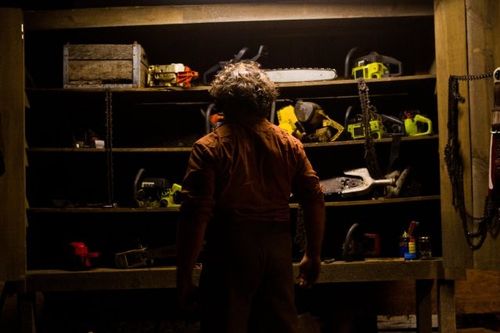
Jed’s den of iniquity lies beneath the southern mansion Heather has inherited, deep in the heart of Newt, Texas; and behind the metal door (amazing how Heather’s grandmother made sure she installed another metal door), waiting with meat mallet at the ready, is Leatherface—and a closet full of chainsaws. The best scene showing context and portent has Jed playing like a cowboy holstering up for his showdown with the bad folk that killed his kin. Now we know what happens when you take Leatherface’s chainsaw away: he gets another one.

And he wields it with grisly skill, slicing through torsos, ankles, wrists, chests, and various other body parts not moving out of the way fast enough. An extended face-removal with carefully positioned foot-twitching gave me nightmares. Having Leatherface stitch on a new face (which, curiously, looks like any of his older faces) through his cheeks with a large needle—under what I suspect are very unsterile conditions—in closeup, is not very cheerful, either.

Other critics of Texas Chainsaw 3D appear torn between the semi-humanization of Leatherface as he squares off against the bad guys, and the lack of zest he displays in not lopping off limbs during the carnival festivities as he chases Heather up a Ferris Wheel. One critic even derides the tossing of the chainsaw at the sheriff (and into the 3D audience) as laughable, but Jed’s got a whole closet full of them, so why not?

As for humanization and restraint, both are in keeping with the character’s motivations. As for me, I’m torn over how Heather, after seeing her friends horribly butchered, still considers Jed family, and the sheriff’s decision to let the crazy homicidal son of a bitch keep living, and why Dr. Who never show’s up to solve the temporal paradox of director John Luessenhop’s screwed up timeline.

If Texas Chainsaw 3D is any indication of what we can expect from Hollywood in their treatment (mistreatment?) of classic horror movie reboots, I want to travel back in time myself before it’s too late.

In the meantime, watch John Dies at the End instead.