Zombos Says: Typical Rob Zombie Fare
Listen to the Movie Review
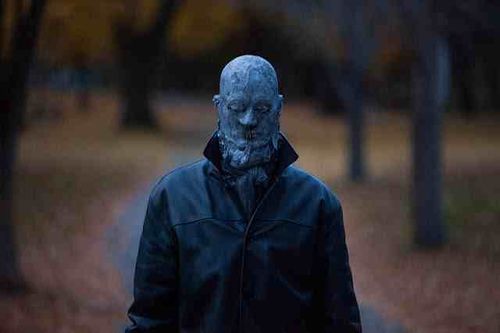
The Lords of Salem is a visually complex fever dream (or confused one; I can argue for both) from director Rob Zombie. We know how it will end. We already know how all his movies will end. Zombie's blind spot is being unable to fool us through tension and suspense. Each movie becomes an exercise in the downward descent, the great fall, the whac a mole hit squarely every time. This, of course, kills any hope of seeing anything more than a mono story done in stereo colors.
But what colors!
I do love his use of older black and white movie clips, too. And then there are those large Andy Warhol style black and white pop art prints in various rooms of Heidi's (Sheri Moon Zombie) apartment. He even manages to include a print of Commando Cody, who bleeds profusely on the bathroom wall as Heidi withers away. The movie clips Zombie uses will be familiar to genre fans, but his enthusiastic deployment of them, in-between his deliberately overbearing religious and sexual imagery, errupts everything into a Pop Rocks experience: it loses its novelty and significance with continued use.
With Rob Zombie there's only one ending to all his movies—I mentioned that—but how he gets there is also a familiar trip with familiar characters. The Lords of Salem has a lot of scenery to look at while we make the trip. He takes us through the neighborhoods of pre-1980 Times Square porno, with all the subtlety of a black velvet clown with neon color highlights, and stops to hammer us with cackling old crones reveling giddily in their evil, stepping out of their ancient woodcuts to overboil this pot of nihilistic stew as they spit and gloat and reek of foulness. I can't tell if he's going for femjoy dominance and parody or deep down he secretly fears castration so his witches are really what he thinks of women.
Those crones toil well beyond Shakespeare’s boil and bubble in their roles of the Devil’s desciples. Meg Foster is stunningly unrecognizable as the decrepit and saggy high priestess, Margaret Morgan. After being burned alive and hankering for revenge, she takes aim at the female descendents of the puritans that baked her and her covenors to a crisp.
The bizarre music the witches play winds up on vinyl and is mysteriously delivered to the radio station Heidi and her fellow DJs (Ken Foree and Jeff Daniel Phillips) burn the midnight oil at. The music casts its spell and we watch its effect on Heidi.
And watch.
And watch.
And the one possible tense string brought into play by Bruce Davison’s Matthias, an author who is slowly realizing the witches he declares extinct are actually quite alive and currently in the process of serving him tea, is plucked only once, then abruptly stopped; a wasted note that would have truly surprised me if Zombie stepped out of his limitations and played it for all it was worth.
And we continue to watch.
And watch some more as Heidi misses her radio broadcasts, ignores her friends, forgets to walk the dog, and drags her tiny butt in and out of the nightmares Zombie stitches together for visual impact more than emotional context. Providing intertitles to let us know what day of the week it is, time isn't really important. Everything blurs to an ending that reaches further in its reckless abandon than any of Zombies previous films. I applaud the attempt while lamenting the near-sighted vision.
Whether you view all this as an LSD trip or a redux-psychedelia tab pressed from oils of Rosemary’s Baby, Suspiria,and 1970s trash-art esthetic,or you just want to take Zombie as film auteur reaching out to the rows in back of the theater, his continuing metal-crashing against white-thrashing Christian dogma and precepts is the same bellicose vein throbbing excess seen through each of his films.
After all his movies share the same bleak monotone, you start to feel Rob Zombie hates himself, hates the stain-free life, hates the bad to the bone life, and hates having to make sense of any of it for us, or himself.
And especially hates us for having to pass judgement on it or daring to derive entertainment from it.
That’s refreshing. I admire his zeal even if I think he’s thick as a brick in his approach to horror.
