 My article, The Creature from the Black Lagoon Still Holds Us Captive, first appeared in the British magazine We Belong Dead, issue number 13. I highly recommend you pick up a copy. WBD is the best fan written magazine available today covering classic horror. This issue in particular is a tribute to the Creature from the Black Lagoon movie series.
Where is Universal Orlando’s Creature from the Black Lagoon ride?
Since 1954, when Universal Studios grabbed on to the tail-end of the 3-D cinema craze with their tropical-locale beauty and the beast story, and ever since Marilyn Monroe in The Seven Year Itch instinctively empathized with the Creature’s need to be loved (or at least not shot at) , and after all these years of fond memories and undying merchandizing for this beloved “beastie” (as director Jack Arnold called the Creature), I want to know why there’s no ride, no tourist attraction to beguile us. Given the best they could do was Creature from the Black Lagoon: The Musical, which played from 2009 to 2010 at the theme park, I’m not that hopeful.
They did a ride for Jaws, loved it, but there’s none for the last great Universal Monster, the one whose box office success leveraged Universal-International’s entry into the 1950s science fiction atomica and alien-invasion cycle, where big and bigger monsters, and they were quite unlovable ones at that, weren’t as mesmerizing as this low budget, process shots galore, jungle adventure set in the mysterious isolated lagoon.
Imagine a boat ride, which would be akin to Disney World’s Jungle Cruise. Wouldn’t you get a thrill standing on the deck of the tramp steamer Rita, helmed by its crusty and resourceful captain, Lucas (Nestor Paiva), as it enters the mysterious lagoon no tourist has set foot in? Wouldn’t you get a chill encountering the Gill Man as his curiosity gets the better of him and he dares to come aboard looking for companionship, for understanding, for a soul mate after all those years of being alone? After all, the Devonian period he hails from goes back a few hundred million years.
With Creature from the Black Lagoon borrowing thematic elements from King Kong and Frankenstein, we already know how well his search for companionship and understanding will go; and that would be not well at all. Like Kong, he becomes infatuated with a woman, and like Frankenstein’s Monster he’s mistreated on sight, making him retaliate in kind. His mistreatment involves fire, too, but unlike the Frankenstein Monster, the Creature has to also dodge harpoons and cope with rotenone, a piscicide–yes, it’s a real chemical used to catch fish. The desperate scientists drop it into the lagoon to knockout the Creature after they’ve riled him up.
Here is where sustained tension and subtextual motivations come into play, making Creature from the Black Lagoon a more intelligent and prescient script than many critics (Bill Warren among them) have given it credit for. While subsequent 1950s science fiction movie fare focused on the more horrific aspects of the aftermath of scientific meddling and hubris (all those big spiders, bugs, and dinosaurs chomping and stomping) the subtleties here center on conservation versus exploitation and research versus trophy-hunting. But the Creature is not the only prize being hunted and that opens another thematic element centered around the prima fascie movie gender roles of the 1950s that dictate male scientists are take-charge characters and decision-makers, and female scientists are always pretty, always think about romance, and always scream a lot when not making coffee or patching up those battered, take-charge males.
The beauty and potential trophy wife role is filled by Kay (Julie Adams), a research scientist who, in turn, draws much studious attention from her pushy boss, Mark (Richard Denning), who thinks he’s a better catch for her than her more reserved but earnest fiancé, David (Richard Carlson). Mogambo-minded Mark, seeing dollar signs and newspaper headlines, finances the expedition to the Amazon when a fossilized hand with webbed fingers is found in a geological dig by Dr. Maia (Antonio Moreno). It takes David’s enthusiastically delivered speech, part science-justification, part science lesson (fashionable for all 1950s science fiction movies) to lend gravitas to the expedition’s intentions. David is, surprisingly, the environmentalist and conservationist. He wants to study nature, not wrap it around his will. It takes Mark’s aggressive posturing directed toward Kay and the Creature to generate the sparks above and below the waterline. The action moves between David, Mark, and the Creature butting heads and gills over Kay and the interplay between them as each asserts his intentions over her and the outcome of the expedition.
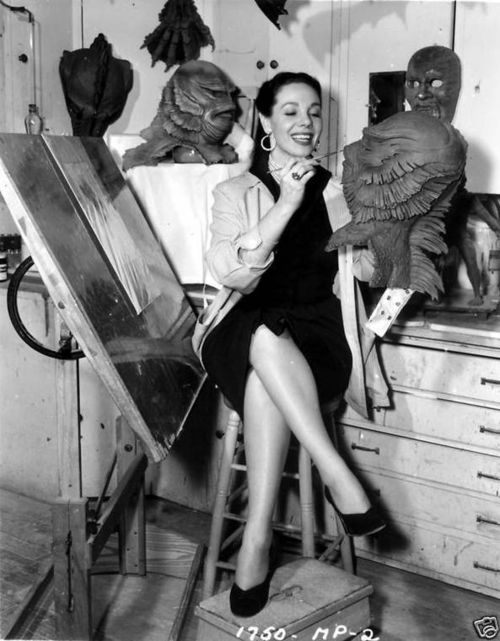
It takes Bud Westmore’s makeup team to builld our feelings for the Creature while scaring our wits at the same time with his unique mix of piscine and humanoid features. Fess up now, it’s the Creature Aurora model kit you always preferred to build and paint, right? Commercial artist and part-time actress Milicent Patrick is now credited with designing the Creature’s iconic head, with Chris Mueller doing the sculpting. Jack Kevan created the airtight molded sponge bodysuits worn by Ricou Browning (doing the underwater scenes) and the larger Ben Chapman (doing the above water scenes). The original design called for a less fishy, more Oscar statuette looking Gill Man (a smooth-skinned humanoid) due to one studio executive’s preferences (I wonder if he was related to Irwin Allen?), but that didn’t prove scary enough on camera. More scales and gills were added, giving us the Creature we know and love today. Bud Westmore appeared to have taken offence at Milicent Patrick and her successful publicity touring for the movie, claiming she took too much credit for creating the Creature. He threatened to never use her talents again and followed through on his threat. She was good, having designed the alien in It Came from Outer Space and also that wonderful pants-wearing Metaluna Mutant. The consensus now is that Bud Westmore was the one actually in love with the limelight and taking too much credit in the first place for what his team had accomplished.
Another person who possibly received more credit than he truly earned is the underwater scenes director, James C. Havens. According to Tom Weaver, Havens didn’t bother to don scuba gear to join Ricou Browning, Scotty Welbourne (who worked the 3-D cameras), and the stunt doubles under the water to direct them in situ. Instead, Havens floated on top, looking down from above to direct the action taking place farther below. Quite a trick when you consider a 3-D movie like this relies on key coming-at-you moments and spatial-blocking to sell those three-dimensions within the frame; how could you gauge the effectiveness of these moments when you’re not looking at them the way you intend your audience to see them?
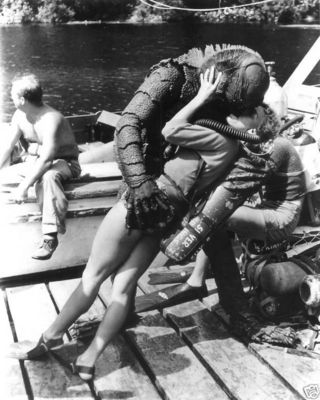
While Havens easily breathed air while directing his scenes, Ricou Browning, who could hold his breath a lot longer than you or I ever could, relied on air hoses kept close, but out of camera range, on either side of him during shooting. He already had experience with how to breathe from an air hose while underwater, and that came in handy when attempts to supply him with a self-contained air supply failed to work as too many bubbles were showing and there wasn’t enough room in his suit to accommodate the tanks easily. Although breathing that way may have been second nature to him, the limitations of the Creature’s headpiece made clear sight difficult for both him and Chapman. During the filming of the climactic scene where the Gill Man is carrying an unconscious Kay through his grotto, Chapman guestimated wrongly and bonked her head against one of the grotto’s fake rocky walls. Luckily, Julie Adams was not actually rendered unconscious from that mishap, but the publicity department played up her head scrape for all it was worth, including a snapshot of Adams receiving serious medical attention: a Band-Aid applied by a nurse.
Heavy publicity during production and through the release of the movie was a new marketing slant undertaken by Universal-International Studios. That effort, combined with the use of the Moropticon single-projector 3D system instead of the cumbersome and expensive dual-projector system the majority of theaters still couldn’t afford, made possible the wide-release of Creature in 3-D to more urban theaters than usual, although many smaller neighborhood theaters still showed the movie flat (in 2-D). The Moropticon system allowed a standard 35mm projector to be “converted to 3-D in minutes by attaching the Moropticon prism lens to the front of the unit.” The installation of the system only cost the theater a hundred dollars, provided the theater agreed to purchase twenty-five hundred pairs of viewing glasses per month for twelve months. Then, as is the case today, those glasses generate a lot of money. The underwater scenes take full advantage of 3-D with harpoons whizzing by, retonone fizzing and clouding up the water in our direction, and a shimmering spatial dimensionality enhanced by careful choreography of the action moving toward and away from the viewer.
Jack Arnold, who personally storyboarded his movies, envisioned the most memorable scene, whether viewed in 3-D or flat: the alternatingly sexual and playful swim between Kay, gliding on the surface (not Julie Adams but her stunt double), and the Creature gliding through the water below her, entranced by her leggy aquatic form. He cautiously reaches out to her, draws back, then reaches out again. It’s a beautifully realized interplay that can be interpreted in various ways with varying levels of innocence and maturity, such as Johnny Weissmuller and Maureen O’Sullivan’s frisky swim in 1934’s Tarzan and His Mate. Here, however, the censors had much less to worry about.
The Creature’s moment of bliss is fleeting. Hunted, captured, shot at, harpooned twice, and made groggy from being doped up repeatedly with retonone, he manages to elude Mark’s best efforts to stuff and mount him and Kay’s best screams to deter his ardor. The final confrontation in the grotto leads to two more sequels and a mystery: just what are those three columns seen in the grotto’s background? Is the implication that the Gill Man’s parentage is not as Devonian as we think but alien? Or was a matte painting from a previous movie not moved in time and to save money they kept on shooting?
Even more problematic: why does Kay, a research scientist who should know better, carelessly throw her cigarette butt into the pristine lagoon she couldn’t wait to swim in? Maybe that’s what really pissed off the Creature?
Note: Sources used in the writing of this article include Tom Weaver’s audio commentary for the disc releases of The Creature from the Black Lagoon; the Wikipedia article on CFTBL; Ghouls, Gimmicks, and Gold: Horror Films and the American Movie Business, 1953-1968 by Kevin Heffernan; the documentary Back to the Black Lagoon written and narrated by David J. Skal; and Bill Warren’s love/hate relationship written up as Keep Watching the Skies! Science Fiction Movies of the Fifties. The use of the term “rad,” which is short for “radical,” comes from the Teenage Mutant Ninja Turtles. No common ancestry between them and the Gill-Man is implied.
Pictures used in this article are from http://www.vintag.es/2013/04/behind-scenes-of-creature-from-black.html.
