From Zombos Closet

Halloween 2014: Home Depot
Spooky Phone, Witch Way Flight School
and Chia Zombies

Found these entertaining Halloween treats at Home Depot today. The Spooky Phone is killer. Scary sayings when you pick up the handset (or set the sensor), and the eyes on the skull light up. The Witch Way Flight School lights up as the witches fly around overhead. The Chia Zombies are wild and cool looking enough to keep out all year long. Nicely made items and fun additions to your decorative endeavors. 

Spooky-phone

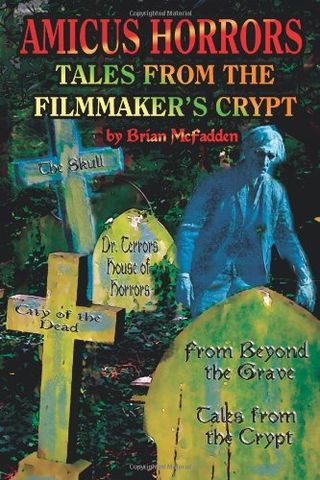
Book Review: Amicus Horrors
Tales from the Filmmaker’s Crypt

Amicus-horrors-bookZombos Says: Fair to Good

This review first appeared in We Belong Dead magazine, issue 14, published by Eric McNaughton. I highly recommend you pick up WBD, any issue. No. 14, in particular, is 100 pages, packed with articles, not commercial fluff, written by passionate fans of classic horror movies. Remember when Diabolique was actually good? Or when Fangoria wasn’t trying to sell you their DVD junk? Don’t sulk, start reading We Belong Dead.


Disappointed is the feeling that comes into play after reading journalist Brian McFadden’s Amicus Horrors. For someone who visited the British studio owned by two Americans, conducted interviews with Peter Cushing (arguably the best chapter in the book) and Vincent Price (the most threadbare chapter), there is an expectation of a more rewarding read to be found here. McFadden, however, writes as if he is churning out newspaper articles, leaving his book’s chapters disconnected from each other, causing noticeable repetition across them, and the inclusion of much material not related to Amicus padding their length and blurring his title’s focus. Like me, by the time you finish his book you may also be a tad annoyed at having read, again and again, why The Deadly Bees turned out so badly.

The Vincent Price at Amicus chapter, for instance, goes well beyond his movie efforts at Amicus. Redeeming its unnecessary movie career rundown are McFadden’s few interview notes: among them Price gives credit to Daniel Haller, the art director for Roger Corman’s Poe-inspired movies, as the man who gave them their expensive look, and an explanation for how Price spent his sizable expense account from AIP when he was on loan to Amicus—buying artwork, lots of artwork.

McFadden gives the history of Amicus, detailing how Milton Subotsky, who would come to handle the day to day production in Britain, joined with Max Rosenberg, who stayed in America to handle the financing. More or less, just blaming-the-teen-musicals seems to be the chief instigator. McFadden draws parallels between Subotsky’s script-writing experience with the multi-segment storylines supplying the musical numbers, threaded together by a simple plot, and Amicus’s notable portmanteau movies that followed, beginning with Dr. Terror’s House of Horrors. In this chapter can also be found extensive background on Amicus’s first movie, The City of the Dead, where McFadden hints at Subotsky—a voracious reader—possibly being influenced by Richard Matheson’s Psycho, and how budget constraints helped the movie achieve its creepiness factor instead of hindering it.

Again and again, McFadden notes the key facets to the strategy Amicus used for keeping costs down and production values high. Aside from “renting a small bungalow at Shepperton Studios,” shooting scenes using the same set back to back to eliminate relighting and repositioning the cameras saved time and money, and hiring star actors for specific shoots that lasted only 2 or 3 days instead of having them wait around and getting paid for the wait kept budgets low. Subotsky also reasoned that paying for one or two stars for a segment in a portmanteau movie would attract an audience to sit through the entire movie, even if those stars appeared briefly.

Mentioned, but not fully explored, is why Amicus strayed from their successful horror portmanteau movies, coming at a time when Hammer’s success was waning, to do less successful movies that didn’t follow the omnibus format; or as McFadden wonders “why Amicus started trying to serve martinis when their stock and trade was beer and ale.” McFadden should have wondered more on this for our benefit.

After his promising and interesting second chapter, McFadden spreads the rest of his chapters thinly across the notable stars and supporting actors appearing in Amicus movies, an Amicus Filmography and Commentary, exploration on Amicus-Related Films and Amicus Imitators, two chapters best left to another book, and chapters on the music scoring and the Shepperton and Twickenham studio locations. His penchant for rattling off movies ad nauseam and straying from his Amicus focus becomes distracting, although you may find some of the straying rather interesting, like Peter Cushing’s adventures trying to attract studio attention in America and his brush with the Canadian Mounties.

Unnecessary is his chapter, A Brief Side Trip to Hammer, especially after McFadden’s premise that Hammer receives most of the attention and Amicus so little. He adds nothing new here, and leaves the reader wondering if he had a lot of notes and thoughts and decided to uncork them to flow in this book without seriously considering their relevance or discussion integrity as a whole. There’s one production note I did find surprising: I, Monster was supposed to be “3-D without classes” (the Pulfrich Effect) but wound up 2-D instead, leaving a lot of unnecessary camera movement to confound its audiences and annoy Christopher Lee.

While there is much to read here and there, more coverage on Amicus-related material is left wanting, leaving the reader wanting more than the pint he offers.

Halloween Rubie’s Spooky Decoration
Skull, Dracula, Ghosts

These illustrations are killer. The execution of this novelty, not so much. That black ‘Press Here’ label wasn’t meant to be removed (underneath is wiring and solder), so these beautiful decorations are marred by that big black dot in the center. And you can’t change the button battery unless you cut into the back to find it. Tsk, tsk.

rubies halloween spooky decoration

Movie Pressbook:
The Land That Time Forgot (1975)

I picked up my first Edgar Rice Burroughs paperbacks at Phil Seuling's comic shop in Brooklyn. The pages were tanned, the stories exciting. Also snagged a leather-bound set of Charles Dickens works. Oh, yes, and I bought a lot of comics, met Roy Thomas and other comic and Warren magazine notables, and had the time of my life. I would ride my bike to the shop after school just about every day. And yes, my bike had the chrome bullet headlight, fox tail, banana seat, and long handlebars. Somebody stole it one day and I've not been able to fully capture the magic back ever since. Of course, now that I'm all grown up, my Mustang helps soothe the loss. Maybe I should tie a fox tail to its antenna. 

land that time forgot Pressbook 08072014_0016

As Above, So Below (2014)

As_Above,_So_Below_PosterZombos Says: Very Good

Before you see this refreshingly artful exercise in claustrophobic mayhem–the accurately but poorly titled As Above, So Below–brush up on your Nicolas Flamel and alchemy history beforehand. And you may want to take some headache-relief in advance, since the enthusiastic point-of-views and shaky-camera in this mockumentary horror may give you a beaut.

The story is seen through the de rigueur determined camera operator who keeps filming no matter what happens, (Edwin Hodge fills that role as Benji), and his pinhole cameras, worn near the headlamps of archaeological adventurers Scarlett (Perdita Weeks) and George (Ben Feldman) as they dare the Paris Catacombs’ unexplored regions. So expect much close proximity blurring and corner of the camera eye terror-flashes, as well as a modicum of incoherence in the audio and the action as per this now overused and unnecessary, but versatile, cost-cutting conceit. (Relatively speaking, of course: but its $5,000,000 budget has grossed $13,000,000 so far.)

I also recommend you ignore Metacritics and Rotten Tomatoes: their movie ratings are irrelevant and off the mark as usual. I don’t understand why anyone with a mind of his or her own would even bother with these useless vestigial websites unless the interest is one more of socializing with the herd than reading actual film analysis and earnest reviews. Yes, the usual illogically better-than-to-be-expected cinematography ensues from the use of a limited handheld camera and those micro ones, but this is, after all, a horror movie and you’re watching it to be scared. More importantly, keep in mind this is not a found-footage movie. I keep seeing this mentioned in various reviews and it’s incorrect. I realized it wasn’t found-footage two-thirds into the deepening pile of bones and unexplored passageways our catacomb explorers were getting themselves more deeply lost in. In no credible way would their cameras ever be found to make this a found-footage movie; a realization that adds a little more intrigue and alters expectations for the better.

Scarlett is searching for the Philosopher’s Stone and Nicolas Flamel (Harry Potter fans will recognize the name) provides the clues to its whereabouts through his tombstone. Like Mikey in the Goonies and Professor Jones in Indiana Jones and the Last Crusade, she’s determined to let nothing stop her in her life’s goal; not the Paris Catacombs and their mounds of skulls and bones, or the potentially pesky rats scurrying through them, or the stifling, endless creepy corridors she’s warned to stay out of. Inevitably they are herded into one particular dusty, ancient, chamber foreshadowed by its warning “Lasciate ogne speranza, voi ch’intrate” (Abandon all hope, ye who enter here) etched into the narrow entrance. Gulp.

Director John Eric Dowdle (Quarantine) has a knack for enabling goal-driven women in supernatural storylines to reach beyond the typical bosom-bouncing scream queen falderol. Scarlett holds a few PhDs, speaks four languages, and she is so persuasive she even convinces her former boyfriend, George, who’s still smarting from when she abandoned him to incarceration in a Turkish prison, to accompany her. George provides important translations and a calming effect to her rambunctious jump-in-then-look approach to tackling challenges. And, gosh, they still do love each other; once they stop yelling at each other.

The hook comes through what each person encounters in the catacombs and what lies farther below: a hint is that personal inner demons feed everyone’s encounters with the supernatural; an unexpected upright piano with a dead key and a rotary phone appear, though wildly out of place in such morbid surroundings; the movie’s trailer shows a flaming car that spoils a critical moment that’s not fully explained (at least not in one viewing); a hooded figure sitting on a wooden throne in the pitch dark suddenly decides to take a walk; the walls come alive and bite hard. More character insight and a little more time to help us pay attention to it should have been added to the script. Traps, copious blood-letting, face-mashing, a long drop with a sudden stop, and all those character-driven bedevilments pop up with the rapidity of a haunt attraction, leaving us and everyone else breathless. Benji, who clearly needs to lose weight before tackling tight places, wedges tight among the bones. As he panics, so do we. Those little squeaky noises at his butt don’t help lessen his hyperventilation, or ours for that matter.

It’s hard to say if As Above, So Below will boost the Paris Catacombs tourist trade or dampen it, but I hope to see more of Scarlett and George. This may be the start of a beautiful horror franchise.