From Zombos Closet

Pressbooks (Non-Horror)

Betrayed (1944) Pressbook

Orson Welles had a column in the New York Graphic (sic), called “Orson Welles’ Almanac,” in which he wrote: “Plant things that grow above the ground today, and go immediately to the Strand Theatre in Brooklyn and see a “B” minus picture called When Strangers Marry. It’s A plus entertainment but because it’s a quickie without any names on it, When Strangers Marry hasn’t had much of a play. Making allowances for its bargain-price budget, I think you’ll agree with me that it’s one of the most gripping and effective pictures of the year. It isn’t as slick as Double Indemnity or as glossy as Laura, but it’s better acted and better directed by William Castle than either.” (Wellesnet)

Betrayed (aka When Strangers Marry) is a William Castle revelation. We usually peg Castle as the carnival midway-styled showman and director who gave us memorably classic (albeit cheaply) rendered movies promoted with theater gimmicks. But Castle, who was smart enough to nab film rights to, and desperately yearned to direct, Rosemary’s Baby, and who collaborated with Orson Welles on Lady From Shanghai (a noir that beats other noirs silly), was one hell of a director without the gimmicks too. He also was greatly disappointed to find out he wouldn’t be directing Lady, although he had nabbed the film rights to that one too. Not only was he a good director, he also knew a good movie prospect when he saw one.

In Betrayed, Robert Mitchum, Kim Hunter, and Dean Jagger stretch the noir shadows when the obscenely rich guy wearing the Lion’s head mask and flashing thousands of dollars he hated to go home with winds up dead. Castle keeps the short running time (61 minutes) ticking by with suspense and creative use of the camera as it prowls around the threadbare sets and setups. His foreshadowing nods are a master class; simple but direct. With three (“without any names”) killer actors to help him, and a filmed story that stays razor-focused, and a nice-touch Hitchcockian cameo by Castle, this movie deserves more respect and inspection. Here’s the pressbook from Monogram.

When Strangers Marry 1944 movie pressbook

The Phantom (1931) Pressbook

Secret passageways, creeping stalkers prowling at night, love triangles complicating relationships like guys and gals had nothing else to do, and intrepid women reporters, tough as nails, always screaming on cue. Ah, the early days of mystery and intrigue. Oh, and toss in that crazy scientist conducting brain experiments (which was a scripting go-to back then for some reason), a “Thing” kidnapping that spunky reporter (through those convenient sliding panel beckoning hidden passageways), and that close-by sanitarium as the main hideout. Don’t you also miss those days of naming actors with catchy nicknames like “Big Boy” Williams in the credits? I don’t recall women ever getting nifty nicknames, do you?

One more thing (no, not that Thing). I mention The Phantom because it is recognized as having influenced the horror genre and was an early independent film (Artclass Pictures Corp.) with horror elements. (See The Phantom (1931): Hollywood’s First Independent Horror Movie for a critical analysis.)

The Phantom 1931 movie pressbook

God Forgives…I Don’t! (1967) Pressbook

God Forgives...I Don't 1967 movie PressbookYou can thank the Spaghetti Westerns (1960s and 1970s) for the movies and streaming series that took the wholesomeness of early cowboys roaming the range (with happy songs, a chaste behavior under those big hats, and their trick horses), and made them all gritty, grimy, and bristling with beardy machismo and sweaty violence. So when you cringe at the uncivilized behaviors and dirty faces in American Primeval, don’t forget to blame Italy for moving the genre into a blood-running prone, over-realism that gave Clint Eastwood his big break.

God Forgives…I Don’t from Italy, courtesy of AIP, involves the script staples of a train robbery and stolen gold. Mayhem follows. Not quite at the level of Sergio Leone, but still an enjoyable dusty romp. The pressbook highlights the “exotic beauty” of Gina Rovere and how the western reflects American folklore. The poster art is quite a beauty too.

The Spider Returns (1941) Pressbook

The Spider Returns 15-chapter serial brings the pulp hero, The Spider, to the big screen for a second time. This sequel to 1938’s The Spiders Web, is a bit more tongue-in-cheek with the usual fisticuffs and mayhem delivered by the Gargoyle, another crimelord with Fifth Column connections, with his usual assortment of ruffians to do his bidding. The movies embellished on The Spider’s (played by Warren Hull) wardrobe by giving him a spiderweb pattern across his cape and head disguise. Otherwise, he’d be the spitting image of The Shadow, another popular pulp hero dressed all in black, who hit the movies starting in 1941. It is interesting to note the Newspaper Slants – School Tips page suggests contacting schools to hype the movie.

The Spider Returns 1941 movie pressbook.

Bombay Mail (1934) Pressbook

Edmund Lowe starred in Chandu the Magician (1932), against Bela Lugosi’s evil villain, Roxor. In 1934, Lugosi took over as Chandu in the 12 chapter serial, The Return of Chandu, while Lowe starred in Bombay Mail. Although set in Bombay, it was actually filmed on various sets that included several railway stations and a studio-built Imperial Indian Mail train. Lowe learned his trade in vaudeville and silent films. Although the quintessential Hollywood leading man at that time, as he grew older Hollywood relegated him to Poverty Row productions.

Bombay Mail 1934 Movie Pressbook

Secret Agent X-9 1945 Pressbook

Lloyd Bridges only movie serial, Secret Agent X-9, also featured two actors who played Charlie Chan’s sons in that popular movie series, Key Luke and Benson Fong. Going after a synthetic fuel formula provides the motivation for thirteen chapters of action and cliff hangers. Universal was unique with their serials by not providing the traditional chapter recap of the story so far. Instead, they had characters in a following chapter recap, through their dialog, what transpired in the previous chapter (as noted in Gripping Chapters: The Sound Movie Serial, by Ron Backer, BearManor Media). Universal did a Secret Agent X-9 serial in 1937 too. That storyline centered around stolen jewels. Both serials were based on the comic strip character of the same name written by Dashiell Hammett and drawn by Alex Raymond.

Secret Agent x-9 movie serial pressbook, 1945

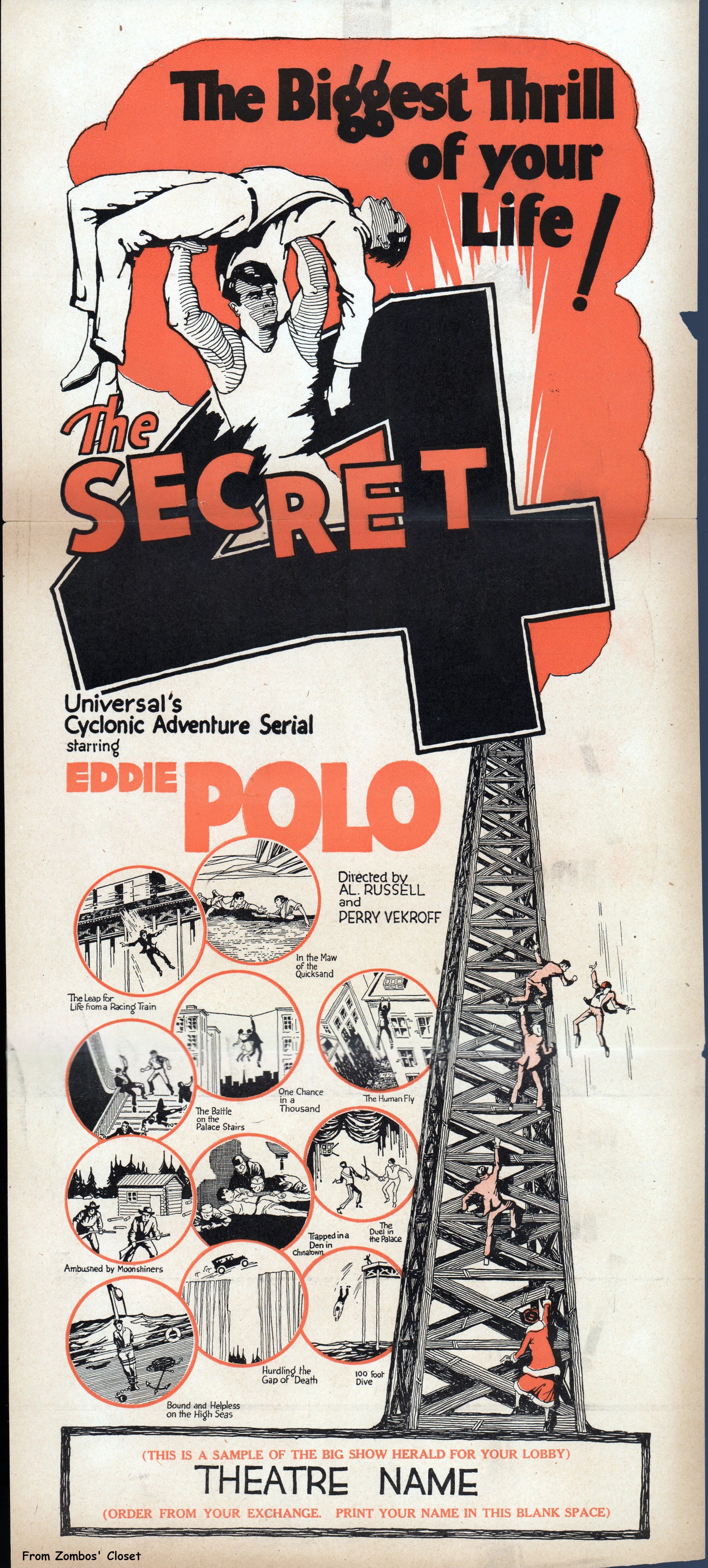
The Secret Four (1921) Movie Herald

This may be the oldest herald (and pressbook, posting soon) in my collection. While the 1921 The Secret Four movie serial is now lost, it looks pretty darn exciting. This herald is about 22 inches long and 9.5 inches wide, so quite a herald to be handing out to movie patrons. The movie was 15 episodes across 30 reels, silent of course, and filled with great chapter titles like The Creeping Doom (8), Floods of Fury (13), and the Dive of Despair ((5). Maybe it’s me (okay, sure, it usually is), but looking at this herald, and with the movie filled with “international intrigue to seize world power by gaining possession of hidden oil deposits in the United States (IMDb),” I’m reminded of the pulp hero, Doc Savage, who first appeared in the 1930s. I wonder if this may have been one source of inspiration for the character.

The Secret 4 1921 Movie herald

Outlaw Girl (1950) Pressbook

It Came From Hollywood has a thing for outlaw girls. Just saying. Of course, who doesn’t. Go back to the movies of yesterday and you would find lots of outlaw (aka “bad”) women in the usual mis-behaving role, be it westerns, noirs, jungles, crime, small town and big city neighborhoods, you name it. In Outlaw Girl, you “don’t tangle with Mangano!” That would be Silvana Mangano in this Italian import courtesy of Lux Film, Paramount, and I.F.E Releasing Corp (they did the English dubbing). “Shooting from the hips” in this one, she helps a wronged man get even with those who done him wrong. Trivia from IMDb Pro notes the love theme  was re-used in Hercules and Hercules Unchained. Mangano became a sex symbol and notable film star, and was wife to Dino De Laurentiis.

With exploitation lines like “No. 1 Sex Appeal gal in the role of a gun moll,” no longer today’s promotion du jour, this pressbook provides a glimpse into how movies were sold through the male gaze for adults.

Outlaw Girl pressbook cover

The Masked Rider (1941) Pressbook

It Came From Hollywood sends along this pressbook for Johnny Mack Brown’s The Masked Rider. Ford Beebe directed (Night Monster, Flash Gordon Conquers the Universe). Beebe preferred directing westerns, which were the staple movies for many studios at the time. Then the 1950s rolled around and science fiction took over (just like Woody getting sidelined by Buzz Lightyear in Toy Story). John Brown played in many westerns. His handsome mug got a choice spot on Wheaties cereal boxes in 1927, leading to Hollywood and a string of casting in top-liners until he was suddenly replaced during a 1931 movie, Laughing Sinners. According to b-westerns.com “Apparently Brown’s slow, southern drawl caused some problems when talkies arrived, and MGM opted not to renew his contract.” His career nose-dived and he changed his name to Johnny Mack Brown and starred in B-movie westerns, which made him quite popular.

The Masked Rider 1943 pressbook The Masked Rider 1943 pressbook The Masked Rider 1943 pressbook The Masked Rider 1943 pressbook

Female Jungle and
The Oklahoma Woman 1956
Double Bill Pressbook

American Releasing Corporation eventually became American International Pictures (AIP), which specialized in double bill bookings. This double bill pressbook is for Female Jungle and The Oklahoma Woman. Two separate folded sheets for each movie were put into the folded cover sheet, with the emphasis on newspaper ads touting sex appeal to entice movie-goers. For Female Jungle, it was “Jayne Mansfield…sex on the rocks” and for The Oklahoma Woman it was “a whip-wielding she-devil.” Clearly, young teen men were the target audience. Touch Connors (don’t touch that) starred in The Oklahoma Woman. Connors (no relation to Chuck Connors) eventually came to his senses and renamed himself as Mike Connors (who you may know as Mannix from the television series). The publicity campaign was a no-brainer (actually brainless) with “Put up a big front with Jayne” selling the woman-on-the-floor-holding-desperately-onto-the-leg-of-a-guy theme, and the promise of the Queen of the Outlaws cat-fighting with her female rival and cracking that whip (on guys, ouch) theme.

Roger Corman already had The Oklahoma Woman, which cost $60,000 dollars, ready to go. They just needed a second movie to complete the double bill and did so with the $49,000 Female Jungle, a Burt Kaiser written and produced effort. Female Jungle was shot in six days. According to IMDb, Mansfield was paid $150 dollars for her role in the movie, which was expanded after a serious incident kept Kathleen Crowley from continuing in her lead role.  Lawrence Tierney and John Carradine also appeared in this one.

Female Jungle and Oklahoma Woman double bill pressbook

I, the Jury (1953) Pressbook

The first Mickey Spillane novel became the first movie too. I, the Jury was filmed for 3D, but by the time it hit theater screens, the short-lived 3D craze of the 1950s was waning, so most first and second run houses showed the movie in standard 2D. Harry Essex adapted the novel (his writing credits include Creature From the Black Lagoon, Kansas City Confidential, It Came From Outer Space, and, okay, Octaman–hey, no one’s perfect).

David J. Hogan in his Film Noir FAQ doesn’t give much love to the movie, but he does point out the action scenes were well handled and that Spillane came from a comic writer background, which could explain why his character, Mike Hammer, is so super macho. Unfortunately, Biff Elliot was a poor choice to play Hammer and drags down the movie. So, dare I say it, he didn’t nail the Hammer. Trekkers know him as Schmitter from the Devil in the Dark episode of the original Star Trek. He also did episodes for Alfred Hitchcock Presents and some horrors, the Navy vs. the Night Monsters and Blood Bath. I’d like to see those on Svengooli.

The pressbook is a big deal at 16 pages. One of these days I’ll figure out the psychology behind the choice of colors used in pressbooks as it doesn’t match the one used in film colors. The color used in this pressbook doesn’t quite match to the violence and grittiness in Mike Hammer. What do you think? One last note: this pressbook must have gone a round with Hammer as two unnecessary cuts ruin two pictures.

Mickey Spillane I the Jury Pressbook 1953