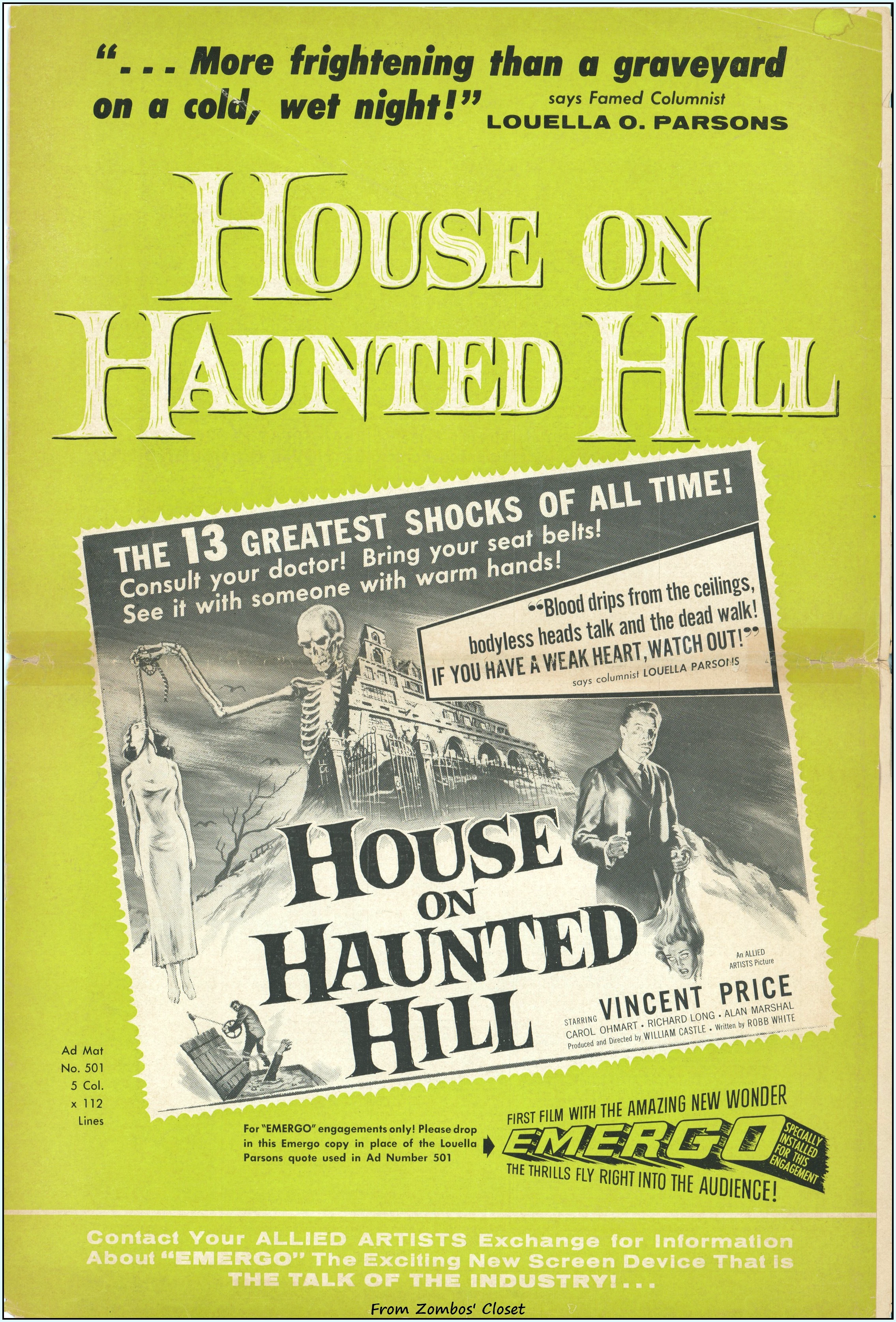
House on Haunted Hill (1959) Pressbook
I’m reposting this pressbook, with new and improved images, to coincide with Granny Creech’s House on Haunted Hill radio spots. Lots of promotion in this Allied Artists pressbook, including News About Emergo.

I’m reposting this pressbook, with new and improved images, to coincide with Granny Creech’s House on Haunted Hill radio spots. Lots of promotion in this Allied Artists pressbook, including News About Emergo.
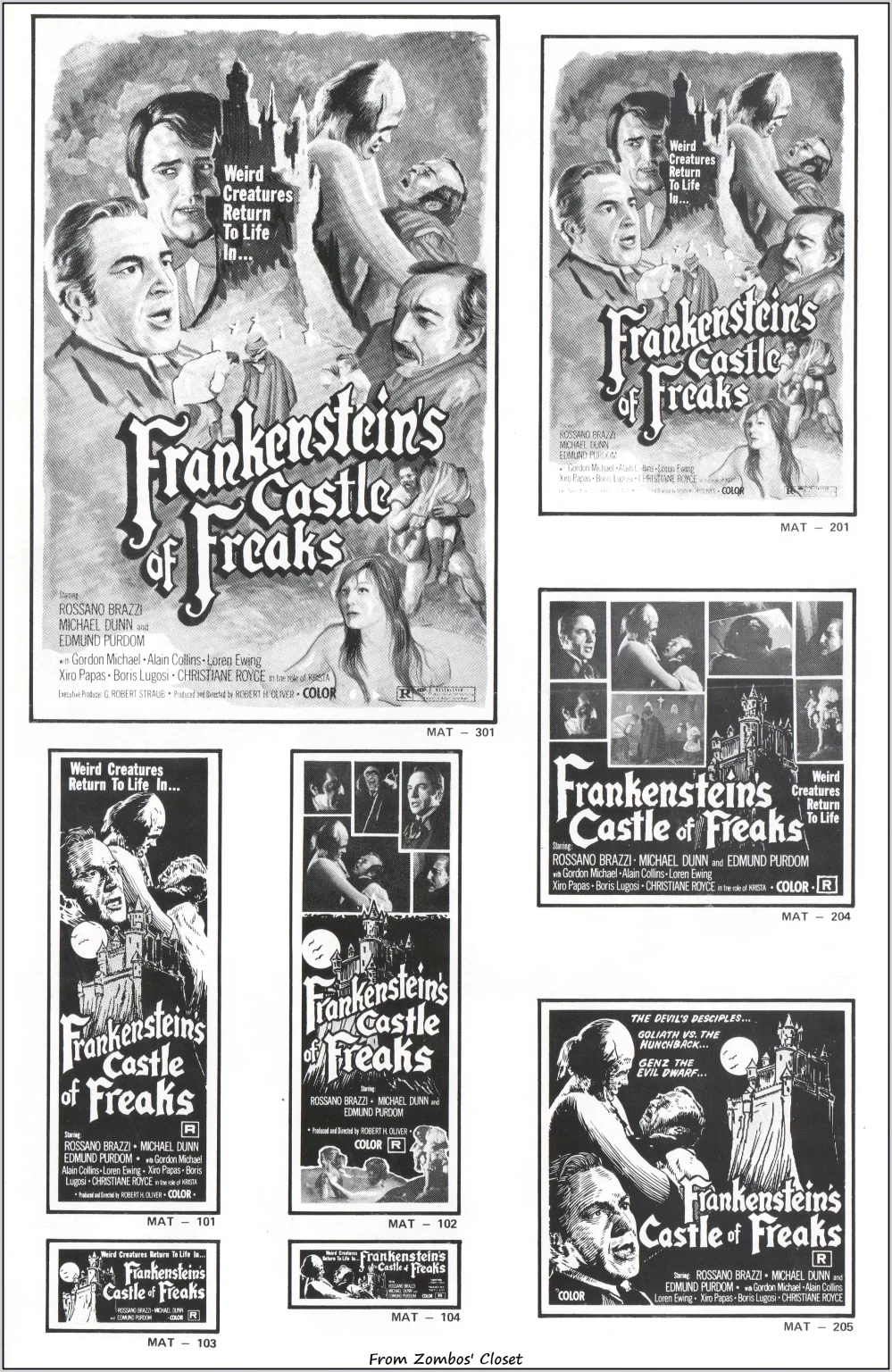
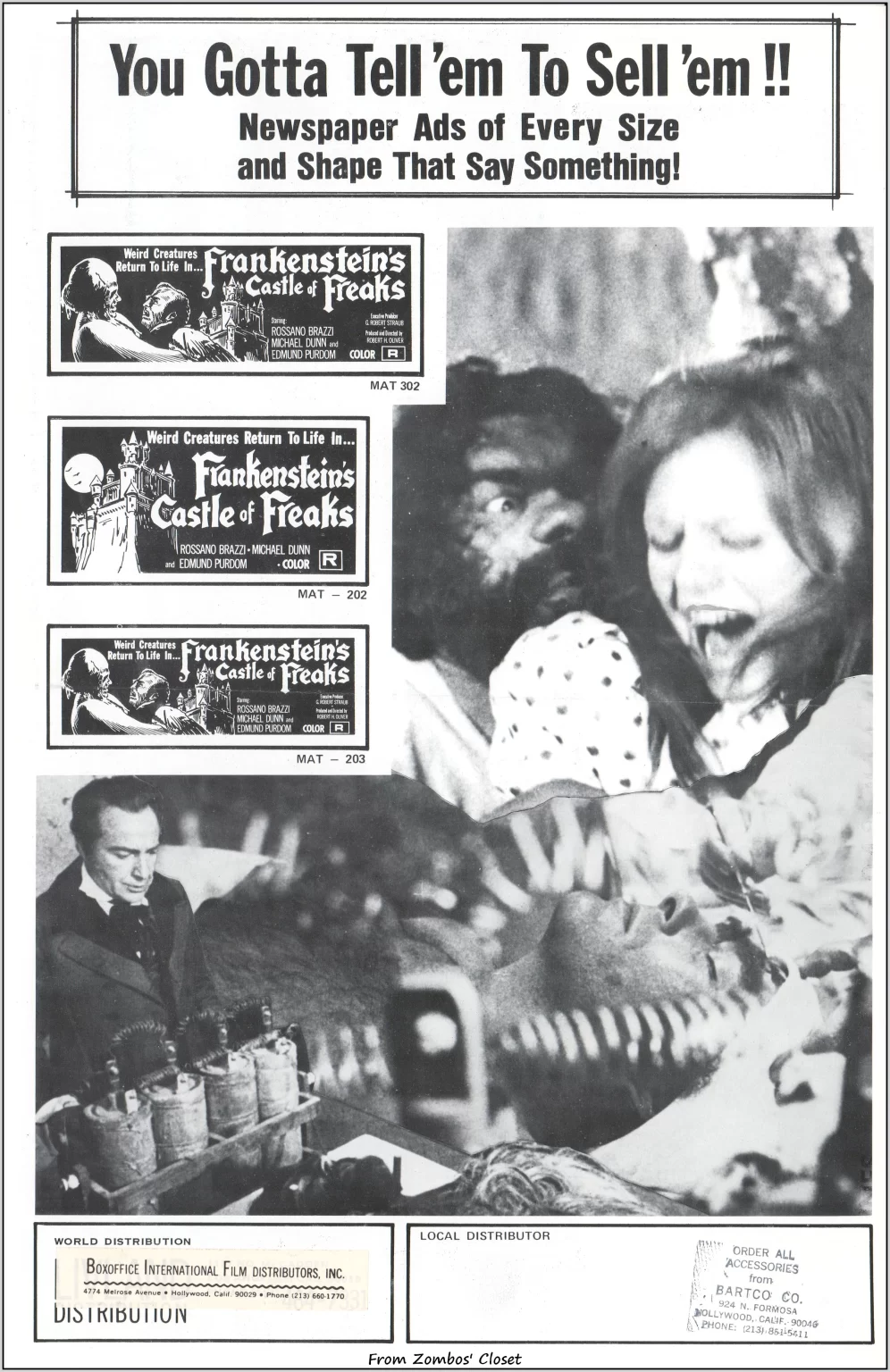
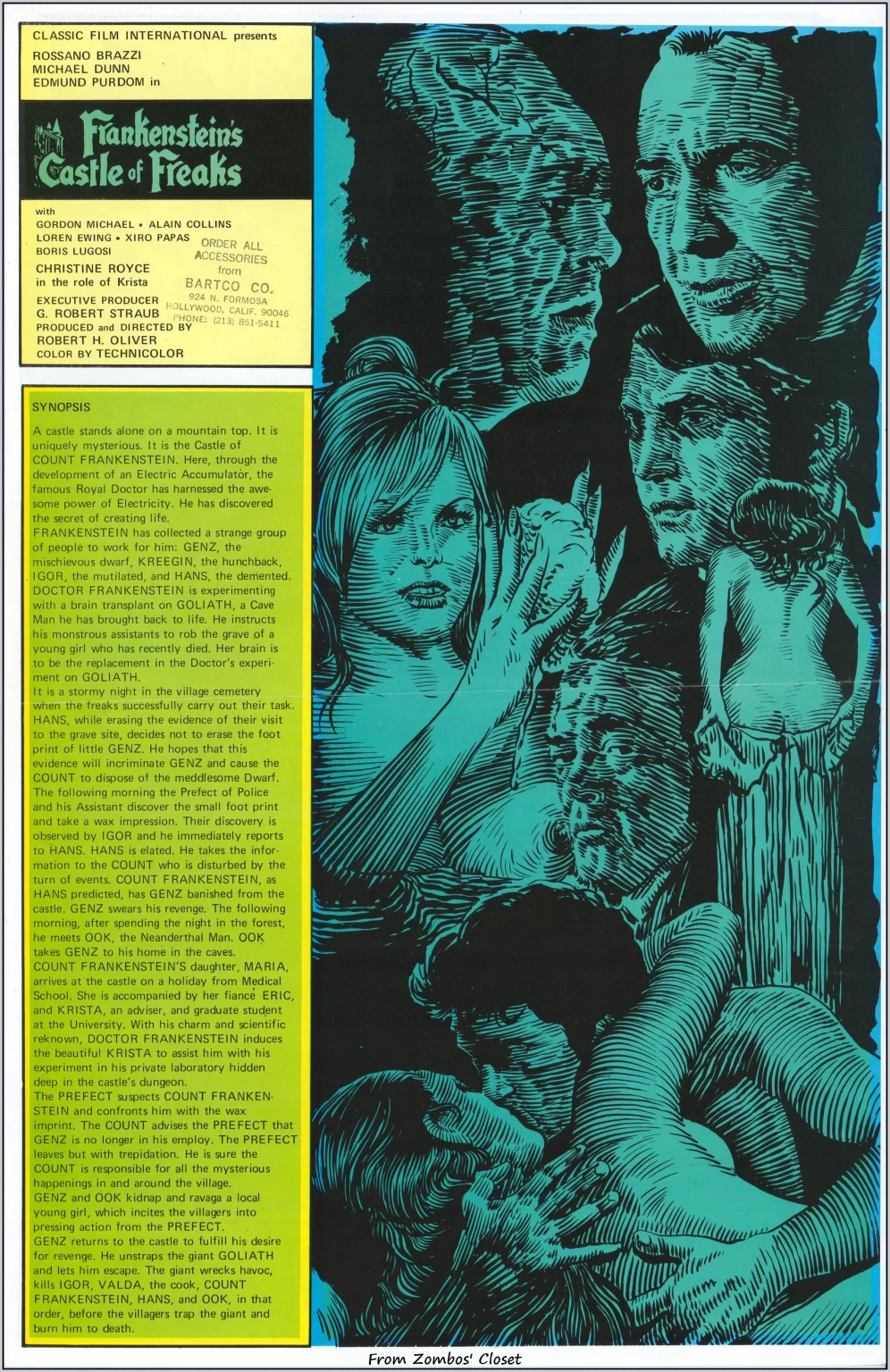
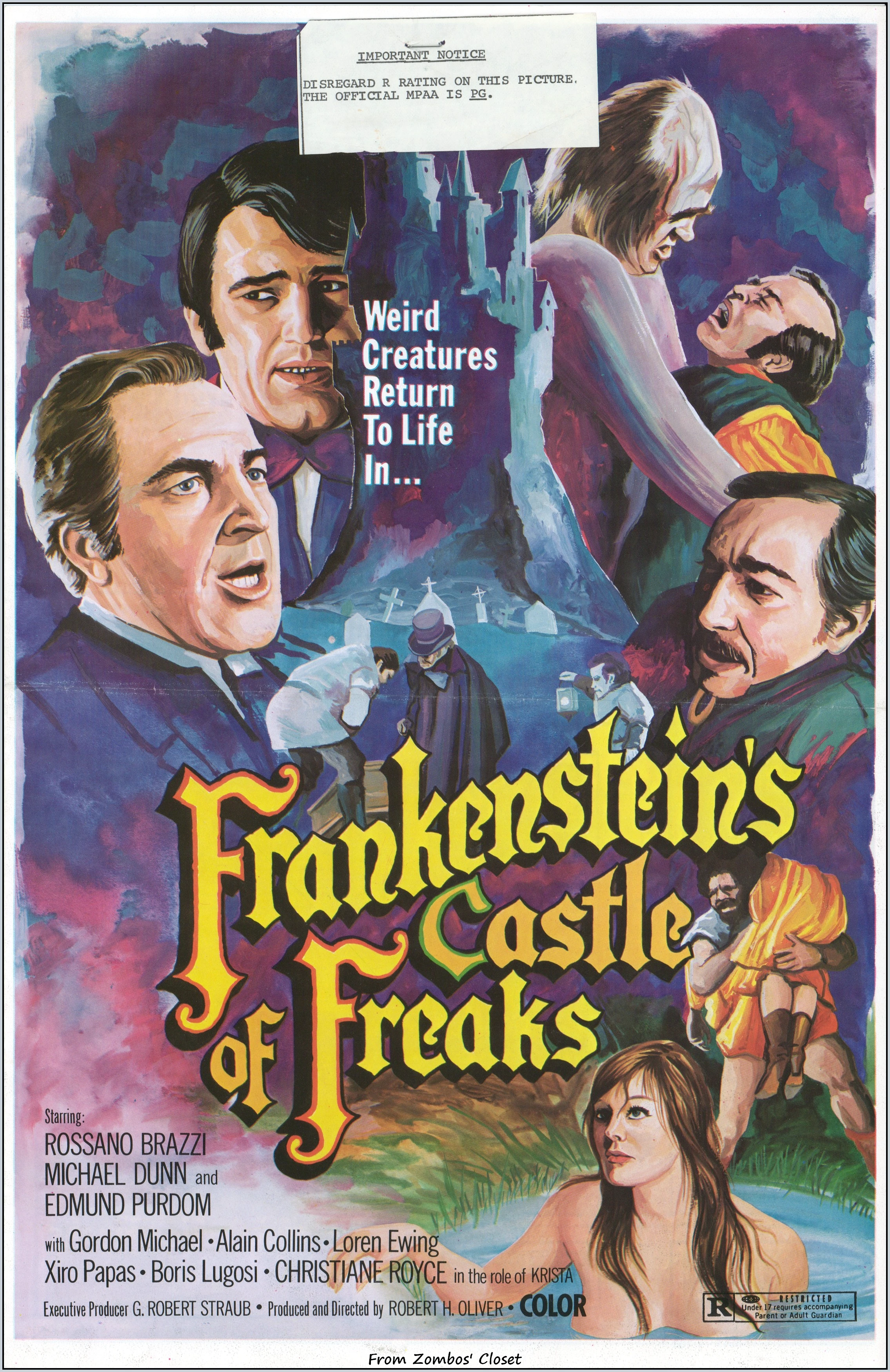
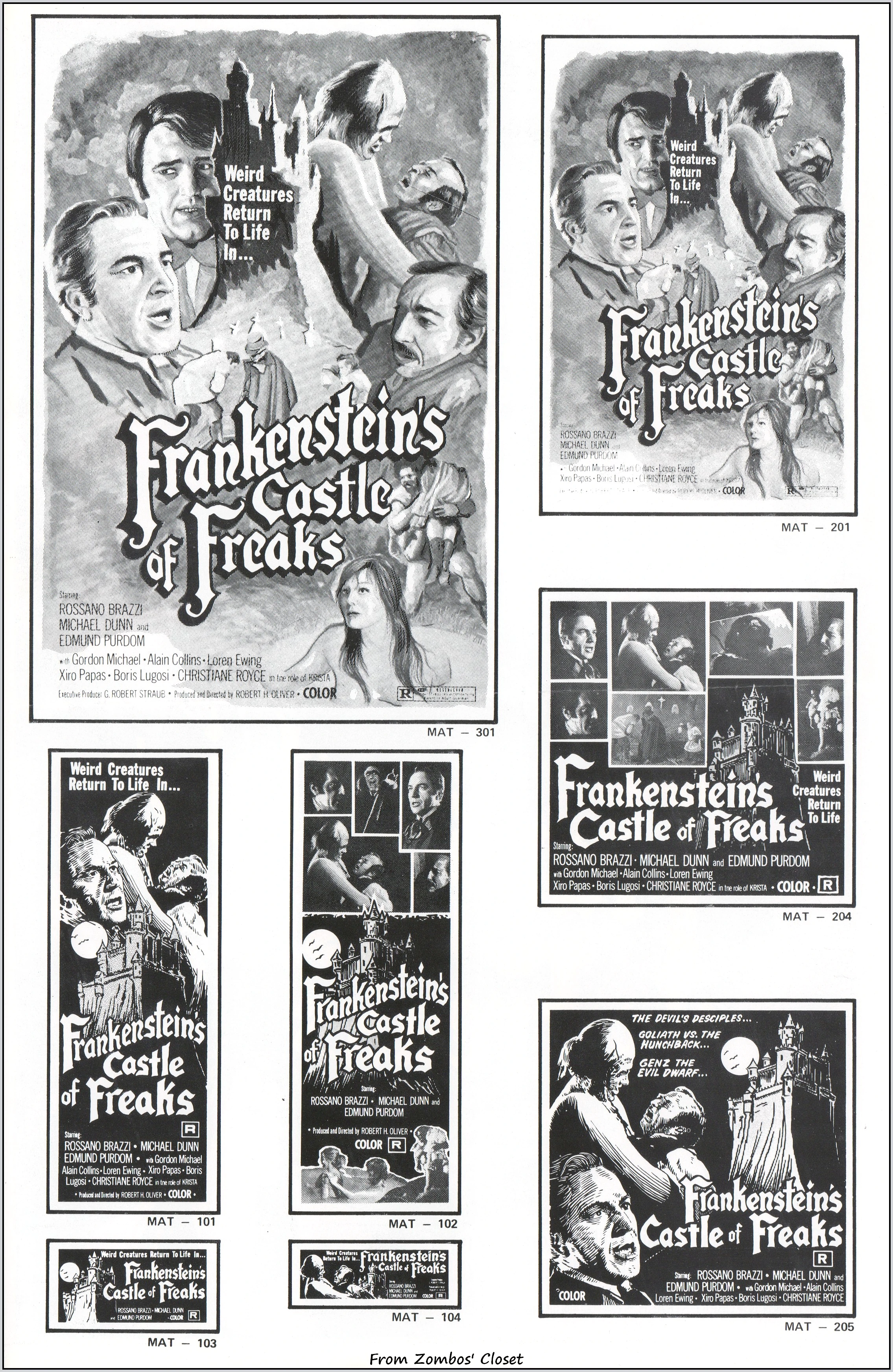
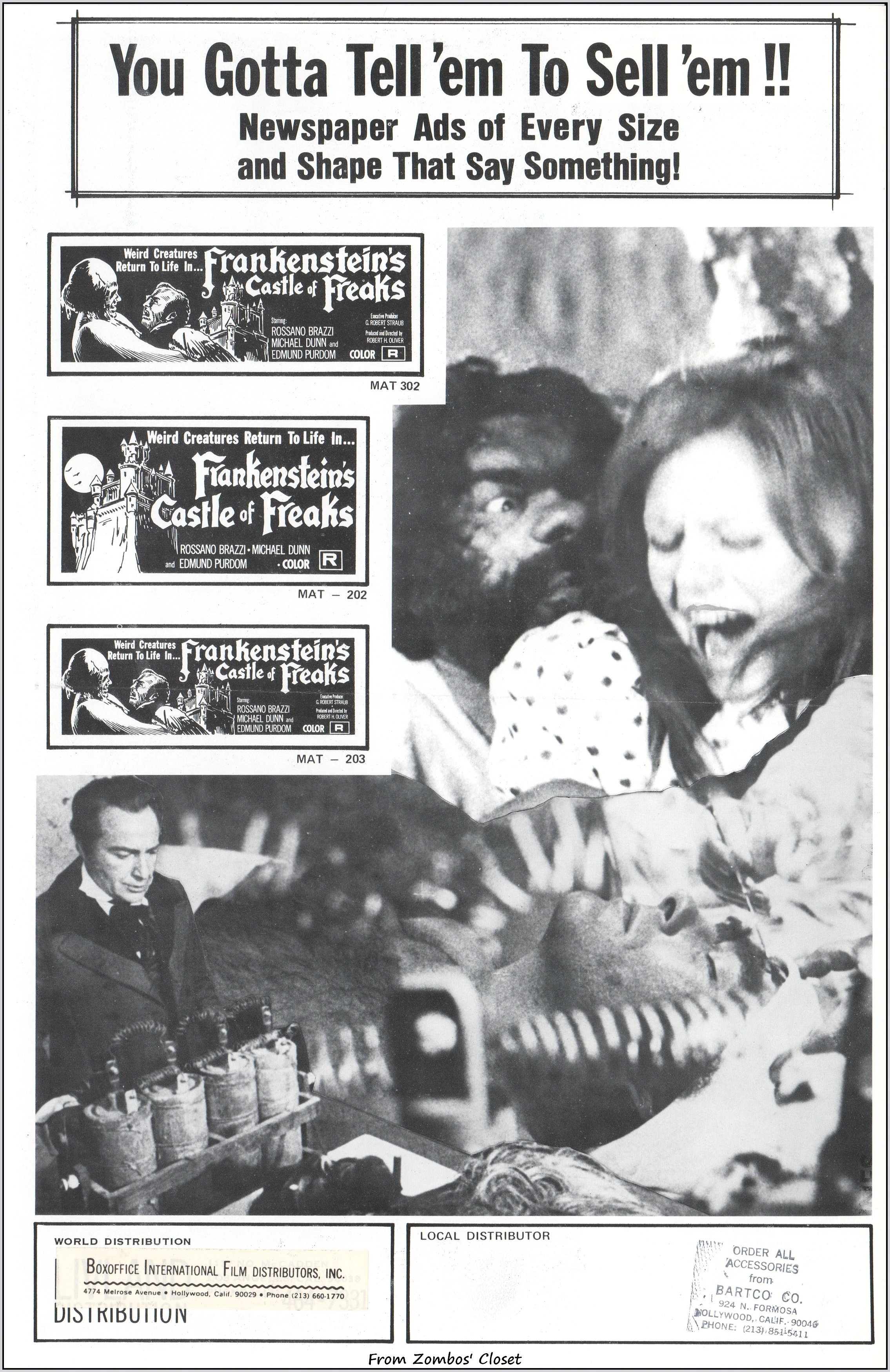
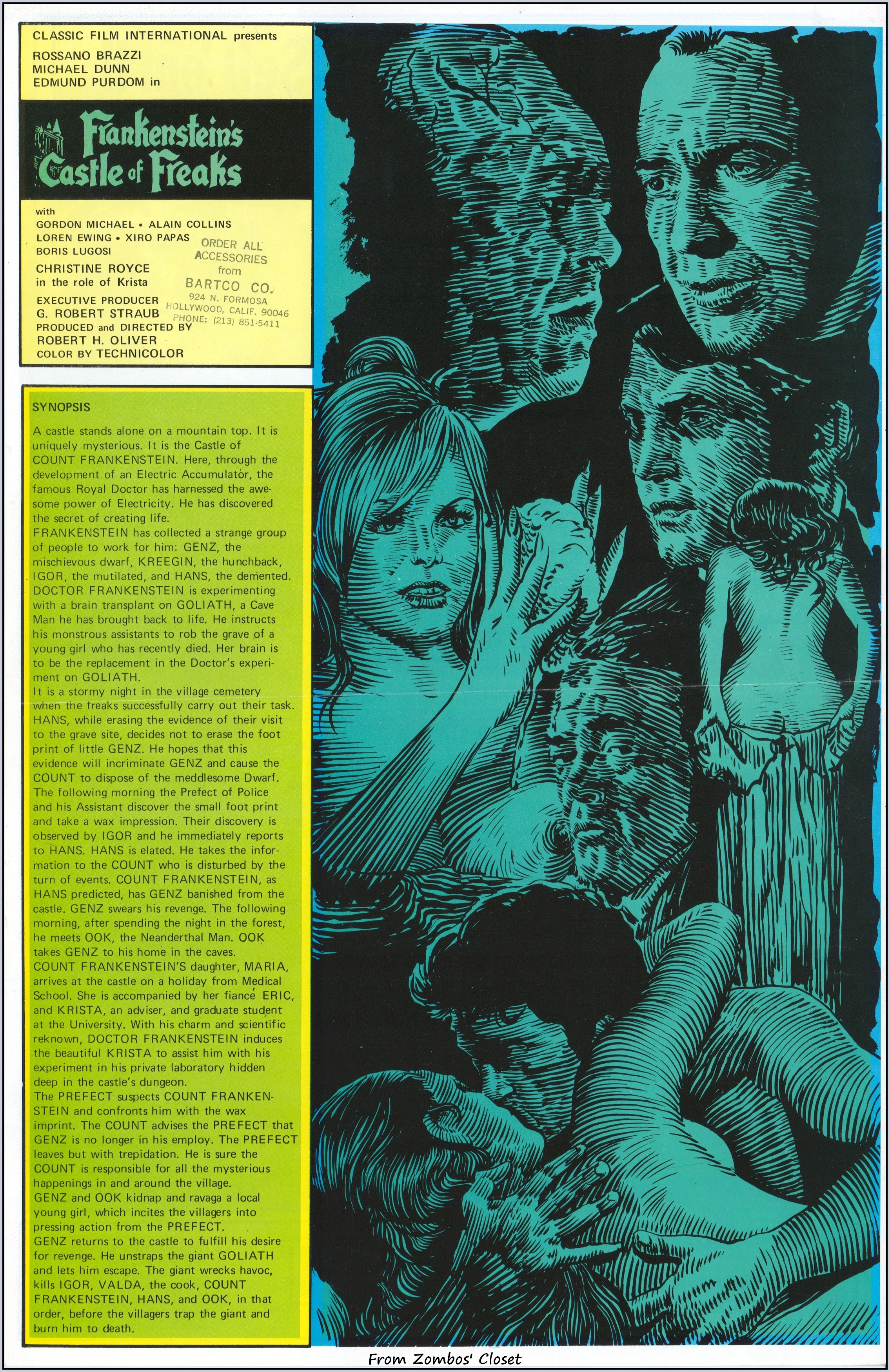
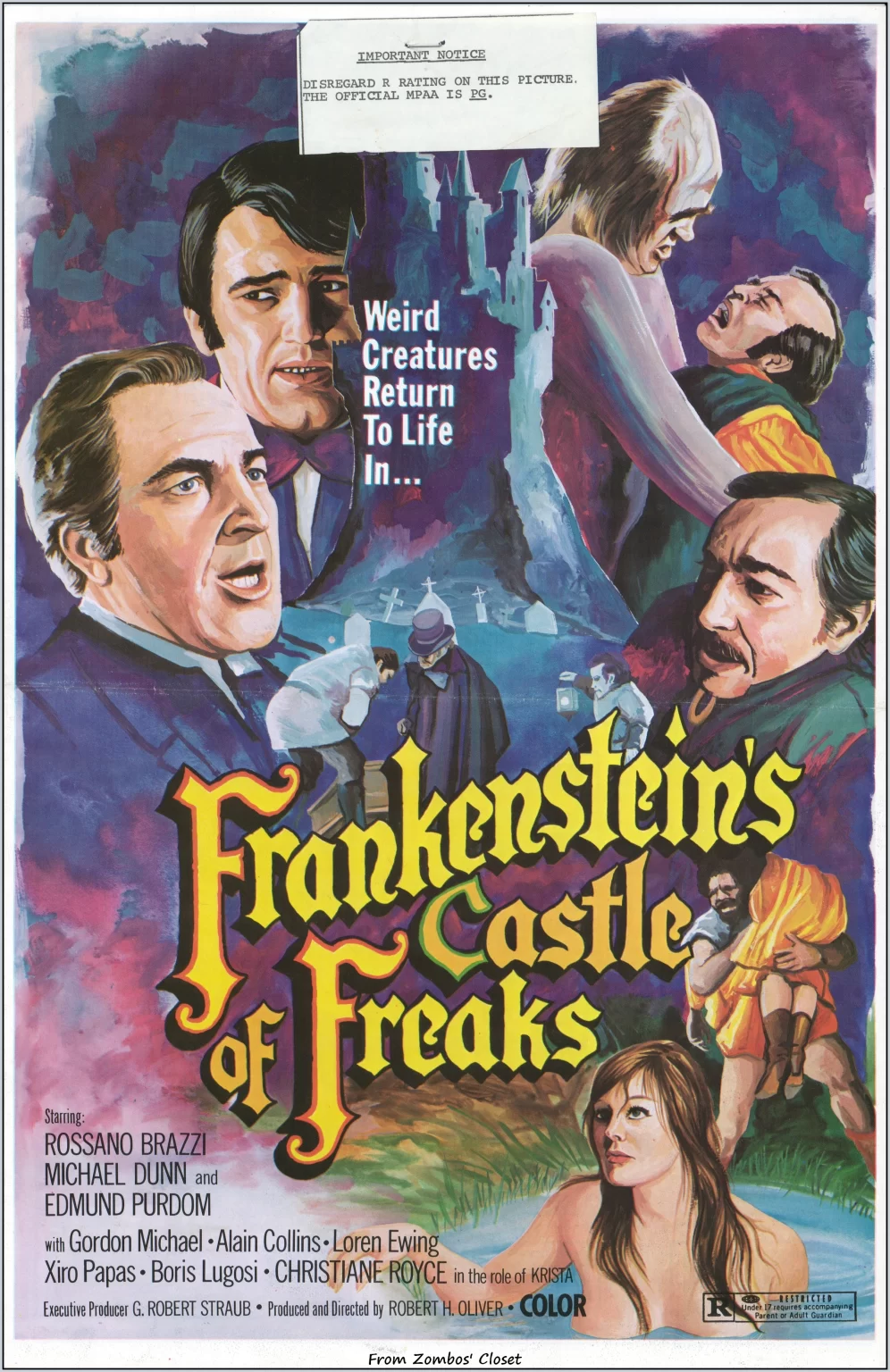
The pressbook for Frankenstein’s Castle of Freaks is only four pages, 11 by 17 inches, but the illustrations are really pretty good and they help sell a movie that needed more visual and script goodness devoted to it. As it stands, assuming you don’t poke your eyes out half-way through, it is a fun romp with a little alcohol consumption to loosen up your critical faculties. It falls into the category of it’s really bad, but cheeky enough to make it worthwhile to see. If you can see it with friends, even better. Make a party of it, pour the wine but hold the cheeses. The movie has enough of them. How you can put Michael Dunn and Rossano Brazzi together and come away with this weird tale is a self-study course in what bad movies are all about. Even the director, Dick Randall, is questionable. No one really knows who directed it. Dick’s a fake (now I’m thinking how many times I can say Dick in this article and get away with it, all legit like).
So what if it’s “one of the trashiest horror movies produced in Italy in the 1970s” (Roberto Curti, Italian Gothic Horror Films, 1970-1979), trash can still be fun. What does Roberto know that we don’t? Well, yeah, he’s an expert film historian and all that. But anyway, what’s very interesting is the stapled, typed notice on the cover. There’s some questionable moments in the movie that are definitely not PG, so not sure who went to lunch during the ratings screening, but the note is a tad off.
Ook, the giant running amok killing people, is Salvatore Baccaro, but they gave him the name Boris Lugosi in the credits. Now that’s a movie I’d love to see: someone cloning Boris Karloff and Bela Lugosi and a tragic lab accident renders them one-half each of the same body. Wild, right? I got dibs on the screenplay.
Ray Harryhausen strikes again in It Came From Beneath the Sea. The 1950s nuclear bomb paranoia brings another irritated giant monster to attack mankind. The Wikipedia entry notes a humorous problem for Kenneth Tobey as he kept sinking in the sand next to Faith Domergue, and Harryhausen’s budget only allowed for six of the octopus’s eight tentacles to be animated. Thanks to ZC lurker Terry Michitsch for requesting this pressbook (and the one for First Men in the Moon, which I’ll post as soon as I can find it. It’s buried in the closet Terry, somewhere, I swear). This movie was double-billed with Creature with the Atom Brain. (ZC Note: I pulled this one from the 2018 archives to go along with Granny’s radio spots for It Came From Beneath the Sea. If you have any issues with that, you can speak to my lawyer, Tryan Sumi.)
Comic reader version: Download It Came From Beneath the Sea Pressbook
…
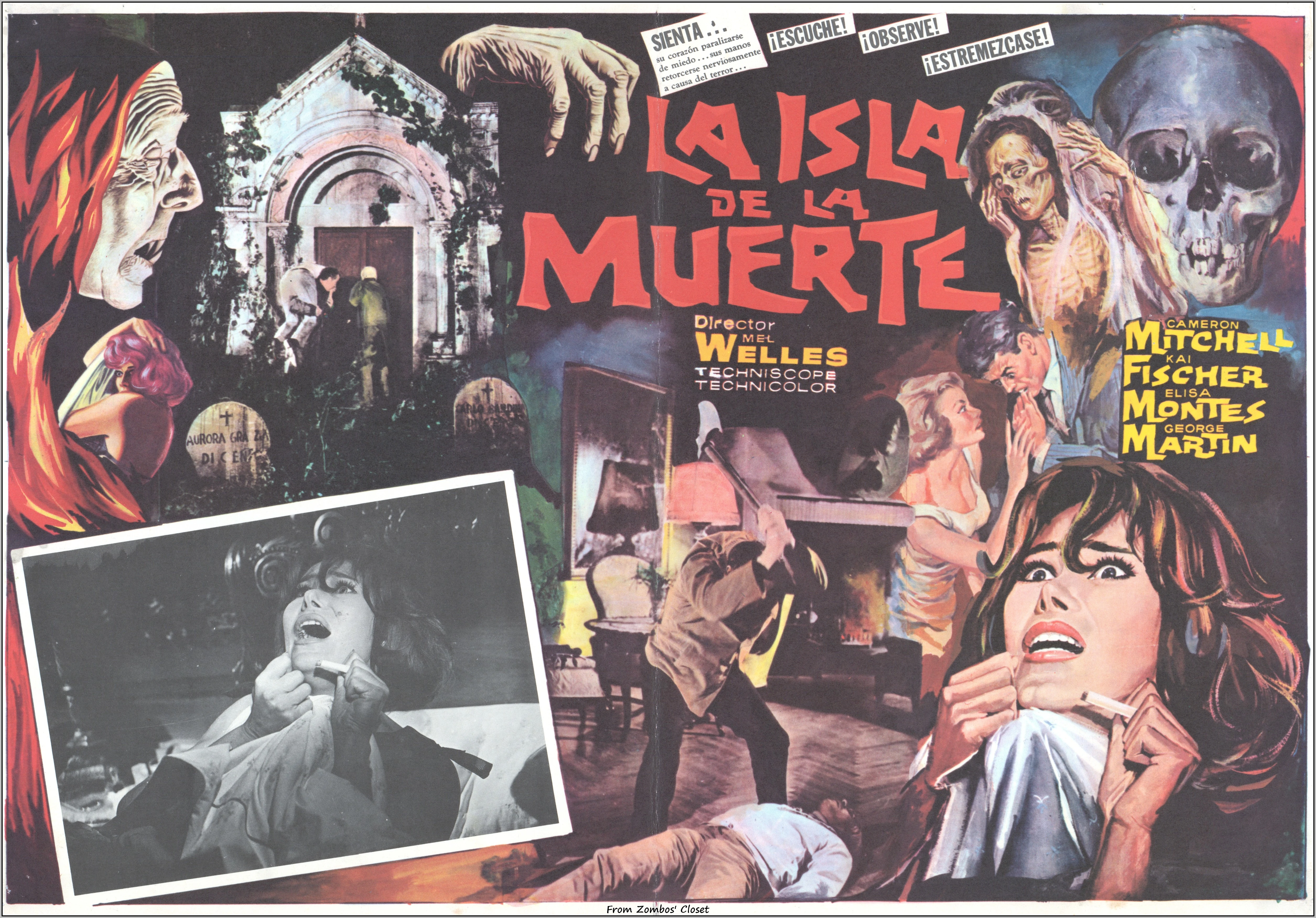
This La Isla de la Muerte Mexican lobby card is big, coming in at 17 by 24.5 inches. I have a fondness for Mexican lobby cards that have an illustration mimicked in the inset photo (or is it vice versa?). Baron von Weser (I’d pronounce it vun-weeeeeezer for dramatic effect) keeps people-eating plants on his island in this Allied Artists Pictures production. AAP was a subsidiary of Monogram Pictures. Cameron Mitchell played the baron. Mel Welles (another name that trips off the tongue) directed. He also did Little Shoppe of Horrors and Lady Frankenstein. Mitchell’s voice was dubbed for the English version. Go figure.

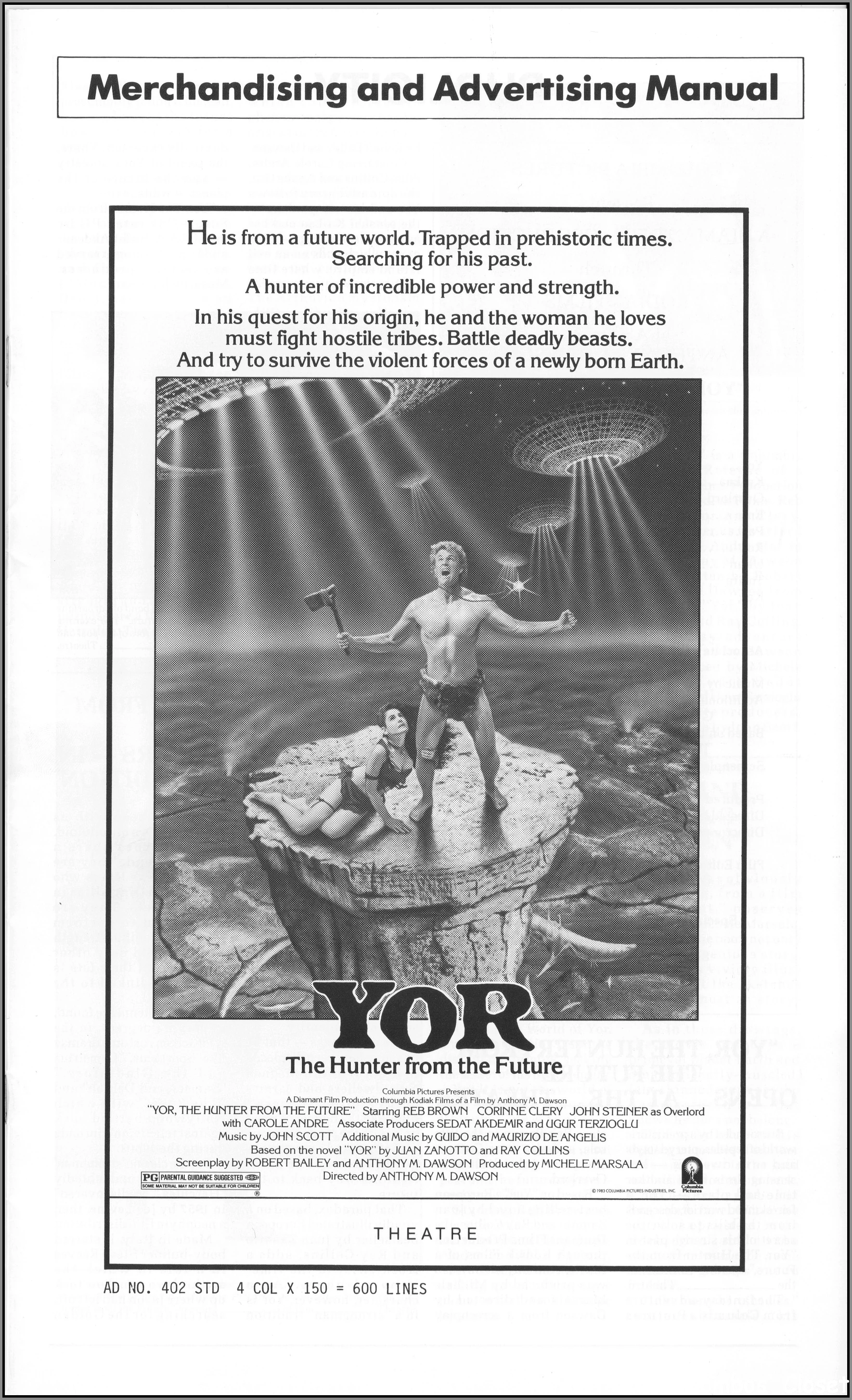
A French, Turkish, and Italian (oh my!) movie from 1983, Yor, the Hunter From the Future has dinosaurs, flying saucers, scantily clad men and women, robots, a giant bat, and Reb Brown. He played Captain America in a 1979 made for tv movie where he wore more clothes. Yor won three Golden Raspberry Awards in 1984. I’m not sure if director Antonio Margheriti was sober when working but you shouldn’t be if you want to watch this one. The pressbook is pretty cool, though, with a coloring contest, maze contest, and fun riffs on the Yor place or mine and Axe me, I’m Yor’s variety.
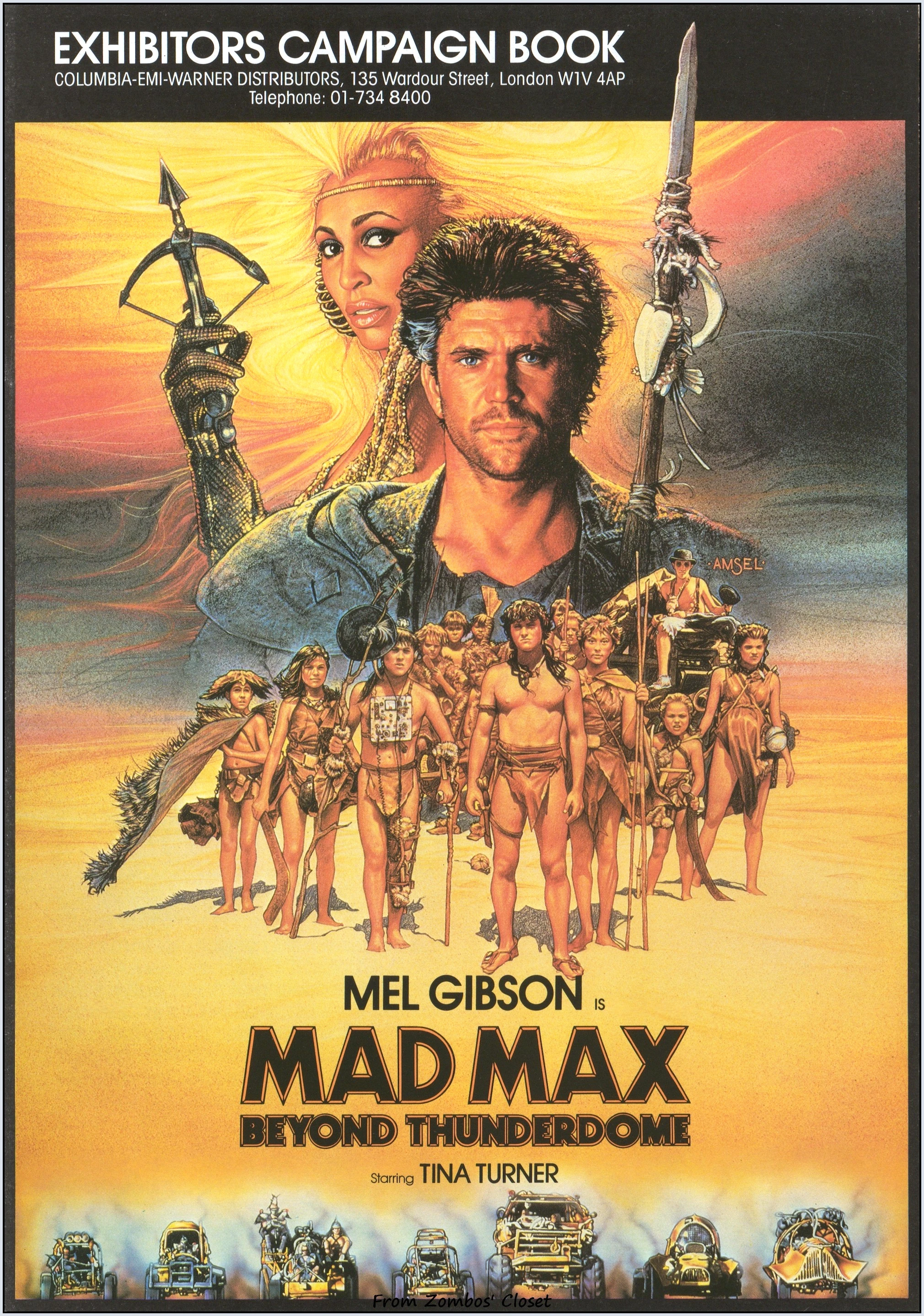
The third entry into the Mad Max franchise, Mad Max Beyond Thunderdome boasts a good soundtrack ,Tina Turner, and a chart-topping song, We Don’t Need Another Hero. It also boasts one of the rare times that critic Roger Ebert awarded four stars to a science fiction post-apocalyptic actioner. Like he said, “the fight between Mad Max and Master-Blaster is one of the great creative action scenes in the movies.” This Columbia-EMI-Warner British pressbook isn’t too shabby either. You wouldn’t think a movie like this would get promotional items like a crossword, maze, word search, and spot the difference newspaper competitions, but there you go. At a $10,000,000 cost, the movie netted $36,000,000 at the box office, though less money than its two predecessors. Its effect on popular culture in general, and the apocalyptic, dystopian, and wild hairdos in future movies? Priceless.
…
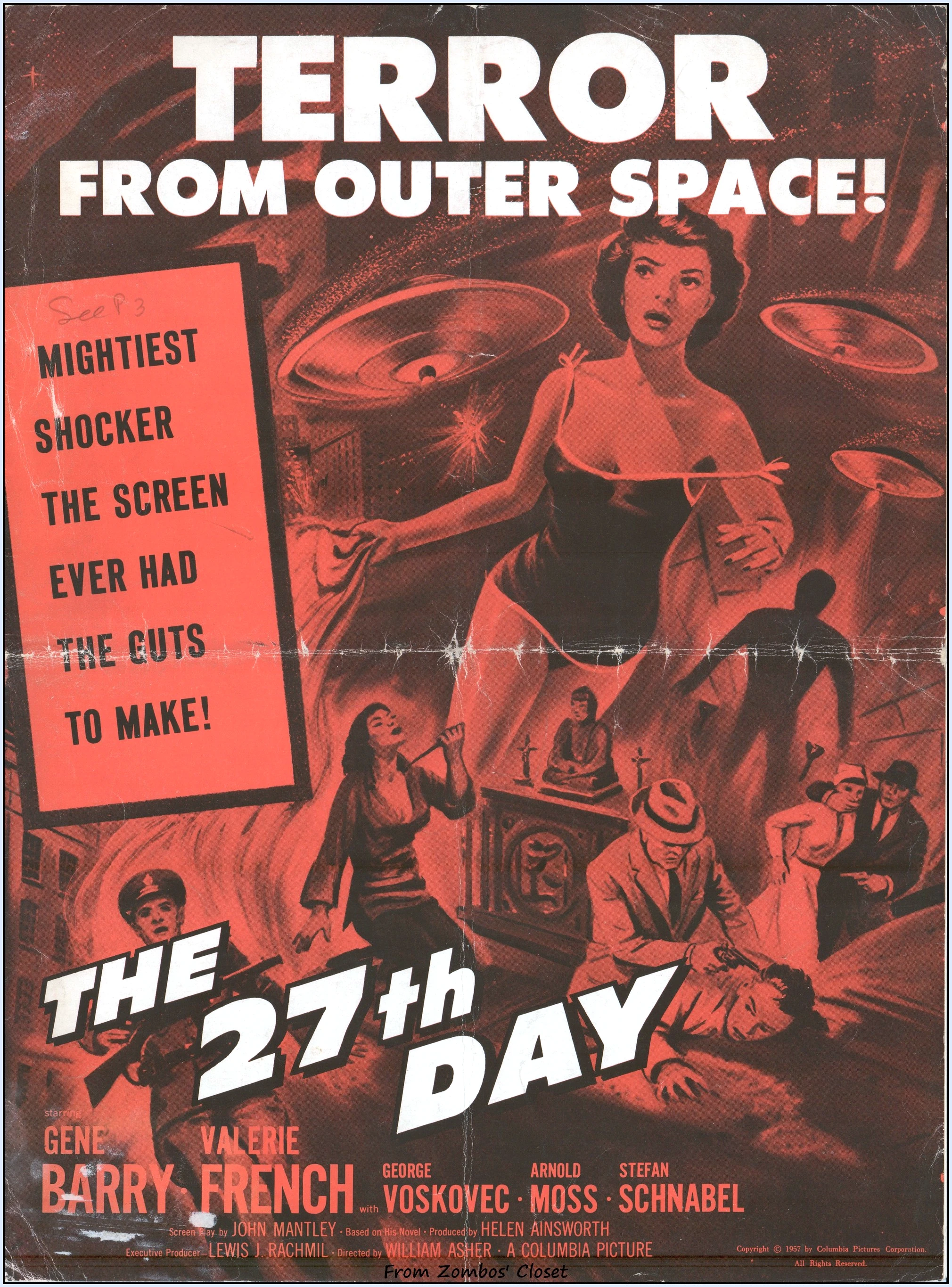
An intriguing movie from the cold war era (or rather, the first one), The 27th Day involves an alien from a dying planet giving five persons the ability to destroy human life on a massive scale. Is it a test? Is it a trick? Directed by William Asher, who did a lot of television-episode directing for I love Lucy and Bewitched, and a screenplay by John Mantley (author of the novel), who went on to write for Gunsmoke, The Wild Wild West, and Buck Rogers in the 25th Century, the story has themes of global destruction, communism, and political tensions that are still relevant today. William Asher also directed the AIP beach party films of the 1960s and a forgotten slasher called Butcher, Baker, Nightmare Maker 1981 (check out Moria for more information). The one shot of the alien spaceship interior is taken from Earth vs. The Flying Saucers (both that movie and this one were produced by Columbia).
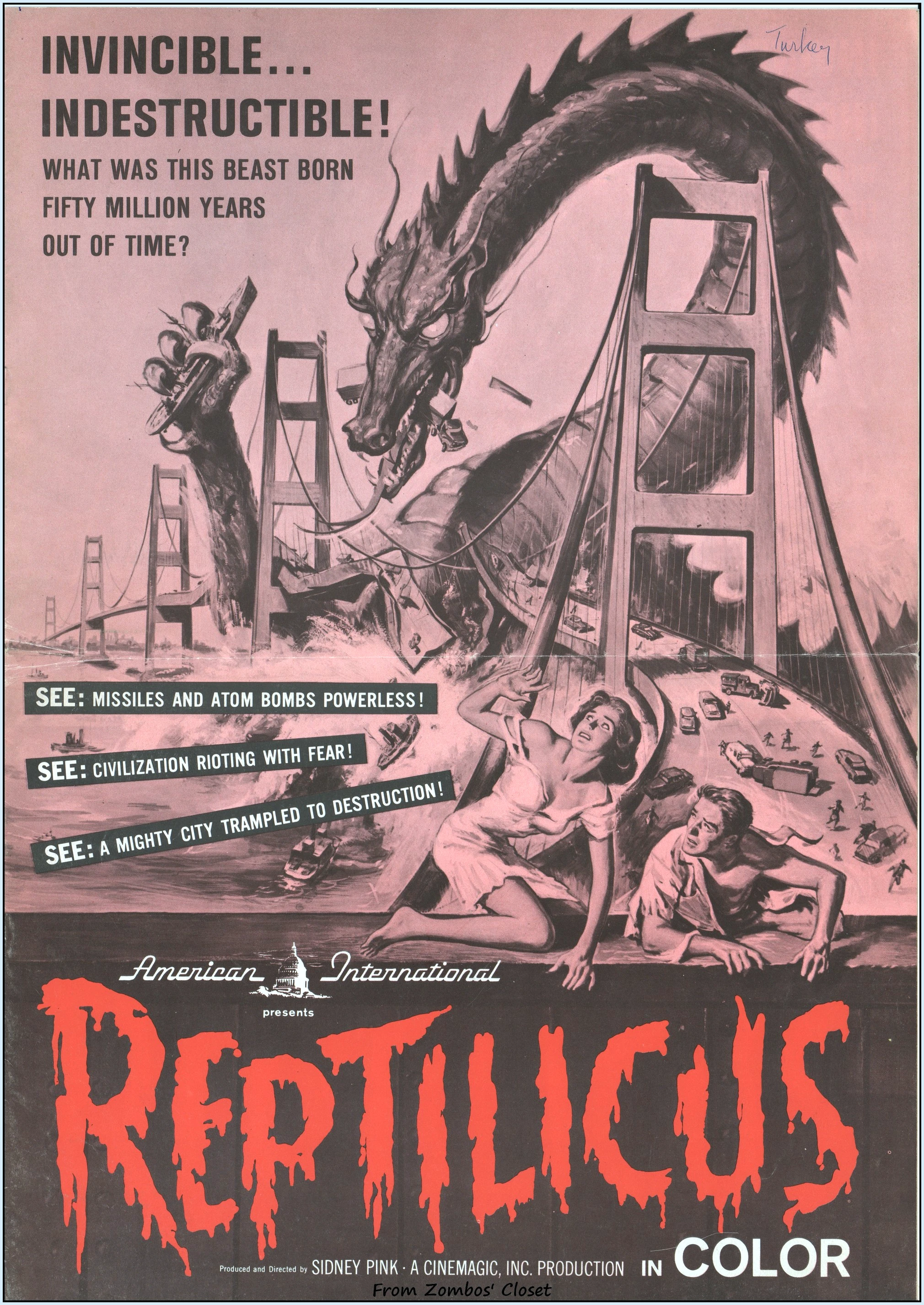
If ever a movie needed a horror host, it would Reptilicus, a Danish import distributed by AIP. Bill Warren in his Keep Watching the Skies! American Science Fiction Movies of the Fifties (okay, so it wasn’t American or the 1950s but…), unloaded both barrels in his usual stye. “Reptilicus has the dubious distinction of being a movie so bad American International almost refused to distribute it.” The monster twist here is that if any part of Reptilicus survives it regenerates the rest. As in The Giant Claw, the monster is a puppet, with “the body…dragged around by the head.” He goes on to mention that Reptilicus flew in the European prints of the film, but they were cut for the American release. Some suing went on between AIP and Sid Pink (he wrote the story and co-directed) over the originally delivered movie, and then some suing went on between Sid Pink and AIP and Monarch Books after the novelization hit the bookshelves. Apparently the novelization was rather racy containing “lewd, lascivious and wanton desire…” Of course, none of that was in the movie, unfortunately. You be the judge! I think a double bill viewing with this and The Giant Claw should be mandatory.
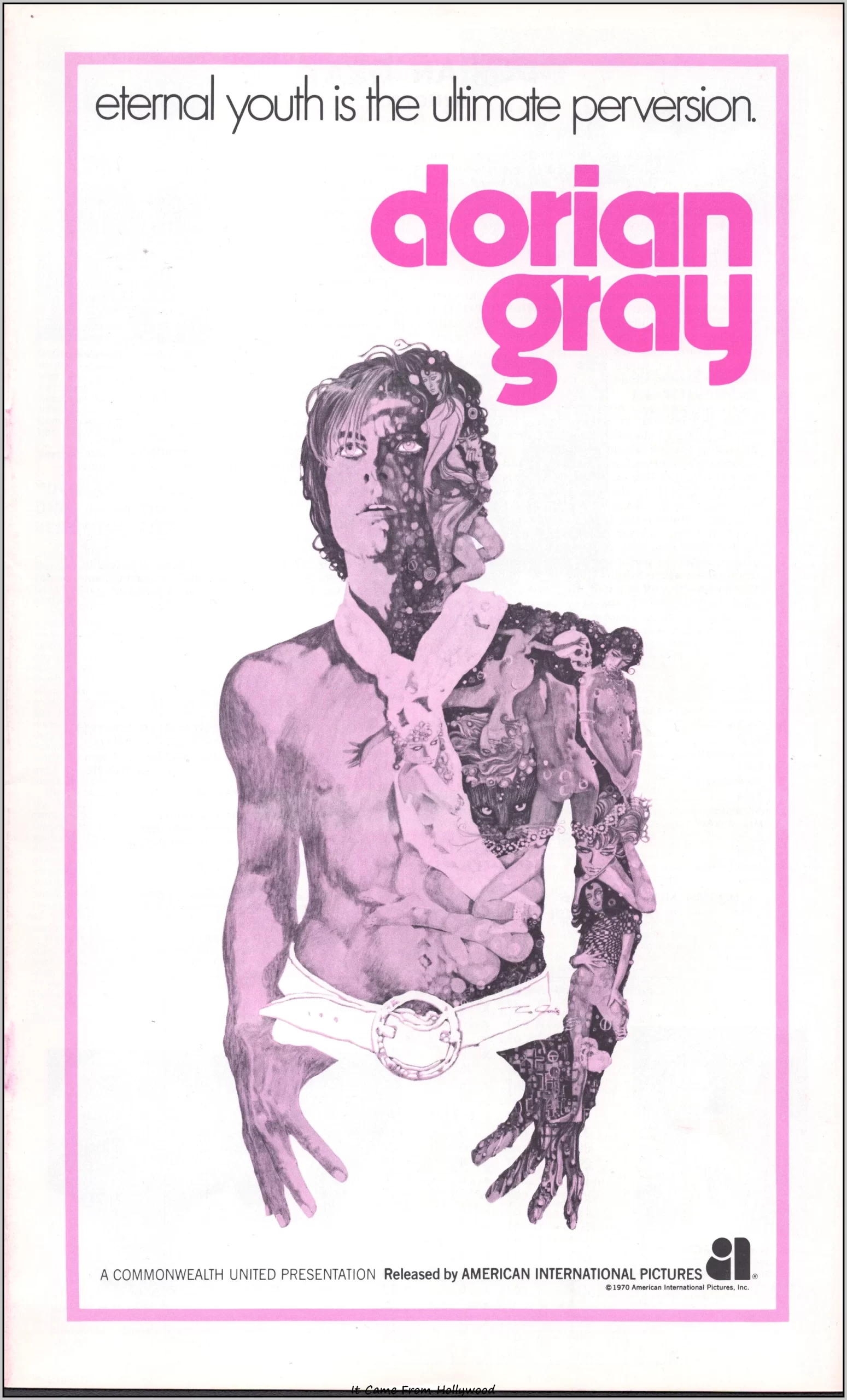
Oscar Wilde’s novel, The Picture of Dorian Gray, has been made into many movies. The earliest surviving version, according to IMDb, is one from 1915, where the sins of Dorian center mostly on cocaine use. This updated 1970 version by AIP amps up the sexual aspects of Wilde’s novel, with Dorian’s descent reflecting the more daring social and cinematic atmosphere of the 1970s as influenced by the sexual revolution that began in the 1960s. AIP’s pressbooks tended to focus on ad mats for newspapers, posters and lobbies for theaters, then maybe a page or two devoted to exploitation and movie and actor details. They also printed on one side of the sheet, so contained blank pages. The teaser ads are especially psychedelic even without color. (courtesy of It Came From Hollywood)
…
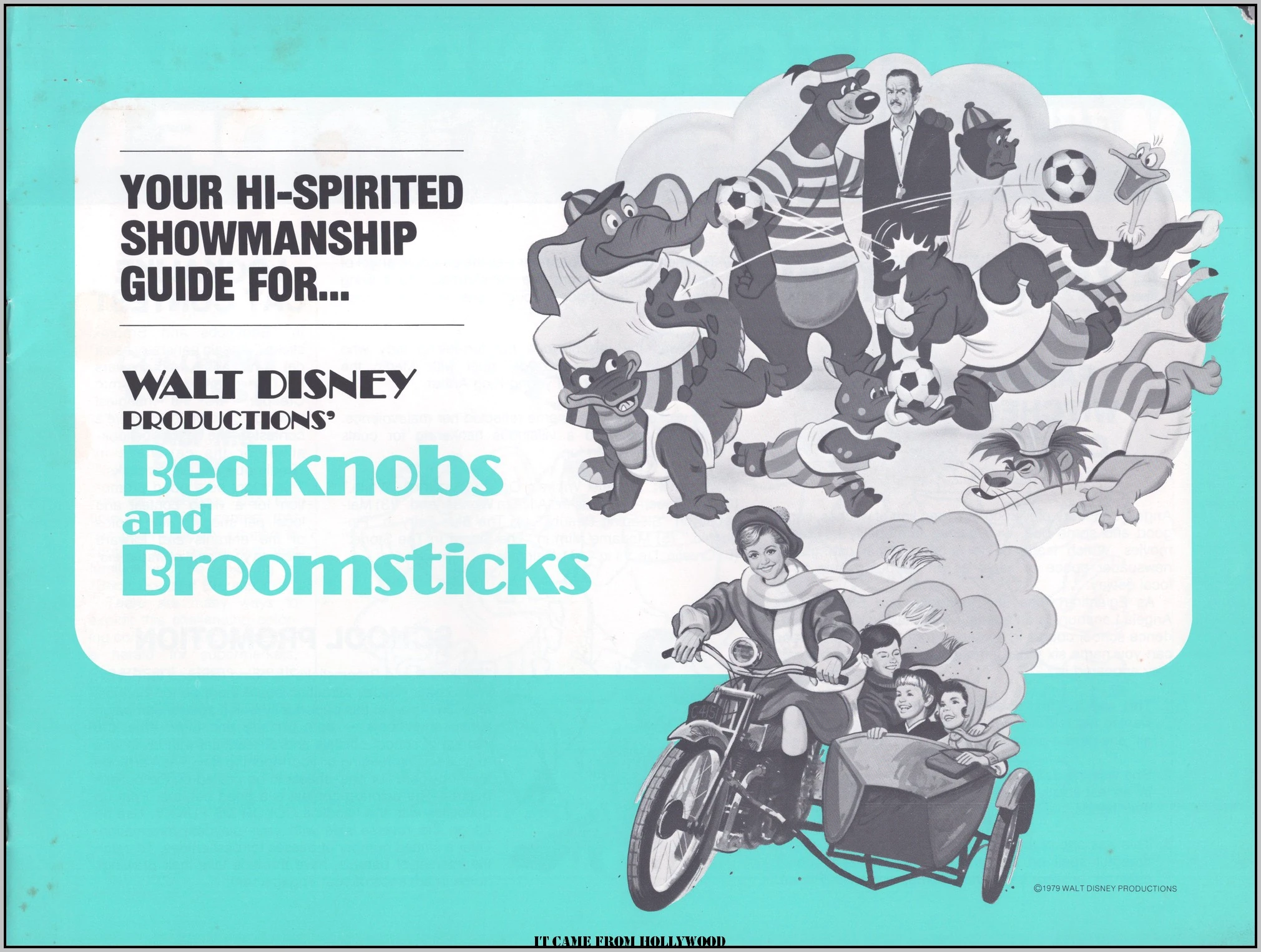
Courtesy of It Came From Hollywood…the re-release 1979 pressbook for Bedknobs and Broomsticks. The Sherman Brothers, who wrote the songs for Mary Poppins, Chitty Chitty Bang Bang, The Jungle Book, and many others, wrote the songs for this movie. They also wrote It’s a Small World After All, so nobody’s perfect. My favorite work of theirs would be Mary Poppins, which reaches sublime heights of melody and heartstrings’ tugging. The rights to Bedknobs and Broomsticks were acquired before those of Mary Poppins, but it was shelved a few years to make way for Mary Poppins, since the stories were somewhat similar. Julie Andrews was the preferred witch for Bedknobs, but feared typecasting and demurred. Angela Lansbury eventually took the role. The movie won the 1972 academy award for Best Visual Effects over its competition, When Dinosaurs Ruled the Earth. (Click each image to expand it–you will need a BIG screen–or right-click the expanded image to download it. And you don’t need witchcraft to find more pressbooks, just rummage through our categories.)
Bedknobs and Broomsticks (1971) Re-release PressbookRead More »
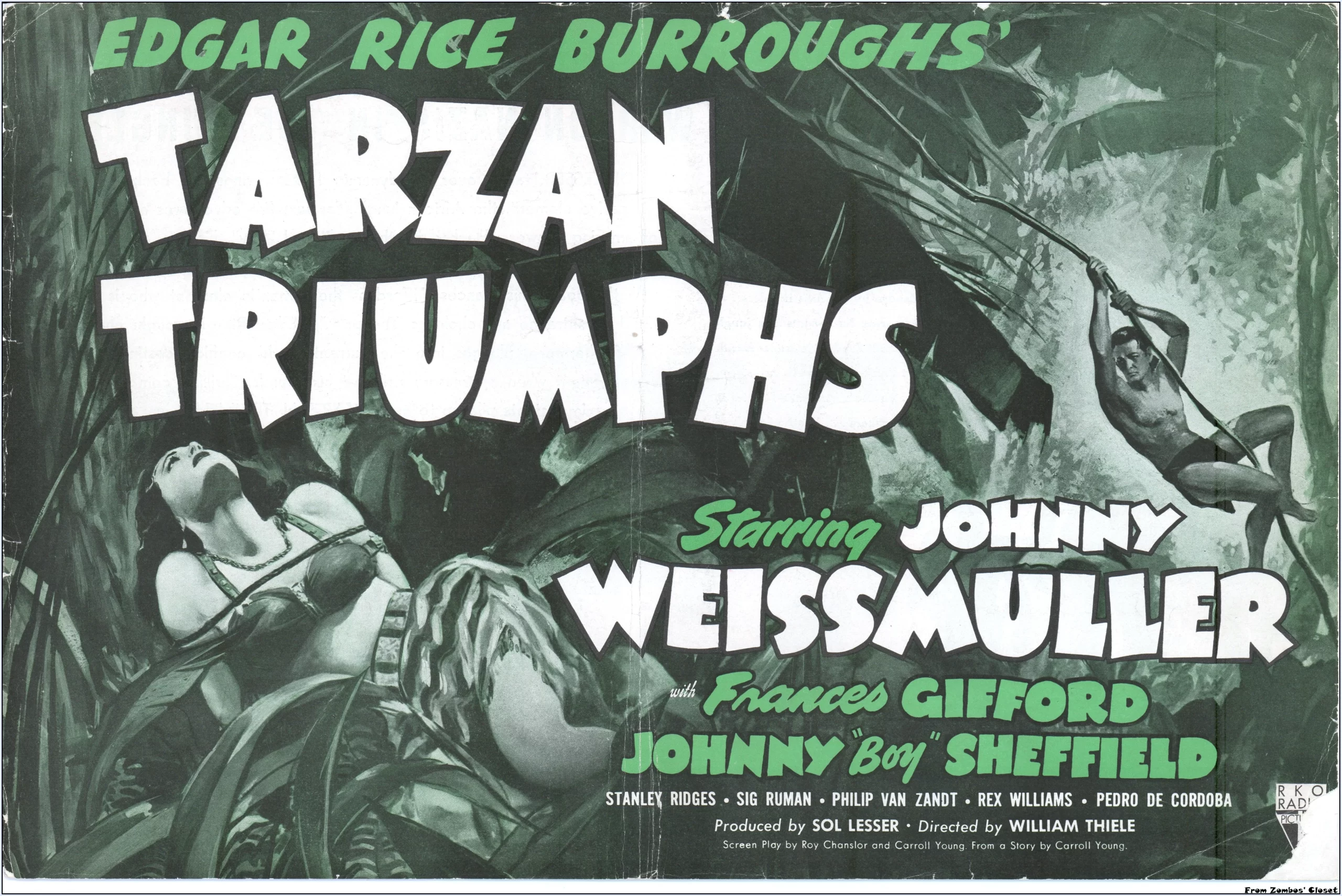
Tarzan contributes to the war effort in Tarzan Triumphs, but fights Nazis only with the help of Cheetah and Boy (Johnny Sheffield), but not Jane (Maureen O’Sullivan). She is tending to her sick mom back in England. But really, O’Sullivan was under contract with MGM, not RKO, Tarzan’s new studio-jungle home, so enter Francis Gifford playing the princess Zandra of Palandrya, another Hollywoody idyllic land of white in the dark jungle (and lots of pretty women), taken over by the Nazis. For a guy who has no job, has a very limited vocabulary, and has only one piece of clothing, he sure attracts women an awful lot. His “jungle people fight to live, civilized people live to fight” sure hit the nail on the head for his time, and any other time for that matter. My favorites from the Exploitation department: Design a costume for Zandra (at least she knows how to dress for company) and the costume contest for the best dressed woman as Zandra. The poster art is pretty good too. Click each image to expand it–you will need a BIG screen–or right-click the expanded image to download it.) And you don’t have to read the signs to find more pressbooks, just rummage through our categories.
…
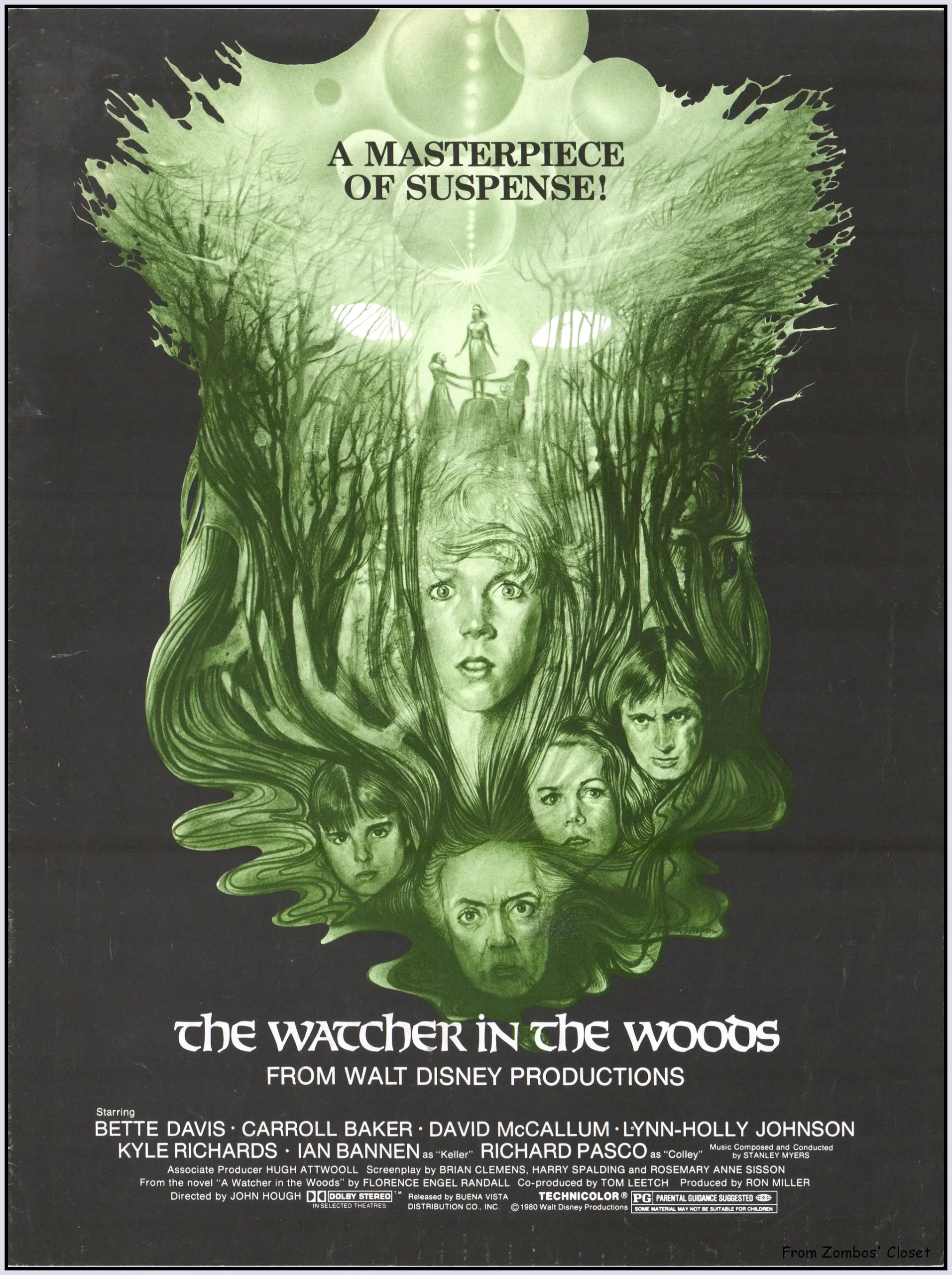
One of Disney’s more troubled productions, The Watcher in the Woods hit theaters, was pulled from theaters, was re-edited, reshot, and re-written, and has multiple endings galore; although the 1981 version of the film’s re-release is the official ending. Yet, with Bette Davis, David McCallum, a creepy suspense permeated with a supernatural mood that gives way to science fantasy, it is one of Disney’s more compelling entries and ranks as a good horror movie (at least by this critic). One funny note: Bette Davis, who was pushing past 70 at the time, insisted on playing her younger self instead of another actor. After a lot of makeup and work to make her look younger, the director and Davis watched some test footage. The director told her it wasn’t working. Davis’s response: “You’re goddamn right.” For more Bette Davis-ness, see Dick Cavet’s interviews with her.
Download pressbook images: The Watcher in the Woods Pressbook or click the images to enlarge (but use a BIG screen).
…