 Zombos says: very good
What kind of horror movie fan are you? Do you go for the more fictional creatures of the night, say Dracula or the Frankenstein Monster, or the ever-ubiquitous zombies? Perhaps you prefer your horrors more real, a Hannibal Lecter munching on someone’s guts instead of a Werewolf ripping them apart? My preference leans toward the imaginary terrors: I know they are not real, so I can enjoy their scares more because I know they really will not get me, if you know what I mean. But then there are the terrors by day and night that are not imaginary, even when framed in a fictional narrative. They draw on the real world, deriving their monsters from the headlines, or history, or the neighbor whose house sits one or two across from you; or maybe they even attend the same school you do.
In Alejandro Amenabar’s Tesis, Angela (Ana Torrent) wants to write a thesis on audiovisual violence. It is all very academic, if you were to ask her, but deep down, there is something else driving her rationale for wanting to write on such an unsavory topic. Sure, she is a film student, and, yes, she enlists her professor’s reluctant help in securing graphic viewing material, but it is not quite that simple. Director and writer Amenabar complicates the path to her thesis by tossing in questions about whether she is being honest with herself, whether others are being honest with her, and just how much her thesis is an academic exercise or a deep pleasure she wants to gratify. Her confusion with all this is our confusion too, and that’s where Tesis kicks into gears as a thriller, a horror, and a do you like watching this stuff and why? And, of course, there’s the monster to contend with. But who is it?
The key players involved in answering this important question, while providing the drama, actions, and scares are, (if you are a Boris Karloff Thriller fan, imagine he is sinisterly introducing them with that knowing twinkle in his eyes): Angela, the student who cannot keep her thesis totally academic; Chema, (Fele Martinez), the student whom everyone knows is the go to weirdo for sick videos; Bosco (Eduardo Noriega), the student who Angela is strangely attracted to in an unhealthy way; Castro (Xabier Elorriaga), the substitute professor who believes audiences drive what movies should be made; and Figueroa (Miguel Picazo), Angela’s professor, who suffers from asthma and pokes around forgotten places in the university where dust and mold spores are not the only things that can make his asthma much, much worse.
Amenabar wrote Tesis while he attended Complutense University and filmed it in the halls of the School of Communications. How he filmed it makes for a rather big building with austere hallways and secretive spaces. It is in one of these spaces that Professor Figueroa discovers a snuff video, after Angela asks him to see what violent content is available in the library. Unfortunately, he is too successful in finding the right material for Angela’s thesis.

Before this plot-forward discovery, Angela has already presented us with a question. Earlier, while riding the train to school the conductor warns that a suicide has splattered across the tracks and insists that everyone not look at the tragic and violent scene as they leave the station. Angela cannot resist, however, and almost reaches the platform’s edge before she is directed away by the conductor. She could not help herself. She wanted to see the aftermath of the suicide. But what about us watching her wanting to see the suicide? I admit I was disappointed. Perhaps I have watched too many recent horror movies and my expectations were formed by them. No Jacques Tournier subtlety for many of today’s directors and fans, they just want the gore. Did I really want to see brains and limbs and guts spread out in a nice red splotch of chunky mess? How would that have made Tesis better for me? The movie starts teasing us about violence and how we view it before the story even begins. How metafilmic! But be assured you do not need to worry about the story getting bogged down because of it. Even Scream, a metafilmic movie franchise, is terrifying and satisfying to watch, although Amenabar’s tone and mood here are more realistic, more downbeat than Scream would care to be.
Angela asks Professor Figueroa to help her find violent videos for her thesis. While he hunts through the library, she asks her classmate Chema to see what video nasties he may have. At first, he refuses to show her anything and recommends Mickey Mouse as a more suitable thesis topic. In the cafeteria, they glare at each other as she listens to classical music through her earphones and he listens to heavy metal through his. We know they are opposites, on the surface, but are they really opposites at heart? Chema finally agrees to show her his collection of videos. She asks if people really watch these movies. He replies, “You, for instance.” She says she does not enjoy them.
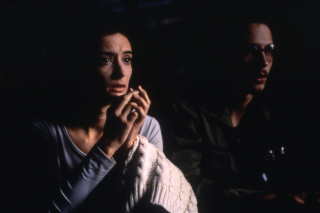 The following day she finds the snuff video that Professor Figueroa discovered in the library. At first she can only listen to it. Once Chema finds out about it he wants to see it. They watch it together and he recognizes the girl in the video, Vanessa, had gone missing from the university a while back. He also sees a digital zoom was used. Angela, although it is her thesis project, is facing away from the television screen. She refuses to look, seeing only intestines where Chema sees the horizontal lines indicating which camera was used to film the torture and death. She does not want to get involved, now knowing a real person may have been killed. But later, seeing Bosco using the same type of camera that recorded the snuff movie, she cannot help herself and starts following him. The cat and mouse game begins. Is Bosco the killer or someone else? Why is Angela drawn to Bosco when Chema insists he is a psycho? Why does Chema hide information from Angela even though he is drawn to her? At first reluctant to seek the truth, Angela is carried away by her own attraction to danger and violence. Her role switches from thesis-motivated investigation to final girl survival as the human monster smells fresh blood.
A lot of very dry but very revealing critical analysis has been written about this Goya Award winning film made by a film student about fictional film students, but at its core is a simple question: how much violence, whether real or fictional, do you want to see? And why do you want to see it? It is a good question that all horror fans should ask themselves.


