From Zombos Closet

JM Cozzoli

A horror and movie fan with a blog. Scary.

The X-Files I Want to Believe (2008)

Zombos Closet: The X-Files: I Want to BelieveZombos Says: Very Good

Mulder:
Scully? Why would he say that? “Don’t give up.” Why would he say such a thing to you?

Scully:
I think that was clearly meant for you, Mulder.

Mulder:
He didn’t say it to me. He said it to you. If Father Joe were the devil, why would he say the opposite of what the devil might say? Maybe that’s the answer, the larger answer. Don’t give up.

Can a summer movie containing no car chases, no explosions, no larger than life monsters still succeed? Yes, according to director Chris Carter and writer Frank Spotnitz, if the movie is The X-Files: I Want to Believe. Replacing the special effects-driven drumbeat of the summer blockbuster with the drama of people wanting to believe in something greater than themselves, Fox Mulder and Dana Scully are brought together again to find the truth behind strange disappearances in snowbound, rural, West Virginia (though actually filmed in Canada). Along the way, they must come to a greater understanding of their own truths: the ones that drive both of them to never give up.

For Mulder, the truth is out there, waiting to be revealed if you keep searching for it. For Scully, the truth is deep inside, waiting for you to see it, even when those around you refuse to believe in its possibilities. For Father Joe, the truth is already known: he loathes it and desperately hopes for a greater one to take its place. For Janke and Franz, they want to believe in something the two of them can share, even if it is freaky enough to open an x-file-styled investigation; for them, the end justifies the means, and those means are gruesome. Who will be saved, damned, or remain indifferent? This is the essential quandary that every x-file poses for us as well as Mulder and Scully.

LOTT D Roundtable: The Allure of Evil

Allure01

Why are we attracted to and mesmerized by evil people in horror cinema and novels? Gloomy Sunday’s Gothic-romantic, Absinthe, kicks off this round of commentary from the League of Tana Tea Drinkers to explore this question. From Bela Lugosi to Freddy Kruger, the league pokes and prods as only it can do, to unearth the answers, the assumptions, and the contradictions.


Gloomy Sunday explores the bad boys of screen and novel…

Why are we attracted to villains? Why are we drawn towards characters we really should hate? Why do we sometimes find sex appeal in characters who are hideous or deformed? Is it we can relate better to people who have flaws, people who are more realistically human with their dark sides instead of the cookie cutter heroes and heroines we usually see in movies?  Or does it go deeper, to an instinctual level, left over from a more primitive time, when only the strong thrived and reproduced, drawing us to the powerfully wicked onscreen?

Pinhead from Clive Barker’s The Hellbound Heart and the later Hellraiser movies–although I only speak for the first two because after that they suck–is one of my favorite villains and one I think has strong sexual appeal despite his skin being the color of a dead fish, with nails protruding from his head, and a strange, but kinky, sadomasochistic leather outfit hinting at damnation. If you wanted to, you could compare the premise Hellraiser is based on to a metaphor for sexual freedom by looking at the puzzle box, which involves a quest for something much desired, yet secret, dark, and forbidden to have. If Pinhead quickly came into scene and dispatched his victims, we would not be so drawn to him. Instead, he shows human characteristics we can relate to. In Hellbound, Hellraiser II he does not kill Tiffany when she opens the box because he knows that “hands did not call us, desire did.” He seems fair even though he is a killer, and he continually lets Kirsty slip through the damning cracks by allowing deals and bargains. Is it his power we are drawn to, the relief provided by his human flaws that we can relate to, or the subtext of sublime sexual naughtiness he is the front man for?

Reviews and Interviews With A Bit of Fiction

Here are some of the reviews and interviews I framed with a fictional story that highlights the various characters living in Zombos’ mansion, or just illustrates my incessant need for cheekiness.

Interviews

Crimson QA With Austin Williams

Gospel of the Living Dead With Kim Paffenroth

Paul Bibeau’s Sundays With Vlad

Jonathan Maberry on Writing

Reviews

Ghost in the House of Frankenstein

Tokyo Gore Police

Dying to Live: Life Among the Undead

Dying to Live: Life Sentence

Tap Dancing to Hell and a Pot O’Gold

Part One — Castle of Blood


The Dark Knight (2008)

Darkknight01Zombos Says: Excellent

Nobody panics when things go according to plan, even if the plans are horrifying. If I tell the press that tomorrow a gangbanger will get shot, or a truckload of soldiers will get blown up, nobody panics. But when I say one little old mayor will die, everyone loses their minds! Introduce a little anarchy, you upset the established order, and everything becomes chaos. I am an agent of chaos. And you know the thing about chaos, Harvey? It’s fair. –the Joker in The Dark Knight.

Moral darkness permeates Christopher Nolan’s The Dark Knight. The Joker, Batman’s antithesis, returns to his unsavory blend of homicidal insanity and nihilistic artistry, first seen in the 1940 Batman comic book, but softened in his subsequent appearances. Gone is the whimsically murderous trickster of precise origin, the clown prince of crime as portrayed in movies, the Batman television series, and many of the DC comic books. Replaced by Heath Ledger’s chillingly amoral, incomprehensibly insane and powerfully corrupting scion of the Devil, no one, including us, is left laughing now.

Throughout The Dark Knight, one question propels the story with its increasing urgency for an answer: how can Batman and Gotham city combat the irreconcilable evil embodied by the Joker without resorting to evil themselves? Batman, Lt. Gordon, and District Attorney Harvey Dent (Aaron Eckhart), must answer it in their own way as the Joker forces them into an ever narrower space for dealing with his escalating chaos and body count. With his smeared makeup, stringy hair, cruelly scarred mouth–and ever-changing story as to how he received his permanent smile–Ledger’s Joker is so evil, so anarchic, and so corrupting in his influence, there is no middle ground for goodness and morality to easily stand on. A human Thanatos unfettered by guilt, he makes Hannibal Lecter and the Jigsaw Killer look like Abbott and Costello. The only way to stop him is to murder him; at least, that’s what he really wants. But will Batman put aside his moral code to do it? More importantly, do we want him to?

Remote Control Zombie of Your Very Own!

Remotecontrolzombie It's here, it's here! Run for your lives and grab one!

Now, if they'd only come in life-size…

From Archie McPhee:

THE REMOTE CONTROL MOANING, WALKING ZOMBIES!

That's right, you can finally control your own undead minion using a brain-shaped remote that toggles it on and off. No more breaking into graveyards and casting voodoo spells, technology will do it all for you! One push of a button sends your own personal zombie shuffling and moaning in whatever direction you point him! Use this remote control zombie to scare your office mates and torment your pets.


Graphic Book Review: Zombie World Winter’s Dregs

Winters_dregs01

Zombos Says: Very Good

Summertime fun getting you down? Can't wait for the colder days, darker days, more depressing sunless days? Want to bury all sand-loving, beach-going, family members and significant others up to their necks close to the water's edge at low tide? Fret no more. Don't get mad, suicidal, or homicidal; instead, pick up Zombie World: Winter's Dregs and Other Stories from Dark Horse, and bring back your sanity with its two-hundred and forty pages packed with apocalyptic carnage.

These four stories, originally appearing in the Zombie World comic book series, bring us closer to those undead we all crave. Think surviving the glump at the gasoline pump is hard, try dealing with ravenous hordes of commuters who want to fill up on you. With writers and artists like Bob Fingerman, Kelley Jones, Tommy Lee Edwards, Pat Mills, J. Deadstock (how apropos), Gordon Rennie and Gary Erskine, you can feel secure in knowing that your hard-earned greenbacks are being well spent.

The title story, Winter's Dregs, kicks off the mayhem in a fast-paced panel by panel exchange between central characters caught up in their daily lives–and deaths. In a city overrun by rats, when people dying in reverse shakes up the routine run to Starbucks, cry havoc and let loose the zombies. Each page is drawn in a heavy, EC horror comics, over-inked style, bleeding black into the surroundings, the characters, and the action. The murky colors create a sense of constant dread which lets up only after you reach the last panel. The story takes time to set up its characters first, then introduces zombies in a subway smackdown after the mayor orders a full-scale assault on brazen rats vexing his administration. Involved dialog and social interactions sustain the buildup to zero hour, fleshing out the people whose mundane paths intertwine with the staggering undead in this day in the life–and death–of a city.

Diary of the Dead (2007)
Another Day Unlike Any Other

Zombos Closet: Diary of the DeadZombos Says: Very Good

It was a gloomy scene both inside and out. Gloomy inside because outside it was sunny-bright and barbecue-hot, and “perfect beach weather” as the saying goes, making it all the more depressing for those of us who cherish the cooler Autumn months.

Inside the library, not even the sombre and ominous strains of Midnight Syndicate’s The Rage soundtrack could assuage Zombos’ contortions across the various furnishings at regular intervals. For Autumn people like us, summer is that seasonal aberration, a temperate nuisance we must endure before the joys of the grayer October Country days take precedence.

The Fantasy Clock on the mantelpiece stuttered the slow passing of time. I put down the book I was reading, 41 Stories by O. Henry, to see if I could charge Zombos with enough energy to get him out of his summer doldrums. His latest contortion had him slumped across the emerald-green velvet upholstered Sleepy Hollow chair.

“How about watching Edges of Darkness in the cinematorium?” I asked. “It’s got vampires fretting over their human food supply when zombies invade their home turf?”

Zombos moaned.

“Then how about we go to Adventure Land and we ride the Haunted House again and again?” I asked.

Zombos moaned louder.

I tossed over the scintillating premiere issue of Scarlet: The Film Magazine to him: no galvanic response. Van Helsing’s Journal of World Fantastica produced no spark, either. Damn, this was more serious than I thought.

In the hallway, Zimba and Zombos Jr’s going-to-Jones-Beach clamour chided us, by intention, as they rushed past the library door. Zombos Jr. made a point of banging his sand toys loudly, and Zimba clip-clopped more heavily in her flip-flops. A whiff of suntan lotion floated into the library causing Zombos’ pearly-white skin to sneeze through his nose in allergic terror at the thought of hot sunlight roasting it in cocoa butter.

Chef Machiavelli, another beach-lover, happily joined them in their sandy debauchery. He stuck his head into the room as he hurried off. “Severese,” he said with a wink, pointing in the direction of the kitchen.

Zombos sprung to action. The magic bullet had hit its target dead center. For an aging dilettante of horror movies, he sure could throttle into high gear when Brooklyn Italian Ices were in licking distance. His favorite is Jelly Ring, by the way, and mine is Pistachio. We raided the walk-in freezer and devoured large quantities of deliciously flavored ice like zombies chewing on a cornered victim.

“Speaking of zombies,” I began to say, verbalizing my thought.

“What’s that?” asked Zombos, going for thirds.

“Why don’t we watch Romero’s Diary of the Dead. Zombies and Italian Ices go together well, you know.

He looked at me for a second; I was not sure if out of perplexity or sudden brain freeze. “Capital idea!” he said. We loaded up with a generous round of Italian Ice flavors before heading to the cinematorium.

The Incredible Hulk (2008)
It’s Smashing Time!

Zombos Closet: The Hulk Movie PosterZombos Says: Very Good

By the time the Incredible Hulk bellows his signature “Hulk Smash!” in-your-face taunt to the Abomination, he’s already done quite a bit of it in director Louis Leterrier’s successful return to the comic book and television roots that made the rampaging, green (with purple pants), behemoth a colorfully melodramatic composition of frenzied destruction and pathos–a superhero more a reluctant monster doing good by accident rather than a skillful, caped-crusader fighting evil by design.

Writers Zak Penn and Edward Harrison (actor Edward Norton’s pseudonym), reboot the Hulk’s origin, distancing it from Ang Lee’s failed attempt at the franchise in 2003. In the succinct opening credits montage, which uses the same gamma ray infusion device first seen in the 1970’s television series, The Incredible Hulk, flashbacks show the disastrous results of the failed experiment leaving Dr. Banner (Edward Norton) prone to hissy fits on a giant scale. Lou Ferrigno, television’s Hulk, puts in a cameo appearance, reinforcing the thematic connection to that series. There is also a nod to Bill Bixby, who starred as Dr. Banner, through a snippet of his The Courtship of Eddie’s Father, playing on a television set.

In this second, more energetic, attempt to launch the movie franchise, Banner is on the run in Brazil, laying low from the U.S. military while searching for a cure to the raging spirit within him. This transition from Ang Lee’s more introspective approach lessens the relationship-heavy storyline and heaps on the throw a tantrum, whoop-ass Hulk transformations. With smashing moments strung end to end, briefly bridged with poignant ones showing how unfortunate his condition can be–he cannot make love because too much excitement would you-know-what–this movie is less character-complex and talkative than Ang’s, opening the landscape wide for plowing with carnage aplenty; exactly what the perfect, breezy summertime movie is all about: simplicity, much action, and pour on the butter.

The Strangers (2008)
Home On The Strange

Zombos Closet: The StrangersZombos Says: Excellent

The message director Bryan Bertino seems to be implying in The Strangers is not to misuse technology; doing so can get you killed. Two misused cell phones, one misused house phone, and a misused car and ham radio later, he clearly illustrates why in this latest iteration of the home-invading stalker movie. With similarities to 2006’s European Them, Bertino’s masked assailants lay siege to the desolate home and psyches of an already distraught couple, entering the premises at will and often standing quietly in the background watching their freaked-out victims, Kristen (Liv Tyler) and James (Scott Speedman).

After his marriage proposal doesn’t go the way he anticipated it would, James and Kristen head to his family’s vacation house at four in the morning. With red rose petals strewn across the bathtub and bed, and a bottle of champaign less chilled than the soured marriage proposal, both try to reconcile the awkwardness by getting frisky instead. Of course, as you and I know, any hint of sex in a horror film spells trouble with a capital T. Right on que, a nerve-rattling pounding on the front door ends their reconciliation. Outside, a Squeaky Fromme-voiced girl, her face hidden in the darkness created by an unscrewed porch light, is looking for someone. Maybe it’s me, but how can James not get a clue even when he screws the porch light back in after the girl goes away? Clueless victims in horror films make matters much worse, as you and I also know.

Thestrangers02 An empty pack of cigarettes sends him driving to the corner store for a refill, but the corner store is miles away, leaving Kristen all alone. Let’s recap, shall we? A really creepy girl shows up at the front door asking–in a very creepy voice– if some guy they don’t know is home. Oddly enough, the porch light is unscrewed so her features are hidden in darkness. Oh, and let’s not forget the incessant and really, really loud pounding that preceded her appearance: a pounding such a diminutive girl could not have possibly done on her own. Do you see where I’m going with this? apparently James doesn’t. Maybe Kristen is right in not marrying such a dope.

While he’s away, little squeaky comes back, more annoying and creepy than before, with more threatening pounding on the front door. Bertino adds a subtle shifting of the camera, right to left, left to right, as it focuses on the unsettled Kristen, reflecting her growing distress. Then the misuse of technology begins.

Instead of calling the police, Kristen calls James–you know, the dope who left her alone in the first place for an expensive pack of cigarettes. Oops, should have charged that cell phone. She plugs it in and goes for the house phone instead. Not much luck with that either. Gee, I wonder why? Technology can be such a bother when making a horror movie. Isolation is essential when creating the right mood and increasing helplessness. You can’t have good horror if potential victims can make quick phone calls for help, or jump in cars and drive away from trouble. Better to make sure they’re remiss in using all that life-saving, help-bringing, techno-crap; best to eliminate it right away, leaving them powerless. Dead batteries and poor cellular service are two ways to squelch this cell phone empowerment dilemma. Bertino uses them and more in nice, too-easy, techno-swipes enabled through poor decisions, as the strangers silently hover, surprisingly close, in the background, taking full advantage of James and Kristen’s shattered composure and wilting thought processes.

James returns, but leaves his cell phone in the car. Even after Kristen explains the weird things happening, the crazy noises, and stuff in the house moving from where it was left, he’s slow to realize they should be driving off like the devil was shooting white-hot flames after them. When he does decide it’s time to leave, his car is tidily put out of commission, sending them running back into the house where their attackers can enter at will.

In desperation, James remembers the gun. In the best argument for the NRA put on screen, he fumbles trying to use it, load it, and aim it. The axe chopping through the front door adds a sense of urgency, so he figures it all out pretty quick and shoots. Unfortunately, he misses. But he does have a shotgun and lots of shells, right, so they’re safe now. Let the intruders come. He’s ready. Sort of. Then again, no, not really.

The home invasion continues, and James and Kristen continue to work against each other and misuse any technology they come into contact with that could possibly help them. Bertino’s grim, helter-skelter-styled, 1970’s-toned, stalking-slashers-treating-you-bad “because you were home” directorial and writing debut relies on the usual dodges–unwise separation, getting yourself hurt when you can least afford to, and mistaken identity–but through his “uneasy” camera, use of music and loud, incessant, irritating noises, and the movement of his three masked intruders inside and outside the home, builds the terror and suspense. Roger Ebert would have given Bertino one star but upped it to one and a half when he found out this was his directorial debut. I’ll go one better and say he’s earned two stars for mixing tried and true formulas into an effective thriller. The Strangers will make you double-check your door at night and sleep just a bit more uneasily, even with the lights on–and keep your cell phone charged and close by at all times.

What Lives On My Desk!

Freud's desk

As I sit at my cluttered desk in the attic, pining away with the summer doldrums, pondering my next review, my next missive, my next revelation, and even my next fluffy piece of reading-candy, it suddenly struck me: why not highlight the many and varied things that live and breathe–metaphorically–on my desk?

There is always something interesting here, patiently waiting for my attention, or glaring back at me in accusatory silence due to the lack of it. Whether hiding under piles of DVDs, or books, or magazines, whether there for inspiration or tethering to my memories and responsibilities, my desk–anyone’s desk for that matter–is a life-equation summed to its rectangular, oblong, or boxy measurements. So let’s see what’s interesting today, shall we?

They’re Tearing Down My Coney Island

Spook-a-rama

I don’t know why I’m crying, but I am. I don’t know why there’s a lump in my throat, but there is. Astroland is closing. They’re shutting down Deno’s Wonder Wheel Park. They’re tearing down my Coney Island, the one seen in fading Polaroid and Kodachrome snapshots blurring into history, and watched on YouTube snapcasts pidgeonholed into two-minute slices for quick viewing. My tawdry, unattractive Coney Island will be replaced by the upscale, condo-dwelling, MP3-swilling crowd, which quantifies, properly socializes, and neatly categorizes everything into discrete gigabytes of wholesome 0s and 1s on their thumbdrives.

Press start. Hit play.

In our digitized and homogenized world is analog entertainment inconvenient? Entertainment which hasn’t been iPodded, or frontal corporatomized, or discretely measured into binary drips repeatedly delivered through popular media and fat business: who still wants it? Entertainment with tattoos flaring, piercings gleaming, and inner voices speaking first, inner ears listening last: why not open a mall instead? The not so pretty entertainment best enjoyed in ill-fitting clothes and loose bodies summed into fractions instead of rounded numbers: what, no Starbucks? Coney Island’s skewed amusements have sidestepped the ubiquitous, commercialized, lockstep entertainment formulas medicating us through every day until now. But its time has run out.

Maybe I’m overreacting. Maybe I’m out of touch and all’s right with the world. Or maybe, just maybe, the closing of this historic amusement park, this last bastion of hucksterism and questionable rides, of piss-smelling walkways, seedy denizens, and plastic trinkets–maybe this is the death knell for the gritty, indiscreet, and impertinent analog amusements unfit for our digital consumption. You know, the fun stuff not approved, not sanitized, not reamed out to hell by our wannabe clean-cut, moral-spewing but not doing culture?
SpookblogWhen the real Coney Island closes forever, where will Deno’s Wonder Wheel Park and it’s over fifty Spook-A-Rama, “the world’s longest spook ride” go? Okay, well, sort of; it was the longest ride if you counted in the interminable twisting and turning of the Pretzel rotating car as you traversed a narrow outside courtyard, between the darkness of the two buildings once used to contain the myriad terrors popping up at you.

In an almost forgotten summer, in a long ago year, the kid I was got the joke. Before I could inhale my first gasp of disgust at the yucky “spiderwebs” touching my head in the brief, utter blackness of building one (how long had those strings hung in the dank, musty air?), I was flung into the bright sunlit courtyard to make my lengthy–and very uneventful–journey toward building two where the real horrors waited. Most of the ten-minute ride was spent in that courtyard, whirring around the track, looking at fake plants with signs that read “poisonous.” In-between the hissing sounds of compressed air escaping, unoiled machinery screeching, and quivering soundtracks, I swear I could hear William Castle chuckling in the dark of the second building when I finally got to it.

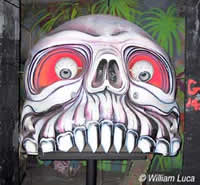
But I took this mindshot long ago, well before building one was torn down and the courtyard track dug up, replaced by more–better–money-making concessions; well before the lurid outside facade of fading, peeling-paint monstrosities was replaced with more innocuous figures of Laurel and Hardy, and Disneyized pirates, banishing the leering, bug-eyed gargoyles, spookshow skulls, and pitchfork-wielding devils to limbo. The salty air hastened decay and ever-increasing safety codes did the rest; little remains of the original grotesqueries quickly flashing by in the darkness; but still they scream for life beyond YouTube and Twitter.

Although many of the original displays have been replaced, either through deterioration or the need to upgrade to current safety codes, Spook-A-Rama has accumulated one of the most eclectic collections of stunts to be found in any dark ride. Some were built on the premises when the ride was new; some are from long-gone manufacturers such as Bill Tracy and Animated Display Creators; others are from newer current studios like Distortions Unlimited, Halloween Productions and Screamers; and many are of unknown origin. Still others were acquired from neighboring Coney Island rides that had closed, such as Tunnel Of Laffs and Dragon’s Cave, as well as the aforementioned ‘Hell ‘N Back’ Tracy-furnished ride at Rockaway.–Bill Luca, www.laffinthedark.com
Danteinferno

Pause.

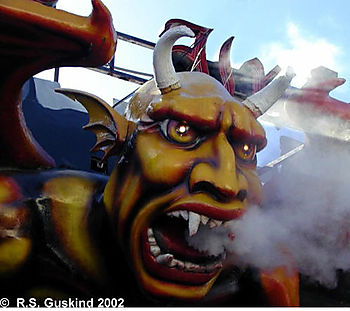
Astroland, the “space-age” theme park’s lease on life has expired, too. I was there in 1962 when it opened. I won’t be there when it closes after this one last season. Many dark rides have come and gone, but Dante’s Inferno is still there. Sure, it’s changed, but haven’t we all? Its original theme, Dante’s Divine Comedy, no longer applies, instead replaced by a hodgepodge of stunts (lingo for the creepy, often cheesy, tableaus) walled behind glass, safely distancing you from the scares, keeping the improper terrors properly out of reach. Nothing here lunges at you or threatens you. Like most digital entertainment: you just watch. Aside from a circular saw dismemberment, most of the terror comes from twirling around in the dark, strobe lights, and waiting for the next stunt. Unlike the denatured facade of Spook-A-Rama, Dante’s Inferno still has skeletons and a pitchfork-wielding devil clutching a victim. Being portable, maybe the ride will find a new home elsewhere.

Slow-reverse. Play.

Take a deep breadth of air from the Coney Island boardwalk. Do you smell it? Deep-fried and crispy-brown it comes, heavy with salty, peppery heat, topped with sugary-sweet dripping ice cream cones, mingling with the odors of sun-bleached wood dried out by wind-blown sand and etched by the thousands of footsteps mashing thousands of potato knishes, squishing millions of hot dogs, kindling endless romantic dreams and littering Coney Island whitefish across many long-gone summers stretched end-to-end.
Fhof.melvinhistorical

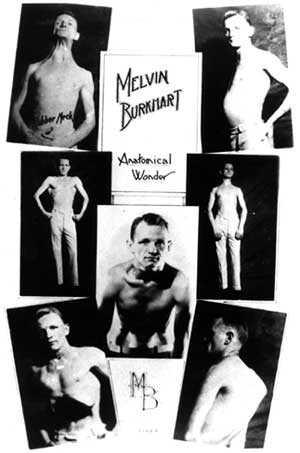
What will happen to the boardwalk when the condos come, and the shopping malls, and the theaters? Where will Sideshows by the Seashore be, the last place where you can experience unusual, analog performers with their imperfect bodies, undulating Ray Bradbury tattoo illustrations, gasoline-thirsty throats, bizarre feats no one else dares to do, and physical triumphs no one else has been cursed and gifted with, showing all off in a genuine, traditional ten-in-one circus sideshow? Where will Satina the snake charmer slither to, or Otis Jordan, the frog boy, roll and light a cigarette with his lips, or Zenobia, the bearded lady, give it a good tug, or Helen Melon, who is “so big and so fat that it takes four men to hug her and a boxcar to lug her!” be hugged? What place for them in our digital age of bodily perfection and propriety? YouTube? No. You can’t take the hammer to pound that way-too-long nail into the Human Blockhead like I did on a stifling summer day. You can’t touch Satina’s way-too-big snake, either, or smell the alcohol swabs as the Human Pincushion sticks needles into his bare flesh.

Fast-forward. Stop.

One last breadth, one last ride. Coney Island’s ghosts, Astroland, and Deno’s Wonder Wheel Park will depart at the end of the 2008 season. Dreams, imagined futures, and forgotten pasts to follow. But, hey, just catch them all on YouTube.

LOTT D Roundtable:
Torture Porn in Horror Today

Image from Oteki Sinema

Cinema tends to reflect either the banality, the sanctity, or the immorality of our times, and patrons of movies promote the ones they like most by buying more theater tickets, more DVDs, and more Netflix rentals for them. The popularity of a movie will invariably foster more movies with similar storylines, similar characters and action themes, and as many sequels as an audience’s attention span will allow. In a word, profit drives the creative ups and downs of cinema. From the independent to the mainstream, whether grindhouse or arthouse, the bottom line accounts for most of what we see and hear in the darkened theaters of Cannes, Sheboygan, and points in-between.

With movies affected by the vagaries of social and commercial forces, how do you explain the cross-genre use of torture porn in films like The Passion of the Christ, Saw, Hostel, Wolf Creek, Irreversible? Or even it’s lesser use in television shows like Battlestar Galactica or 24? How do you justify the extended, agonizing, and too-graphic torture of a human being (or human-like being), who is humiliated and vivisected emotionally, spiritually, and physically? Is it a necessary component for high drama, or just a bottom-line feeder? And what does it say about us, the audience, promoting such movies like Saw every Halloween, forcing each sequel to become a more creative evisceration bloodbath?

The horror-blogging members of the League of Tana Tea Drinkers give their take on torture porn. One word of advice: this is not a fluff piece of transient newsy gossip, or Twitter-sized comments of self-importance. Brew a nice cup of tana tea and butter your brain on both sides before you begin. Now get nice and comfortable. Ready? Let’s begin.