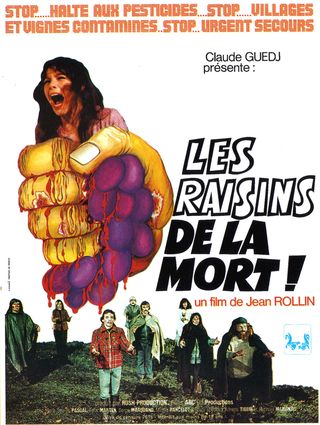
 Zombos Says:
Have a glass of wine instead.
Seriously, have a glass or two of wine instead of seeing this movie. French directors (that would be Jean Rollin in this case) often have trouble handling the subtleties of horror and science fiction; namely that there are no subtleties.
Instead of a clean and clear message delivered through visual and visceral tension and terror, they’ll pause the camera on a scene until it’s threadbare, insist their characters prattle on and on with soul-searching ruminations, and then have them make interminable philosophical arguments about their predicament, stalling everyone in place while the pace unfolding around them screams for celerity and action. Of course, when you get to movies like In My Skin, the scale tips well past the clean and clear measure and goes sailing out the window, but that’s another discussion entirely. Just recall Alien: Resurrection and you will get my drift.
Here are my review notes in lieu of a more polished review. This movie is simply not worth more of my time or effort beyond compelling you, with sufficient information, to make your own judgement on whether to watch it or not. But if you watch it your crazy.
Review Notes for The Grapes of Death:
(Misc. Notes: Interesting, the IMdB lists a 6.2 rating on this. Wonder what their reviewers are smoking. Wait, they even rate 6.3 for Alien: Resurrection. Must be good stuff. Don’t forget to mention the poster art comes from drfreex.com).
Opening beat on worker being overcome from pesticide used on wine grapes. Told to suck it up and get back to work. He does. Foreshadowing trouble to come. Next opening beat on two young woman traveling on empty train to countryside. They are friends. They talk a lot. Comment on how freaky it is traveling with no one else aboard (aside from the conductor, I guess). No attendants, either (budget saver). They stop at one village. Silent guy boards train. What’s wrong with him? He’s leering. Right. He’s infected. Silent, now violent, guy kills one girl, goes to sit in the car with the other.
Takes a long time for Elizabeth (Marie-Georges Pascal) to notice he’s the silent, leering, crazy type. He starts oozing–what the hell, is that grape juice? Cheesy effects here we come. Great. Finally she gets the message. She runs to find her friend. Finds her mauled to death in the loo (could get fancy here and say train de salle de bains). Elizabeth stops train and runs away.
And keeps running for a long while.
(Note: drawn out sequence here; too much time between beats. French directors do that a lot. Unless it’s about chocolate, food, or sex, they can’t handle down time well.) Good cinematography of countryside (or is it good countryside lends itself to photography?)
She enters cottage, sees man and woman by the dinner table, pleads with them to help her, must call the police, etc. She’s hysterical, yelling, she needs to phone cops, he pores a glass of wine for her. Woman standing by him is immobile. What’s up? Oh, right, the guy has some creepy looking plastic makeup on his–I mean rotting flesh–showing. He’s infected, too.
Extreme, and unnecessary, close ups splice back and forth between her face and their’s. She’s told to calm down and stay, rest awhile. Sure. She heads upstairs to find a comfy bed. Conveniently open door leads to finding a body in a room. She pulls the sheet away, finds woman with throat cut open. Guy’s daughter tells Elizabeth he’s insane, killed mom. Right. Kind of caught that before she headed upstairs. Erratic beat here. Can we get on with it? Every scene is lingered over too much, ruining the pacing. Were we that obtuse in 1978?
Finally, he acts violently and kills his daughter with a pitchfork. He makes sure to rip open her blouse first to show her ample breasts. Country living I suspect. She was also infected. Interesting. So story point is men and women are infected differently. Also explains why he didn’t kill his daughter before then. Only kills her now because she’s helping Elizabeth escape?
But then he regrets killing his family. Elizabeth runs for it. To the car. He stops in front of the car and insists she finish him off. She does, after thinking it over. A lot. She rams the dinky car into him. (Note: dinky cars ramming into people is unintentionally funny.) She drives around. Comes across another crazy guy, stops long enough for him to thump his head through her side window again and again and again. Long take closeup of his rubber appliance–I mean weeping sores from his infection. She shoots him dead. (Crap, where’d she pick up the gun(?). It had to be in the farmhouse she drove away from. How’d I miss it? After crashing his head into her side window the dinky car won’t start. Sure, that makes sense.
She’s on foot again and walking around (no budget for gas?). And walking around a lot (before the next beat kicks in.) Wait, now she’s running. Waiting for that damn beat!
A twig snaps, she pulls out her gun, a woman comes stumbling towards her, arms outstretched in front. The woman is blind. Seems okay and not infected. Lucie (Mirella Rancelot) has been going around and around since the morning. Elizabeth and Lucie now stroll toward the village, chatting, arm in arm. They take the long way around.
(Finally, the next beat kicks in. This movie screams “edit me!”)
They come across a dead guy, then a lot of dead guys. Lots of time spent walking through the carnage of dead guys. Lucie keeps insisting on knowing what’s happened. Elizabeth doesn’t tell her. Not sure why. Lucie starts screaming “Luca,” looking for him, but then they’re walking again.
(Note: I don’t think there was this much walking in the Lord of the Rings movies, combined.)
Both women hugging each other now as they walk. Finally, they find Lucie’s house. Where’s Lucas (Paul Bisciglia)? If Lucie pores a glass of wine for Elizabeth I’m going to–wait, Lucas shows up, not looking too good. More infected people show up. They’re not looking so good, either. Whole village must be wine drinkers. Lucie stumbles off on her own, Elizabeth pulls out her gun and loads it. (Wait. Where’d she get more bullets? Crap! I thought I was paying attention.)
Lucie, now walking, with villagers descending on her. Pretty creepy scene. She keeps calling for Lucas. More close-ups of zombiefied faces. Lucie tells them to go away, thinking they’re there to make fun of her. They don’t (go away or make fun of her). She starts walking again, through them.
Let’s see how long this takes before the next beat kicks in. Rollin’s going for a record here, I know it.
Lucas finds her. He’s all weird, starts drooling and laughing. And promptly strangles her with a rope as the villagers watch. Lucie’s screams don’t prompt much urgency from Elizabeth. She does manage to shoot one villager, though, then finds Lucie nailed, topless of course, to a farmhouse door.
Lucas brandishes axe. Really bad special effect of Lucie’s fake head being chopped off her blatantly obvious dummy body ensues–in close-ups, and Lucas carries the head around by its long hair. (Note: Wait a mo, when did Romero do The Crazies? Right, 1973. Rollin must have seen it. This whole rabid village thing is a lot like The Crazies in spirit.)
Lucas chases Elizabeth, head in hand. Villagers stagger after them. She runs away. Again. Then she’s pulled into a house by a blond bombshell. (Note: It’s Brigitte Lahaie the porn actress!) They sit on a couch and chat away. Lahaie pores Elizabeth a drink, too. Can’t beat that country hospitality.
And they chat some more.
We are told the house’s owners are dead, but she had the key, so the house is hers now. Good foreshadowing as to who may have killed them. Really subtle. Hint, hint. Lahaie says the villagers try to get in every night but they can’t (that scenario sounds familiar? –yes, Vincent’ Price’s The Last Man on Earth). Then she changes clothes so they can go out to find safety. Say what? If the villagers can’t get in, they were safe inside weren’t they?
And Lahaie’s acting pretty weird; enough to connect the dots for us, but Elizabeth remains clueless. I sense more running in her future.
Lahaie tricks Elizabeth and the villagers come around. Wow, didn’t see that coming. More close-ups of badly made up infected faces. Lots of prolonged hysterics. Lots of villagers-mingling-around shots to fill time between beats.
La grande femme blonde (as Brigitte “Lahaye” is noted in the credits) soon carries a large torch and holds onto two mean-looking dogs (so what’s Rollin implying here?). More annoying closeups fill time until two guys can drive up in their truck with rifles and dynamite.
Yes! –I mean, of course Rollin has her disrobe to show the two guys she’s not infected. How could Rollin not let Lahaye (nee Lahaie) showcase her assets to the fullest?
More running ensues as Elizabeth escapes while the two guys get an eyeful. And more close-ups of faces ogling through their infections wastes camera time. Elizabeth returns with the torch, but not the dogs, gets too close to Lahaye, and they start fighting. The two guys almost shoot her, but realize she’s not infected and Lahaye is the crazy one. Lahaye grabs the torch and blows up the truck and herself.
Which leaves us with the two guys and Elizabeth walking. Again.
(Note: mention the really annoyingly inappropriate score to this movie while they walk. A monkey with a zither could do better.)
Daylight. They pause for a long chatty rest. Continue walking, do some climbing, then chat some more about needing a pint of beer, realize they just missed the New Wine Festival (could definitely use the Song of the New Wine from Frankenstein Meets the Wolf Man to liven this turkey up), argue over military bases and nuke plants, and politics (I swear to god this is torture to listen to), and who should carry the lone rifle they have. Obviously Elizabeth should, since she can shoot well and produce bullets when needed. And she looked like such a dainty little thing, too. Go figure.
They finally arrive at a farmhouse. One guy makes a phone call while the other plunders the larder and pulls out the food. Ah, French movies. The two guys drink wine (guess they missed the memo about the tainted wine?) and argue a lot, then agree to disagree. She leaves to stagger around outside. She staggers into the barn. Staggers up the barn stairs. Conveniently finds her friend, Lucien (Serge Marquand), hanging out in the barn. Seems a bit abrupt to have him just appear.
He’s infected. They talk about it. He created the pesticide that’s killing everybody. They talk about that. He’s feeling equally guilty and homicidal. She gets closer to her boyfriend and hugs him, infected warts and all. Ah, the French and true love.
The two guys stop arguing and realize Elizabeth had left. They go looking for her. One of them shoots Lucien dead. She then shoots the two guys dead. One last, long, closeup of blood dripping onto her face as the credits roll. My guess is she became infected, too. The end.
Like I said, just open a bottle and have at it. Forget this one, unless you like smelly cheese with your wine.

