Paul McVay over at It Came From Hollywood dug deep to find these radio spots. Here’s what Paul had to say about them.
“Filmways had barely completed their purchase of American International before rushing out massive movie marathon packages to any exhibitor who would take them, and to their credit, it was a pretty smart idea. Attempting to recoup as much money as they could on their investment before they themselves went bankrupt.
“Filmways put together four black-film-oriented movie packages that appealed to every kind of theater and every time of day. Represented here are two of the four packages, Black Classic Unit 2 & Black Classic Unit 4. They include the “All-Day Motion Picture Marathon,” the All-Night Motion Picture Marathon, and the ultra groovy Dusk-To-Dawn Drive-In Movie Marathon. The movies included in the Black Classic Unit 2 package were Truck Turner (1974), Cooley High (1973), Bucktown (1975), and, for some reason, Kung Fu Killers (1974). Each cut is tailored to that specific movie-going experience, be it all night at the Drive-in, all night at your local hardtop or if you weren’t encumbered by a job, all day long in your favorite local theater.
Black Classic Unit 4 included Friday Foster (1975), Slaughter (1972), Cornbread, Earl, and Me (1975), and Black Mamma, White Mamma (1973.) There are three 60-second cuts for each package for a total of six 60-second spots. All are highly polished with film audio drop-ins, sound effects, and some wonderful funky backing tracks. All six spots are different from each other. This was, perhaps, the last time radio advertising for film was this satisfying.”
Black Classic 2-All Day Motion Picture Marathon
Black Classic 2-All Nght Motion Picture Marathon
Black Classic 2-Dusk to Dawn DI Movie Marathon
Black Classic 4-All Day Motion Picture Marathon
Black Classic 4-All Night Motion Picture Marathon
Black Classic 4-Dusk to Dawn DI Motion Picture Marathon
Lloyd Bridges only movie serial, Secret Agent X-9, also featured two actors who played Charlie Chan’s sons in that popular movie series, Key Luke and Benson Fong. Going after a synthetic fuel formula provides the motivation for thirteen chapters of action and cliff hangers. Universal was unique with their serials by not providing the traditional chapter recap of the story so far. Instead, they had characters in a following chapter recap, through their dialog, what transpired in the previous chapter (as noted inGripping Chapters: The Sound Movie Serial, by Ron Backer, BearManor Media). Universal did a Secret Agent X-9 serial in 1937 too. That storyline centered around stolen jewels. Both serials were based on the comic strip character of the same name written by Dashiell Hammett and drawn by Alex Raymond.
Myron Fass of Eerie Publications came out with this non-comic look at Dracula in 1976 (with the short story, Dracula’s Guest, by Bram Stoker, included). It was followed up with another one-shot, Revenge of Dracula, in 1977. Both covers featured Bela Lugosi as the undead count. In Revenge, Sheridan Le Fanu’s Carmilla was added. John Thomas Church provided the non-prose content for both. Revenge was the last magazine to be published by Myron Fass under the Eerie Publications name as he and Stanley Harris split over differences and Harris took the name with him in 1977.
In The Weird World of Eerie Publications by Mike Howlett (Feral House), he recounts how things came to a head. Fass kept a gun in the office. “In the summer of 1976, there was the typical tension in the air, and Myron Fass was storming around the office after having a heated argument with Harris. He retreated to his office and then a gunshot rang out.”
“It was really loud, and everybody freaked out, Howard Smukler recalled. “We had a number of gay editors/artists, or at least non-violent English major types, and they were really going nuts.” The shot went through the wall into Harris’ office, barely missing him.
Dynarama at work! The fight with Kali. Ray likes animating multiple appendages in sword fights!
Wow! I didn’t know last week’s article would have such a reaction!
The gang and I went to Witchwood Cemetery to plan our layout for the upcoming Monster Bash on Halloween and I was besieged by countless apparitions, spooks, cadavers and assorted goblins all wanting to tell me what their favorite Harryhausen film is. They also wanted to share their favorite scenes and why they liked them and how great the effects were. The responses were as varied as the ghouls themselves. We all set around on various tombstones sharing recollections and stories about these films. They truly have had an impact on monsterkids past and present.
After a few hours of sharing, the gals and I did eventually get to plan for The Bash as most of the ghoulish beings had made their way back to their assigned places of repose. I was exhausted from all the talking and moderating the discussions. They liked my radio spots and were excited to see what this week’s entry would bring.
Sadly, I just have two remaining titles to feature, and the movies are some of Ray’s best: The Valley of Gwangi and The Golden Voyage of Sinbad.
The awe-inspiring roping scene in The Valley of Gwangi. Ray at his best!
What can I say about The Valley of Gwangi? The visual effects are near perfect, especially the roping scene between the cowboys and Gwangi. I am still amazed by that sequence and can appreciate the time that went into filming it. Matching the miniature model ropes to the live action plate ropes is something to see! I just wonder how many trips Ray made from the camera’s viewfinder to the model stage and back to ensure the perfect lineup? He had more patience than I ever did! I’m also sure that sequence brought back bittersweet memories of working with his mentor Willis O’Brien on a similar set-up for Mighty Joe Young. Obie would have been proud of the Gwangi one.
In addition, the battle between Gwangi and the elephant surely caused him to harken back to his days working on 20 Million Miles to Earth. This time, though, the sequence is more brutal, as it is plain Gwangi is out for blood and not merely defending himself as the Ymir was. Also the initial appearance of Gwangi is well done and comes as a surprise. Imagine chasing a little critter only to run into a full-grown Allosaurus. Whoops! Better turn around quick!
Ray at the animation stand in front of his large rear-projection screen.
I watched Sinbad the other day just to refresh my memory of it and was surprised how really good it is. The locations and set pieces were some of his best. It has a grittier look about it compared to 1958’s The Seventh Voyage of Sinbad. Characterizations are good and John Phillip Law does an admirable job as Sinbad. And don’t forget Caroline Munro: She was one of the highlights of the film for most male monsterkids.
The spots for The Valley of Gwangi are effective, although they don’t tell the whole story. My only gripe with them is Gwangi’s roar: Did Rodan fill in for him? The spots for The Golden Voyage of Sinbad are somewhat different from what we are used to. It was the ‘70s after all.
So, I present them here as the end of my two-week tribute to Ray Harryhausen, the man who had an effect on many monsterkids through the years. He was a pioneer and an inspiration to us all. He will live on through his movies, and his movies will still make us wonder, ”How did he do that?”
The Golden Voyage of Sinbad Radio Spots (including those done by Stan Lee)
Valley of Gwangi Radio Spots
Lobby card showing the battle between the griffin and the one-eyed centaur.
Do you have any movie radio spots you would like to share? Contact Gary at [email protected].
I’m not sure why The 5000 Fingers of Dr. T is “the greatest merchandising picture.” Oh, wait a minute…yeah, okay. With the “greatest merchandising campaign ever prepared” it does have a lot of merch and tie-ins going for it. I would say, though, that I lean more toward Star Wars being the greatest merchandising picture, given the amount of toys, clothing, decorations–you name it–that it has generated over the years. One thing: merchandising for pictures didn’t start with Star Wars; SW certainly took it to a whole new level, but product placements and merchandising off a film have been part of the movie business for many years. Still, this one is impressive.
This bare bones pressbook from Commonwealth United Entertainment for Dayton’s Devils, focuses on images of the actors with some minor article-publicity. The poster art also hypes Lainie Kazan (a Brooklyn girl) singing the song Sunny. She also starred in the movie (though I remember her mostly from Columbo). It Came From Hollywood, always one for AIP-related movies, sent this one along because AIP acquired domestic film rights to it in 1971 when Commonwealth’s 80 or so million in debt forced it to shutter. Before that, though, it was a heavy-hitter, with notable films like Venus in Furs, The Ballad of Tam Lin, and The Magic Christian. You also have some great actors in this ensemble heist movie, though I’m not sure robbing an Air Force base of its payroll is a good payday at all. The year is 1968, however, so a little does go a long way, unlike today. Of course, the movie follows the usual seven men, one woman format, and the elaborate plotting of the heist, and the–oops!–didn’t plan for that, did we? moments.
“One of Disney’s four “Package Films”. During World War II the studio lost a lot of manpower and resources, which left it with countless unfinished ideas too long for shorts and too short for features. So, inventive as Disney was, it stuck short ideas together into feature-length movies” (IMDb). Combining two shorts, The Wind in the Willows and The Legend of Sleepy Hollow into a feature-length movie, The Adventures of Ichabod and Mr. Toad had alternate titles, Two Fabulous Characters and Ichabod and Mr. Toad. This would be the last package film by Disney, who returned to single-feature in 1950 with Cinderella. While costs were kept low by reusing previous animation work, the Headless Horseman sequence is memorable today and scary enough for the kiddies to enjoy (after being terrorized, of course). The Wind in the Willows segment was narrated by Basil Rathbone.
Ray Harryhausen with Medusa from Clash of the Titans (1981), Photo: Andy Johnson
Ahhhh, Fall is in the air!
Temperatures are falling, the air is crisp and pumpkins are everywhere! And, we all know what that means: Halloween is just around the corner!
I had several of my ghoul-friends over for some witch’s brew and a planning party the other night. We are planning on having our annual Monster Bash at the Witchwood Cemetery at midnight on Halloween, and we were discussing the activities. We have it at midnight so we all can be home earlier in the evening to hand out goodies to all the little monsters that come around our homes here in our community. We have such fun tormenting the little creatures who come our way. I don’t know who has more fun…us or them! Anyway, we were all sitting around on my front porch when the conversation turned to movies. …
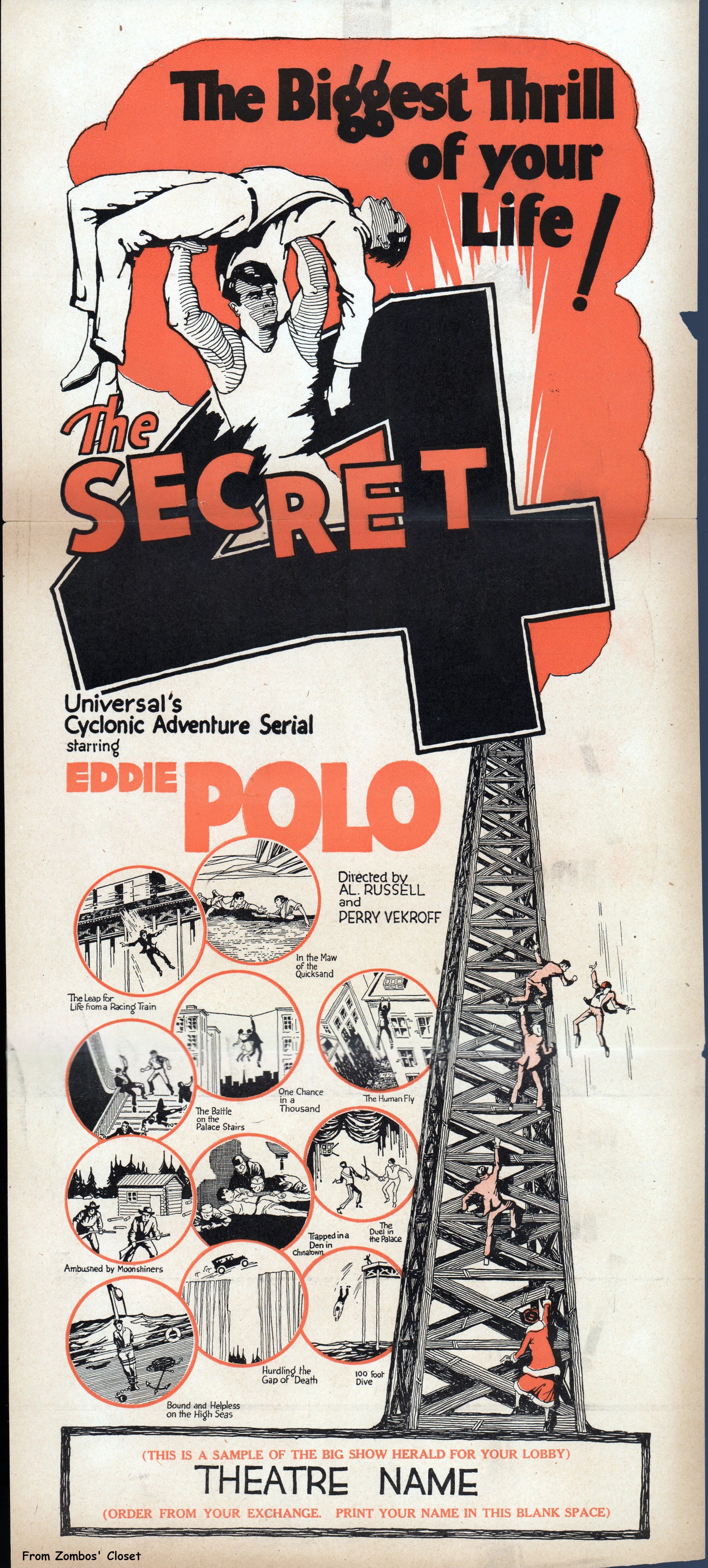
This may be the oldest herald (and pressbook, posting soon) in my collection. While the 1921 The Secret Four movie serial is now lost, it looks pretty darn exciting. This herald is about 22 inches long and 9.5 inches wide, so quite a herald to be handing out to movie patrons. The movie was 15 episodes across 30 reels, silent of course, and filled with great chapter titles like The Creeping Doom (8), Floods of Fury (13), and the Dive of Despair ((5). Maybe it’s me (okay, sure, it usually is), but looking at this herald, and with the movie filled with “international intrigue to seize world power by gaining possession of hidden oil deposits in the United States (IMDb),” I’m reminded of the pulp hero, Doc Savage, who first appeared in the 1930s. I wonder if this may have been one source of inspiration for the character.
You got the Goth black and white all-over with Michaels; lawn-busting animatronics and decor at Home Depot; costumes galore at Party City; and colorful funky cool at Target: and blow-mold-like decor to boot! bringing that nostalgic kitsch vibe. Those doorbell ringers are killer, the large 3D hang ups awesome, and the colorful skeletons and cheeky animated smallies to die for. I love animated smallies! Target was still unpacking the Halloween merch as I snapped some picks (this is the first year they finally started putting the stuff out early), so I’m sure you will find more to love as the season kicks into high gear. But, for now, here are my favs.
It Came From Hollywood has a thing for outlaw girls. Just saying. Of course, who doesn’t. Go back to the movies of yesterday and you would find lots of outlaw (aka “bad”) women in the usual mis-behaving role, be it westerns, noirs, jungles, crime, small town and big city neighborhoods, you name it. In Outlaw Girl, you “don’t tangle with Mangano!” That would be Silvana Mangano in this Italian import courtesy of Lux Film, Paramount, and I.F.E Releasing Corp (they did the English dubbing). “Shooting from the hips” in this one, she helps a wronged man get even with those who done him wrong. Trivia from IMDb Pro notes the love theme was re-used in Hercules and Hercules Unchained. Mangano became a sex symbol and notable film star, and was wife to Dino De Laurentiis.
With exploitation lines like “No. 1 Sex Appeal gal in the role of a gun moll,” no longer today’s promotion du jour, this pressbook provides a glimpse into how movies were sold through the male gaze for adults.
I was working in the crypt the other day when I heard a banging from the old iron door knocker . Opening the door I found Uncle Thaddeus standing there, a sly grin on his old withered face. He held a plastic bag in his hand.
Granny,” he said, “I have found something I know you will like. I was over at the old Squirrel Hollow Antique Mall to see what was new, and I found this.”
He handed me the bag and I opened it. A big smile crossed my face.
“You found it!,” I exclaimed. “I’ve been searching high and low and hither and thither for this.”
“I know,” said Uncle Thaddeus. “It’s a shame it has come a few weeks too late.”
“I’ll make it work,” I said. “Better late than never.”
The Mexican beaded lizard in its starring role as The Giant Gila Monster.
He left with a couple jars of brew in payment, and I examined the treasure carefully. …


 some reason, Kung Fu Killers (1974). Each cut is tailored to that specific movie-going experience, be it all night at the Drive-in, all night at your local hardtop or if you weren’t encumbered by a job, all day long in your favorite local theater.