This article first appeared in We Belong Dead magazine, issue 18, available now. I'll be writing Son of Seriously Silly Monsters for issue 19, and another, and another. There are so many silly monsters, you know, to be serious about…
What actually constitutes a silly monster in movies can be fairly puzzling when you think about it. Sure, you have the seriously silly ones like the walking tree stump, Tabanga, in From Hell It Came, but then there are the intentionally silly creatures like the giant voracious tomatoes in Attack of the Killer Tomatoes! So should we consider the serious sillies or the intentional sillies when it comes to compiling a list?
Tough decision to make. Both can be a lot of fun to ridicule or chuckle at as we fondly recall them or argue over them. Complicating it all, what do you do with movies like The Amazing Colossal Man, where the atomically mutated soldier, who grows bigger than a redwood tree, is not nearly as silly as that giant hypodermic needle plunged into his ankle (a silly prop), or the two men staggering as they hold it (a silly scene), or the poor guy impaled by it when the colossal man gets ticked off by getting jabbed with a giant needle in his giant ankle (a really silly scene)? All very silly when you think about it, true, but we must come to some decision here, otherwise our list will be bigger than him.
I know, let us go with the monsters some knucklehead convinced the clearer-thinking members of a production crew to go ahead and film, the so-obviously-rubbery-fakeries to anyone who hasn’t downed a pint or two, all those malevolent aliens, terrifying mutations, and bug-eyed monsters (both large and small), whose intended victims would be more likely to die from laughing at seeing them rather than being harmed. Maybe it was due to a low budget, or maybe it was the lack of proper oversight in art direction (or too much from the wrong person), or maybe, just maybe, it was the culmination of a harebrained scheme born out of desperation; whatever the reason, I think we can all agree to love these what-were-they-thinking? monstrosities with a cozy sense of bewilderment and satisfaction.
We all have pet choices, but here is the start of my list of the all-time seriously silliest monsters in no particular order.
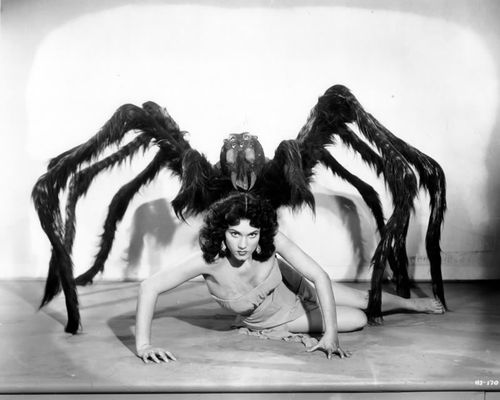
Giant Spider in Mesa of Lost Women: What can you say about a giant spider with eight legs that do not move, yet can kill people without any effort? It does makes for a great photo op with Tandra Quinn, and at least, much humor ensues with one fellow jumping toward the comatose giant spider when he sees it. Usually, victims run the other way but not here. This one gets my seriously silly stamp of approval.
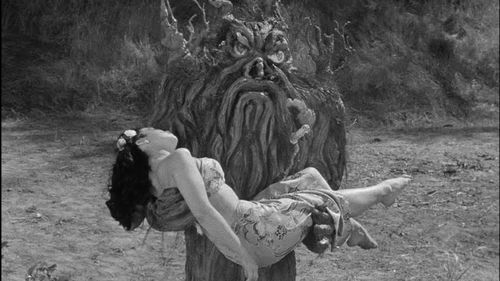
Tabanga in From Hell It Came: High on anyone’s list of seriously silly monsters should be Tabanga. I admit I am a bit torn over this one: I like the storyline and the concept; it is the execution that falls short. Tabanga falls into the slow as molasses category of walking terrors (like in the later Mummy series, but I like the Mummy movies so you won’t see Kharis on this list, no way), and cannot help but bring chuckles as he ploddingly kills people with his, mostly, immobile limbs. For a “half-human animal-stump that grows from a dead native” (according to one pressbook for the movie), he’s a bit too wooden for any real frights. Apparently none of the production crew noticed. The pressbook goes on to list Tabanga’s height at a lumbering 14 feet and misprints his name as Taranga (an actual Maori demi-god). I do not believe anyone noticed the height difference or the name change or cared to.
Jellyfish Man in Sting of Death: There are so many aquatic silly monsters, where does one begin? Why, with Jelly Fish Man of course! How can you not rate a wetsuited jellyfish-headed man at the top of any list? Once again a mad scientist creates a mutant on a budget, saving a penny or two by using clothes. Remember the Metaluna Mutant? Wearing pants from the waist down we could not tell if he had nards, but more importantly, it saved a lot of money on creating more creature costume. Like an alien in an Irwin Allen television production, or a H.R. Pufnstuff reject, Jellyfish Man is colorful in concept but flat in appearance. The purple plastic bag for a head does its best to sell the jellyfish monster aspect like no other prop can. Sadly, it does not work. More horrifying are the beach scenes with their jiggling bikini bums in a panic as the smaller jellyfish (smaller sized plastic bags) attack. 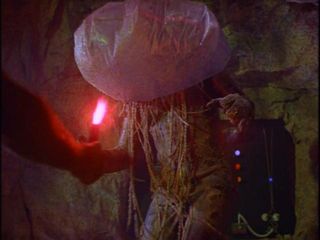
Kooky Monster in Creature from the Haunted Sea: I am not one to nitpick a master like Roger Corman or his movies, but I wonder what he and the production crew were smoking (or drinking) at the time Kooky Monster hit the storyboards. If you took Oscar the Grouch, bashed him numerous times with a frayed mop that had Brillo pads stuck in it, then stuck two tennis balls into his eye-sockets, you would pretty much wind up with Kooky Monster. In some scenes you can see glimpses of human under the costume when skin shows between the costume’s too-short sleeves and pipe-cleaner tipped gloves.
Here is a knowledge nugget from Mark Thomas McGee’s Roger Corman: The Best of the Cheap Acts. “Roger [Corman] was in Havana with Bernard and Larry Woolner, hoping to make a movie for Cuban Color Films, when Fidel Castro took over the town. The sound of machine gun fire in the middle of the night and the report the next morning that people had been gunned down in the streets sent Roger and the Woolners back to New Orleans where things were a little safer. This horrendous event was the inspiration for Creature from the Haunted Sea…”
With this movie considered to be one of Corman’s comedies, you could argue this silly monster falls into the intentionally silly category, so it would be excluded from this list. But it is so outrageously poor in appearance, and given that this movie vacillates in its tone and mood between comedy and seriousness toward confusion as to its actual intent, I bent the rule a tad here.
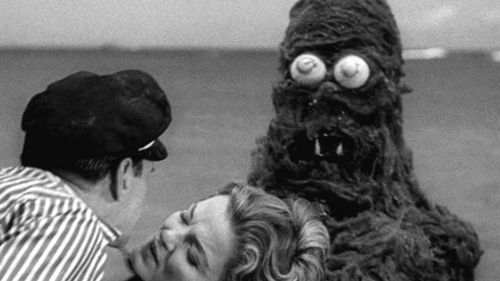
Beulah (aka Tee-Pee Terror, Cucumber Critter, Carrot Monster, Denny Dimwit) in It Conquered the World: 1950s science fiction movies had so many silly monsters to make fun of for sure, but there’s something so engagingly bewildering about Roger Corman’s decision to let this Venusian alien run amok (more like roll slowly, actually) before a camera. Were merchandising a consideration at the time, I will say it does make for quite a cool toy to threaten your Major Matt Masons or Space 1999 action figures with, especially with those mind-controlling little bat-like floppy fliers (launched from a place on its conical body that will remain unmentioned here), and its long, but rigid, arms.
Both Paul Blaisdell, who built Beulah, and Corman, who came up with the design, share in the awkward result. As related in Roger Corman: TBOTCA, “Actually, the original idea for that design was mine and I was playing too much back to my early physics classes. Again, this was a long time ago and I don’t remember exactly but to the best of my knowledge, it was supposed to have come from a very big planet. Therefore, obviously, it would have a very heavy gravity; any creature on such a planet would be built very low to the ground. There’s something to the concept of fear in looking up to something bigger or taller.”
 Blaisdell added the vegetable slant. Using plywood and foam rubber, then taking a hammer to the too smooth surface to give the ‘skin’ some texture, he created his Venusian concept of “a hyper-intelligent mushroom.”

