From Zombos Closet

February 2026

Too Late for Tears (1949) Pressbook

“Look, you can’t say she was like an M&M, hard on the outside, soft on the inside. You just can’t, it’s goofy.” I summed it up as best I could, but Zombos wasn’t buying it.

“I fail to see why I cannot say that. It describes Lizabeth Scott’s persona perfectly,” he countered. “And Too Late for Tears shows her  like that, although perhaps much less than her usually less murderous and selfish characters.”

“I’ll admit her low, cigarette-smoke voice, her noirish demeanor, and her small facial movements and that stillness about her add to one alluring, somewhat cool and aloof, possibly dangerous if cornered, character, but she is definitely not like an M&M here. Maybe a Twix, maybe, if you want to  push it for what she plays here.”

He wasn’t buying my Twix take, but he softened up and we moved on. Shot around Los Angeles landmarks and at Republic Studios, the movie, which may have been a box office keeper or a sleeper depending on the source you were reading, had Dan Duryea playing his perfectly nasty role, Don DeFore before he hired a maid in Hazel, and Kristine Miller, a veteran of westerns and noirs. Lest I forget, Arthur Kennedy lent his mug and gravitas too. The story is typical noir: an accidental event leads to intentional murder. What would you do if someone tossed a bag of money into your car and sped off?

“Okay, what if, instead of an M&M, I say she was like a Choco No No instead?” said Zombos, sparking the argument again. It was going to be a long night.


Too Late for Tears 1949 pressbook.

The Painted Stallion (1937) Pressbook

This 12-chapter Western serial, filmed by Republic Pictures, was the directorial debut of William Witney, who continued directing serials including Dick Tracey Returns, G-Men vs. the Black Dragon, Drums of Fu Manchu, and others. After Republic, he went on to direct movies for American International Pictures and Associated Producers Incorporated as well as television (he directed episodes of The Wild Wild West series). Quentin Tarantino called him “one of the greatest action directors in the history of the business.” (The New Beverly Cinema)

In the Valley of the Cliffhangers, author Jack Mathis alludes to what might have been, storywise:

Given the story for screen adaptation, writers Barry Shipman and Winston Miller perceived Evart’s [Hal G. Evart] creation in a different and extraordinary light during their work on a novel first treatment in 1936 between November 21 and 24. Based on the premise of the painted stallion as a werehorse, the scripters envisioned a lycanthropic fantasy in which legend stated that the stallion–symbol of man–could be either horse or man and was impervious to bullets. The studio, however, decided against this whimsical approach, and following the Thanksgiving holiday Shipman and Miller wrote the final screenplay from an alternate scenario developed several months earlier by Morgan Cox and Ronald Davidson.


The Painted Stallion (1937) Pressbook

A Witch Without a Broom (1967) Pressbook

This just in from Paul over at It Came From Hollywood. Here are his notes…

A Witch Without a Broom 1967 pressbook.

My wife is a WITCH! -OR- Pardon me, but this concept has legs!

This 1967 Spanish production pick-up by Producers Releasing Organization (PRO) was clearly inspired by the hit television show Bewitched (1964-1972), which itself was inspired by no less than two previous cinematic endeavors, most pointedly, United Artists’ 1942 release of I Married a Witch, and the 1958 Columbia Pictures film Bell, Book and Candle. …

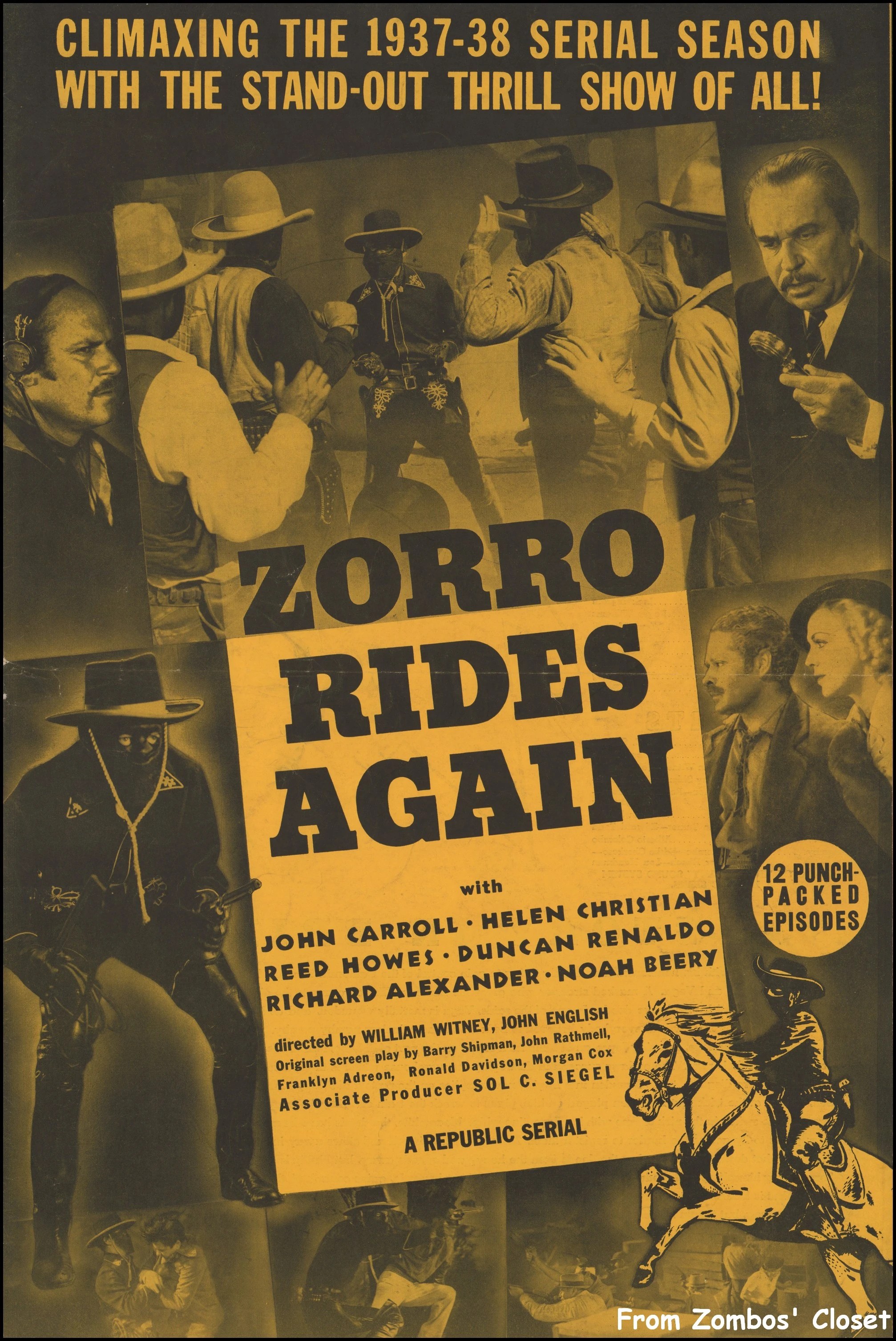
Zorro Rides Again (1937) Pressbook

Zorro Rides Again is Republic’s 12-part serial that mixes the slugfests, cliffhangers, dangerous stunts, and derring-do in a 1930s-modern actioner. Yakima Canutt goes all out to deliver the thrills. In one famous gag he transfers from saddle to moving truck, which looks smooth onscreen, but any misstep would have led to serious injury or death. Moving from horse to speeding train, no problem either. One gag for a cliffhanger had his foot caught in a track switch with a train heading in, closer and closer. His whip-work snags the track switch and disaster averted just in time. His straight-from-the-shoulder punches are also a highlight, as well as those taking them on the receiving end, making it look exceptionally punchy. Canutt did all the heavy lifting for John Carroll who played Zorro. With the mask on, Canutt could do the action scenes, saving Carroll from calamity and bruises. Duncan Reynaldo provided the comedy relief bits. Reynaldo played the Cisco Kid on television from 1950 to 1956, with filming done at Pioneer Town, California. Zorro Rides Again filmed at Bronson Canyon, the Iverson Movie Ranch, and other locations. Some shooting also took place in Cochilla, Mexico.

zorro rides again 1937 pressbook

Young Frankenstein and Old Dracula
Radio Spots

Marty Feldman in Young Frankenstein as Igor

Welcome, all lovers of Frankenstein and Dracula movies! Welcome to my Radio Spot Reliquary.

Ask any old monsterkid which memories are the most endearing from their childhood and most will say sitting in front of the TV on Friday or Saturday night and watching the latest offering on Shock Theater. On top of the list of favorites will undoubtedly include the old Universal Frankenstein and Dracula movies.

Most monsterkids can easily recite all of the Universal Frankenstein movies in order and tell you who played the monster in each.  The same with the Dracula movies. Thanks to magazines like Famous Monsters of FilmlandWorld Famous Creatures, Horror Monsters and Mad Monsters, the life-long love affair with these movies was kept alive month after month. To fill the void, a lot of kids made soundtrack recordings of the movies onto reel-to-reel tape to listen to at every opportunity.

Amateur filmmakers used their 8mm cameras to construct their own versions of these classics, copying key scenes and duplicating creepy characterizations and lighting effects. Oh, and don’t forget the incredible laboratory scenes with their sparking electrical machines, Jacob’s ladders, and large Tesla coils. Those scenes alone were worth the wait, and monsterkids tried their best to recreate them for their amateur productions.

So it came as no surprise when professional comedy filmmakers decided to pay homage to the movies they, too, had grown up with.

Mel Brooks decided to spoof the Frankenstein series with his Young Frankenstein (1974), a loving tribute to the whole classic series that included atmospheric settings, stereotypical characters and the beloved lab sequence, using some of the original electrical machinery developed and used by Kenneth Strickfaden in the original movies. It was a delight and most fans embraced the movie for the nostalgia it brought.

Old Dracula with David Niven movie posterAcross the pond, British studio World Film Services produced a spoof on vampire movies and called it Vampira (1974). After the success of Young Frankenstein, American International Pictures, seeing a golden marketing opportunity, distributed it with a new name, Old Dracula for the United States release. Fans saw it for what it was: a title-play rip-off which lacked the charm and endearment Young Frankenstein had brought. The movie was a very seventies adventure with a sixties air with David Niven as Old Dracula adding a sense of class to an otherwise cheap attempt to copy the success of Mel Brooks’ loving tribute. The two movies were often played together as a double bill.

So, here are radio spots for both movies. Mel Brooks gives a proper approach to his spots which highlight the comedic aspects. A “Wolfman Jack” soundalike (or maybe it is he!) pitches Old Dracula. Looking back, one can see which one is remembered and loved.

Dr. Fronkensteen! Igor! Inga! Frau Blucher! Elizabeth! The Monster! Walk This Way! Dracula! Vampira! Young Frankenstein and Old Dracula!

Old Dracula

Young Frankenstein


Young Frankenstein with Gene Wilder, Marty Feldman, and Teri Garr.

Star Trek II: The Wrath of Kahn
Souvenir Program

After listening to the Wrath of Kahn radio spots, I hunted down this souvenir book that was lost in the nebula that is my closet. After Star Trek: The Motion Picture managed to earn enough money and then some to justify a sequel, Paramount green-lit a second movie, but with a reduced budget. The second movie, Star Trek II: The Wrath of Kahn, was a more energetically paced and tense cat-and-mouse battle of wits between Kirk and an old foe, ending on a daring and very depressing climax for many fans. It cost around 13 million to produce, but took in close to a 100 million dollars. Less than the first movie, but with the lower budget, it did make a greater profit. Helping shaving the production costs down, sets from the first movie were redressed and reused, and ILM reused models and flipped and modified an existing design for the Reliant. The costuming, thankfully, got a more nautical military look to fit the ‘Horatio Hornblower in space’ drama that Nicholas Meyer was going for. The Graphics Group at ILM (which would later become Pixar) also created the Genesis Effect, a 67 second animation demo of Genesis that took ten artists months to produce (web sources say two years). It was the first computer-generated sequence in a movie. A light-sensitive pen on a special screen was used to draw directly into a Cray supercomputer to render the fractal landscape and particle wave sweeping over the planet. Even today it still stands out. By 1985, Young Sherlock Holmes would introduce the first fully CGI character, also by ILM, designed by John Lasseter. For an exciting and informative book on the best original Star Trek movie, read Allan Asherman’s The Making of Star Trek II: The Wrath of Kahn.


Wrath of Kahn souvenir book.

13 Ghastly Tales Book Review

13 Ghastly Tales Book ReviewI started off hating B.D. Prince’s 13 Ghastly Tales. Then I liked them. It oddly started around Jaadu. I’m a sucker-punched softie for carnival and railroad stories, seems he is too. Then I noticed his approach with each story, heated a little with campfire scares, then spun a lot from 1950s comic book horror conciseness, and glazed with a simple but jolting ending. His characters start lean and gristled around the chops, then take on meaty weight as they hustle to whatever horror digests them. Short and sour best sums it all up. There is flash fiction here too that also bites.

So, about that Jaadu. Prince mentions Cole Bros. Circus briefly but it immediately hooks me—all ready and gutted to be pan-fried—because I have a nostalgic connection to Cole Bros. as they were a long-running tented circus here on Long Island. But Emma Wilson and her husband are not visiting Cole Bros., just a smaller circus outside of town. A midway barker grabs their attention while they munch their popcorn and they are quickly swept into the oddities tent. Emma is particularly caught up with all the stifling strangeness and that bizarre bovine with two heads and five legs. Poor Emma. She just so badly wants to have a baby. A common element in each of these stories is a longing, a desire, a need. Amazing how much horror can come from those three simple things. …