From Zombos Closet

November 2020

The Royal Mounted Rides Again (1945)
Pressbook

Courtesy of Joe Dante and Charlie Largent (Trailers From Hell) comes this file copy for The Royal Mounted Rides Again serial. Always interesting are the costs associated with any movie (or serial) promotion. According to the onion skin typewritten page glued (see those annoying brown spots) to page 2, the cost for 6,000 pressbooks came to .233 cents per book; with art work taking 659 dollars for advertising.

ComicRack reader version: Download The Royal Mountain Rides Again Pressbook

You don’t need to ride far to see more pressbooks From Zombos’ Closet.

The Royal Mountain Ride Again Pressbook001

My World Dies Screaming (1958) Pressbook

Terror in the Haunted House, also known as My World Dies Screaming, was the first movie lensed using Psychorama. If you’ve seen The Exorcist, you know what psychorama is: think of those brief flashes of the demon face popping up. In this movie, flashes of a skull were used to subliminally convey terror to the audience, along with other images to convey other emotions. Or so they hoped.

ComicRack reader version: Download My World Dies Screaming Pressbook

See more flashes of pressbooks from Zombos’ Closet.

My World Dies Screaming Pressbook01

Walk Into Hell (1956) Pressbook

What’s a jungle without a witch doctor? At least that’s the theme in most jungle movies from the 1950s. See the movie herald. Of course it’s all about oil found in the jungle, which brings out the human wild beasts. The poster art focuses on a victimized white woman, scantily dressed of course, to sell butts in theater seats.

ComicRack reader version: Download Walk Into Hell Pressbook

Walk into more pressbooks from Zombos’ Closet.

Walk Into Hell Pressbook001

I Was an American Spy (1951) Pressbook

The good old days, when we were focused on enemies from without and Reader’s Digest sensations that shocked the nation instead of dodging the rocks we’re throwing at each other now. This one’s a dramatization of a true hero, Claire Phillips. She spied on the Japanese during World War II and survived a lot of hardship and torture. This pressbook pushes the patriotism and zippo lighters, along with a song, Because of You. The poster art does a good job of exploitation without excess.

ComicRack reader version: Download I Was an American Spy Pressbook

Spy on more pressbooks from Zombos’ Closet.

I Was an American Spy Pressbook01

Night Gallery Art Prints Advertisement

I picked up this advertisement, from 1971, for full color reproductions of some of The Night Gallery portraits. Would love to have these prints instead. Some monster magazines at the time carried advertisements for these prints too. Looking forward to receiving my copy of Rod Serling's Night Gallery: The Art of Darkness, which will show all of the paintings along with commentary and other tidbits of information. One thing you must absolutely do is NOT watch The Night Gallery eps on cable channels like MeTv. Avoid them like the plague. MeTV picked up rights to the 30-minute edited versions that went into syndication. Aside from being butchered to run in a shortened timeframe, they added episodes from The Sixth Sense (also butchered) with Gary Collins and Catherine Ferrar. Rod Serling did new introductions for those episodes, but they aren't Night Gallery. The 30-minute syndicated episodes border on incoherent as editing tricks left them sliced and diced.

Night Gallery

H.P. Lovecraft by Dave Carson (1990)

I was rummaging through the closet today and I found this signed print by Dave Carson. I can't believe it was so long ago that I picked it up. I don't know what's worse: collecting or forgetting what I've collected. I will say it's both depressing that I forgot about it, but exhilirating that I now remember it. While fans and detractors continue to argue over H.P. Lovecraft's influence and racism, his artistic sway over horror fiction and artists remains steadfast. 

Dave Carson Lovecraft Print

Raiders of Ghost City (1944) Pressbook

Here’s another great pressbook courtesy of Joe Dante and Charlie Largent (Trailers From Hell).  This file copy of Raiders of Ghost City pressbook contains a typed, on onion paper, breakdown of the cost for 6000 pressbooks. It rounds to 20 cents per book, with printing and artwork costing the most. Presumably the cost of producing the pressbooks was offset by the sales of promotional material (see the ad mats and showmanship pages) for the theaters promoting the serial.

ComicRack reader version: Download Raiders of Ghost City Pressbook

Raid more pressbooks from Zombos’ Closet.

Raiders of Ghost City Pressbook001

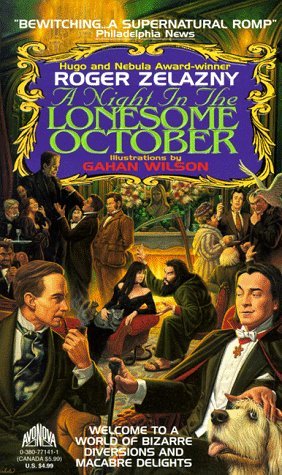
A Night in the Lonesome October
Book Review

62005While reading Roger Zelazny’s A Night in the Lonesome October I kept wondering how it could be made into a movie. The challenge is not so much the talking dog, cat, bat, or rat (they are demon sidekicks, of course), but how Zelazny let their dialogues provide the main flow of the story. The reader needs to rely on the dog named Snuff, and his powers of observation, because he is the one narrating what is happening each day of October, leading up to the eventful battle royale that will take place on Halloween; but his owner is Jack the Ripper, so there is some question as to his sense of good versus evil nose sniffing to be sure.

That pending battle, with the apocalyptic tendencies, will  be waged by the openers and the closers. The openers are more the bad players and the closers are more the good players, but since Saucy Jack, along with Snuff, are on the good players side, using the term “good” requires some stretching. Count Dracula is also in the game, but no one really knows which side he’ll be on when push comes to shove as those slimy, multi-tentacled monstrosities, looking for a new foothold into our dimension, make their move on Halloween night. And so the game begins in this Victorian period piece, played over each day, with each demon sidekick doing a lot of the legwork, trying to figure out who will be an opener or a closer, and how the lines of power are being drawn in the neighborhood. As the maneuverings for power take place, Sherlock Holmes (referred to as the Great Detective), dons disguise and guile to reveal the mystery emanating from the deadly game. Even Larry Talbot, the Wolf Man, puts down all fours, providing assistance to Snuff. What part Talbot will play at the end can go a tail wag either way, but he proves invaluable to Snuff. If Lon Chaney Jr. keeps popping into your head as you read, you will already know how Talbot will play it.

Snuff is rather stiff-lipped and steely pawed and clever at gaining information while strategically sharing it. Mostly with Graymalk the cat as the two strike up an unlikely alliance. Each helps the other out of bad spots as the days move closer to the eventful night. Zelazny keeps his words and paragraphs stiff-lipped too, and there is a prim tempo to each chapter; one chapter for each day in October, with the first one putting the reader immediately into the story with little fanfare.

Interesting little tidbits of the uncanny wind up in odd places. There’s Jack’s monsters trapped in a mirror and furniture, always looking to escape; a human sacrifice is chained, awaiting her doom; a tour of a Lovecraftian dreamscape where ancient beings wait patiently to walk the earth again, and murder most fowl when the going gets rough. Zelazny writes it all as matter of factly as possible, with close calls, bodies turning up, and the tools of the dark arts trade slowly revealing themselves. His economy of words creates a magical opening all by itself, wherein the reader can infer much and imbue each player in this great game, either good or bad,  with feelings and intentions, even if that player crawls, flies, howls or walks on two legs by night. His description of Dracula’s actions, merely a few drops of blood worth, is more chilling than any of the recent Universal endeavors for the ruddy Count. Perhaps Universal should look into doing the movie version? This would make quite a monster rally indeed for the big screen.