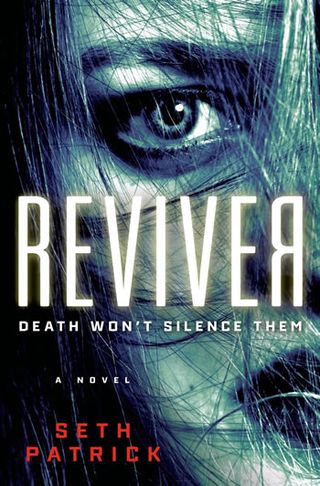
Zombos Says: Good
The gimmick sustaining Seth Patrick’s debut novel, Reviver, takes a little something from Edgar Allan Poe’s The Facts in the Case of M. Valdemar, and then adds the always popular 'Eldritch Abomination from Beyond' trope: you've seen it; the ancient evil waiting to cross over the line between our here and its there, like in the recent supernatural thrillers Last Days and Red, White and Blood. It's the one conceit catalyzing more television and movie stories than you can ever remember, and it's about as old as that eldritch abomination, or at least the hills. It's an important trope, though at times cyclically over employed in supernatural stories.
There's also the "secret agenda" being executed here, which is usually driven by either a secret organization, a known organization, or a dubious corporation. Here the secret agenda is masterminded by a known organization (that may have been incorporated), and although its use provides enough mass to drive the plot and set up the next two novels in this planned trilogy, it's not handled with enough finesse to make it either quirky or different or vexing enough to warrant more than a good showing for its inclusion. Patrick makes sure to also include a lost love, a possible newly found love, and more pages than he really needs to tell his story.
What's missing, and this goes for much of the coterie of genre writers today, is a less streamlined and formulaic approach to handling his characters, their plot threads, and how the story revelations flow–and they flow somewhere, for comparison, between a stream and a brook, if you're into fishing . If not, but you like cooking (or eating), the best alternative example would be the differences between Velveeta and Parmigiano Reggiano. Both serve a purpose, but one provides much more texture, flavor depth, and savory experience in the same mouthful. (And now I promise to lay off metaphors for a month. Honest.)
A hint of depth and savoriness comes in a few scary moments when Jonah Miller, working as a Reviver for the police department's special forensics unit, makes unexpected contact with a presence other than the revived victim he's talking with. At first he's worried that "ghost traces," a malady that results from overwork and burnout from the revival process, is coloring his mind with false impressions. He doesn't let anyone know about his doubts, not even his closest friend and colleague, Never Geary.
Then Daniel Harker disappears. He's the journalist who revealed the unique ability some gifted (or cursed) people have for reviving the dead. He made a lot of money from his book on the subject, but then found something more sinister going on to investigate for his next book. Jonah's investigation into Harker's disappearance, the revelation of a dangerous drug that can enhance the revival ability, but with serious side effects, and the growing mystery surrounding the motives of a radical group of After Lifers, perks up the narrative at around the 218th page. Until then we get a too-measured build up–and too slow–with digressions from the important building blocks of action events as dialogs take over for long psuedo-scientific discussions or backstory fill-ins in 'real' time with the characters, not flashbacks.
Hinting at a more thoughtfully planned out methodolgy to his horror, Patrick delves into interesting facings for his revival dressing: like what if the military used the revival process as a standard interrogation procedure? Just kill the interrogee, revive him, interrogate his corpse–one important aspect of the revival process is that those brought back can't resist but tell the truth–and be done with it. And then there's a building uncertainty as to what exactly ghost traces are as Jonah investigates Daniel Harker's disappearance with the help of Harker's daughter and the journalist's notebook. This uncertainty leads Jonah to rethink who and what that dark figure following him around really is, and who exactly is whom when he does.
