by Professor Kinema
If I were to choose a personal patron saint of sorts, it would definitely be French early Cinema pioneer, George Méliès. A subject of my MALS degree thesis (along with contemporary cinema pioneers Alice Guy Blaché and brothers Louis and August Lumiére), this truly creative man will always be considered the premier cinema autéur. He was the originator of the narrative film, the father of film special effects, and the innovator of lé Cinéma Fantastique.
He was born into a family of successful shoe manufacturers on December 8, 1861. Subsequently trained in engineering and machinery, he was expected to work in the family business. Instead, he chose to pursue an education in le beaux arts, which resulted in his becoming an accomplished artist, stage magician and all around grand showman.
In the winter of 1895, in the company of many other fascinated Parisians, Méliès witnessed his first moving pictures. The Lumiére Brothers, Louis and August, had rented the back part of the Café Indiénne on the Blvd des Capucines and were offering the first screenings to a paying audience. The price for a showing was one franc. After this initial experience, Méliès approached Louis Lumiére and offered to purchase one of their Cinématographes (a reconstructed Edison Kinematograph). The (ultimately ironic) response was, “I’m sorry Monsiéur Méliès, but the Cinématographe is not for sale, it has no commercial future.”
But le Grand Showman thought differently. Being an accomplished artist he made sketches of the apparatus and contacted inventor RW Paul in England–Paul was experimenting with creating ‘pictures that move’–for the necessary parts to construct his own. With his own custom Cinematographe in hand, Méliès original conception was to record his and his associates’ acts of magic and present them throughout his popular stage shows in his Theatre of Magic: the Théatre Robert-Houdin on the Blvd des Italiens.
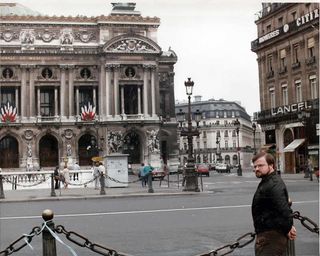 Soon he decided to take his camera out into the streets of Paris and capture daily life. While photographing the traffic in front of the Opera house it jammed. After several minutes he fixed the problem and continued to record images. When he developed and printed this sequence he was astounded at what was accidently caught on film. The camera stayed in one place while the jamming and eventual clearing action created the world’s first ‘jump cut.’ A bus had magically been transformed into a hearse. His revelation was, ‘Not only can the Cinématographe be used to capture acts of magic, but rather, magic can be created within the camera itself.’ The fantastique entity of cinematic special effects was born.
Méliès’ output of magical films lasted from 1895 to 1912. He set a high cinematic standard right at the beginning. However, he didn’t grow with the industry. By 1912 others had been influenced by him and surpassed him in content and technical expertise. At the onset of World War 1 the French government was seizing materials needed for the war effort. Many prints and negatives of his films were confiscated. They were melted down to recover the celluloid, to be used for boot heels for French soldiers. In the grandest of ironies, this was the fate of the truly magical products of an exceptionally creative and innovative artist–the autéur–who’s family background was the business of manufacturing shoes.
By the 1920s Méliès had fallen on hard times. He and his 2nd wife, Jeanne D’Alcy (who appeared as a performer in many of his fantastic films), were operating a newspaper kiosk in the Gare Montparnasse of the Paris Métro. They were recognized. Declared a true cinematic pioneer, a renewed interest was instilled in his work. In 1931 a Legion of Honor medal was bestowed upon him, and he and his wife were awarded a rent-free apartment for the rest of their lives.
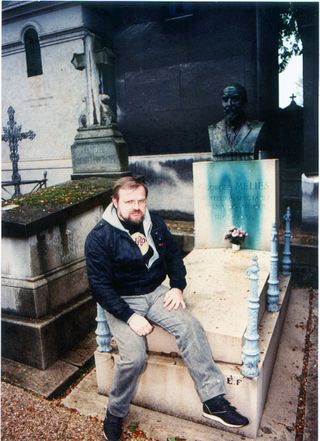
His closing act came on January 21, 1938. Along with several members of his family, he occupies a gravesite in the celebrated Paris cemetery; Père Lachaise. A lifelike bust of him adorns his final resting place. During each visit to Paris, I make it a point to pay a brief visit and pay spiritual homage to Maéstro Méliès.
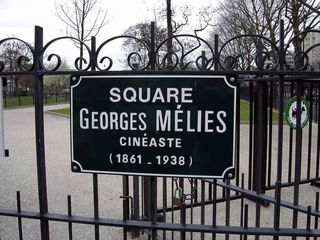 Not far from the Cinématèque, in the Bercy section of Paris, are many streets and a few small parks named after notable French Cinema innovators. One such park is named after Monsieur Méliès.
During one of my occasional get-togethers with ‘Unkka’ Forry Ackerman, he was telling me of yet another magazine (of several doomed projects) that he was involved with titled Monsterama (published 1991-92). A feature from the original FM entitled “Wanted, more readers like…” was to be included. I asked if my photo at Méliès gravesite would be considered. He cheerfully said, “Sure, send a copy of the photo to me in Horrorwood, Karloffornia.”
Monsterama lasted two issues, but, the photo magically made its way to page 100 of the ‘new incarnation’ of Famous Monsters, issue # 200 ( May, 1993).
PK/JK
