From Zombos Closet

April 2010

Television: Happy Town
American Gothic Terror Returns to TV

Happy_town The locals call us "The Bready." We happily employ 12 percent of Haplin's residents, and we are proud to make Haplin a place where the air is alive with the aroma of fresh baking bread, all the live-long day! Enjoy! (Our Daily, Baking and Confectionary, Haplin, MN)

Zombos Says: Very Good

Measure two fingers of sinister mystery from American Gothic, add a dash of Stephen Kingish small-town-hiding-dark-secrets, spice with serial murderer and missing people, stir in an all too quiet and aloof visitor, Merritt Grieves (Sam Neill), top off with a more recent visitor who's way too anxious to ascend the staircase leading to the dark third floor of the boarding house she's staying at, and finally dabble assorted bitters of quirky townsfolk and a sheriff and his son in over their heads. Shake it all violently, garnish liberally with tidbits of plot, then knock back this new series on ABC called Happy Town: it's quite a rush given the promise shown in this first episode, In This Home on Ice.

Cowboys of the Silver Screen Stamps

Bill_Pickett_Handbill While mailing the American Vampire comics to contest winners today, I noticed these nostalgic stamps at the post office. Westerns were the mainstay of Universal Pictures before they discovered more lucrative box-office receipts with monsters. Cowboy serials were the ideal world of every white boy growing up in a long ago era, when American pride, fortitude, and integrity were as sociable and wholesome and as much a given as eating mom's apple pie with a glass of milk on a Sunday afternoon.

As for me, I saddled up with the Lone Ranger and Tonto, rode the trails with Roy Rogers and Dale Evans, and I always hoped to get the pretty girl, kick-ass a little harder with the villains than Tom Mix, and strum the guitar strings faster and straighter than Gene Autry. I'm still working on his Cowboy Code. I wish some of the people I meet and read about these days would work on it, too.

Missing from this wonderful line-up of Americana is Bill Pickett. He's a black cowboy. Not too many folks sashayed up to the box-office to buy tickets for movies with black cowboys back then. But there's black and white in that silver screen all the same.

Way back in 1923, rodeo sensation Bill Pickett became the first black screen cowboy in The Bull-Dogger, and he was just the first in a long line of cowboys of color who galloped through movie history alongside their more mainstream, pale-faced peers. (Robert Silva, The Good, the Bad, and the Black Cowboy)


Looking at these wonderful stamps reminded me of Stephen Avalos' The Ghosts of Edendale, a creepy twist on the invincibility and purity of men wearing white ten-gallon hats, and Dead Birds, a Lovecraftian-western best not viewed alone and after dark.

Which Western horror movies would you recommend? And if you dare say Billy the Kid Versus Dracula, better put up yer dukes, cause them's fightin' words! (Click on the graphic for a larger view while you're ponderin'.)

0119_001

Trading Cards: Midnight Madness, Desert Rats

Desert_Rats_wrapper Here is the twelve card story for my favorite one in the series, Desert Rats, from Rosem’s Midnight Madness Card Set. Story is by Steve Kiviat, and illustrations by Alfredo Osorio. (Copyright 1990 by Rosem Enterprises.)

Can’t you just eat it up! It is so quaintly gruesome. And look at those cute little fuzzy faces. They just gnaw at your heart, don’t they?

Click on the images for a larger view.


Desert Rats Desert Rats
Desert_Rats_1-6back Desert Rats

Book Review: and Falling, fly By Skyler White

and falling, fly Dominic's voice is meltingly tender. "What if you're right? What if hope is the master of Hell? What if something in your own mind, in your own hopes, or fears, or ideas, is the cause of your suffering? What if you are not damned?"

"If I am not damned, what am I?"

"A woman in pain."

Zombos Says: Very Good

Ambiguity and certainty abound in Skyler White's novel and Falling, fly, along with fallen angels turned vampires, a neuroscientist traumatized by his cycle of reincarnations, and an Irish Goth-punk hotel that is either Hell, Limbo, or a comfortable bed and breakfast for its guests. In words thought and spoken, her characters shift between first and third person narratives to dwell on the certainty of their fate and the ambiguity of their despair: continue living fettered by their assorted curses or dare to surmount them even if it means painful loss. But are they indeed cursed as they believe or are they living a delusion? That's the tantalizing conundrum White presents with her words as they blend mellifluously into scenes ripe with irreconcilable decadence, sex, and mythologically-based–and sanctioned–angst over what may or may not be real.

The Silent Scream (1980)

Silent scream

Zombos Says: Good

Listen to the Movie Review

Scotty (the impossibly thin Rebecca Balding) needs an apartment badly. She’s late to the college semester and the college dorms are filled. At the end of an almost fruitless day of apartment hunting, shown in humorous vignettes of crappy places and dubious renters, she finds a small, comfortable room in a big, brooding, beach-side house at the top of a hill. Three other college latecomers join her: there’s the spoiled rich Peter (John Widelock), the feisty, bosomy, fun-loving girl Doris (Juli Andelman), and the hunk, Jack–who makes sure to keep his shirt off or unbuttoned as much as possible because he’s the hunk–played by Steve Doubet. Living in the house are the brooding Mrs. Engels (played by Mrs. Munster herself, Yvonne De Carlo), who stays mostly up in the attic; the quiet and ill at ease Mason Engels (Brad Rearden) hangs out in the bedroom across the hall; and everyone’s unknowingly waiting for a family secret about to become known. Violently. Now guess which one of the college kids gets killed first.

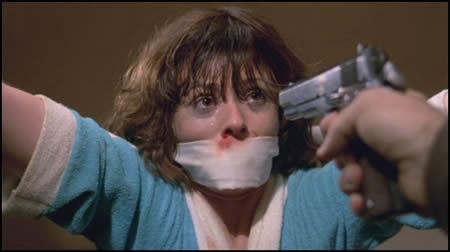
The family secret is also a natural one for an American Gothic story rather than a slasher movie. It takes its time to reveal itself as the tightly wound and fragile Engels’ family composure unravels, and not much mayhem occurs until Scotty is tied up in a closet with her blood about to be spilled across the floor. Deep focus (in an interview on the DVD using a split diopter to accomplish this is mentioned) keeps both the desperate Scotty, who’s eyeing the closet doorknob, and the closet doorknob that is just out of reach, in sharp focus as the knife-wielding killer comes closer: a surprising giallo-styled visualization in an American Gothic framework, culminating in a frisson of terror when door edge, sharp knife, and Scotty’s hand get awfully close to each other.

As one family secret is exposed, another one causes Mason, who’s already emotionally tighter than his buttoned up and tie-less collar, to retreat into fantasy, leading to more violence. There is not much gore or body count here, but Jim and Ken Wheat took over an ailing, unfinished movie and penned it into a ‘coherent’ family tragedy playing out in an old and not so dark house atop a lonely hill. Imagine Henrik Ibsen writing a slasher play and you wouldn’t be too far off the mark describing The Silent Scream. Bridging together existing scenes with clearer motivations, stronger relationships, and a linear progression that slowly builds drama, The Silent Scream is a low key slasher easily lost among the more traditional murderfests of the 1980s like Sleepaway Camp and Friday the 13th because of its less frenetic, more television-styled direction.

The Silent Scream is not much of a mystery; neither is it much of a blood-flowing slasher story. The acting ranges from bread and butter, courtesy of television veterans Cameron Mitchell and Avery Schreiber, to studio classy with Yvonne De Carlo and Barbara Steele. In-between, the college kids act much like college kids do in a slasher movie–they want to have fun and fool around–but there’s a more natural and slower tone to their behavior here. This naturalness makes them more personable. I didn’t want to see any of them die. Peter does act like a jerk when he’s drunk, but he’s spoiled, so he’s a predictable jerk. Doris is fun-loving, but not the kind that usually leads to trouble in a horror movie, and Scotty and Jack do eventually snuggle, but they take their time before jumping into bed.

This is the movie Ti West should have remade instead of his homage to 1980’s slashers, The House of the Devil. Both keep to the same pace, both have an impossibly thin college girl in danger, and both involve families with deep dark secrets, who live in old houses with horror waiting in the attic. But The Silent Scream has a better story and better directorial nuances, making it a more chilling and distinctive movie that draws you in instead of trying to impress you with the director’s ego.

I Sell the Dead (2008)
And Not So Dead, Too

I Sell the Dead Zombos Says: Good

Awaiting execution for his crimes of grave robbing and murder, Arthur Blake (Dominic Monaghan) recounts his nocturnal exploits, conducted with his accomplice Willie Grimes (Larry Fessenden), to the attentive Father Duffy (Ron Perlman). Over wine, Blake reveals how his low-paying start with providing certainly-dead cadavers to a nefarious Dr. Quint (Angus Scrimm) blossoms into a more lucrative endeavor procuring the less-certainly-dead–vampires, zombies, and a ‘sideshow freak’–for an inquisitive medical clientele. Director Glenn McQuaid embellishes this Victorian period parody and homage of late night B-movie horror staples with bizarre and suitably grimy characters, lots of foggy scenes, and a witty story that outwits itself now and then by rushing too quickly to the punchline.

Making Blake’s and Grimes’ jobs all the harder are the seedy, insane, and fear-inducing house of Murphy, led by Cornelius (John Speredakos) and his mysterious father. Valentine (she wears a mask to hide her badly burned face), and Bulger (he had his teeth replaced with canine chompers), round out the colorful Murphys, who vie with Blake and Grimes for the ghoulish spoils. Occasional comic book-styled illustration appears, especially when highlighting the picaresque Murphy clan, lending a horror comic motif similar to 1982’s Creepshow and the more recent Trick ‘r Treat (2008).

I sell the dead McQuaid keeps his scenes excruciatingly tight in an attempt to conceal the production’s budgetary limitations, but often this produces the opposite effect by calling more attention to his meager mis en scenes because of their static framing (made worse by a woozy camera movement within the frame when least needed). At other times, his closeups highlight the slapstick antics of Blake and Grimes, and their wild encounters with the Murphys, with giddy aplomb.

What really sells I Sell the Dead are McQuaid’s Victorianesque characters and their travails while digging up their best prospects. His penny dreadful-flavored twists and turns with horror conventions percolates new life into recognizable situations: a vampire encounter at a crossroads turns into farce when the garlic and wooden stake are unwisely removed and frantically put back, again and again; an unusually frigid grave yields an unexpected corpse; and zombies prove highly desirable for medical research into immortality, but tend to be hard to procure. A chance shipwreck provides an opportunity to cash in on the burgeoning zombie demand.

Rowing to Langol Island in the dead of night ahead of the Murphys, Grimes, Blake, and their new, overly eager, apprentice Fanny (Brenda Cooney) go looking for the shipwrecked zombies. They find one crated undead, the foot of another undead, and Valentine, Bulger, and an angry Cornelius. In the ensuing mayhem after Valentine removes her mask, frightening Blake, Grimes–and a zombie–into a frenzy, Grimes gets bitten and the undead bite off more than they can chew with the Murphys.

I Sell the Dead is a cheeky blend of the usual horror setpieces made unusual by playing them almost to absurdity as Grimes and Blake cope with the ever present threat of the Murphys and the rigors of their demanding profession in order to get ahead. Before they lose theirs. Jeff Grace’s music is a treat as it evokes the mood and style of earlier horror movies from Hammer to Amicus, especially when playing against the animated opening credits. For many horror aficionados, especially those weaned on Shock Theatre and supernatural horror movies from the 1950s to the 1970s, I Sell the Dead will be a lot of fun to watch.