From Zombos Closet

May 2009

Helena the Hussy of Horror Strikes

Helena_Swamp_Thing_PR

Helena, Hussy of Horror has launched her new monthly web series with Drinks with the Swamp Thing, a brief look at finding the perfect cocktail for your spring party as well as a review of the 1982 cult classic, Swamp Thing.

Originally done as a one shot for last fall’s Miss Horrorfest contest, Helena soon found new life by shooting an introduction for the festival run of the upcoming Anthem Pictures DVD release, Deadlands 2, Trapped. New Videos will be posted monthly. On the docket are shows about the original Friday the 13th and Jaws 3.

For more go to www.HussyOfHorror.com or https://vimeo.com/hussyofhorror.

Interview With Robot 13’s Hall and Bradford

Robot 13 issue 1On the surface, the comic is about a skull-headed robot who fights giant monsters from Greek Mythology. From a storytelling standpoint, however, it’s somewhat a reworking of Frankenstein meeting Homer’s Odyssey- it’s the story of a thing created by Science who goes on a Hero’s journey of sorts to find out who he really is…(Thomas Hall, co-creator, Robot 13).

Thomas Hall and Daniel Bradford bring their talents together to create Robot 13, a slightly Gothic, somewhat mechtorian-styled robot with amnesia and a purpose. With meticulously drawn illustrations that would give Hellboy a run for the money, precise panel narrative, and enough mystery to keep even Sherlock Holmes happy, this series looks promising. After reading issue 1 I was left disappointed that it was only 24 pages long. I wanted to read more. To assuage my depression until issue 2, I asked Hall and Bradford a few questions.

You’ve taken mythological elements, blended in a bit of steampunk, and added a quest for identity. What led you and Daniel Bradford to choose these elements for your storytelling?

Thomas: When Daniel showed me his sketches of what eventually became Robot 13, I knew we needed to do something really unique with him, but I wasn’t sure exactly what. At the time, we were pitching a story including a version of that robot for a CGI project, and when that didn’t work out we decided to do something totally different with a comic than we did that pitch.

I have always loved giant Japanese monsters and anything Ray Harryhausen did, so I wanted to see our robot fight some BIG creatures. Daniel drew a shot of the robot having just killed a Kraken, so I jumped at that. Daniel mentioned Frankenstein as a point of reference for our story, and we talked about that a lot. Both of us have a love of the old Gothic literature and art, and adding those elements with a modern spin on them was an attractive idea to us. For a while, it seemed like we had too many ideas, so we thought about it a lot and I did some research to try and find some common ground in it all.

Around that time, I was flying out to Arizona to the Phoenix Cactus Comic Con to do the show with Daniel, and I brought a notebook with me that had everything we had talked about and Daniel’s sketches and other notes. During that 4 hour flight, I worked out what wound up being the basis to the Robot 13 back story. Sure, we have tweaked a few things and it’s evolved over time, but during that flight I found a way to incorporate everything that we both wanted to try in a comic. When we had a moment, I told Daniel what I had come up with, and with only a few minor changes we pretty much had our direction.

Interview With Kim Paffenroth
Dante in the Valley of the Dead

It and the girl were now both on Dante, the girl tugging at the hem of his frock, the boy getting a hold of his right arm. Dante grabbed the girl’s long hair with his left hand, pulling her away from himself before she could bite into his thigh or stomach. He tried to pull his right arm away from the boy, but the dead grip was powerful and tenacious. The two children were dragging him down, and for a moment he felt fairly sure he’d be dead soon, too (Valley of the Dead).

DanteIt was bound to happen sooner or later; zombies devour everything in their path, so why not devour the classics? While they may have their rotten pride and prejudices grounded in earthly appetites of the flesh, author Kim Paffenroth brings a sophisticated approach to their dinner table by introducing poet Dante Alighieri to the undead.

Unlike the one trick, novelty-book approach taken in Pride and Prejudice and Zombies, Paffenroth sets his scholar’s philosophical eye on the situations Dante encounters as he meets both living and the dead in his journey across a strange valley during a zombie plague. Like any good zombie, I wanted a closer look into the brain of Paffenroth and his thoughts on writing Valley of the Dead.


You’re a big fan of Dante and his poem the Divine Comedy, which details his journey through the Christian visions of Hell, Purgatory, and Paradise. The allegorical nature of the Divine Comedy lends itself to various layers of meaning; but no one until now has mentioned zombies. What inspiration led you to have Dante square off against zombies?

When I was working on Gospel of the Living Dead (Baylor, 2006), my analysis of the Romero zombie films, it struck me how similar his zombies were to the damned in Dante’s Inferno – not so much tortured with flames and the usual trappings of hell, as just mindless, lost souls, endlessly repeating their stupid, pointless activities. Later it occurred to me to reverse the idea of the influence: what if Romero’s zombies were similar to the inhabitants of Dante’s Hell, because Dante had actually seen a zombie infestation during the 17 years that he’s off the map and could’ve been anywhere. Then, when he went to write Inferno, he incorporated the zombie horrors he had seen into his poem. Once I’d seen that possibility, it was just a matter of working carefully through Inferno, thinking of zombie analogs to each circle of hell. And that was the really fun part!

With Pride and Prejudice and Zombies poised to hit the shelves, you appear prescient of the unlikely melding of zombie and classic fiction. What is it about zombies that makes this oddball marriage work?

Well, two things come to mind. When zombies are about, mayhem and violence are sure to follow. So, it would seem pretty natural to either put them into a work that’s already full of gore, like Inferno, since they’d be right at home, or else put them in a story that’s so genteel and lacks any mayhem, like Pride and Prejudice, so they could stir things up and provide some comic relief.

The other thing I wonder about, is how when they’re not eating people, zombies are so unobtrusive and bland, so maybe it makes more sense to insert them into a work, rather than put in something like a giant robot or dinosaur or vampires, since those monsters would throw the fictional world into a deeper turmoil and upset its balance more. In other words, except during actual zombie attacks, I can have Dante talk about the same things he does in the Divine Comedy, and the author or PP&Z can have his characters talk about the same things they do in Pride and Prejudice. The zombies would thereby “fit” better and not disturb the fictional world as much as other monsters, leaving the world of the “classic” more recognizable and familiar.

LOTT D Horror Post Roundup

Lugosi, Bela (Mark of the Vampire)_01 Beware! Once again, the archives have been unburied, and the hideous horrors unleashed! For your entertainment and edification pleasure, of course. Members of the League of Tana Tea Drinkers dig six feet deep to find their past misdeeds…and reveal them to you, one post at a time!

 The Drunken Severed Head interviews Shane Briant, in three parts, about his Worst Nightmares.

Each segment is about twenty minutes. In Part One, Mr. Briant talks about his new book, about his writing process, and working on Dan Curtis’ The Picture of Dorian Gray. He does a cool bit of impersonation when reminiscing about two of the people involved, actor Nigel Davenport and producer Dan Curtis. In Part Two, he talks about what working at Hammer studios was like, and in Part Three, he riffs on a few dysfunctional fans.

Classic Horror deals death with a brutal kick and describes ten sadistic ways to die in a horror film.

They said, “Hey, guys, we have somebody getting yanked apart by two semi trucks in our movie. What about listing off some other brutal and/or sadistic deaths?” I was intrigued, which is often enough to get me to put fingers to keyboard, so here we go.

And Now the Screaming Starts worries about the first-class passengers in Crocodile 2: Death Swamp.

Regular readers of ANTSS know that I’ll pretty much watch anything with a giant alligator or crocodile in it. Tell me that you’ve got a flick in which a giant croc lurks in the potted plants of a bowling alley and preys on the wacky regulars of league night and I’ll go along, despite my better judgment…This flick pushes the limits of even my utterly uncritical indulgence.

The Vault of Horror goes retro with a review of Lucio Fulci’s Zombi 2.

It happened about ten years ago, when this cheesy, third-string pay-per-view provider I used to have presented a Halloween double-bill of Zombi 2 and I Spit on Your Grave (trick or treat, kids!!). Having the movie all but dropped in my lap, I knew I simply had to tape it. The time had finally come to confront Fulci.

Star Trek (2009)
To Boldy Go Again

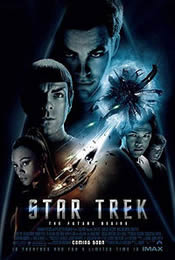
Star trek

Zombos Says: Very Good

J.J. Abrams’ Star Trek is not Gene Roddenberry’s Star Trek. It is a mix of Star Wars exuberance and Battlestar Galactica grittiness. With rapidly-repeating ship’s lasers blazing away in debris-strewn space battles, and revolver-like phasers shooting energy bullets, Roddenberry’s wagon train to the stars concept is taken to heart, but do not look for moral or social introspection here: in this reboot of the Star Trek franchise, Abrams puts aside the morality plays, for now, and points both warp nacelles to the action-filled stars, creating an emotionally charged adventure that brings together Roddenberry’s memorable captain and crew again for the first time. This Star Trek boldly goes where no movie in the series, odd or even numbered, has gone before, and keeps the heart of Roddenberry’s creation beating strongly and, ironically, more sure than much of what followed the original series’ next generation: Abrams remembered that the characters are always more important than the mechanics, and the story must be told through them, not about them.

Timewarp: some time in the 1960’s I stand in front of a small stage in the bomb shelter of my grade school, St. Mary Mother of Jesus. Star Trek, the television series, is hot, and every boy wants to be Kirk or Spock and put on school plays with them, us, fighting vicious Klingons. For this school play I do not get to play Kirk or Spock. I get to play the Away Party sap of the week; the guy who gets phasered or blown up in the opening minutes of the episode. This time, though, the principal, a nun whose temper is more feared than Klingon grooming, shoots down the play because the boys take the fighting part to heart and she will not have such science fiction tomfoolery in her wholesome school.

Abrams, along with writers Roberto Orci and Alex Kurtzman, put the overused time-warped- cheat in use again to make it all comfortable enough for long-time fans and fresh enough to entice newbies. By revolving the drama around Spock, both young and old versions of him from this and that universes, this movie’s alternate universe and timeline allows the good old days and the new good days to comingle, leaving elbow room for growing the characters we know so well into those characters we know so well, while retooling the franchise with today’s sensibility for special effects and space drama.

The opening minutes blast furiously across the screen as the USS Kelvin encounters Nero (Eric Bana), a Romulan with mean tattoos and a bad attitude, who reminded me a little of Shinzon from Star Trek: Nemesis. (Is it just me, or does every foe encountered in a Trek movie want to destroy Earth?) Kirk’s father is captain of the Kelvin for only a few minutes before he dies, but its what he does in those minutes that saves baby Kirk, mom, and many others; he rams Nero’s larger mining spaceship, the Narada, to give time for the lifeboats to get away.

Star trek 2009 On earth, Kirk (Chris Pine) grows up to become a reckless, directionless, bad boy. On Vulcan, a young Spock is taunted by his classmates for being part human. When he loses his temper and pummels his tormentor to a pulp, he begins to question his place in Vulcan society. Spock (Zachary Quinto) eventually joins Starfleet, turning down an invitation to join the Vulcan Science Academy after he is insulted one last time. Kirk is chided by Captain Pike (Chris Pine), after a barroom brawl with Starfleet cadets, to do better. He does, and on the way to Starfleet Academy, Kirk and Bones (Karl Urban uncannily channeling Deforest Kelley’s likable doctor) hook up. To complete the introductions for this classic trio, Kirk and Spock lock egos over Kirk’s creative and humorous solution for Spock’s serious Kobayashi Maru no-win training scenario, with Kirk exclaiming he doesn’t believe in no-win situations.

Timewarp: it is 1973 and I stand in a long line waiting a long time to get into the second Star Trek Convention held in New York City. This time the original crew is on hand to boldly celebrate Trek geekiness. Thousands of Trekkies turn out, seriously upsetting the notions of Star Trek’s fanbase with organizers. Yet, it is comforting to find many others who also think the Spock’s Brain episode sucks. I feel vindicated. I feel empowered. But I still don’t know who I want to be for Halloween; maybe Kirk, maybe Spock; much debate ensues as we reminisce about the first interracial kiss on network television, and who would win in a battle between Romulans and Klingons. Seeing William Shatner get a pie tossed in his face was kind of fun, too. He handles the situation like Kirk would have and we love him for it.

The reason Nero is so hell-bent on destruction is the usual one of revenge, triggering the near pixelated storyline which allows everthing to happen in-between timelines in the story in a way that broadens the action while neatly setting up the Enterprise crew’s relationships, and moving the light drama along at warp speed. There is a lot more comedy here than in previous Trek movies, but it helps define the endearing and recognizable qualities of each youthful crewmember; although it is a bit strained for Scotty (Simon Pegg of Shaun of the Dead) and his alien engineer. The Transparent Aluminum paradox from Star Trek IV: The Voyage Home gets a nod with Spock and Scotty’s timejumping transwarp equations. While the science is far-fetched, the action is not. It is hot and heavy with more Star Wars inspired monsters and aliens and clarity.

Much detail is given to the Enterprise’s engine room and interiors, providing a greater sense of the immense technological innards housed in the ship, and the transporter scrambles things up in a different way, but many of the original sound effects can be heard, along with new ones, and the all important viewscreen on the bridge is now a window to space on which images can be projected as needed.

Leonard Nimoy as the imperturbable Spock provides the critical mass that ties this movie to the series while also freeing it to explore new worlds and new adventures. It is bittersweet knowing this ends the original crew’s voyages for good, but heartening to know Star Trek will continue. Maybe this Halloween I’ll be Kirk; or Spock; or maybe a Klingon. I like Klingons.

Book Review: Hater
Whose Fear Is It?

Hater I phoned the office a few minutes ago but there was no answer. I was relieved when I didn't have to speak to anyone but then I started to panic again when I thought about how bad things must have got if no one's turned up for work. There's nothing else to do now except sit back on the sofa in front of the TV and watch the world fall apart (Hater by David Moody).

It takes a little over a week for the world to fall apart for Danny in David Moody's Hater; not that his life was all that together before everything else goes to hell. Family, neighbors, people around him are propelled into a Ballardian new world order where fear leads to anger, anger leads to hate, and hate leads to violence. But this dark side, in Moody's first book of his Hater trilogy, depends on whose point of view your seeing the escalating, spinning out of control, events from. As Danny describes his much less than ideal job, dissatisfying life, cold marriage, and children-interruptus, you wonder how much worse it can get for him. A lot, surprisingly.

Max and Me Look At Experiments in Terror 3

Experiments in Terror 3 “Striking for the third time, Experiments in Terror 3 unleashes another hallucinogenic orgy of the uncanny, the dreadful, and the macabre.”

Well, perhaps…

“Employing a mesmerizing montage of terrifying tropes and fiendish footage, our kino-coven conjures more than a bewitching hour of visionary cinema. Pounding a stake through the heart of genre convention, this shocking program expands the cinematic language of fear, breaking the chains of narrative logic and leaving only the black void of the infinite unconscious.”

We’ll be the judge of that…

Max and me chat about our likes and dislikes with Experiments in Terror 3. TK from Love Train for the Tenebrous Empire was scheduled to join us, but she ditched at the last moment. Smart move given our level of conversation. We did copiously borrow from her review, though, as she is much more articulate than either of us.

me: I looked for eit3 on imdb, but didn’t see it.

Max: To hell with the corporate fellatio that is IMDB! (Raising clenched fist in the air) 😉

me: Swish! and another proletarian-despised head hits the basket. Hey, no fair, you’re using emoticons! I can barely type.

Max: YOU can barely type? I don’t even exist! I’m a roomful of monkeys–one of us at a time accidentally producing coherent sentences!

me: Well, then send a few of them over to help me out. While I’m waiting let’s discuss the first film about Richard Chase.

Max: You know, when I was told that the first film on the review screener I was going to get was a Dick Chase film, I thought it was going to be a different sort of film!

me: Long pause as I look up Dick Chase…

Max: Aw, Zombos, you don’t look up *subtext*!

me: Ohhhhhh. I did find Deck Chairs, though.