From Zombos Closet

March 2009

The Haunting In Connecticut (2009)
Boo Who?

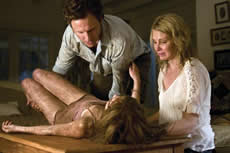
the haunting in connecticutSince its inception in the field of spiritualism, the concept of ectoplasm has escaped to become a staple in popular culture and fictional supernatural lore. Notable examples include Noel Coward’s 1941 play Blithe Spirit, and the 1984 film Ghostbusters, in which “ectoplasmic residue” secreted by ghosts is portrayed as viscous, cloudy and greenish-white, similar to nasal mucus, famously referred to in Bill Murray’s lines “Your mucous”, and “He slimed me!” (Wikipedia).

Zombos Says: Good

Right before I drove to the theater last night, to watch a late showing of The Haunting in Connecticut, a lightning storm sparkled and boomed through Westbury, dropping pea-sized hail and fat raindrops by the bucketful. Perfectly horrid weather for, as it turned out, a not so perfect horror movie. While director Peter Cornwell and writers did manage to startle me twice, The Haunting in Connecticut has more in common with Tobe Hooper’s energetic spookfest Poltergeist than the lingering, atmospheric scares in Lewis Allen’s The Uninvited or Robert Wise’s The Haunting, but not enough in common to make it as good.

The Snedeker family’s travails with a reportedly true-life demonic haunting in Southington, Connecticut have been documented (I’ll leave it up to you if you’d like to put quotes around documented or not) in an episode of A Haunting, which aired on the Discovery Channel, and in Ray Garton’s book, In A Dark Place. Taking the cheerless funeral home ambiance and malevolent presence aspects of their paranormal experience, the movie embellishes it with necromancy, runic magic, angry earthbound spirits (earthbound spirits in horror movies always seem to be angry), and spiritualism. This backstory, involving seances run by the sinister Dr. Aickman and his reluctant medium, Jonah, would have made a more effective and terrifying movie entirely on its own.

LOTT D Horror Post Roundup

Ride-'em-cowboy Howdy Pardners! Kick up those spurs and tilt those hats, it’s time for another month’s worth of favorite posts from the notorious LOTT D horror ranch. They’re lined up and waitin’ for you…grab your partner and dos-i-do, round the middle and on your toes!

Igloo of the Uncanny kills his fourth best friend while reviewing the Swarm.

Unspeakable Horror! blows the Whistle to Open Worlds and analyzes the black beast stereotype we all fear.

Blogue Macabre goes all sci fi and reveals the answers behind Battlestar Galactica’s mind-blowing series finale.

The Drunken Severed Head sends us this timely tribute to Uncle Forry, held at the Egyptian Theatre in Los Angeles, from Jim Bertges.

Slasher Speak is hovering on Cloud 9 over their Bram Stoker Award nom for the speakably good Unspeakable Horror: From the Shadows of the Closet, named a finalist for Superior Achievement in an Anthology. Way to go!

Mad Mad Mad Mad Movies tells us not to judge Savage Weekend by it’s boom mike or other technical faults or “egregious continuity flubs, shots framed with some foreign object (possibly the cameraman’s thumb) obscuring the top of the lens, and…” because it does “add some cool performances by David “Dr. Hill in Re-Animator” Gale (with rockin’ 70s ‘stache!) and William “This is my brother Darryl, this is my other brother Darryl” Sanderson playing (what else?) a country bumpkin with a difference, and I think it’s an undiscovered gem. Check it out.”

In My Defense: Popcorn Movies Are Good

Popcorn movie I was pleasantly surprised to see mention of my review for Knowing at Cinefantastique Online. Steve Biodrowski, in citing my review, brings up a good point about my apparent contradiction calling Knowing a popcorn movie on the one hand, while raving about it on the other. So here is my short explanation.

The term popcorn movie has been used, mostly and usually, as a disparaging term for films that pander to a mass audience (and even smaller ones) while showing little or no creative or artistic effort, design, or thought. I understand this, but I choose to not use the term in this way.

Quite frankly, and sadly, a sizable amount of theater and straight to DVD movies, both horror and non-horror, can be categorized as popcorn movies if the term is used in this way, forcing it to lose the value, the sting of negativity, if you will, it was originally meant to convey. There is now an expectation of mediocrity in film production greater than the expectation of excellence; this renders the negative connotation, usually applied to the use of the term popcorn movie, superfluous.

I rather avoid this and use popcorn movie to mean a film worth seeing–whether it appeals to a mass audience or not–that is enjoyable on possibly many levels, including the emotional, psychological, and spiritual states one may experience while watching it, and being thought provoking as well. The film may be disturbing, enlightening, or just plain fun, but the bottom line is that you, the viewer, are left with a sense of "damn, that was good."  Using this, admittedly personal criteria, I consider Casablanca (my favorite film by the way), Citizen Kane, and Halloween popcorn movies, along with many others I have enjoyed watching, like Watchmen.

I was left with a sense of damn, that was good after seeing Knowing. I hope you experience the same.

LOTT D Horror Post Roundup

PickapostBeware! The archives have been unburied, and the hideous horrors released! For your entertainment and edification pleasure, of course. Members of the League of Tana Tea Drinkers dig deep to find their past misdeeds…and reveal them to you!

Blogue Macabre provides a timely public service announcement to help you prepare for the next zombie holocaust. So pay attention.

Mad Mad Mad Mad Movies gives 2.5 thumbs up for demon-antics in Amityville II: The Possession. It’s the .5 thumb that bothers me, though.

And Now the Screaming Starts hops in the saddle as Jesse James Meets Frankenstein’s Daughter, and squares it all away with a nice little overview of director William “One Shot” Beaudine’s career. He isn’t called one shot for nothing!

The Drunken Severed Head gives us their best of the worst, in two parts no less! So head on over and get a heads up on the best of the worst posts they’ve dared to show us. So, just head on over so I can stop before I head into another heady pun!

Dinner With Max Jenke reveals their dream version of Rob Zombie’s Halloween 2. (Though it reads more like an hallucination, really.)

Knowing (2009)
Destiny In a Handbasket

Knowing 2009

Zombos Says: Excellent

That particular sequence caused me no end of headaches and nightmares, because we decided at an early stage to get it all in one continuous shot. So from the moment when the plane crashes into the freeway and goes breaking up and exploding into a field, Nic’s character then pursues, and runs into the maelstrom and tries to save people (from Alex Proyas interview).

I am taken aback by the negative–at Times, vitriolic– criticism for Nicolas Cage and director Alex Proyas’ dark, apocalyptic thriller Knowing; such disdain is usually reserved for horror films, not more mainstream fare. As he did in Dark City, Proyas conjures another sepia-toned vision of determinism, fate, and faith, and ratchets up the tension with three carefully crafted, special effects-laden scenes of death and destruction before finishing with an outstanding fourth. Cage, as astrophysicist John Koestler, portrays an everyman, quirks and all, coiled and held tight in the moments, filled with knowledge but mostly powerless. Borrowing the science fiction staples of pending global cataclysm (seen in 1951’s When Worlds Collide, slated to be remade in 2010 by Stephen Sommers), and celestial intervention, Knowing is an emotionally charged drama meticulously combining horror, science fiction, and fantasy conventions into an absorbing story worthy of more serious, and less caustic, critique.

The Last House on the Left (2009)
To What Purpose?

The Last House on the Left

Zombos Says: Good (And to the idiot who walked in at the movie’s midway point, sat down in front of me, and proceeded to chat on his cell phone until I had to tell him Miss Manners was looking for him in the lobby, I would have loved to have set that microwave on high with his poppin’ head in it.)

This film, for example, which as I write has inspired only one review (by “Fright”), has generated a spirited online discussion about whether you can kill someone by sticking their head in a microwave. Many argue that a microwave won’t operate with the door open. Others cite an early scene establishing that the microwave is “broken.” The question of whether one should microwave a man’s head never arises (from Roger Ebert’s review of  The Last House on the Left, 2009).

Of course, whether one should turn on the kitchen garbage disposal to mangle a person’s hand into bloody pulp, accompanied with stereophonic screams of agony, could be another philosophical question to ponder in this vicious–yet, oddly, less terrifying–remake of Wes Craven’s gut-wrenching 1972 interpretation of Ingmar Bergman’s The Virgin Spring. But philosophical ponderance is not often measured into horror movies as much as sadistic inhumanity. So to what purpose do I bathe in blood, along with the innocent and the damned, on this hellish, stormy, night of vengeance?
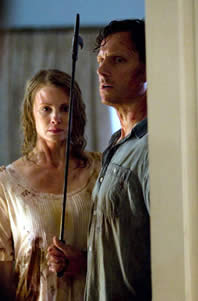
Last House on the Left The criminals who eventually rape and attempt to murder Mari (Sarah Paxton) are certainly depraved enough to warrant ill-treatment by her parents. But how far can her parents go before becoming just as depraved as her tormentors, and why do the rest of us choose to watch it all happen? For the suspense? There is none. For the terror? We know what is going to happen so there is no terror. To watch normal people act abnormally when driven beyond the edge of reason? A strong possibility here, especially if those abnormal acts include suffering, redder gore, and darker death; key thematic elements in many horror movies.

At least Ingmar Bergman put God squarely in the middle of his story, forcing guilt and shame on the parents who mete out vengeance to their daughter’s killers. You will not find emphasis on a divine presence in this latest incarnation of a story that really did not need to be retold. No guilt or shame, either. There is lots of ungodly loud, screeching music though, like bones dragged across a chalkboard. Unless you are entertained by the  creative ways directors and writers emphasize these thematic elements, there is not much here for you. But if you are, you will especially enjoy the totally gratuitous ending involving a microwave and a deliberately paralyzed sadist. If you’ve seen Gremlins, you know what to expect.

Leading up to the poppin’ head gag, as I like to call it, are the usual characters found mucking about in horror cinema; there is the psycho-witch-bitch girlfriend, Sadie (creepily played by Riki Lindhome), who, I am sure, pulled the arms off of little boys (and girls) while she was growing up; led by the snake-oil-salesman cool, sociopathic boyfriend, Krug (Garret Dillahunt), who easily attracts psycho-witch-bitch type women; followed by the tag-along guy, Francis (weasily played by Fred Podowski) who likes to watch as the other two go medieval-crazy on their victims.There is also the withdrawn, confused son of Krug, Justin (youthfully played by Spencer Treat Clark), who is not all that comfortable associating with the other three. A brief mention of his dead mom makes you wonder how she died.

Setting calamity in motion is Mari’s friend Paige (perkily played by Martha MacIsaac), who insists on following Justin back to his motel room to sample his stash of primo weed. Mari, tired of waiting in the car, enters the room and finds Justin and Paige puffing away. Mari gives into Paige’s insistence to join them, and starts puffing away, too. This being a horror film, you know Paige and Mari must now suffer and die for smoking weed, even if it is the good stuff. Justin’s severely maladjusted family enters the room to fulfill that invariable rule.

Taken into the woods, Mari and Paige are dutifully tormented, Mari is humiliated and raped, and Paige is murdered. While not as emotionally disturbing as Wes Craven originally directed it in 1972, their torment is still brutal and unpleasant to watch. Unable to leave the way they came, Krug, Sadie, Francis, and Justin head through the dark woods to the last house on the left (actually, it looked like it was the only house on that road), where Mr. and Mrs. Collingwood, Mari’s parents, put them up for the night. Barely alive, Mari manages to crawl back home and alert her parents to the true natures of their house guests. Much blood-soaked mayhem ensues.

I hope this is the last version of The Virgin Spring we will be tormented with. While the acting, direction, and writing are all very well done, fans of horror have been taken down this road too often already.

Graphic Book Review: Simon Dark’s Gotham City

Simon DarkLurks in Shadows. Hides in the park.
Simon. Simon. Simon Dark.
If you're good he'll stay away.
If you're bad he'll make you pay.
Lurks in Shadows. Hides in the park.
Simon. Simon. Simon Dark.

Zombos Says: Very Good

Simon Dark's first two graphic novels, What Simon Does (collecting issues 1 through 6) and Ashes (collecting issues 7 through 12), must be read together. The first sets up Simon's bizarre background and the second delivers the main storyline of Lovecraftian-styled witchcraft, which depends on that set up. Mixing fairly equal parts of mystery, occult science, and recognizable horror elements such as the Gothic, a creepy-looking sack-like mask, and conniving robed worshipers of demonic beings, Steve Niles builds an effectively darker Gotham City than even Batman deals with. This atmosphere is further enhanced through Niles' characters, those both good and evil, who either aid or hinder Simon Dark in his continuing battle with the dark side, and in his search to understand his ultimate purpose for being.

These characters are arrestingly drawn by Scott Hampton, who makes Simon's world properly Gothic, but perhaps a little too dark at times. His carefully stylized, foreground-heavy, panels flow across pages like single frames in a movie, creating images that are  static and posed, and lacking an internal dynamism. He reminds me of Al Williamson, although not as detailed when drawing background imagery. Hampton's unique faces are like portraits and they play an important role in his composition by generating emotional depth with their sober expressions; at first, this near photo-realistic approach is elegantly novel, but it can lead to confusion between the two heroines; a pathologist, Beth Granger, and Simon's soulmate, Rachel Dodds, when their features blur into similarity as dire events involving them unfold . Rereading clears up this confusion (along with clothing cues I missed initially), but more detail and less black in the scenes would have mitigated this.