
Posted on October 02, 2012 in Universal Horror | Permalink | Comments (0) | TrackBack (0)
Reblog
(0)
| |
|
|
The following article by Scott Essman first appeared in Below the Line: Voice of the Crew. I'm reprinting it here with his permission.
Posted on September 25, 2012 in Universal Horror | Permalink | Comments (1) | TrackBack (0)
Reblog
(0)
| |
|
|
ZC Rating 4 of 7: Very Good
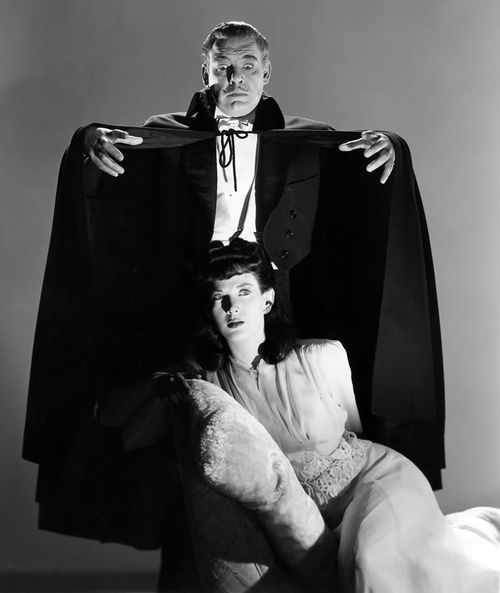
We had finished watching Son of Dracula in the cinematorium. It was half-past midnight, and I had prepared our third round of New Orleans Fizzes, going a little heavier on the gin and somewhat lighter on the tonic.
"Son of Dracula does not receive the attention it deserves because," said Zombos, "as the usual criticisms go, Lon Chaney Jr. lacks bite; and he does not have a compelling, accented voice suitable for a Hungarian vampire; and he is too pudgy; and he is not menacing enough; and--"
"True, true, true, to a point," I interrupted, "but this eerie, studiously filmed Southern-Gothic horror noir tells its occult story outside the typical Universal Studios scripting conventions. Instead of lab coats and operating tables, and motivations centered around jump-starting the Frankenstein Monster, and let's not forget those trite, pseudo-scientific explanations provided for supernatural monsters, Son of Dracula oozes inky blackness in its shadows stretching across rooms, enveloping tight corners, and graying the Dark Oaks Plantation's dour, moss-covered swampland."
"And it's also a love story," added Zimba, " involving a Gothic-minded woman, Katherine, (Louise Allbritton), whose morbid interests in death and eternal life provide the opportunity that brings Count Alucard (Lon Chaney, Jr.) from his blood-drained homeland to vibrant New Orleans. I like that part best!" She sipped the drink I handed her.
"The mistake most critics make when discussing this movie," I continued, "is due to the script's intentional muddling of the name Alucard with Dracula, hinting, fairly obviously--and I blame Universal's marketing department for this--that Lon Chaney is not playing the son, but is Dracula."
"But Katherine does tell Frank (Robert Paige), her boyfriend, that Alucard is Dracula," countered Zimba. "Don't forget she intends to spend eternal undead life with Frank, after he kills Dracula, of course. So is the title, Son of Dracula worthless? How about Dracula Reverses Name, Visits America? Would that be more appropriate?" Zimba hiccupped. "Did you go heavy on the gin again?"
I ignored her. "I suggest a different critical approach. First we must dismiss what Katherine said; she's mistaken or delusional and doesn't really know who Alucard is beyond the fact he's a vampire. An idea not all that farfetched when you've already accepted she's marrying Alucard so she can become a vampire, then plans to destroy him so she can put the bite on her boyfriend so they can live happily undead ever after. Secondly, believe the movie title. Count Alucard is not Dracula, he is, indeed, the son of Dracula, metaphorically speaking."
"Go on," said Zombos, finishing his drink. His pallid cheeks were rosier than usual.
"With this perspective firmly in place, Lon Chaney's interpretation of Dracula's son visiting America broadens to encompass fascinating vistas of backstory speculation. Such speculation can erase Hungarian accents and reimagine Alucard's pre-story as an overweight American visiting the Old Country. How he falls under Dracula's spell I'll leave to your imagination, but in some way he inherits the count's luggage, formal evening wear and ring, and heads to America to find new blood, just like his "dad" did in the original Dracula by going to Great Britain."
"Okay, so he has inherited the Dracula curse, so to speak, and travels to New Orleans with the promise of a new bride and fertile hunting grounds?" summed up Zombos.
"Precisely. Now let's examine the merits of the movie without the shackles of all this Chaney's-not-Bela negativity, shall we?"
Zimba started snoring. I may have gone heavier on the gin than I thought. I continued and spoke a little louder.
"For the first time we see the bat to vampire transformation onscreen. Not perfect, but it does look better than when done in Abbott and Costello Meet Frankenstein. Then there's the vaporous transformations as Alucard, and eventually Katherine, flitter about; especially the sequence where Alucard's coffin rises out of the swamp water, then vapor seeps from under the lid to coalesce into Alucard himself, then he and the coffin glide across the water together. It's breathtaking. Not only does Chaney Jr. look sartorially commanding in his evening wear, but the intrinsically supernatural elements of his power to shapeshift and move his coffin effortlessly across the swamp water is elegantly executed. Here's a creature of the night who's immensely powerful, yet vulnerable, as we see later on."
"But it is Robert Paige as Frank who provides the most dynamic by going bonkers," said Zombos.
"Yes, that's true. He's the one the story pivots around. His rough handling by Alucard, flinging him easily across the room, leading to his shooting Katherine to death, which leads to his mental unhingement--"
"--And Katherine's wish-fulfillment," said Zombos.
"Yes, and her wish-fulfillment," I agreed. "She becomes a vampire, visits Frank in his jail cell, and sells him on her live-happily-until-stake-do-us-part dream. Katherine plays like Vampira before there was a Vampira. She's Goth before there was Goth. The story's really about her and Frank, and Alucard plays second fiddle to them. The mighty vampire is being played for a fool." I sipped my Fizz. I definitely went too heavy on the gin this time. "You don't see that too often."
Zombos yawned, then took another sip. "This is one Universal Horror production that is slickly directed above and beyond the basics by Robert Siodmak. His kicking his brother off the movie to go with Eric Taylor's screenplay allowed for the crime-noirish, vampire romance-nuanced storyline to flower. Another element that harkens back to the old style Van Helsing scientific reasoning that encompassed the occult is how Dr. Brewster (Frank Craven) plays into it."
I nodded in agreement. "That's right. Kindly country doctor recognizes the Dracula curse in action before anybody else does. He's the key authority figure, more so than the police. Around his normalcy Frank, Katherine, and Alucard do their dance macabre. Aside from wanting to commit Katherine on grounds of insanity because she's too morbid for his tastes, Dr. Brewster is the investigator who gathers information for the police, and eventually convinces them there's more going on than meets the eye."
I took a sip and continued. "The icing on the cake is the darkly poetic sets, from swampland to nursery. The confronation between Frank and Alucard in the swamp drainage tunnel is surprisingly succinct and effective. Scratch one all-powerful vampire. At least for this movie, anyway. From his powerful tossing of Frank across the room with one hand, to his sheer terror at seeing his coffin go up in flames, Chaney captured an unusually telling final moment every vampire must dread deep down, no matter how old or powerful, making us feel it; one we seldom see beyond the quick stake or sunlight dissolution. Death for the undead."
Both Zombos and Zimba were dreaming dreams no mortal ever dared to dream before by the time I finished my Fizz. They looked comfortable enough, so I let them be. I prepared another Fizz before bed, but this time I added a little more tonic. But just a little.
For more information on Son of Dracula, I recommend American Gothic: Sixty Years of Horror Cinema by Jonathan Rigby, and Universal Horrors: The Studio's Classic Films, 1931 to 1946, 2nd edition. Both are essential reading for the horror fan.
Posted on March 12, 2012 in Universal Horror | Permalink | Comments (2) | TrackBack (0)
Reblog
(0)
| |
|
|
Do you recall who ultimately defeats Dracula and Frankenstein's Monster? Dracula, seconds after seeking safety in his coffin from the morning’s light, is efficiently pushed and pulled into the sunlight, to quietly fade away when Dr. Edelmann opens the lid, defeated by a man of science and medicine (although he is cursed by Dracula with a dark side medically acquired through a blood transfusion.) The Monster, finally recharged and ambulatory, is quickly and easily done in with flammable chemicals by Larry Talbot; defeated by a man, formerly cursed with lycanthropy, but now medically cured. The monstrous other, that dangerous and abnormal thing to be feared in every horror movie, novel, and story, and often cited by more sociological theory-prone genre buffs, is succinctly dealt with in House of Dracula using practical means. Even Dr. Edelmann’s Mr. Hyde-like alter-ego is quickly brought to heel by Talbot using a handgun; the last old monster to be cleansed from the new world, not by fire or stake or silver, but by a more practical and modern and ordinary, and lethal, weapon.
Let’s tally it up, shall we?
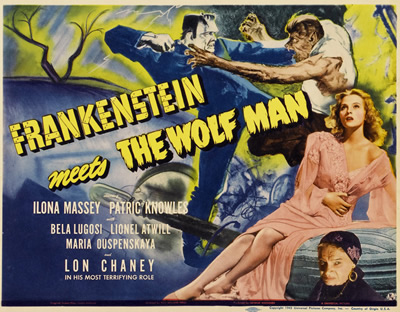
Talbott shot Dr. Edelmann dead and killed the Monster. Talbott was cured of his supernatural affliction by an operation to relieve pressure on his brain. Talbot lived. Of course, he became the Wolf Man again for Abbot and Costello Meet Frankenstein--no explanation given--but for now he's happy. Watching him look at the full moon without changing into the Wolf Man is a fulfilling climax to his journey to find true death in Frankenstein Meets the Wolf Man, then to find a cure in House of Frankenstein and House of Dracula. A cure! Before this, monsters weren't cured, they were to be feared and exterminated as promptly as possible. When Talbott forces Inspector Holtz (Lionel Atwill) to lock him up so he doesn't kill anyone, his transformation brings pity from Dr. Edelmann and tears from nurse assistant Milizia, not fear. And when Dracula introduces himself to Dr. Edelmann and requests his help in finding a cure, the doctor isn't scared or even a little worried. Instead he poo-poos the whole notion of vampires, although he knows the folklore quite well, and then consents to take on the challenge after discovering Dracula is suffering from a blood infection.
From doctors pushing past the boundaries of God's domain (Frankenstein and Bride of Frankenstein), to doctors misguided by an intoxicating taste of mastery over nature (Son of Frankenstein, The Ghost of Frankenstein, Frankenstein Meets the Wolf Man), to doctors unwavering in their scientific hubris (House of Frankenstein, House of Dracula, Abbot and Costello Meet Frankenstein), the message is simple: it's not about the monsters outside, but the monsters within, and the strength of their power comes from fear. But there were worse things than imagined monsters and worse fears to be generated from a society carrying torches constantly without realizing it.
With the not-of-this-world threats of classic monsters supplanted by the realistic technological and sociological ones springing up from world war and the grim dawn of the Hiroshima Age, our nightmares could no longer hide behind folkloric, superstitious terrors from an ancient world; they danced uncontrollably at the periphery of our imagined armageddons. What remained for Universal's now rendered harmless bogey men would be a final sendup in Abbott and Costello Meet Frankenstein, and a rebirth as "friendly" monsters that would spark a generation of monsterkids looking for safety, and their imagination's release, from the sturm und drang of an increasingly insensible and unfriendly world.
Then a peeping tom, zombies eating Pennsylvania, and an excessively messy wizard would bring the horror closer to our porch steps, making the fears of the night a piddling trifle compared to the terrors by day.
Posted on January 04, 2012 in Universal Horror | Permalink | Comments (0) | TrackBack (0)
Reblog
(0)
| |
|
|
Read Part 6: House of Frankenstein
ZC Rating 3 of 7: Good
House of Frankenstein and House of Dracula are situated within short walking distance of each other and their inhabitants use the same narrative roads to tell their stories. The furnishings are also similar, albeit a bit sparser in Dracula's house. But Larry Talbot is still here, Frankenstein’s creation is still in need of a jolt, and the battle between supernatural ambiguity and scientific clarity, begun in 1931’s Dracula, ends here with scientific reason ultimately winning, illuminating the irrational monsters of Universal’s horror pantheon from their primal darkness with the enlightening tools of science.
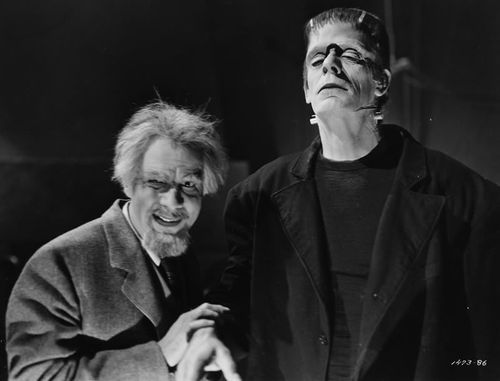
Taking a quick walk around House of Dracula’s façade, most genre buffs and critics would find it a lesser structural composition than Frankenstein’s house, although the rooms are basically the same. Also the same are the hunchbacked assistant’s role—although shockingly pretty and demure this time (Jane Adams), unlike the murderous Daniel in that other house—and once again the impotent Monster (Glenn Strange) is accidentally uncovered to await another jump start to his electrodes from the quintessential and ubiquitous electrical apparatus always at hand for just that purpose. Larry Talbot (Lon Chaney Jr.) is here, too, showing up unexpectedly at the front door—you may recall he died in House of Frankenstein—and Dracula returns—ditto with him—showing up just before dawn to ask for help, too, but only one of them is sincere in his need for a cure.
It’s this help both werewolf and vampire receive in House of Dracula that makes this movie a pivotal and historically important notation in the transition from the supernatural horrors of the 1930s and 1940s to the scientific hubris (and its subsequent faux pas), and the technological fears of space alien confrontations and mass biological infections of the 1950s and 1960s sci-horror cycle. Most compelling for this transition is Larry Talbot’s cure from lycanthropy through surgery, and the discovery that Dracula’s “disease” is caused by parasites in his blood; a theme to be expanded on in later vampire movies and fiction. Like versatile duct tape, “the miracle of medicine,” as Dr. Edelmann says, becomes the multi-use fix-it for conditions formerly considered primeval, cursed afflictions beyond practical understanding or abatement by conventional means.
There’s also a neatly executed budgetary and esthetically pleasing grace to be found in Erle C. Kenton’s staging of House of Dracula’s spook show drama, embellished by Dracula’s animated metamorphosis from bat to man, and the near operatically executed sequence of Dracula’s deception and subsequent destruction by sunlight, to foster a greater appreciation and reconsideration of its merits and position within the Universal Horror Mythos.
To be clear, yes, there’s a giddy abandon regarding plot tidiness—just how do Dracula and the Wolf Man come back to life after House of Frankenstein?—and common sense--just how does the Monster look so damn clean and tidy after swimming in sandy muck for so long?—to warrant some derision. But taken as a whole, when scenes are considered in relation to the movie’s breezy, theater play-like storyline (which rubs scripting elbows so close to House of Frankenstein they squeak) and contrasted against the requirements of the Hays and studio offices, and the impotence of the classic monsters compared to the ruthless efficiency of Dr. Edelmann’s ( Onslow Stevens) homicidal serial killer alter-ego, a curious thing happens: you can begrudge a few allowances for immortal monsters wearing immortal clothing and bats hanging from clearly visible wires; there’s simply so much more to think about.
For instance, why are Dracula and the Wolf Man without bite in this movie? The only onscreen murder is committed by Dr. Edelmann after he’s intentionally infected by Dracula’s parasitic blood. Larry Talbot’s transformations end before he can visibly chew on anyone and Dracula—pardon me, Baron Latos—dons his silly top hat and opera cape to woo Ms. Morelle (Martha O’Driscoll) with more gusto than shown for his thirst for blood. Lon Chaney Jr. may be dressed in Yak hair and putty, but that’s all there is to show us he’s the Wolf Man. When he transforms in the prison cell, rattles the bars half-heartedly, then falls asleep!, what are we to make of this? Did the censors interfere with the Wolf Man’s ferocity, or did the presence of rational science strip him of his wolfhood? In the cliff side cave where Dr. Edelmann searches for him after he tries to commit suicide, he attacks but again fails to draw blood. His sudden transformation back to human form conveniently leads to the Frankenstein Monster’s discovery. At no time is Larry Talbot a real threat. Neither is Dracula. And especially, neither is the Monster. What gives?
Surprisingly, John Carradine, when sans hat and cape, presents an imposing vampire this time out, aided by gothically-toned encounters with Ms. Morelle. Her piano music, turning from romantically poetic to darkly troubled when Dracula appears, provides one of the more engrossing effects of the vampire’s formidable supernatural underpinning. Like his magical glowing ring in House of Frankenstein, he wields it to seduce his desired bride. Ms. Morelle becomes intoxicated by its troubling, foreboding, yet strangely compelling sound.
But this hint of worse things than death is all we'll see of those children of the night, because the scientific method of Dr. Edelmann, and the wonders of science, renders everything else sterile; just in time for the scientific horrors of the 1950s. And yet there's one more attempt to revive the monster, this time by Dracula himself. Talk about driving nails in coffins. Bela Lugosi dons his vampire's cape once more, but this time Van Helsing is no where to be found.
Wait, it gets even stranger...
Read Part 8: Abbott and Costello Meet Frankenstein
Posted on November 11, 2011 in Universal Horror | Permalink | Comments (0) | TrackBack (0)
Reblog
(0)
| |
|
|
by Scott Essman
Though it was not a Universal monster, "Murder" Legendre, as played by Bela Lugosi, was an early and somewhat overlooked Jack Pierce makeup in United Artists' White Zombie, a movie released the year after Frankenstein and in the same year as Old Dark House and The Mummy, all of which were Universal films featuring more noted monsters by Pierce.
Both Lugosi and original Frankenstein director Robert Florey were reassigned to Murders in the Rue Morgue when test films for Frankenstein displeased Carl Laemmle Jr., head of production at Universal, in 1931. Though Lugosi would return to Universal to make films such as The Black Cat (1934), The Raven (1935) and The Invisible Ray (1936), he made White Zombie at UA.
Pierce had never actually signed a contract with Universal even though he was makeup department head from 1928-1947. He had previously left the studio in 1927 to work at Fox to create an ape-man character for The Monkey Talks. But after White Zombie, Pierce never again worked outside Universal until he was dismissed in 1947 after the merger with International Pictures.
White Zombie was a low budget film even by 1932 standards, having been made for a rumored $50,000, filmed in two weeks in March of 1932 and released that August. Of course, neither the film or character received the publicity or notoriety of the Universal horror classics of the early 1930s. But the image of Lugosi in Pierce's makeup should be considered relevant to cinema enthusiasts.
Posted on June 23, 2011 in Universal Horror | Permalink | Comments (2)
Reblog
(0)
| |
|
|
Read Part 5: Frankenstein Meets the Wolf Man
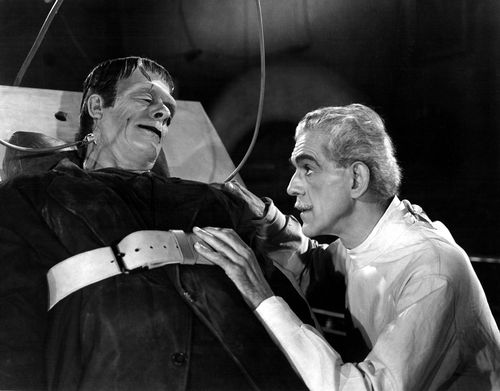
Despite its all star cast, and the return of Boris Karloff to the fold, the film was the silliest and dullest of the entire series. In its non-stop and methodical rushing through stock horror sequences, it approached the standardization of the "B" Western, and even lacked the kind of bravura dialogue that at least can provide a pseudo-Gothic veneer. (William K. Everson, Classics of the Horror Film)
Although Everson pans House of Frankenstein, this second monster rally from Universal's production treadmill is not silly or dull, and steps lively through its "stock horror sequences" of brain-swapping mad science, murderous hunchbacked assistants, and star-crossed lovers, all with a patina of Gothic-noir finesse. It's slick slacks, neatly pressed and sharply creased, and while it does not dwell deep in meaning, House of Frankenstein remains a well-directed, entertainingly acted, and visually appealing Universal-stylized horror movie.
John Carradine's portrayal of Dracula is another matter.
Except for his glowing, mesmerizing, ring providing most of the vampire's menace--it offers a glimpse of evil shadows moving furtively in a nightmare world--Carradine's Big Bandleader accoutrement and eye-pop stare brimming from under a silly-tilted tophat, and short opera cape dandily draped across his shoulders, do their best to murderlize the spookshow tone. At least Dracula's early demise in the movie lessens our burden of having to suffer Caradine's ham and corn buffet for long, and frees Larry Talbot (Lon Chaney Jr) to pine away and lament his lycanthropic curse, which is really the main storyline anyway.
Perhaps Universal was banking on the audience appeal for the Frankenstein name, but House of Frankenstein and the subsequent House of Dracula are two peas in a pod, and should have been named House of the Wolf Man and Sublet of the Wolf Man respectively.
Maleva the gypsy is no where to be found . The Frankenstein brothers, daughters, and baronesses are gone, too. The Monster (Glenn Strange) remains; more lifeless than ever in body and spirit, but still recognizable dressed in those defining neck bolts. Erle C. Kenton's patent leather direction, Hans J. Salter's mood-rich music (along with Paul Dessau), and the creative best from the art and set B-movie decoration crews with what's at hand all funnel through a lean filming schedule and budget to stir shadow, menace, and monsters briskly when the lightning strikes again.
Imprisoned mad Doctor Gustav Niemann (Boris Karloff) escapes the dark, dank prison cell he's in, along with the homicidal Daniel (J. Carrol Naish), a hunchback outcast dreaming of a straight body. Niemann's incessant raving about brain transplants appeals to Daniel. He follows the Doctor when a lightning bolt blasts open an escape route for them, hoping Niemann will place his brain into a better body. As the rain pours down, they chance upon Lampini's (George Zucco) traveling sideshow of horrors. Lampini's reluctance to take them where they want to go ends abruptly between Daniel's tightly gripping hands, shown through a flash of sudden terror in Lampini's eyes, Daniel lurching menacingly closer with those outstretched hands, and a gurgling cry as Niemann smirks in quiet satisfaction. With plans for revenge on those who imprisoned him, and a driving desire to find the life and death secrets of Frankenstein, Niemann assumes Lampini's name and travels to Visaria ( or insert your own village name here since continuity went out the door with Lampini's body).
Bela Lugosi was slated for the role of Dracula, but the movie was dependent upon the presence of Boris Karloff being released from the stage tour of Arsenic and Old Lace (1944). Shooting was delayed, and John Carradine was cast instead of Lugosi, who had a prior engagement: ironically, playing Karloff's "Jonathan Brewster" role in another touring company of Arsenic and Old Lace (from the IMDb entry on House of Frakenstein).
In the mold of Bride of Frankenstein's Pretorius, Niemann is a maniacal scientist bent on one-upping Frankenstein. Brain-swapping becomes modus-operandi, raison d'être, and
bargaining chip for Niemann as he pursues his revenge, first on Burgomeister Hussman (Sig
Ruman), with the help of Count Dracula.
"Early drafts of the story reportedly involved more characters from the Universal Stable, including the Mummy, The Mad Ghoul, and possibly The Invisible Man," according to Wikipedia, but the only monster to remain in Lampini's traveling horror show is Dracula. Curiously, he is not the vampire late of Whitby Abbey, or even the vampire last seen burning to ashes in Dracula's Daughter. No continuity from there to here is intended. The skeletal remains of Dracula, with a stake embedded deep into its ribcage, is pure spookshow dramatics parlayed into a rapidly unfolding and stylish vignette of terror for Hussman, kicking off Niemann's revenge with a flourish. It begins with the piecemeal reconstitution of Dracula's body and clothes when Niemann pulls out the stake in a huff after meeting the Burgomeister. With his threat of the dreaded stake poised to strike again, and his promise of fealty to the Lord of the Undead, Niemann convinces Dracula to help him.
In quick succession, Dracula ingratiates himself to Hussman, seduces and hypnotizes Hussman's Americanized granddaughter-in-law Rita (the effervescent Anne Gwynne), turns into a large bat to kill Hussman (done with a nifty animated transformation capped by an attack shown in direful silhoette), and is discovered by Hussman's son Karl (Peter Coe) who realizes what's happening and sounds the alarm to Inspector Arnz (Lionel Atwill). With the inspector and his men in hot pursuit on horseback, Dracula, in turn, chases after Niemann and Daniel as they race away with his coffin in Lampini's wagon. With the sunrise moments away, Niemann directs Daniel to dump it. Unable to reach his daytime santuary in time, Dracula is reduced to a skeleton once again. His hypnotic influence over Rita ends when his ring falls off his boney finger.
Economically directed and succinct in execution, it's still exhilarating and entertaining with flair, and certainly not the script calamity it's purported to be in many critical analyses. Carradine projects a more energetic Dracula when he's not staring with widened eyes or donning his tophat, but he doesn't have Lugosi's seductive and menacing silent presence, or tincture of arcane evil when in motion, which, arguably, could be considered a hindrance to the faster pace of action here.
Continuing to Visaria, they rest at a Gypsy campsite, where Daniel comes to the aid of a girl being whipped. He insists they shelter her and Niemann reluctantly agrees. Daniel's infatuation with the playful Ilonka (Elena Verdugo) is not returned when she sees his hunchback, making him more impatient to receive the new body promised to him by Niemann.
And the one he wants is all ready preoccupied by Larry Talbot.
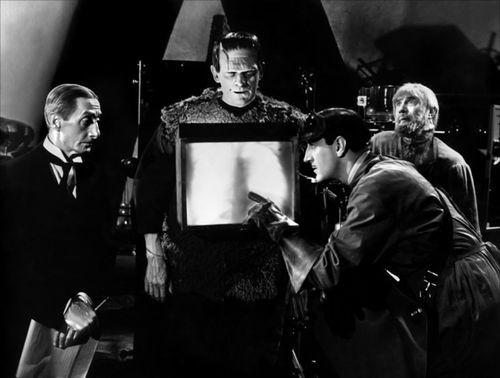
Photograph of Glenn Strange as the Frankenstein Monster (with Boris Karloff) courtesy of Dr. Macros High Quality Movie Scans.
Posted on March 18, 2011 in Universal Horror | Permalink | Comments (1)
Reblog
(0)
| |
|
|
Posted on January 27, 2011 in Pressbooks & Heralds, Professor Kinema, Universal Horror | Permalink | Comments (0)
Reblog
(0)
| |
|
|
Posted on January 26, 2011 in Pressbooks & Heralds, Professor Kinema, Universal Horror | Permalink | Comments (0)
Reblog
(0)
| |
|
|
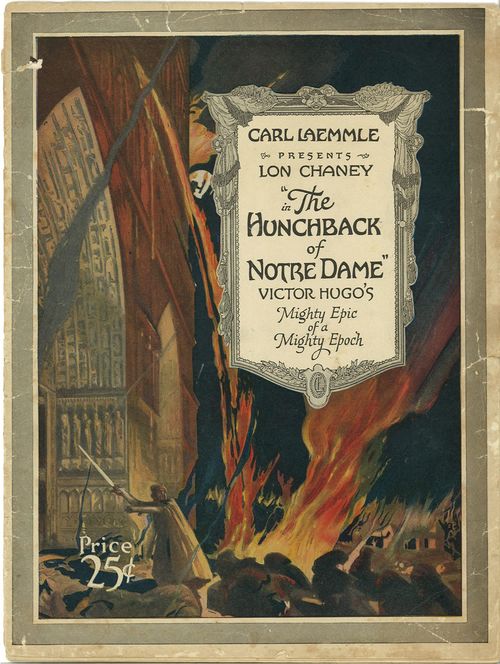
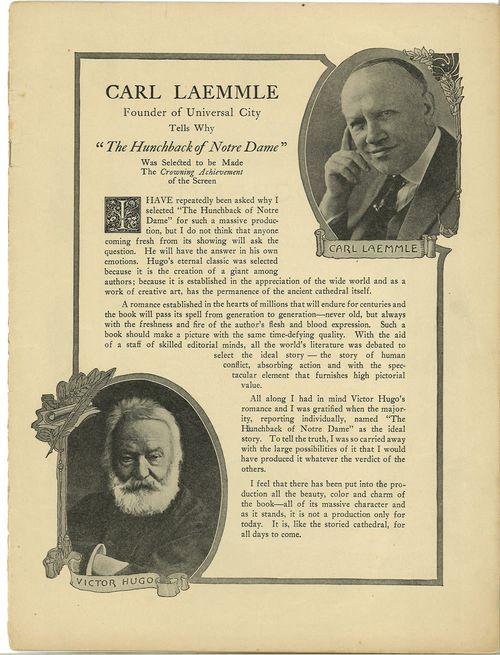
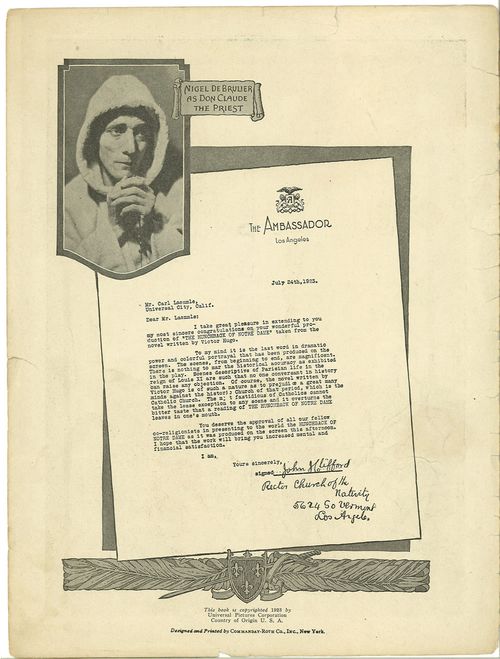
My eyes popped out when I saw this 1923 souvenir program for The Hunchback of Notre Dame in Professor Kinema's archives. After I put them back in so I could see better, I knew I had to share these fantastic 18 pages of movie history. And you don't even need to pay the 25¢ cover charge!
Continue reading "The Hunchback of Notre Dame (1923)
Souvenir Program
Part 1 of 3" »
Posted on January 25, 2011 in Pressbooks & Heralds, Universal Horror | Permalink | Comments (0)
Reblog
(0)
| |
|
|