 Zombos Says: Good (but not so Frabjous)
Once upon a time, mercury was used in the making of hats. It
affected the nervous systems
of hatters, causing them to go bonkers with mood swings and flights of fancy and trembling distress and, well, to become as mad as a hatter. Which is all well and good to explain the Mad Hatter's unpredictable behavior in Wonderland--or is it Underland?--but what about Tim Burton? He never ever is really ever quite the same, being the same as before, I mean, nor all grown up now will he be again, I'm afraid.
"Look, my good man, I'm going to croak by the
time you get to that review. Time to jam the jelly and all that."
I looked around. I was walking in the garden when a
low voice, seeming to come from the daffodils, interrupted my reverie. My
reveries are often interrupted, but usually by Zombos, not voices coming from
daffodils. The flowers had bloomed unusually early this year.
"Down here, and mind your big feet."
I looked down. A toad, dressed in a Harris Tweed suit
and driving a very Mini Convertible Cooper, blew puffs of smoke from a long
cigar as he looked up at me. He raced the engine, allowing the car to jump
forward every now and then. I seem to have a penchant for meeting odd creatures
that smoke long cigars and talk when they really should not be able to. Besides,
don't they know smoking isn't healthy?
"I beg your pardon?" I said, for want of
anything better to say.
"Your review. You know, of Alice in Wonderland. Burton and
Woolverton want to do me next."
"I...beg your pardon?" I said, repeating
myself. A bad habit, to be sure, but I can't help it.
The toad took a quick puff, shifted the car into park,
and hopped up on the front seat. He took the cigar out of his mouth and opened
his arms wide. His bright green complexion and brown tweed clothes contrasted
quite colorfully against the yellow and white of the daffodils.
"Don't you recognize me?" he asked,
incredulous. "It's me, Mr. Toad. Your bestest buddy from childhood. Dear
oh dear, talk about the wind in the willows; more like you've got wind blowing
round in that noggin of yours."
I thought for a moment. "You're Mr. Toad? From
Toad Hall?" I said, not at all sure because my bestest buddy from
childhood was The Little Prince as I best recalled.
"Kaching! A winner every time!"
"But, I don't understand. Oh...wait a minute,
this is silly. I can't be talking to Mr. Toad from Toad Hall. I must have dozed
off and...and I'm dreaming...yes. Next I'll be seeing the White Rabbit running
by, telling me to hurry up and write my review, too."
"No, you won't," said Mr. Toad. "That
groundskeeper of yours, Cretinous—"
"You mean Pretorius," I corrected him.
"Yes, whatever. Look, anyway, he ran over the
White Rabbit with his Mini Moke. Blind as a bat that man is. Last time I saw poor
old Bre'er his lifeless legs were dangling off the kitchen table. Looks like
you're having rabbit stew for dinner.
"That's simply not possible," I said with
certainty. "I hate rabbit stew."
"Suit yourself. But you must get to that review,
and until you do, I'm not budging one inch nor one ounce. Been slacking off you
have, and I'll have none of it when serious blogging work's to be done."
Mr. Toad folded his long arms across his plaid vest and puffed away at his
cigar.
"Look," I said, "the movie's not even
horror. Why do you expect me to—"
"Not horror! Not horror he says! Then what do you
call that ghastly dance the Mad Hatter does on Frabjous Day?" said Mr.
Toad.
"Well, yes, now that you bring it up, it was
pretty terrifying to watch."
"And what about Bandersnatch's eye getting
plucked right out of its socket?" added Mr. Toad to strengthen his
argument.
"Hmm...true. Definitely a horror-gimmicky kind of
effect. But there was no blood or stringy bits so I'm not sure you can—"
"Splitting hairs are we?" Mr. Toad folded
his arms tighter and glared at me.
A minute passed by in silence.
"I suppose I'm not dreaming."
"Correct, sir." Mr. Toad continued glaring.
He tapped the long ash at the end of his cigar onto the daffodils.
Another minute passed in silence.
I sighed. "All right, then. I guess I'm reviewing Alice
In Wonderland."
"Yippee!" said Mr. Toad. "Callooh!
Callay!" He danced round the car seat with delight.
"Better watch your—"
Big feet.
I tried to warn him, but it was too late. His large
left shoe kicked the gearshift into drive, and his equally large right one
slipped off the front seat and wedged itself over the gas pedal and under the
brake. The car sped out of sight with him croaking in terror and frantically
grabbing at the steering wheel. I didn't see the crash, but it did make quite a
crunching noise. I couldn't tell if the plume of smoke rising into the air was
coming from his cigar or the wreck. After thinking it over for a few minutes, I
decided to investigate, although doing so went against my better judgment,
given the circumstances. As I walked toward the plume of smoke, Pretorius'
yellow Mini Moke drove past. I saw Chef Machiavelli riding in the back seat.
"It's rabbit stew and frog's legs tonight!"
yelled Pretorius. Chef Machiavelli smiled at me as they rounded the bed of
daffodils and headed toward the garage.
Now this is just not right, I thought to myself. I didn't like frog's legs,
either.
Upon observing the now grown up Alice, the laconic
Blue Caterpillar, Absolem (voiced by Alan
Rickman), rudely tells her she's lost much of her muchness. So has Tim Burton,
it seems, in bringing his visual feast of Squire and Knave (Crispin Glover),
big-headed and right-headed Queens, and a millinery Joker to moribund life; and
strife, as the Red Queen (Helena Bonham Carter) rules Wonderland with an iron
scepter, and her pet Jabberwocky (voiced by Christopher
Lee) broils the landscape along with those slithy toves.
Eschewing the brillig and mimsy, Alice
In Wonderland picks up years after the young Alice (Mia Wasikowska)
stumbled down the rabbit hole. At 19 she is famished from lack of sleep and
lack of independence. Avoiding betrothal to a popinjay Duke (Leo Bill), she
flees the unexpected engagement party to follow that worrisome White Rabbit
(voiced by Michael Sheen) once more to
Wonderland; or should I say Underland. Silly Alice apparently got the name all
mixed up after her first visit; it isn't Wonderland at all, just Underland.
Under all of us, I take it, but especially underneath Alice's thoughts and
dreams.
Linda Woolverton's story
is neither a remake, undermake, overmake, or reimagining: it simply sits among
the borogoves with hat firmly in Johnny
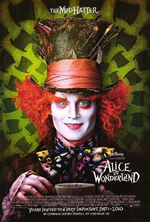
Depp's hands as the Mad Hatter. Only
this time he's not all that mad, but still quite colorful in a Kabuki-Creole
sort of way with his Bozo-frizzy hair, pouting white face, and kaleidoscopic
bow tie. And he's quite the dancer, too, with his unnatural and illogical
futterwacking after the climactic battle, to celebrate Frabjous Day. There's
more than meets the brow with this hatter, I am sure of it. It's a shame we
don't get a chance to see it. This could have been quite the road trip movie
with Alice and the Mad Hatter hitting those weird Wonderland-now-Underland trails.
Instead, we get a Happy Kids Meal-styled futterwacking Mad Hatter, and a
conventional wicked-Queen-needs-to-be-usurped modus operandi, complete with the
usual cryptic scroll of destiny laying it all out in pictograms. And everyone
waits for Alice to do the job with Vorpal Sword in hand, clothed in shining
armor fitting her like a glove.
One, two! One, two! And through and
through
The vorpal blade went snicker-snack!
He left it dead, and with its head
He went galumphing back.
While the Vorpal Sword and evil Jabberwocky follow
Lewis Carroll's nonsense, Woolverton and Burton also follow a familiar trail of
Walt Disneyisms, bringing a Narnian-like battle to the forefront of their
girl-to-woman-to-independence growth in Alice. Although Burton's dark visual
palette infuses the nonsense, Woolverton's script follows the conventions,
leaving both tepid, much like the bickering between Tweedledum and Tweedledee
(Matt Lucas). The irreconcilable characters inhabiting Underland have no wonder
in them, leaving Alice to decide alone whether to fight the Jabberwocky to free
them all, and by doing so, free herself to pursue her own destiny in Aboveland,
or succumb to her uncertainty and a loveless, pointless marriage.
Through all this, Johnny Depp's Mad Hatter hints at
sadness, madness, and a peculiar life story begging to be told. He dances
instead.
And why is the Red Queen so mean? Comfy pigs for her
feet and screaming "Off with their heads!" does not reveal why she
desires to rule Underland so wickedly. But rule she must, so she sends the
elongated Knave of Hearts to do her dirty work.
All of this is weird to a point, but stays
conventionally so, which is unusual for Tim Burton. He weighs seriousness in
every scene, ignoring Carroll's underlying insouciance, and the culminating
battle as the armies of Red and White Queens clash on a chessboard-battlefield
while Alice fights the dragon-like Jabberwocky for Underland becomes one of
many such battles fought in many such movies.
How a darkly whimsical and maniacally nonsensical work
from Lewis Carroll can lead to such a conventionally safe movie like Alice
In Wonderland makes me
wonder much, indeed.

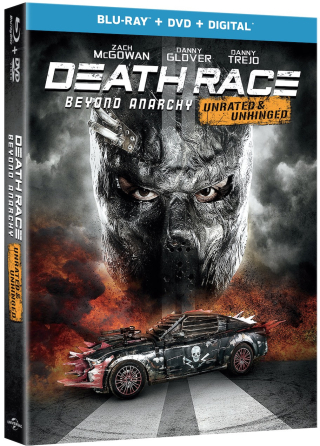 Death Race: Beyond Anarchy arrives on DVD/Blu-ray October 2nd, 2018. Here's the neatly pressed information for you speedy anarchy types.